SB 996 and Chassis-Free Manufactured Homes: A Cheaper Way to Build on a California Lot in 2027?

On January 1, 2027, California's legal definition of a manufactured home stops requiring a permanent steel chassis under the floor. SB 996, by Senator Steve Padilla, signed September 30, 2026 as Chapter 995, rewrites Health and Safety Code §18007 so that a manufactured home is a structure built on or after June 15, 1976, "with or without a foundation system," with the same meaning as the federal statute, and orders the Department of Housing and Community Development to adopt rules by July 1, 2027 allowing chassis-free homes to be built, installed, sold and occupied "in parity" with chassis-built ones. The change follows Congress's 21st Century ROAD to Housing Act, which became law on July 11, 2026 and dropped the chassis from the federal definition. For a California lot owner, the question is whether this makes the cheapest kind of house cheaper, and whether a lender will finance it. The honest answers today: probably, by a few thousand dollars, and not yet.
Why the chassis mattered
Federal law has defined a manufactured home since 1974 as one built on a permanent chassis, the steel frame that carries it from the factory on its own wheels. The chassis stays under the home for life, adds weight and height, and makes the home look like what it is. The Niskanen Center estimated that removing it could cut the cost of a manufactured home by $5,000 to $10,000, according to the Lincoln Institute of Land Policy; Senator Elizabeth Warren used the "up to $10,000" figure in pushing the federal change. A home without a chassis can sit lower on a foundation, carry a crawlspace or a garage underneath, and be stacked or placed in ways a chassis-built home cannot.
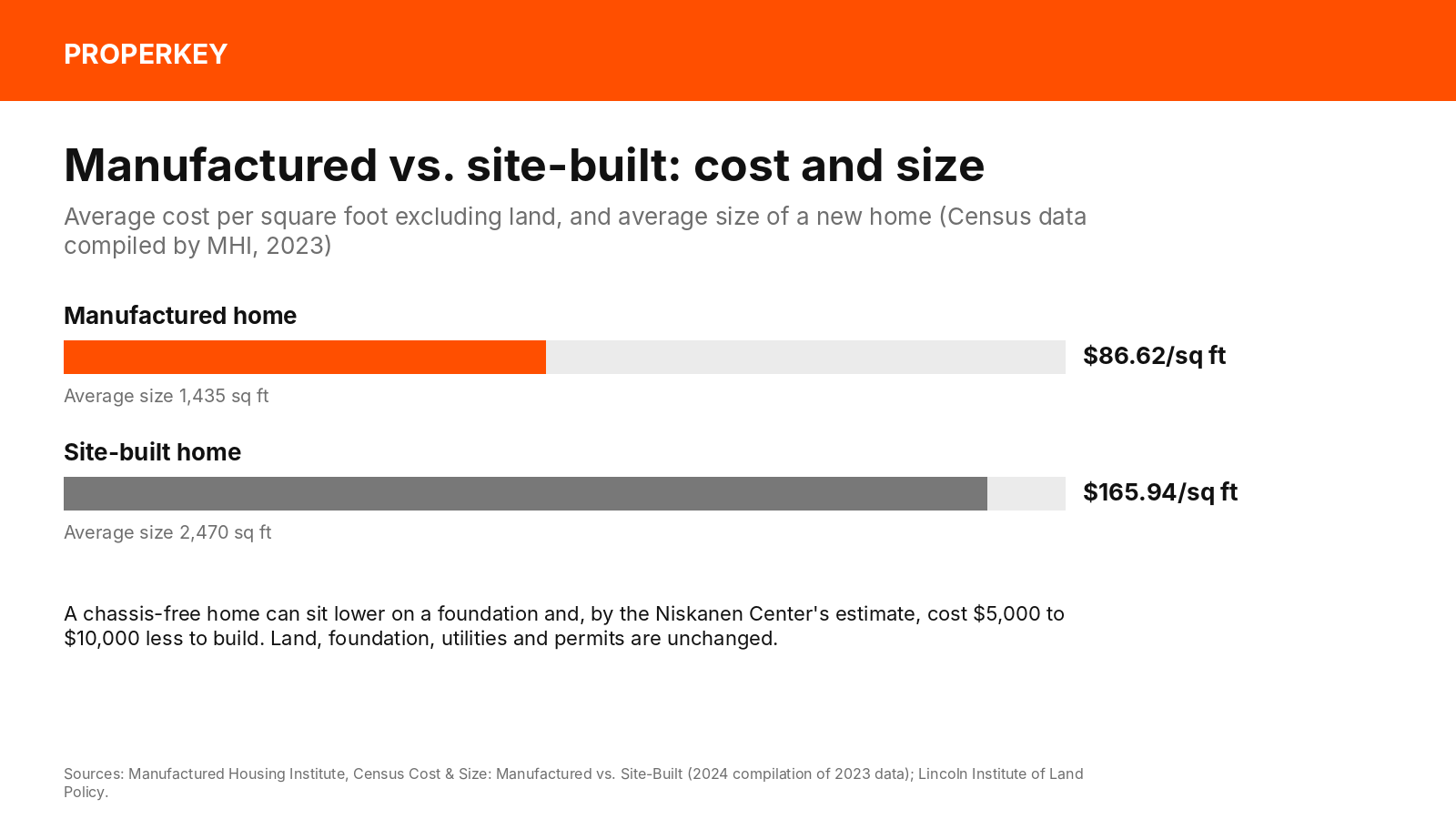
Cost is the reason the category exists. The Manufactured Housing Institute's compilation of Census data puts the average new manufactured home at $86.62 per square foot versus $165.94 for a site-built home, excluding land, with an average size of 1,435 versus 2,470 square feet. The Census Bureau's survey puts the average sales price of a new manufactured home at $129,400 in June 2026.
What SB 996 does, and what it does not
The bill does three things. It conforms the state definition to the federal one in §18007 and in the Commercial Code. It adds §18025.7, directing HCD to "review, revise, and adopt regulations to permit the construction, installation, sale, and occupancy" of chassis-free manufactured homes in parity with chassis-built ones by July 1, 2027, with a report to the Legislature on the same date. And it adds §18025.8, requiring HCD to report by July 1, 2029 on how to regulate, finance, title, tax and protect owners of homes in divided-tenure and leasehold arrangements. The vote was 77–1 in the Assembly and 40–0 in the Senate.
"Parity" in SB 996 means parity between the two kinds of manufactured home in HCD's rules. It is not zoning parity with site-built homes; that already exists. Government Code §65852.3 has long required cities and counties to allow a manufactured home on a permanent foundation on any lot zoned for a single-family dwelling, subject to the same architectural standards as a site-built home. SB 996 does not change titling, property-tax treatment or the real-property conversion process; an earlier version of the bill that would have done so was rewritten in the Assembly and did not become law. And it does not itself write the construction standard: HUD proposed in June 2026 to exempt only upper-floor sections from the chassis requirement, and the ROAD to Housing Act now requires HUD to write standards for fully chassis-free homes. Those federal standards were not final as of November 2026, which is why HCD's July 2027 deadline matters.
Will a lender finance a chassis-free home?
Not under today's rules. Fannie Mae's Selling Guide defines an eligible manufactured home as one "built on a permanent chassis that is attached to a permanent foundation system", and no Fannie Mae, Freddie Mac or FHA guidance for chassis-free homes had been published as of this writing. Until the agencies update their eligibility, a buyer of a chassis-free home should expect a construction-type loan, a portfolio lender or cash. Prop 37, which passed on November 3, does include "a manufactured home where the borrower is the first purchaser" among the newly built homes its state second mortgage can finance, but the first mortgage still has to come from a lender that will take the collateral. Properkey's finance desk shops the lenders that will.
What it means for a lot in the foothills, and for an infill lot
For a lot in Butte County's fire-rebuild areas or elsewhere in rural California, a manufactured home is already the lowest-cost house that can be placed, and SB 996 lowers that floor once HCD's rules and HUD's standards land. The home still has to meet the state's wildfire construction standards in a high-hazard zone, still needs an insurance quote before the purchase closes, and still has to be placed on a permanent foundation to be treated as real property. For an infill lot in San Diego or Los Angeles, the pairing to watch is SB 996 with AB 956's two detached ADUs: a factory-built 800-square-foot unit without a chassis is a lower-cost way to add the second and third homes the law now allows. Properkey lists lots for a $0 listing fee and can quote insurance on a factory-built home before it is ordered.
Questions people ask
Can I order a chassis-free manufactured home for a California lot today? Not in practice. The federal construction standard is not final and HCD's parity rules are due July 1, 2027. Chassis-built homes remain available and financeable now.
Does SB 996 change where a manufactured home can go? No. Zoning parity on single-family lots has been state law for decades; SB 996 changes the definition of the home and HCD's installation rules.
Will a chassis-free home be cheaper? The best published estimate is $5,000 to $10,000 less per home, from the Niskanen Center. Land, foundation, utilities and permits are unchanged.
Can a Prop 37 loan buy a manufactured home? The statute includes a newly built manufactured home where the borrower is the first purchaser. The program has no start date yet, and the first mortgage must come from a lender that accepts the home as collateral.
This article summarizes a new statute and published estimates as of November 6, 2026; it is not legal, lending or tax advice.
Sources: SB 996 bill text, Chapter 995; ACMA on the 21st Century ROAD to Housing Act; HUD proposed rule on the manufactured-home definition, June 2026; Lincoln Institute on the chassis requirement; Manufactured Housing Institute cost and size comparison; Census average sales price of new manufactured homes (FRED); Fannie Mae Selling Guide B2-3-02; Prop 37 legal text; AB 956.
Written by Keyro, Properkey's AI. Properkey, DRE #01979718.



