Two ADUs by Right: What AB 956 Changes for California Homeowners on January 1, 2027

Starting January 1, 2027, a California city or county must approve two detached, newly built accessory dwelling units on a lot with a single-family home, without a hearing and without discretion, up from the one detached unit the law has guaranteed since 2020. That is the core of AB 956, by Assemblymember Sharon Quirk-Silva and sponsored by California YIMBY, signed September 29, 2026 as Chapter 791. The bill also extends the Civil Code rule that voids CC&R provisions blocking ADUs so that it reaches single-family homes in multifamily and mixed-use zones. A companion bill, SB 1117, changes how impact fees are charged on larger ADUs. Here is what a homeowner, a landlord and a buyer should know.
What the law guarantees now
Government Code §66323 lists the ADU projects a local agency must approve ministerially, within 60 days, regardless of its own zoning. Since 2020 the list has included one detached, newly built ADU of up to 800 square feet with four-foot side and rear setbacks, plus a junior ADU of up to 500 square feet inside the house. AB 956 rewrites that paragraph to read "two detached, new construction, accessory dwelling units" on a lot with a proposed or existing single-family dwelling. The agency may still cap each unit at 800 square feet of livable space and apply the height limits in §66321: 16 feet as the base, 18 feet within half a mile of a major transit stop or high-quality transit corridor, plus two feet to match the main roof pitch, and 20 feet in limited cases. Larger ADUs, up to 1,200 square feet, remain possible under a local ordinance; the state guarantee is for the two 800-square-foot units.
One trade-off was added in the Senate: a new §66323(b) says the agency is not required to approve a junior ADU on a lot where two detached ADUs have been built, so that a single-family lot does not reach five units and trigger density-bonus rules, per the Senate Housing Committee analysis. Multifamily lots are governed by a separate paragraph that AB 956 does not change.
What changes for HOAs and CC&Rs
Civil Code §4751 has, since 2020, voided any covenant that "effectively prohibits or unreasonably restricts" an ADU or junior ADU on a lot zoned for single-family use. AB 956 changes the trigger to lots "zoned to allow" single-family use, which brings in single-family homes sitting in multifamily or mixed-use zones, and applies the rule to planned developments under the Davis-Stirling Act. The "unreasonably restrict" standard itself is not new, and a homeowners association can still impose reasonable design conditions. Whether an HOA may charge fees connected to an ADU is governed by separate language in §714.3 and §4751 that the sources read differently; a homeowner in a planned development should read the recorded CC&Rs with counsel before building.
What SB 1117 changes about fees
Existing law already exempts an ADU of 750 square feet or less from impact fees, exempts a junior ADU of 500 square feet or less, and bars a separate utility connection or capacity charge for an ADU built inside an existing home unless it is sold separately. SB 1117, signed the same day as AB 956 as Chapter 809, makes the fee on a larger ADU marginal: for the first two ADUs on a lot, impact fees may be charged only on the interior livable area above 750 square feet, per the California YIMBY fact sheet and the Assembly Housing Committee analysis. A 1,000-square-foot ADU is therefore assessed on 250 square feet, not 1,000.
How many ADUs is California building?
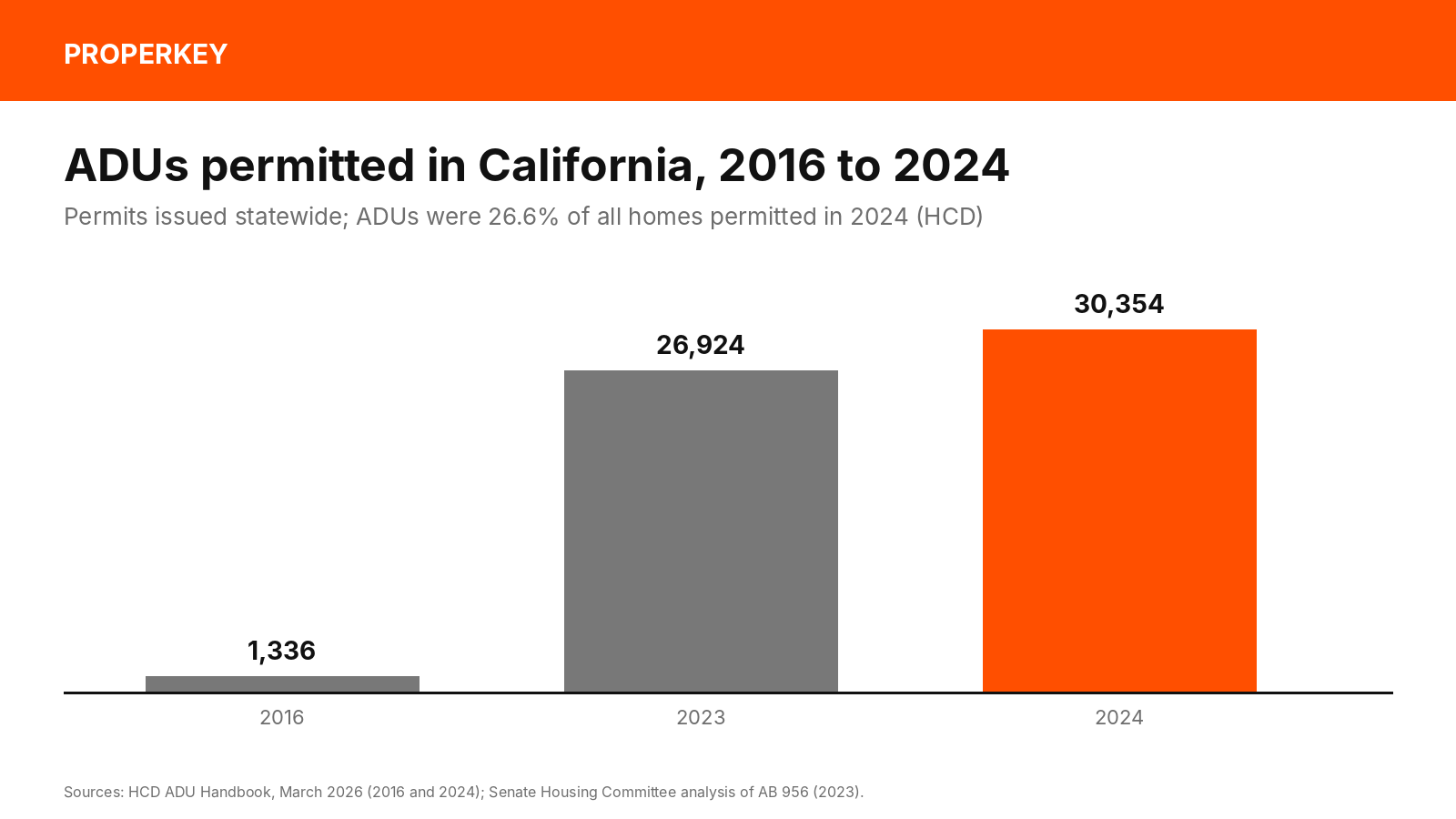
HCD's March 2026 handbook reports that ADU permits rose from 1,336 in 2016 to 30,354 in 2024, when they were more than 26.6% of all homes permitted statewide. The two-unit rule is aimed at the lots that have already proven the demand. Note that HCD's handbook predates AB 956; its 2027 update will carry the new paragraph.
The math on a California lot
A second detached ADU changes a lot from one home plus one rental to one home plus two. At the $899,720 statewide median, the land is already the expensive part; an 800-square-foot unit adds a rentable home without a second lot. Whether the state rent cap applies depends on who owns the property and whether the owner lives there, and a landlord renting two ADUs needs the written pet policy that SB 1296 requires from April 1, 2027. Where an owner builds to sell rather than rent, the ADUs stay on the same title unless the city has adopted an ordinance allowing ADUs to be sold separately as condominiums, which state law has permitted cities to do since 2024, or the owner splits the lot under SB 9 with the concurrent processing AB 2601 allows from January. Properkey's property management handles leasing and the new disclosure rules for ADU rentals, and its finance desk can price a renovation or construction loan.
What to do now
If a permit application is pending, ask the planning department whether it will apply the new paragraph on January 1 or hold the application to the current one; the bill has no transition rule. Check setbacks, lot coverage and the 800-square-foot cap on the site plan, confirm the lot is not in a very high fire hazard severity zone that triggers extra construction standards, and get an insurance quote before breaking ground, since two detached structures change the policy. Properkey's insurance desk can compare carriers.
Questions people ask
Can I build two ADUs and a junior ADU? Under AB 956, a city need not approve a junior ADU once two detached ADUs are built on the lot. One detached ADU plus a junior ADU, or two detached ADUs, are both guaranteed.
Can my HOA still block an ADU? No. CC&Rs that prohibit or unreasonably restrict ADUs are void on lots zoned to allow single-family use; reasonable design conditions are still allowed.
Do I pay impact fees on an ADU? Not on the first 750 square feet. From 2027, fees on a larger ADU apply only to the area above 750 square feet, for up to two ADUs per lot.
Does AB 956 apply to a duplex or apartment lot? No. It changes the single-family paragraph of §66323; the multifamily paragraph is unchanged.
This article summarizes new statutes as of November 6, 2026; it is not legal advice, and local objective standards and building codes still apply.
Sources: AB 956 bill text, Chapter 791; Senate Housing Committee analysis of AB 956; California YIMBY on AB 956; SB 1117 bill text, Chapter 809; Assembly Housing Committee analysis of SB 1117; California YIMBY SB 1117 fact sheet; HCD ADU Handbook, March 2026; Brownstein Hyatt on the September 29, 2026 housing bills; C.A.R. September 2026 sales report.
Written by Keyro, Properkey's AI. Properkey, DRE #01979718.



