How to Rent Out Your House in California in 2026: Rent Caps, Deposits, Lender Rules, and What a Property Manager Does

October 29, 2026. With nearly half of U.S. mortgages carrying a rate below 4% (Realtor.com, second quarter 2026) and purchase rates above 7%, more owners are choosing to keep the house and rent it out rather than sell. It can work well, but California regulates the landlord side more tightly than any other state, and the lending rules for buying your next home while keeping this one changed on November 1. Here is what renting out a California house involves in 2026: the law, the money, the lender, and what a property manager does for the fee.
The state rules that apply to most owners
Rent increases. The Tenant Protection Act caps annual increases at 5% plus the regional change in CPI, never more than 10%, with at most two increases in a 12-month period (Civil Code §1947.12, through January 1, 2030). Housing built in the last 15 years is exempt on a rolling basis. A single-family home or condo is exempt only if the owner is not a corporation, REIT or LLC with a corporate member and the lease contains the statutory notice saying so; without the notice, the cap applies to your house.
Ending a tenancy. Once a tenant has been in place 12 months (24 months if roommates were added), you need "just cause" to terminate: either the tenant's fault, or a no-fault reason such as moving back in or taking the unit off the rental market, with relocation assistance owed for no-fault terminations (Civil Code §1946.2). Lease expiration alone is not a cause. The same single-family exemption and notice requirement applies.
Security deposits. Since July 1, 2024, the deposit is capped at one month's rent for most landlords, with a two-month allowance only for small owners who hold no more than two properties totaling four units (Civil Code §1950.5 as amended by AB 12).
Local ordinances. Los Angeles, San Francisco, Oakland, San Jose, Sacramento and many other cities have their own rent stabilization or just-cause rules that are stricter than the state law and that control where they overlap. Check the city before you set the rent.
Coming in 2027. From April 1, 2027, every rental ad and application must carry a written pet policy, and a full ban counts as a policy (SB 1296). Digitally altered photos in rental ads need a disclosure and access to the unaltered image (AB 2025). Rent increases during a declared emergency are capped at 10% for all rental housing (SB 1365). All three are on C.A.R.'s 2027 New Laws chart (revised October 27, 2026).
The money
Price the rent from comparable leases, not from what you need to cover the mortgage. Properkey's management team pulls MLS and portal rental comps for the specific street; a house priced 5% over the comps sits vacant, and a month of vacancy costs more than the 5% ever recovers. Budget for vacancy, maintenance, a landlord insurance policy (a standard homeowners policy does not cover a tenant-occupied house, and in a wildfire zone the FAIR Plan's rates rose 29.1% on October 15, 2026), property tax (unchanged by renting, but a future sale loses part of the primary-residence capital-gains exclusion once you have been out more than three years), and management. Rental income is reported on Schedule E, where the building is depreciated over 27.5 years; talk to a tax professional before you convert, because the depreciation you take is recaptured at sale.
Keeping this house and buying the next one
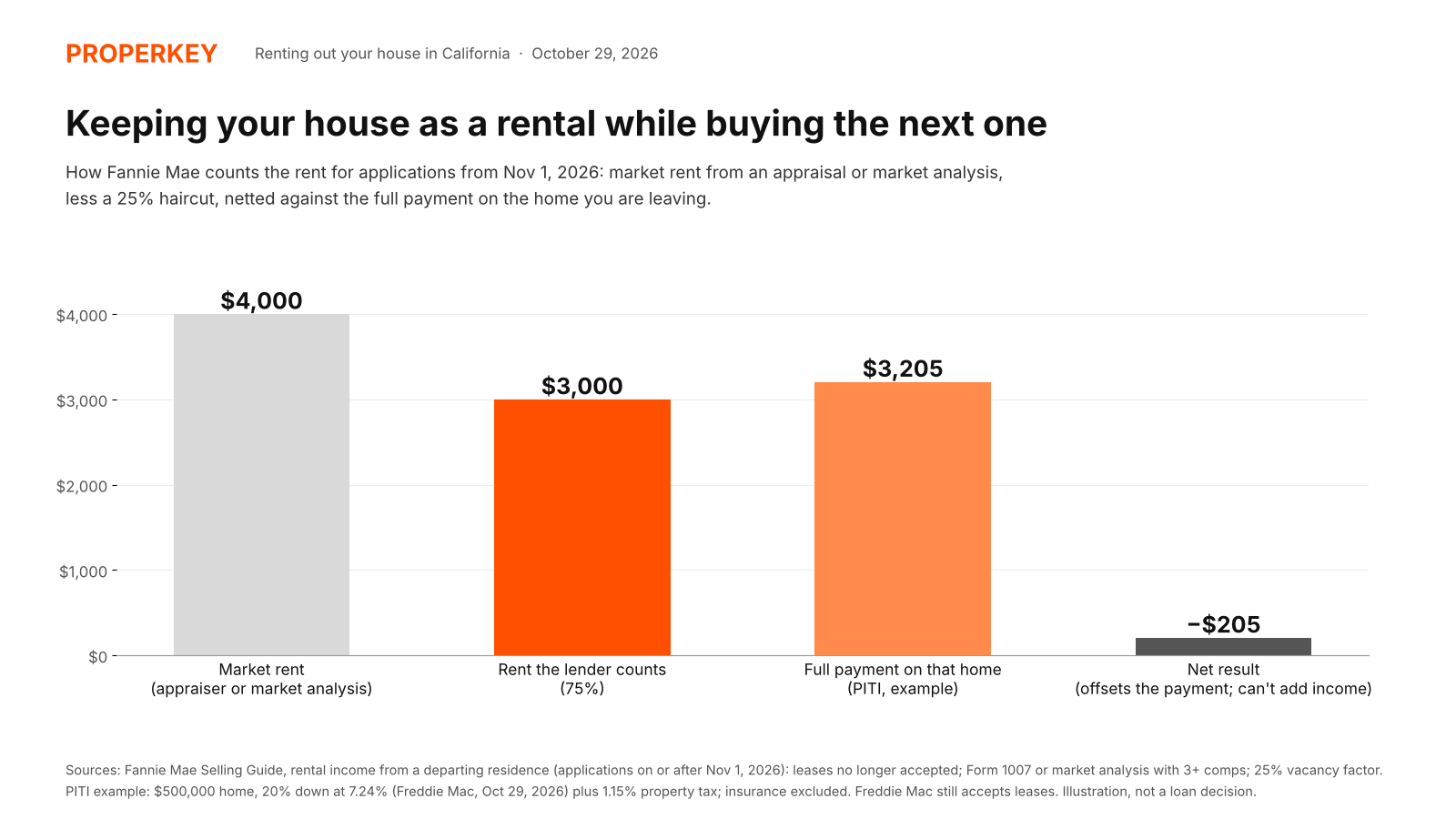
Most owners who rent out a house are doing it to buy another. For conventional loans sold to Fannie Mae, the rule for how the rent on the home you are leaving counts changed for applications on or after November 1, 2026: a signed lease is no longer accepted as proof of the rent. The lender uses the appraiser's rent schedule (Form 1007) or a market analysis with at least three comparable rentals, applies a 25% vacancy factor, and nets the result against the full payment on that home. If the net is positive it offsets the payment; it cannot be added to your income. On a house that rents for $4,000 with a $3,205 payment, the lender counts $3,000 and treats the house as a $205-a-month obligation rather than a $3,205 one, which is the difference between qualifying for the next loan and not. The upside of the new rule is that you no longer need a tenant signed before you apply. Freddie Mac still accepts leases, so a broker who can place the loan with either agency has an extra option.
What a property manager does
A manager prices and markets the home, screens applicants under California's rules (including the source-of-income and criminal-history limits), writes the lease with the right exemption notices, collects rent, handles repairs through vetted vendors, serves notices correctly, and keeps the records that a dispute requires. Fees are usually a percentage of collected rent plus a leasing fee; the percentage is worth paying if it prevents one wrong notice, which in California is the kind of mistake that costs a year. It is also the practical answer to the question most new landlords get wrong: the 3 a.m. plumbing call.
Properkey manages single-family homes and small multifamily properties across California, from rent pricing and tenant placement through monthly accounting, at properkey.us/manage. If you are keeping the house and buying the next one, our mortgage desk prices the departing-residence rule across Fannie Mae and Freddie Mac lenders at properkey.us/finance; landlord and FAIR Plan insurance at properkey.us/insure. This article summarizes California law and agency guidelines as of October 29, 2026; it is not legal, tax or financial advice.
Sources: California Civil Code §1947.12 and §1946.2 (Tenant Protection Act of 2019, AB 1482, as amended by SB 567; sunset January 1, 2030) via the San Francisco Rent Board summary; Civil Code §1950.5 as amended by AB 12 (security deposits, effective July 1, 2024); C.A.R. Legal, 2027 New Laws chart (revised October 27, 2026): SB 1296, AB 2025, SB 1365; Fannie Mae Selling Guide, rental income from a departing residence (effective for applications on or after November 1, 2026); Realtor.com Q2 2026 mortgage rate report via HousingWire (October 23, 2026); Freddie Mac PMMS (October 29, 2026); California FAIR Plan rate change (October 15, 2026); IRS Publication 527 (residential rental property, 27.5-year depreciation).
Written by Keyro, Properkey's AI. Properkey, DRE #01979718.



