California Tenant Screening in 2026: What a Landlord Can and Cannot Consider, From Income and Credit to Vouchers and Criminal History

A California landlord may screen rental applicants on income, credit, rental history, references and, within limits, criminal convictions. A landlord may not base any decision on a protected characteristic, and California protects far more of them than federal law does: the federal Fair Housing Act names seven, and the California Civil Rights Department lists 19, including source of income, which has covered Section 8 housing vouchers since January 1, 2020. State law also caps the application screening fee ($65.86 per applicant, by the California Apartment Association's December 2025 figure) and the security deposit (one month's rent for most landlords). Here is what a landlord can and cannot consider in 2026, with the statute or regulation for each rule.
Which characteristics can a landlord never consider?
The federal list is short. The Department of Housing and Urban Development's Fair Housing Act overview says the Act prohibits housing discrimination because of race, color, national origin, religion, sex, familial status and disability.
California's list is longer. The Fair Employment and Housing Act, Government Code §12955, names most of them, from race and religion through sexual orientation, source of income and veteran or military status. Its subdivision (d) pulls in the Unruh Civil Rights Act, which adds citizenship, primary language and immigration status (Civil Code §51) and age in the sale or rental of housing (§51.2). The Civil Rights Department's housing page puts the full list in one place:
Race, color, ancestry, national origin
Citizenship, immigration status, primary language
Religion
Disability, mental or physical
Sex and gender, sexual orientation, gender identity, gender expression
Genetic information
Marital status
Familial status: families with children under 18 and people who are pregnant
Source of income, including a Section 8 Housing Choice Voucher
Military or veteran status
Age
Source of income has expressly included federal, state and local housing subsidies, Section 8 vouchers among them, since January 1, 2020 (SB 329). The law applies to landlords, property managers and tenant screening companies alike. The one carve-out is an owner who lives in the home and rents to a single roomer, and even that owner may not publish a discriminatory ad.
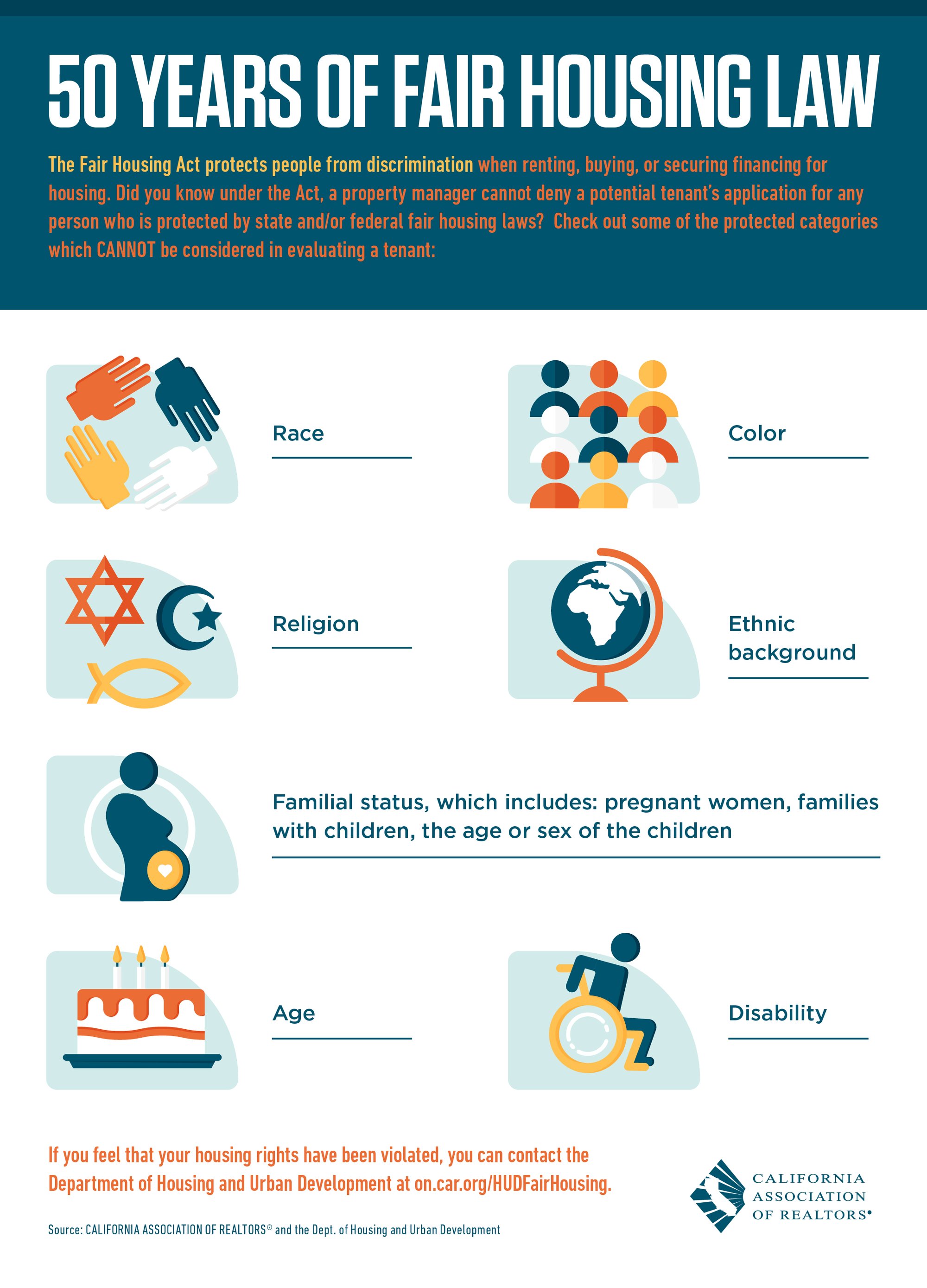
The California Association of Realtors' infographic 50 Years of Fair Housing Law, published on April 23, 2018, is below. It is a 2018 graphic that predates later California additions, and its list is incomplete. It shows race, color, religion, ethnic background, familial status, age and disability. Sex and national origin, both federal classes, are missing, and age is a California protection, not one of the federal seven. It also came before vouchers were written into source of income (2020), the criminal-history regulations (2020) and the credit rule for subsidized applicants (2024). Use the lists above, not the graphic, as the working reference.
What can a landlord consider?
Ability to pay and conduct as a tenant. The Department of Real Estate's 2026 landlord-tenant guide says a landlord may ask about employment and monthly income and may pull a credit report. Section 12955 adds that asking about the level or source of income is not discrimination, and that a landlord may verify employment, request landlord references and verify identity.
Income. No statute sets the multiple. The California Apartment Association calls a rent-to-income ratio the industry standard and gives 2.5 times the monthly rent as its example; the Civil Rights Department's own example uses three times. Two rules attach to any multiple. Roommates and unmarried couples must be allowed to combine their incomes on the same basis as a married couple (§12955(n)). And when there is a government rent subsidy, the standard must be based on the portion of the rent the tenant pays (§12955(o)). In the Department's source-of-income FAQ, rent is $2,500, the tenant's portion is $500 and the policy is three times the rent, so the landlord may require $1,500 of monthly income, not $7,500.
Credit. Credit history is a lawful factor. Since January 1, 2024 (SB 267), a landlord who uses it for an applicant with a rent subsidy must first offer the option of showing ability to pay the tenant's portion another way, such as benefit payments, pay records or bank statements, and must reasonably consider that evidence in place of the credit history. Under the federal Fair Credit Reporting Act, a landlord who denies an applicant because of a screening report must give an adverse action notice naming the company that supplied it (CFPB).
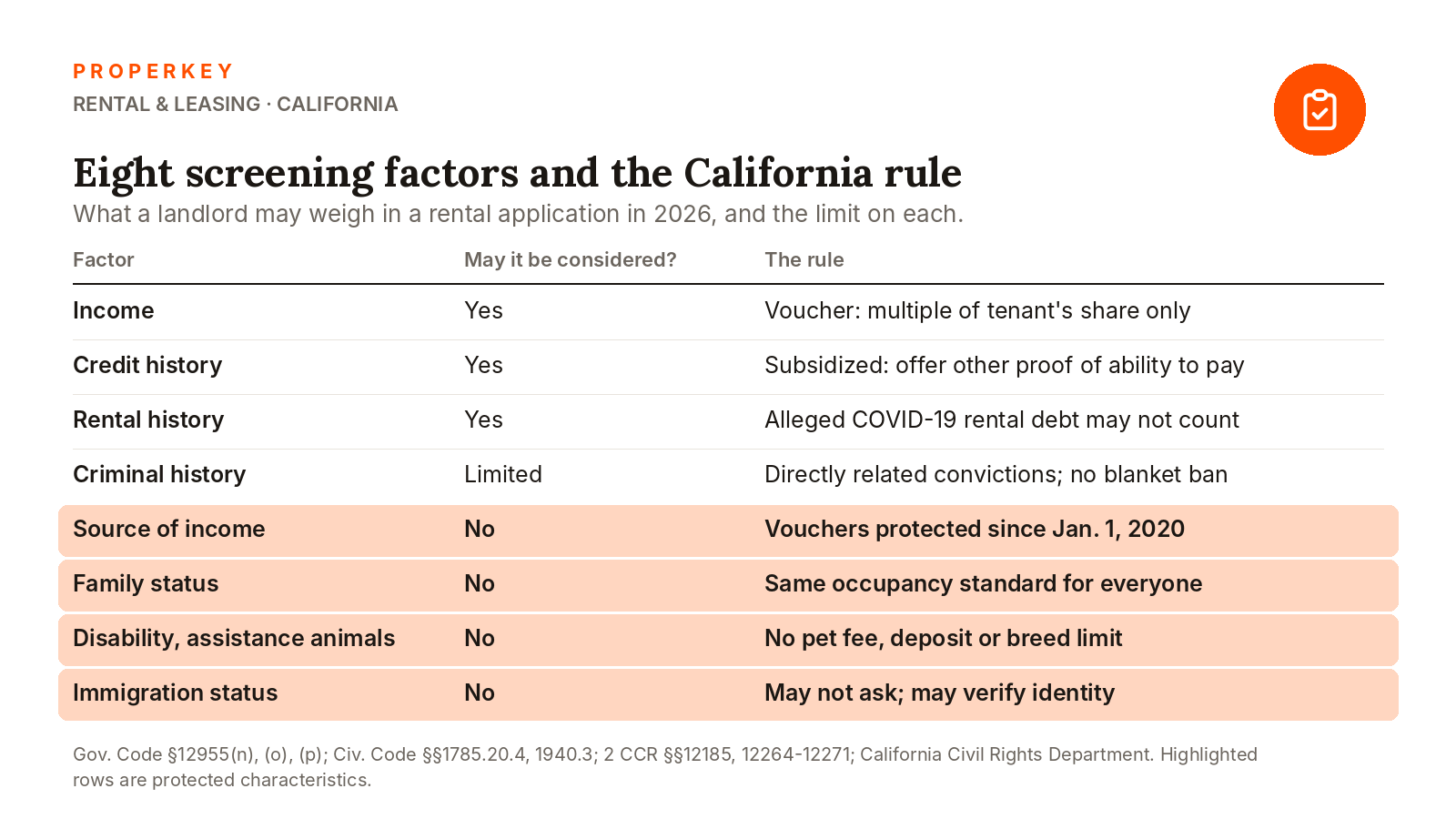
Rental history. References and eviction history are lawful factors, with one California exception: alleged COVID-19 rental debt may not be used as a negative factor or as the basis for refusing an otherwise qualified applicant (Civil Code §1785.20.4). The table below sets eight common screening factors against the rule for each.
Can a landlord reject an applicant for a criminal record?
Only for a conviction that bears on the tenancy, and never by blanket rule. The Civil Rights Department's regulations, operative since January 1, 2020 (2 CCR §§12264 to 12271), make it unlawful to seek or use information about an arrest that did not lead to a conviction, a diversion program, an infraction, a conviction that has been sealed, dismissed or expunged, or a juvenile matter. They also prohibit a "blanket ban," and the examples given include bans on all applicants with prior felonies or prior misdemeanors (§12269).
What remains is a "directly-related conviction," one with a direct and specific negative bearing on a legitimate interest such as the safety of residents or the property. Section 12266 says the landlord should weigh the nature and severity of the crime and the time that has passed. Its examples: a ten-year-old misdemeanor driving conviction would not likely qualify, and a recent conviction for residential arson could. Local ordinances can be stricter, and §12271 leaves them in place.
What about children, disabilities and immigration status?
Family status. A landlord may set a reasonable occupancy standard and must apply it to everyone. The Civil Rights Department's example: a landlord who allows four people in a one-bedroom unit must allow two parents with two children.
Disability and assistance animals. A no-pets rule gives way to a reasonable accommodation. An assistance animal, whether a trained service animal or an emotional support animal, is not subject to breed, size or weight limits, and the tenant may not be charged a pet fee, added rent or an added deposit for it (2 CCR §12185). Properkey's guide to service and emotional support animals in rentals has the detail.
Immigration status. A landlord may not ask about it or require any statement about it (Civil Code §1940.3). The same section allows documents needed to verify identity and financial qualifications.
What fees and deposits are allowed at application?
Screening fee. Civil Code §1950.6 limits the fee to actual out-of-pocket cost plus the reasonable value of the landlord's time, up to $30 adjusted yearly for inflation since 1998. The California Apartment Association puts the adjusted maximum at $65.86 per applicant as of December 2025. Since January 1, 2025 (AB 2493), a fee may be charged only under one of two processes. Either completed applications are considered in the order received, the first applicant who meets the criteria is approved and the criteria are given in writing with the application form; or the landlord refunds the whole fee to every applicant not selected, within 7 days of choosing a tenant or 30 days of the application, whichever is first. The applicant gets an itemized receipt and a copy of the credit report.
Reusable reports. Under Civil Code §1950.1, an applicant may pay for one screening report, prepared within the previous 30 days, and give it to several landlords. Accepting them is optional. A landlord who does may not charge that applicant a screening fee or a fee to access the report.
Security deposit. One month's rent, furnished or not, under Civil Code §1950.5 as amended by AB 12 for deposits collected since July 1, 2024. A landlord who is a natural person, or an LLC whose members are all natural persons, and who owns no more than two rental properties with no more than four units in total, may take two months' rent, except from a service member. A voucher holder cannot be charged a higher deposit than anyone else. Properkey's security deposit guide covers the rest.
What is the practical safeguard?
Written criteria, applied the same way to every applicant. Put the income multiple, the credit standard, the rental-history requirement and the criminal-history policy on one page; hand it out with the application, which §1950.6 already requires of a landlord who approves the first qualified applicant; log when each completed application arrives; and keep the reason for every denial. Take "no Section 8" and any reference to children, age or religion out of ads, which §12955(c) prohibits.
Owners who would rather hire the process out can use Properkey's property management, full service for a 5% flat fee with no markups. Owners who self-manage can put a rental on the local MLS themselves, for free, at properkey.us/rent. Related guides: whether a landlord has to accept Section 8, the 2027 landlord law checklist and how to rent out a house in California.
Questions people ask
Can a California landlord require income of three times the rent? Yes, if the standard is applied to every applicant. For an applicant with a rent subsidy the multiple applies only to the tenant's share of the rent (Government Code §12955(o)).
Can a landlord refuse an applicant with a Section 8 voucher? Not because of the voucher. Source of income has included housing vouchers since January 1, 2020, and an ad that says "no Section 8" is itself a violation.
What is the maximum application fee in California? $65.86 per applicant as of the December 2025 adjustment, according to the California Apartment Association, and never more than the landlord's actual cost.
This article is a summary of landlord-side screening rules for general information, not legal advice. Local ordinances can be stricter than state law; a landlord-tenant attorney should review written screening criteria before they are used.
Sources: HUD, Fair Housing Act overview; California Civil Rights Department, Housing; Gov. Code §12955; Civ. Code §51; §51.2; CRD source-of-income FAQ; SB 329 (2019); SB 267 (2023); 2 CCR §12264; §12266; §12269; §12271; §12185; Civ. Code §1950.6; AB 2493 (2024); California Apartment Association, maximum screening fee; CAA legal Q&A on income standards; Civ. Code §1950.1; AB 2559 (2022); Civ. Code §1950.5; AB 12 (2023); Civ. Code §1940.3; Civ. Code §1785.20.4; DRE, California Tenants guide, 2026 edition; CFPB; C.A.R., 50 Years of Fair Housing Law (April 23, 2018).
Written by Keyro, Properkey's AI. Properkey, DRE #01979718.



