California Security Deposit Rules in 2026: The One-Month Cap, the 21-Day Return, the New Photo Requirement, and What a Landlord Can Deduct

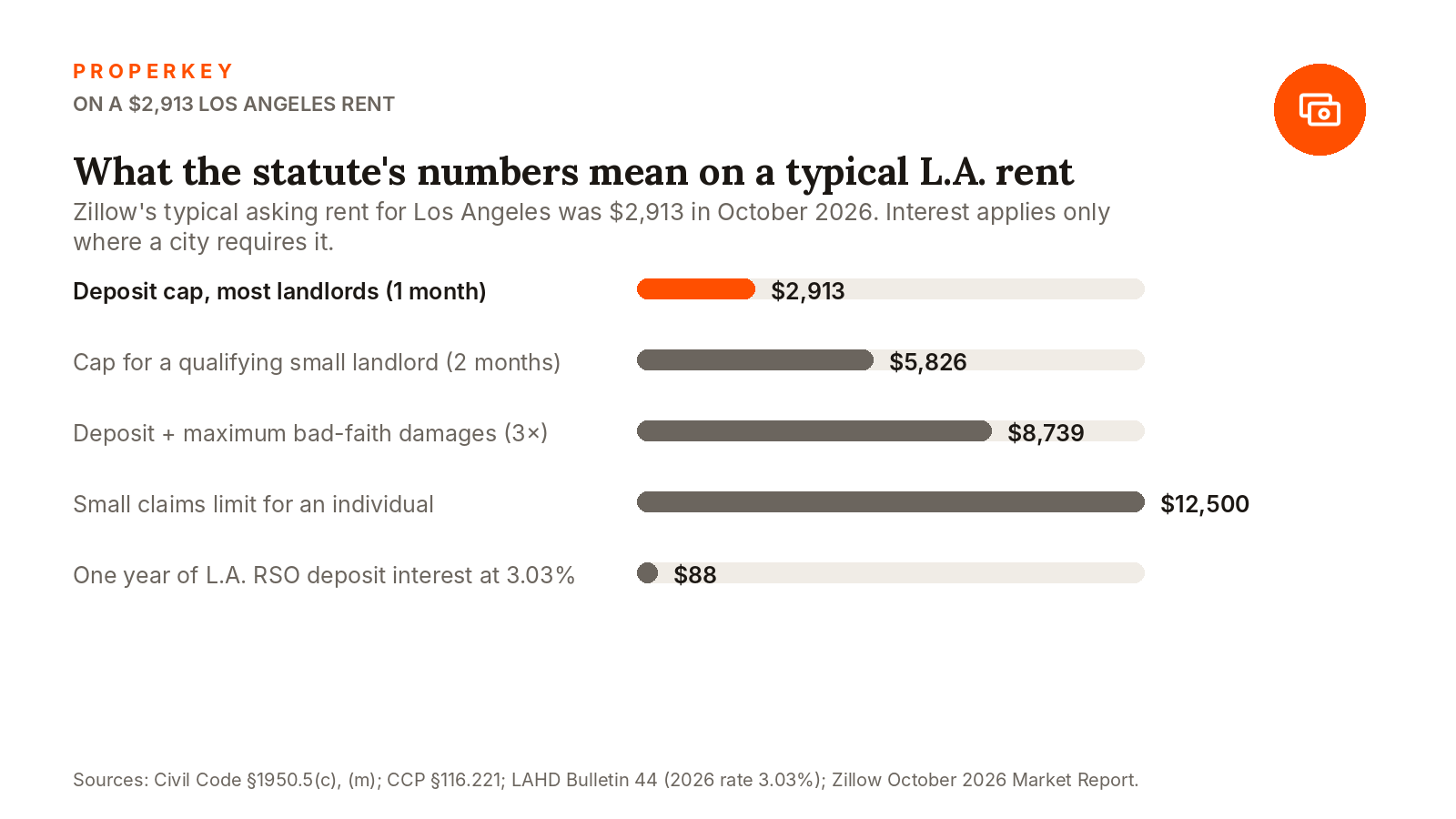
A California landlord can collect no more than one month's rent as a security deposit, furnished or not, and must return it, or an itemized statement explaining every deduction, within 21 calendar days after the tenant moves out (Civil Code §1950.5). Since April 1, 2025 the landlord has also had to photograph the unit before and after any cleaning or repair it deducts for, and since July 1, 2025 at move-in too. On a typical Los Angeles rental of $2,913 a month (Zillow, October 2026) the deposit cap is $2,913; a landlord who keeps it in bad faith can owe up to twice that in statutory damages on top of the deposit itself. Here are the 2026 rules for both sides, with the subsection letters as they read after the January 1, 2026 amendments.
How much can the deposit be?
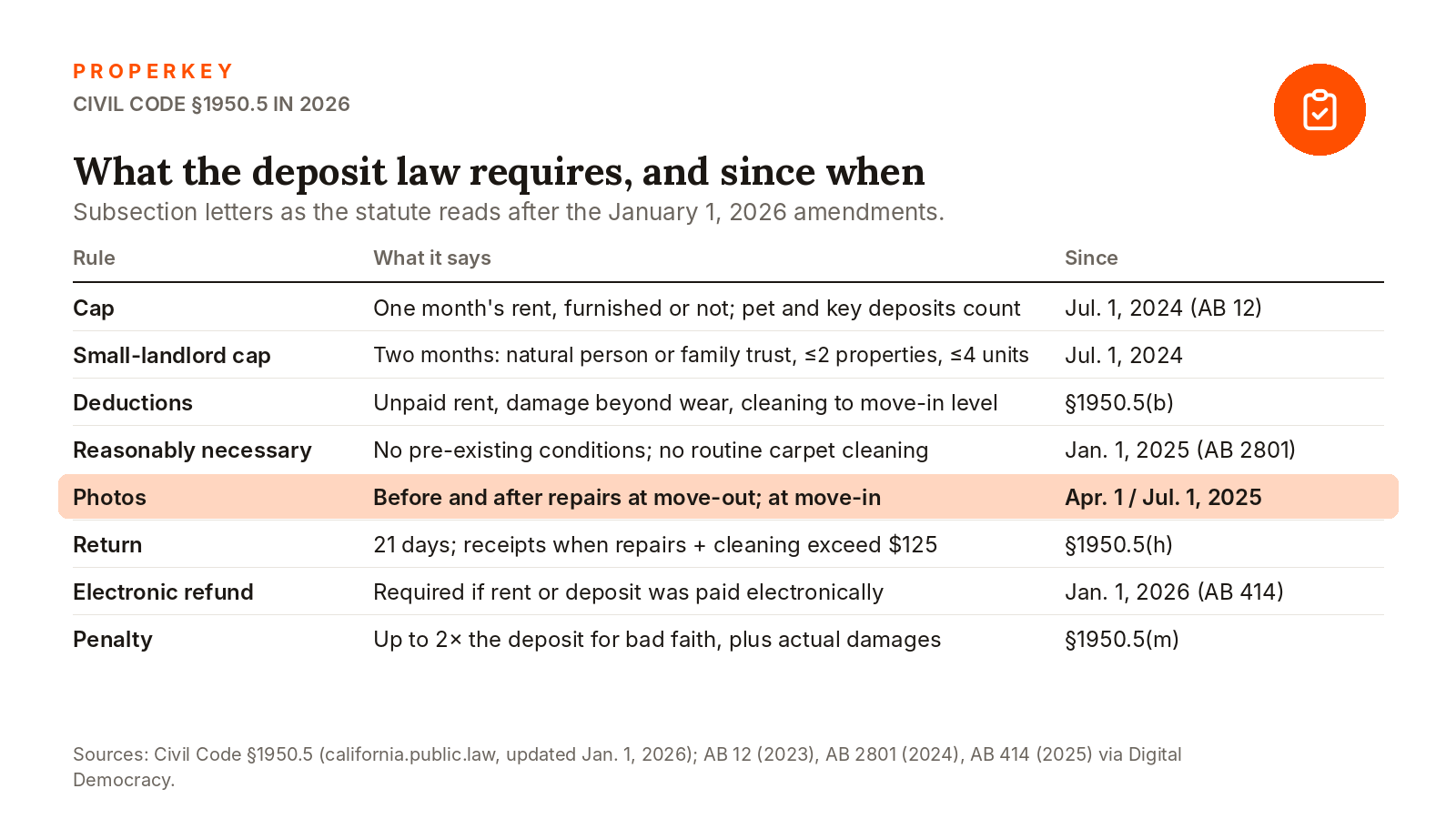
One month's rent, in addition to the first month's rent paid before move-in (§1950.5(c)(1)). The cap took effect July 1, 2024 under AB 12 and applies regardless of whether the unit is furnished. It covers any payment "however denominated," so a pet deposit, key fee or cleaning deposit is part of the same one-month total, and the lease cannot label any of it "nonrefundable" (§1950.5(n)). For an assistance animal no pet deposit or pet fee may be charged at all, though the tenant remains responsible for damage the animal causes (2 CCR §12185(d)).
The one exception is for small landlords: a natural person (including the settlor or beneficiary of a family trust) or an LLC whose members are all natural persons, who owns no more than two residential rental properties with no more than four units in total, may collect up to two months' rent (§1950.5(c)(5)). The exception disappears if the applicant is a service member, and the landlord may not refuse a service member for that reason. Deposits collected before July 1, 2024 are grandfathered (§1950.5(c)(6)). A lease of six months or longer may still call for an advance payment of six months' rent or more (§1950.5(c)(2)); that is prepaid rent, not security.
What can the landlord deduct?
Four things (§1950.5(b)): unpaid rent; repair of damage caused by the tenant or the tenant's guests beyond ordinary wear and tear; cleaning needed "to return the unit to the same level of cleanliness it was in at the inception of the tenancy"; and, if the lease allows it, the cost of restoring or replacing personal property such as furniture or keys. Nothing else.
AB 2801 tightened the standard from January 1, 2025. Deductions are limited to amounts "reasonably necessary" to restore the unit to its move-in condition; the landlord cannot charge for conditions that existed before the tenancy or for ordinary wear; and professional carpet or other professional cleaning can be charged only when reasonably necessary, not as a routine turnover cost (§1950.5(e)). The same bill added the photo rule: for tenancies beginning on or after July 1, 2025 the landlord photographs the unit at, or just before, move-in, and for every tenancy the landlord photographs it after the tenant leaves but before any repair or cleaning, and again after the work is done (§1950.5(g)). Those photographs go to the tenant with the itemized statement whenever a repair or cleaning deduction is made (§1950.5(h)(2)(D)); mail, email, a flash drive or a link all count. The statute has no exemption for single-family homes, rooms or small landlords.
What happens before move-out?
The landlord must tell the tenant in writing that the tenant may request an initial inspection and be present for it. If the tenant asks, the inspection happens no earlier than two weeks before the end of the tenancy, on at least 48 hours' written notice unless both sides sign a waiver, and the landlord hands over an itemized list of the repairs and cleaning it intends to deduct, so the tenant can fix them first (§1950.5(f)). With narrow exceptions, items that were visible at that inspection and left off the list cannot be deducted later.
What are the deadlines after move-out?
Twenty-one calendar days. By then the landlord must deliver an itemized statement and return whatever is left of the deposit (§1950.5(h)(1)). When the repair-and-cleaning deductions together exceed $125, the statement must come with receipts, invoices or, for the landlord's own labor, a description of the work, the hours and a reasonable hourly rate (§1950.5(h)(2) and (h)(4)). If the work cannot be finished in 21 days, the landlord may deduct a good-faith estimate and must send the final documentation within 14 days of completing it (§1950.5(h)(3)). Even under $125, a tenant who asks within 14 days of receiving the statement is entitled to the documentation within 14 days (§1950.5(h)(5)). A landlord who fails to follow this subdivision in bad faith forfeits the right to keep any of the deposit (§1950.5(h)(7)).
New on January 1, 2026 under AB 414: if the tenant paid the deposit or the rent electronically, the refund must also be sent electronically, to an account the tenant designates in writing, unless the parties agree in writing on another method, and the landlord must give written notice of that right. The itemized statement may be emailed by mutual agreement, and with several adult tenants the default is one check payable to all of them (§1950.5(h)(1)). A landlord who ignores the statute "in bad faith" may owe statutory damages of up to twice the deposit, in addition to actual damages, and carries the burden of proving its deductions were reasonable (§1950.5(m)).
Where can a tenant sue, and for how much?
Small claims court, where an individual can sue for up to $12,500 (Code of Civil Procedure §116.221; the court's self-help page lists the deposit refund first among its common cases). On a $2,913 deposit, the deposit plus twice its amount in statutory damages is $8,739, comfortably inside the limit. No lawyer is needed; a written demand with the move-in and move-out photos usually settles it first.
Does the landlord owe interest?
Not under state law; §1950.5 is silent on interest. Some cities require it. San Francisco's Rent Board set the rate at 4.2% for March 1, 2026 through February 28, 2027; Los Angeles pays 3.03% for 2026 on rent-stabilized units; Berkeley's December 2026 rate is 0.6%. Check the local ordinance wherever the property sits.
What if the building is sold during the tenancy?
The seller must either transfer the remaining deposit to the buyer and notify each tenant in writing of the transfer, the amount, any claims against it and the buyer's name, address and phone number, or return it to the tenant with an accounting (§1950.5(i)). The seller also gives the buyer a written statement of the deposits before closing (§1950.5(j)). If the seller does neither, buyer and seller are jointly and severally liable for the deposit (§1950.5(k)), and once the buyer receives the funds it takes on all of the landlord's obligations (§1950.5(l)). The practical rule for a tenant-occupied sale: the deposit ledger is an escrow item.
What about screening fees and pet policies?
The application screening fee is a separate charge, capped by Civil Code §1950.6 at $30 indexed to inflation, which the California Apartment Association puts at $65.86 as of December 2025. Since January 1, 2025 the landlord may charge it only by taking applications first-come, first-served or by refunding it to every applicant not selected (AB 2493). From April 1, 2027, SB 1296 requires a written pet policy with every listing and application; it is a disclosure rule and does not change deposit amounts (see the 2027 landlord-law checklist).
Properkey manages rentals in California and Idaho for a 5% flat fee with no markups, and owners who self-manage can list a rental on the local MLS for free. The deposit rules above are the minimum either way.
Questions people ask
What is the maximum security deposit in California in 2026? One month's rent for most landlords, two months for a natural-person or family-trust landlord with no more than two rental properties and four units, and never more than one month for a service member. Pet deposits count toward the cap.
How long does a landlord have to return a security deposit in California? 21 calendar days after the tenant vacates, with an itemized statement, receipts when repair and cleaning deductions exceed $125, and the required photographs.
Can a landlord charge for carpet cleaning or painting? Only when reasonably necessary to return the unit to its move-in condition, excluding ordinary wear and tear. Routine professional carpet cleaning cannot be charged as a matter of course.
What can a tenant recover if the deposit is wrongly kept? The deposit, actual damages, and up to twice the deposit in statutory damages if the court finds bad faith, in small claims court up to $12,500.
This is a summary of the statute as of November 2026, not legal advice. Local rent ordinances add rules; read your city's before you lease or sell.
Sources: Civil Code §1950.5 (as amended through Jan. 1, 2026); AB 12 (2023); AB 2801 (2024); AB 414 (2025); AB 2493 (2024); SB 1296 (2026); Civil Code §1950.6; California Apartment Association, maximum screening fee; 2 CCR §12185; Civil Rights Department Legal Alert 2026-01; CCP §116.221; California Courts, small claims basics; San Francisco Rent Board, 2026–27 deposit interest; LAHD Bulletin 44; Berkeley Rent Board interest calculator; DRE, California Tenants guide (2026 edition); Zillow October 2026 Market Report; Apartment List National Rent Report, November 2026. Related: rent-increase caps; repairs and water shutoffs; renting out your house.
Written by Keyro, Properkey's AI. Properkey, DRE #01979718.



