What Is the Maximum a Landlord Can Raise Rent in California? The 2026–27 Caps by Region, City Limits, Exemptions and Notice Rules

For most California renters, the maximum rent increase a landlord may impose between August 1, 2026 and July 31, 2027 is 8.1% to 8.8% a year, depending on the region, under the statewide Tenant Protection Act: 8.7% in Los Angeles and Orange counties, 8.2% in San Diego County, 8.1% in Riverside and San Bernardino counties, 8.8% in the five core Bay Area counties, and 8.6% everywhere else. The ceiling in any year is 10%. Cities with their own rent control set lower limits, from 1.6% in San Francisco to 3% under Los Angeles's rent-stabilization ordinance, and a long list of homes is exempt from the state cap altogether, most importantly single-family houses and condos owned by an individual, if the lease says so. Here is how the cap is calculated, what your city allows, who is exempt, how much notice you are owed, and what happens when a landlord asks for more.
The statewide cap: 5% plus inflation, never more than 10%
Civil Code §1947.12, enacted by AB 1482 in 2019 and tightened by SB 567 in 2023, says an owner "shall not, over the course of any 12-month period, increase the gross rental rate for a dwelling or a unit more than 5 percent plus the percentage change in the cost of living, or 10 percent, whichever is lower, of the lowest gross rental rate charged for that dwelling or unit at any time during the 12 months prior to the effective date of the increase." Two more rules sit inside that sentence. The base is the lowest rent charged in the prior 12 months, so a landlord cannot raise, roll back and raise again. And rent may be increased "in no more than two increments" in any 12-month period, with both increments counting toward the cap.
The "cost of living" is the April-to-April change in the Consumer Price Index for the metro area where the home sits, or the California CPI where the federal government does not publish a regional index, rounded to a tenth of a percent, for increases taking effect on or after August 1 of each year. The California Tax Credit Allocation Committee's July 15, 2026 memo and the Attorney General's rent-cap page give this year's numbers:
Los Angeles–Orange (Los Angeles and Orange counties): CPI 3.7%, cap 8.7% (last year 8.0%)
San Francisco Bay Area (Alameda, Contra Costa, Marin, San Francisco, San Mateo): CPI 3.8%, cap 8.8% (last year 6.3%)
San Diego (San Diego County): CPI 3.2%, cap 8.2% (last year 8.8%)
Riverside–San Bernardino: CPI 3.1%, cap 8.1% (last year 7.5%)
All other counties (California CPI): 3.6%, cap 8.6% (last year 7.7%)
On a $2,500 rent, those caps allow $202.50 to $220 a month. The 10% ceiling would allow $250. Rent increases that took effect before August 1, 2026 use the prior year's figures. The cap does not apply to a new tenancy: when no tenant from the previous lease remains, "the owner may establish the initial rental rate" freely, and the cap governs increases from there. The law sunsets January 1, 2030 unless the Legislature extends it.
City rent control: lower caps where they exist
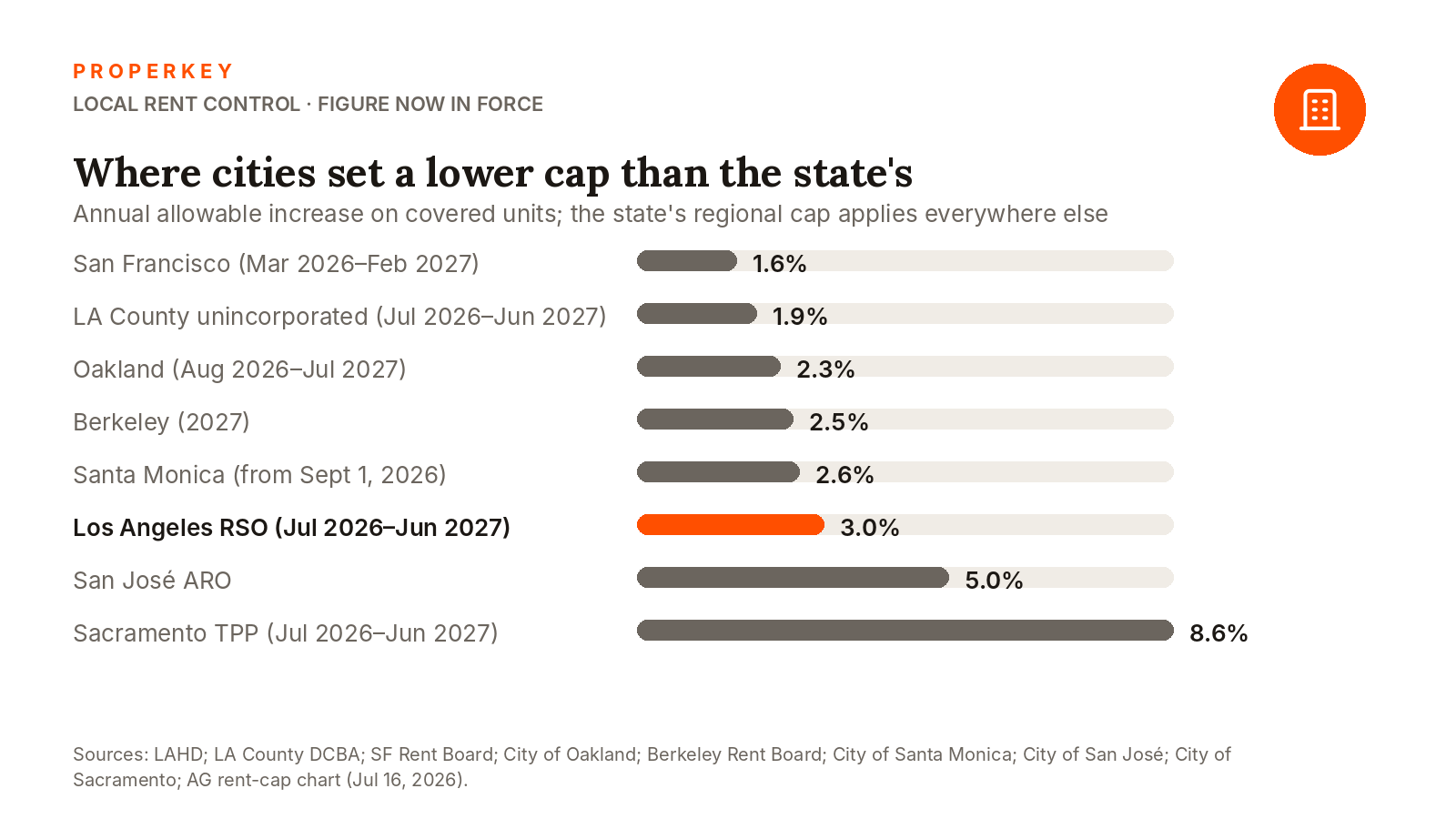
The state cap yields to a local ordinance that is stricter. The main ones, with the figure now in force:
Los Angeles (city), Rent Stabilization Ordinance: 3% for July 1, 2026–June 30, 2027. The City Council rewrote the formula in December 2025: 90% of CPI with a 1% floor and a 4% ceiling, and the old 1% add-ons for landlord-paid gas and electricity were eliminated for increases from February 2, 2026. The RSO covers multi-unit buildings with a certificate of occupancy on or before October 1, 1978; newer buildings fall under the state cap and the city's just-cause ordinance. Unincorporated Los Angeles County allows 1.919% (2.919% for small landlords) through June 30, 2027.
San Francisco: 1.6% for March 1, 2026–February 28, 2027 (60% of CPI), up from 1.4%.
Oakland: 2.3% for August 1, 2026–July 31, 2027, the lower of 60% of CPI or 3%.
Berkeley: 2.5% for 2027 (65% of CPI), effective January 1, 2027; 1.0% in 2026.
Santa Monica: 2.6% from September 1, 2026, capped at $70 a month on units already at $2,674 or more.
San Jose, Apartment Rent Ordinance: one 5% increase per 12 months, on buildings of three or more units built and occupied before September 7, 1979.
Sacramento, Tenant Protection Program: 8.6% for July 1, 2026–June 30, 2027 (5% plus the California CPI), once per 12 months, with a 10% ceiling in the city code.
San Diego (city): no local cap. The city's 2023 Tenant Protection Ordinance adds just-cause and relocation rules; rent increases follow the state's 8.2% figure for San Diego County this year.
Who is exempt from the state cap
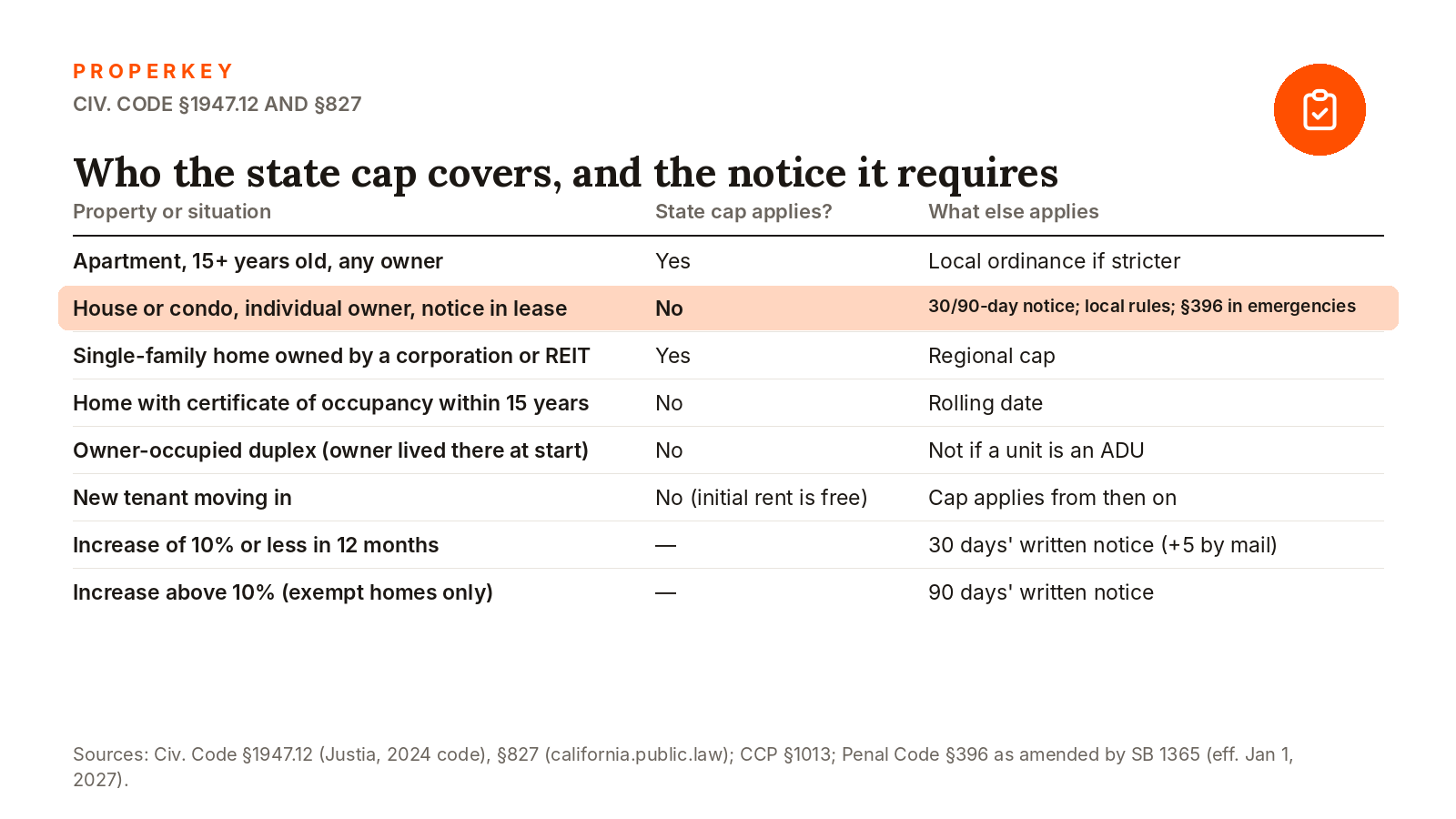
Subdivision (d) of §1947.12 lists the exemptions, and the biggest one covers much of California's rental stock. A single-family home or condominium ("alienable separate from the title to any other dwelling unit") is exempt if the owner is not a real estate investment trust, a corporation, or an LLC with a corporate member, and the lease or a written notice carries this language, word for word: "This property is not subject to the rent limits imposed by Section 1947.12 of the Civil Code and is not subject to the just cause requirements of Section 1946.2 of the Civil Code. This property meets the requirements of Sections 1947.12 (d)(5) and 1946.2 (e)(8) of the Civil Code and the owner is not any of the following: (1) a real estate investment trust, as defined by Section 856 of the Internal Revenue Code; (2) a corporation; or (3) a limited liability company in which at least one member is a corporation." For tenancies that began or renewed on or after July 1, 2020, the notice must be in the rental agreement; without it, the house is covered. The other exemptions are housing with a certificate of occupancy issued within the past 15 years (a rolling date, so a 2012 building becomes covered in 2027), an owner-occupied duplex where the owner lived in one unit when the tenancy began (not counting an ADU), deed-restricted affordable housing, and school and college dormitories. Mobilehome owners renting a space are outside §1947.12; park-owned mobilehomes rented to tenants are inside it.
Exempt from the cap does not mean exempt from notice, from the city's ordinance if one applies, or from the emergency price-gouging statute (below).
How much notice a landlord must give
Civil Code §827(b) requires written notice before any rent increase on a month-to-month or shorter periodic tenancy: at least 30 days if the increase, alone or combined with others in the past 12 months, is 10% or less of the lowest rent in that period, and at least 90 days if it is more than 10%. Notice served by mail gets five extra days under Code of Civil Procedure §1013. Under the state cap no increase can exceed 10%, so the 90-day rule now applies mainly to exempt properties. Mobilehome space rent needs 90 days' notice under §798.30 regardless of size. A fixed-term lease cannot be raised mid-term unless the lease itself says so.
Emergency price gouging: the 10% rule that reaches every rental
When the Governor or a local government declares a state of emergency, Penal Code §396 caps rent increases at 10% above the pre-emergency rent for covered housing, with criminal penalties. SB 1365 (Allen), signed September 30, 2026 as Chapter 1028, extends that cap from January 1, 2027 to "any rental housing without regard to the length of the initial lease term," including single-family homes exempt from §1947.12, and turns the old exemptions into affirmative defenses a landlord must prove, such as an increase tied to repair costs. The Los Angeles fire cap is a reminder that these protections expire: the Governor's last extension ran only to February 7, 2026, the county extended its own version in 30-day steps, and on May 19, 2026 the Board of Supervisors declined another extension, so no §396 rent cap has been in effect in Los Angeles County since May 28, 2026 (LAist).
What a tenant can do about an illegal increase
An owner who "demands, accepts, receives, or retains" rent above the cap is liable to the tenant for the excess, for injunctive relief, for attorney's fees at the court's discretion, and for up to three times the overcharge "upon a showing that the owner has acted willfully or with oppression, fraud, or malice" (§1947.12(k)). There is no fixed fine; the remedy is the refund and, for bad actors, treble damages, within a three-year limitations period. The Attorney General and city attorneys may also sue. A written waiver of the cap in a lease is void. Start with a written letter citing §1947.12 and the regional percentage; small-claims court handles claims up to $12,500. The Attorney General's landlord-tenant page summarizes the rules in plain language.
What the market is actually doing
Few landlords are near the cap this year. Apartment List's November 2026 report puts the national median rent at $1,384, up just 0.1% from a year ago, with Los Angeles down 0.6% (one-bedroom $1,864) and San Diego up 0.7% ($1,972). Zillow's September rent index shows Los Angeles at $2,929 (+1.8%), San Diego $2,967 (+2.2%), Sacramento $2,269 (+1.8%) and San Francisco $3,445 (+11.8%, the outlier). An 8.7% increase in a market rising 1.8% invites a vacancy, and a turnover costs the owner more than the increase earns. For owners, the 2027 compliance list is getting longer: the pet-policy disclosure, altered-photo rule and two-ADU law all land in the next five months. Properkey's property management is full service for a 5% flat fee with no markups, in California or Idaho, and owners who prefer to self-manage can list a rental on the MLS for free.
Questions people ask
What is the maximum rent increase in California for 2026–2027? Under the Tenant Protection Act, 5% plus the regional April-to-April CPI change, capped at 10%: 8.7% in Los Angeles and Orange counties, 8.8% in the core Bay Area, 8.2% in San Diego County, 8.1% in Riverside and San Bernardino, and 8.6% elsewhere, for increases effective August 1, 2026 through July 31, 2027. Cities with rent control allow less; exempt properties have no state cap but still owe notice.
Can a landlord raise rent 10% in California? Only where the regional cap allows it, and this year none does: the highest is 8.8%. A 10% increase is the absolute ceiling under §1947.12 and also the limit during a declared emergency under Penal Code §396. Owners of exempt single-family homes may raise more than 10%, but must give 90 days' written notice.
Is my single-family rental covered by AB 1482? It is exempt only if the owner is an individual (not a REIT, corporation or LLC with a corporate member) and the required exemption notice appears in your lease. If the notice is missing from a lease signed or renewed since July 1, 2020, the cap applies. Homes built within the past 15 years are exempt regardless of owner.
How much notice is required for a rent increase in California? Thirty days in writing for an increase of 10% or less over 12 months, 90 days for more than 10%, plus five days if mailed. Mobilehome space rent requires 90 days. Local ordinances may require more.
This is a summary of California statutes and city ordinances as of November 10, 2026, not legal advice. Local rules change annually; confirm the current figure with the city's rent program.
Sources: Civ. Code §1947.12 · CTCAC rent-cap memo, July 15, 2026 · CTCAC memo, July 29, 2025 · California Attorney General, rent caps · Attorney General, landlord-tenant issues · Civ. Code §827 · Civ. Code §798.30 · LAHD renter protections · LA County DCBA · San Francisco Rent Board · City of Oakland · Berkeley Rent Board · City of Santa Monica · City of San José · City of Sacramento TPP notice · SB 1365 (Ch. 1028, 2026) · LAist on the LA County cap · Apartment List, November 2026 · Zillow September 2026 Rent Report
Written by Keyro, Properkey's AI. Properkey, DRE #01979718.



