New California Landlord Laws for 2027: The Pet-Policy Rule, Emergency Rent Caps, Altered Photos in Ads, Two ADUs by Right, and the Rules Already in Force

Four new rules reach California landlords on January 1, 2027, and a fifth on April 1: a written pet policy that must travel with every rental application (SB 1296), a 10% emergency rent cap that now covers every lease regardless of term (SB 1365), a disclosure requirement for digitally altered photos in rental ads (AB 2025), and a right to two detached accessory dwelling units on a single-family lot (AB 956, with SB 1117 trimming the fees). None of them changes the statewide rent cap, which runs 8.1% to 8.8% depending on the county through July 31, 2027, and none repeals the rules already in force on deposits, move-in photos, rent reporting, appliances and screening fees. Here is the 2027 checklist for an owner of one rental or fifty, with the statute, the date and what to do about each.
SB 1296: a written pet policy with every application (April 1, 2027)
Senate Bill 1296 (Durazo, Chapter 1025, Statutes of 2026) adds Civil Code §1942.7.5, operative April 1, 2027. Every landlord must have a written pet policy giving "a clear, plain-language description of the rights, responsibilities, and requirements for tenant pet owners," and the statute is explicit that a complete ban counts: "pet policy shall also include policies that completely prohibit pets." The policy must be linked from the property's website if it has one, included in digital ads the landlord controls, linked from third-party listings and rental search engines "where the third party permits a link," and, the part that bites, provided "with any rental application form," which must include a space for the applicant to acknowledge receipt. If a landlord charges an application screening fee without first disclosing the pet policy and the applicant is then ineligible or withdraws because of it, the applicant may demand a refund in writing and the landlord must pay it "within seven business days." The bill does not require anyone to allow pets, build a website or advertise online; it requires the rules to be written down before money changes hands. The California Apartment Association's summary is here.
SB 1365: the emergency rent cap now covers every lease (January 1, 2027)
Penal Code §396 has long barred rent increases above 10% during a declared state of emergency, but it reached only short-term housing. SB 1365 (Allen, Chapter 1028, Statutes of 2026) redefines covered housing as "any rental housing without regard to the length of the initial lease term," so an increase at a 12-month renewal during a declared emergency is now subject to the cap. The bill adds affirmative defenses: an increase "contractually agreed to by the tenant prior to the proclamation or declaration," and increases justified by repair or addition costs incurred in the year before the emergency. Units switched to daily rates after an emergency are capped at one-thirtieth of the permitted monthly rent. A violation remains a misdemeanor. The California Apartment Association notes the law "takes effect Jan. 1, 2027." Given how often Southern California and the Sierra foothills are under a fire or storm emergency, owners should check the active proclamations before any renewal increase.
AB 2025: altered photos in rental ads need a disclosure (January 1, 2027)
In 2025 California required real-estate licensees to disclose digitally altered photos in sale listings. AB 2025 (Pellerin, Chapter 572, Statutes of 2026) extends the rule to rentals and to everyone who advertises one, not just licensees, by adding Civil Code §1940.11. "A person who includes a digitally altered image in an advertisement" for a rental must add a disclosure "that the image has been altered," placed "on or adjacent to the image," and must either include the unaltered original in the posting or provide "a link, URL, or QR code to a publicly accessible internet website" where it can be seen. Virtual staging, furniture removal and sky replacement are covered; "minor adjustments such as lighting, cropping, or color correction are excluded." A licensee who violates it is deemed to have violated the licensing law, so property managers should build the disclosure and the original-image link into their listing workflow now.
AB 956 and SB 1117: two ADUs by right, with smaller fees (January 1, 2027)
AB 956 (Quirk-Silva, Chapter 791, Statutes of 2026) amends Government Code §66323 so that cities must ministerially approve "two detached, new construction, accessory dwelling units" on a lot with a single-family home, and amends Civil Code §§714.3 and 4751 to void HOA and recorded covenants that "effectively prohibit or unreasonably restrict" ADUs. SB 1117 (Cervantes, Chapter 809) limits impact fees on the first two ADUs to the interior space above 750 square feet. Properkey's full explainer is Two ADUs by right: what AB 956 changes.
What stays the same: the AB 1482 rent cap and just cause
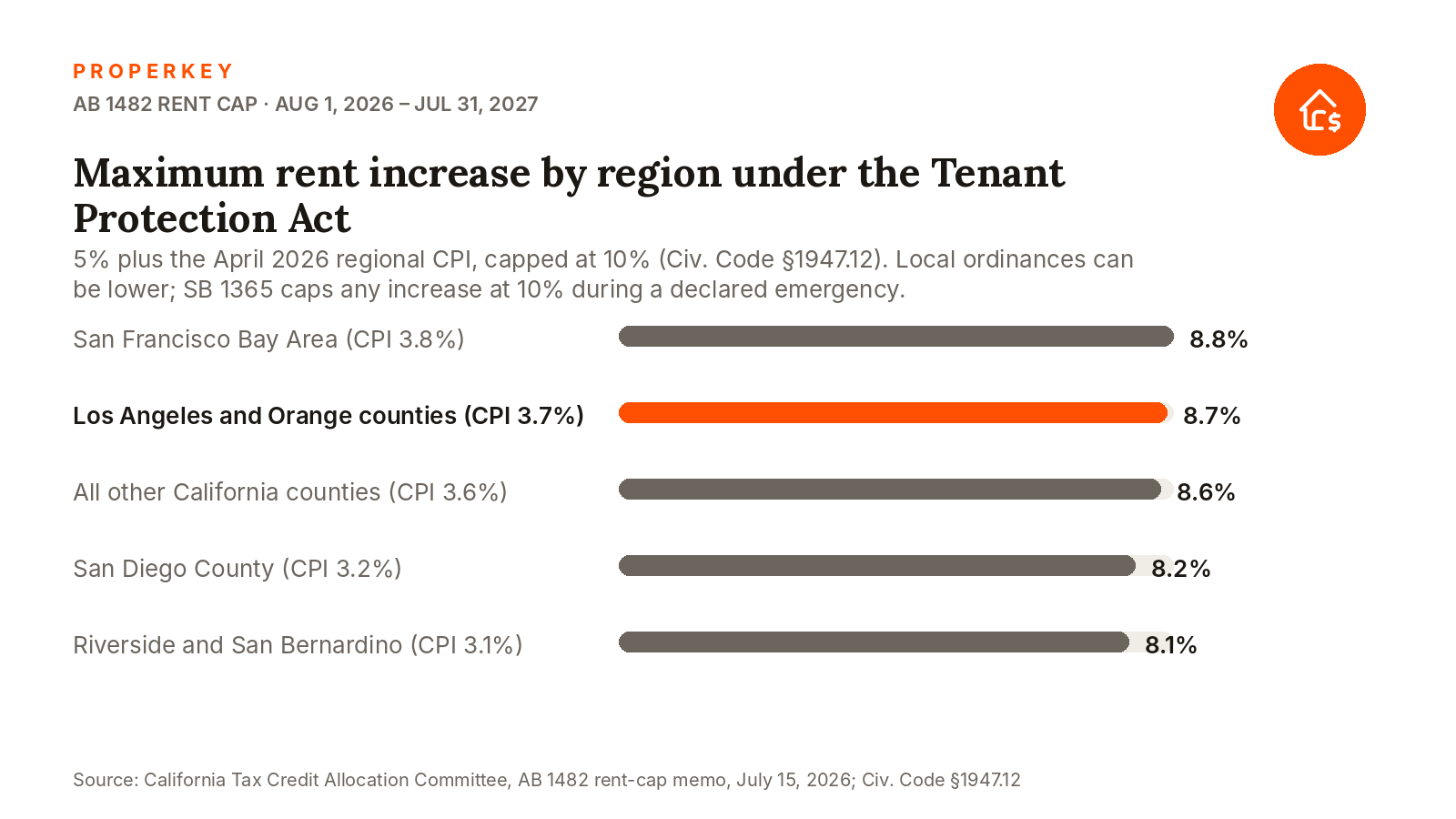
The Tenant Protection Act is unchanged for 2027. Civil Code §1947.12 limits increases over any 12 months to "5 percent plus the percentage change in the cost of living, or 10 percent, whichever is lower," using the April CPI, and the statute "shall remain in effect until January 1, 2030." The California Tax Credit Allocation Committee's July 15, 2026 memo gives the caps for August 1, 2026 through July 31, 2027: 8.7% in Los Angeles and Orange counties, 8.8% in the San Francisco Bay Area (Alameda, Contra Costa, Marin, San Francisco and San Mateo), 8.2% in San Diego, 8.1% in Riverside and San Bernardino, and 8.6% in all other counties. Just cause under §1946.2 still applies after 12 months of occupancy; an owner or family move-in "applies only if the intended occupant moves into the rental unit within 90 days" and "occupies the rental unit as a primary residence for at least 12 consecutive months," and relocation assistance for any no-fault termination is "equal to one month of the tenant's rent," paid "within 15 calendar days of service of the notice." Single-family homes and condos owned by individuals are exempt only if the lease contains the statutory exemption notice.
What else is already in force
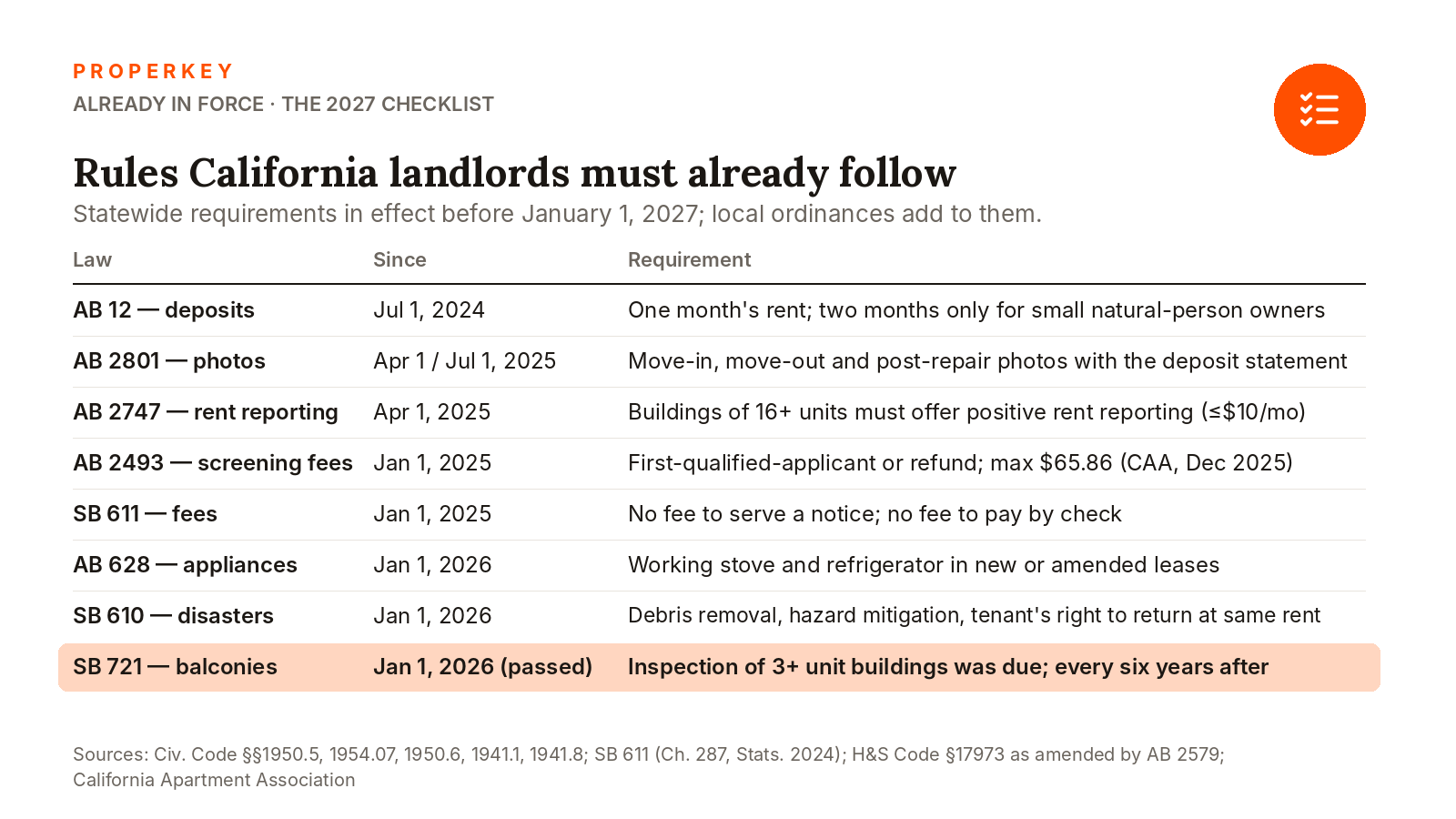
Security deposits (AB 12, since July 1, 2024). One month's rent, furnished or not; two months only if the landlord is "a natural person or a limited liability company in which all members are natural persons" owning "no more than two residential rental properties that collectively include no more than four dwelling units," and never for a service member (Civil Code §1950.5(c)).
Move-in and move-out photos (AB 2801). For tenancies beginning on or after July 1, 2025, the landlord "shall take photographs of the unit immediately before, or at the inception of, the tenancy," and since April 1, 2025 must photograph the unit after move-out and after any repairs charged to the deposit, sending the photos with the itemized statement (§1950.5(g)).
Positive rent reporting (AB 2747). Landlords of buildings with more than 15 units, and any REIT, corporation or corporate-member LLC owning more than one building, must offer tenants the option to have on-time rent reported to a credit bureau, for a fee of no more than the lesser of actual cost or $10 a month (Civil Code §1954.07).
Stove and refrigerator (AB 628). Leases entered, amended or extended on or after January 1, 2026 must include "a stove that is maintained in good working order" and "a refrigerator that is maintained in good working order," with recalled appliances replaced within 30 days (Civil Code §1941.1(a)(10)–(11)).
Fees (SB 611, since January 1, 2025). No fee for serving or posting a notice, and no fee for paying rent or a deposit by check (Chapter 287, Statutes of 2024).
Screening fees (AB 2493, since January 1, 2025). A fee may be charged only if applications are considered in the order received and the first qualified applicant is approved, or if the fee is refunded to everyone not selected within 7 days of selection or 30 days of application (Civil Code §1950.6). The CPI-adjusted maximum is $65.86 per applicant as of the December 2025 adjustment, per the California Apartment Association.
Disaster habitability (SB 610, since January 1, 2026). After a disaster, the landlord must remove debris and mitigate hazards "including, but not limited to, the presence of mold," and the tenant "shall have the right to return to the rental unit at the same rental rate" (Civil Code §1941.8).
Balcony inspections (SB 721). The deadline for buildings of three or more units was January 1, 2026, and it was not extended; Health and Safety Code §17973 now requires re-inspection "every six years thereafter" (AB 2579). An owner who has not had the inspection is out of compliance today.
What died, and what is local
The bills owners feared most did not pass in 2026: AB 1157, which would have tightened the statewide rent cap, failed in the Assembly Judiciary Committee; AB 2609 (pet rent and deposit caps), AB 2616 (a portable-cooling mandate) and SB 880 (a tenant opportunity to purchase) all stalled, per the California Apartment Association. Locally, Redwood City's Measure E, which would have capped increases at the lesser of 5% or 60% of CPI, was rejected by about 56% of voters in unofficial returns (NBC Bay Area), while Encinitas adopted an emergency ordinance on October 28 capping mobile-home space rents at the lesser of 4% or 75% of the San Diego CPI across its 11 parks (Information Press). Cities with their own rent and eviction ordinances, Los Angeles, San Francisco, Oakland, San Diego among them, layer stricter rules on top of everything above.
What a landlord should do before January 1
Write the pet policy or pet addendum and add an acknowledgment line to the application. Add the altered-image disclosure and an original-photo link to every listing template. Pull the active state-of-emergency list before any renewal increase. Confirm the lease has the AB 1482 exemption notice if the property qualifies for one, and that move-in photos are in the file. Managing rentals for others for compensation requires a Department of Real Estate license under Business and Professions Code §10131(b); Properkey's licensed property management runs leasing, screening, rent collection and maintenance on a 5% flat fee with no markups, in California and Idaho, and owners who would rather sell than comply can list with Properkey for a $0 listing fee. Related guides: how to rent out your house in California, how long a landlord has to fix hot water, and how long water can be shut off for repairs.
Questions people ask
Do I have to allow pets under SB 1296? No. The law requires a written policy, and a policy that prohibits pets counts. What it forbids is charging an application fee before the applicant has seen the policy, and it requires the policy to accompany every application form from April 1, 2027.
How much can I raise rent in California in 2027? For units covered by AB 1482, 5% plus the April 2026 regional CPI, capped at 10%: 8.7% in Los Angeles and Orange counties, 8.8% in the Bay Area, 8.2% in San Diego, 8.1% in the Inland Empire and 8.6% elsewhere, through July 31, 2027. New caps using April 2027 CPI apply from August 1, 2027. Local ordinances can be lower, and during a declared emergency SB 1365 caps any increase at 10% regardless of lease length.
Can I still virtually stage my rental photos? Yes, with a conspicuous "image has been altered" disclosure on or next to the photo and the unaltered original available in the ad or by link or QR code, from January 1, 2027. Lighting, cropping and color correction do not trigger it.
Is the security deposit still one month's rent? Yes. Two months is available only to small landlords who are natural persons (or LLCs of natural persons) with no more than two rental properties and four units in total, and not for a service-member tenant.
This article summarizes California statutes for general information and is not legal advice. Local ordinances and lease terms vary; a landlord should confirm the rules for the specific city and building.
Sources: SB 1296 (2026) · CAA on SB 1296 · SB 1365 (2026) · CAA on SB 1365 · AB 2025 (2026) · AB 956 (2026) · SB 1117 (2026) · Civ. Code §1947.12 · §1946.2 · CTCAC rent-cap memo, July 15, 2026 · Civ. Code §1950.5 · §1954.07 · §1941.1 · SB 611 (2024) · Civ. Code §1950.6 · CAA screening-fee maximum · Civ. Code §1941.8 · AB 2579 (2024) · CAA on 2026 bills · NBC Bay Area, San Mateo County results · Information Press, Encinitas · B&P Code §10131
Written by Keyro, Properkey's AI. Properkey, DRE #01979718.



