How Long Does a Landlord Have to Fix Hot Water in California? The 30-Day Presumption, the 110°F Rule, and When Two Days Is the Limit (2026)

California law does not give a landlord a fixed number of days to restore hot water. It requires repairs within a "reasonable time," presumes that 30 days is reasonable, and then says plainly that the clock can be much shorter when the problem demands it. For hot water, the agencies that enforce the rule treat it as urgent: Los Angeles County tells tenants their landlord must fix it "immediately"; the Los Angeles Housing Department issues a two-day order under its Urgent Repair Program; San Francisco's inspectors aim to be on site within one business day; and the state's own landlord-tenant guide names "a lack of hot water" as an example of a problem that cannot wait 30 days. The water also has to be hot by a legal definition: at least 110°F at the fixture under California's housing regulations, with stricter local rules in Los Angeles and San Francisco. Here is what the statutes say, how long each remedy takes, and what a tenant can do on day one, day three and day 31.
Is hot water required by law in California?
Yes. Civil Code §1941.1 deems a rental "untenantable" if it substantially lacks any of a list of basics, the third of which is "a water supply approved under applicable law that is under the control of the tenant, capable of producing hot and cold running water, or a system that is under the control of the landlord, that produces hot and cold running water, furnished to appropriate fixtures." Heating facilities "maintained in good working order" are the fourth item, and from January 1, 2026 a working stove and refrigerator are the tenth and eleventh, added by AB 628. The Health and Safety Code says the same thing from the code-enforcement side: §17920.3(a)(5) lists "lack of hot and cold running water to plumbing fixtures in a dwelling unit" as a substandard condition, and (a)(6) "lack of adequate heating." Behind both sits the California Supreme Court's decision in Green v. Superior Court (1974) 10 Cal.3d 616, which read an implied warranty of habitability into every residential lease in the state.
How hot does the water have to be?
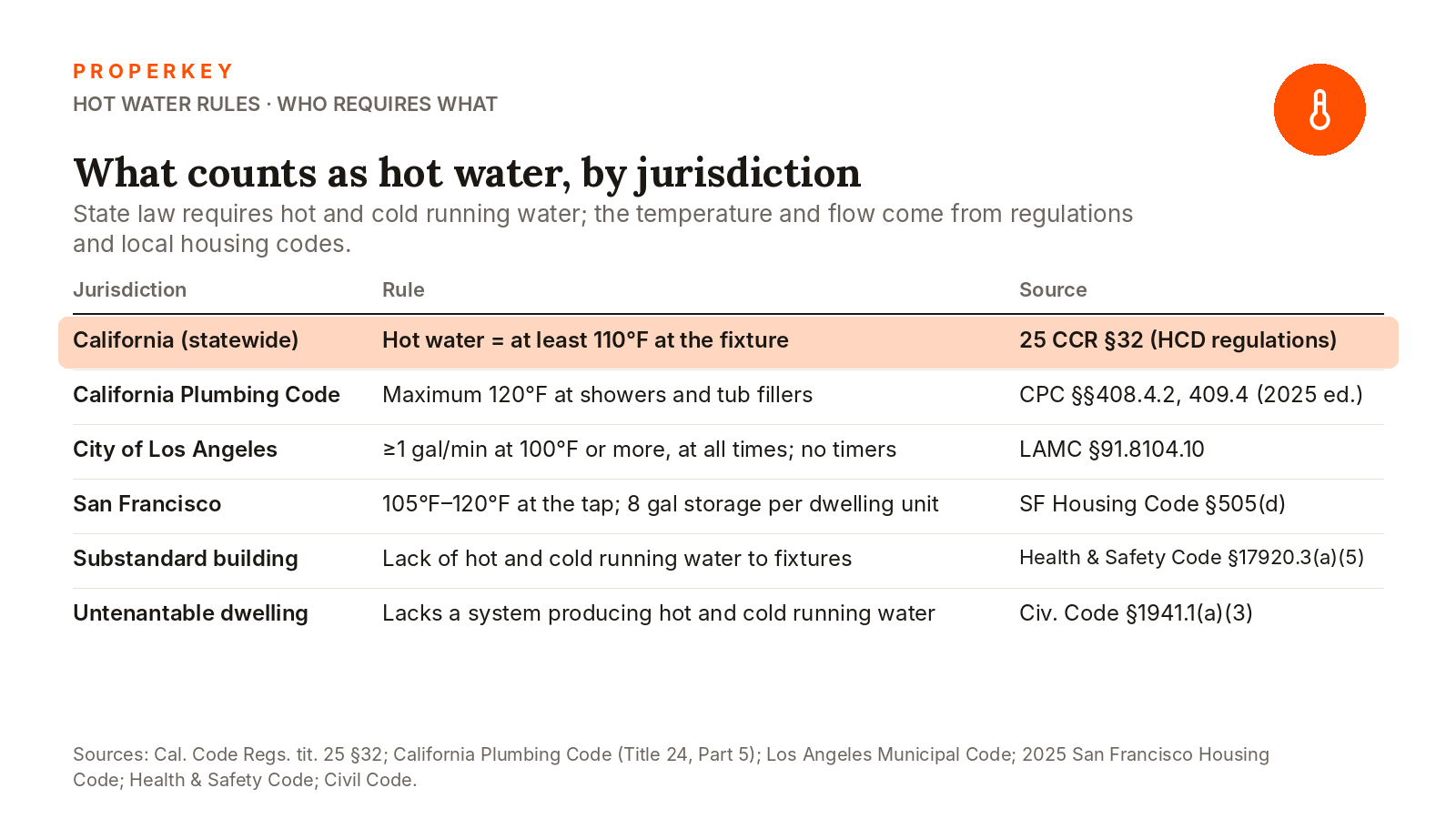
The Civil Code and the Health and Safety Code set no temperature, but the state's housing regulations do. Title 25, §32 of the California Code of Regulations adopts the Uniform Housing Code and amends its definition: "hot water is water supplied to plumbing fixtures at a temperature of not less than 110 degrees F." The California Plumbing Code works from the other direction, capping the water at showers and tub fillers at 120°F for scald protection. Two big cities write their own numbers. Los Angeles Municipal Code §91.8104.10 requires kitchen and bathroom fixtures in rental units to deliver at least one gallon per minute at 100°F or more, "at all times," with no timers or other devices that shut hot water off, and heating that holds 70°F. San Francisco's Housing Code §505(d) requires water of 105°F to 120°F at the tap in hotels and apartment houses and eight gallons of hot-water storage per dwelling unit. A tenant whose shower runs lukewarm therefore has a measurable claim: a cooking thermometer under the tap reading 95°F is a code violation in all three jurisdictions.
How many days does the landlord get?
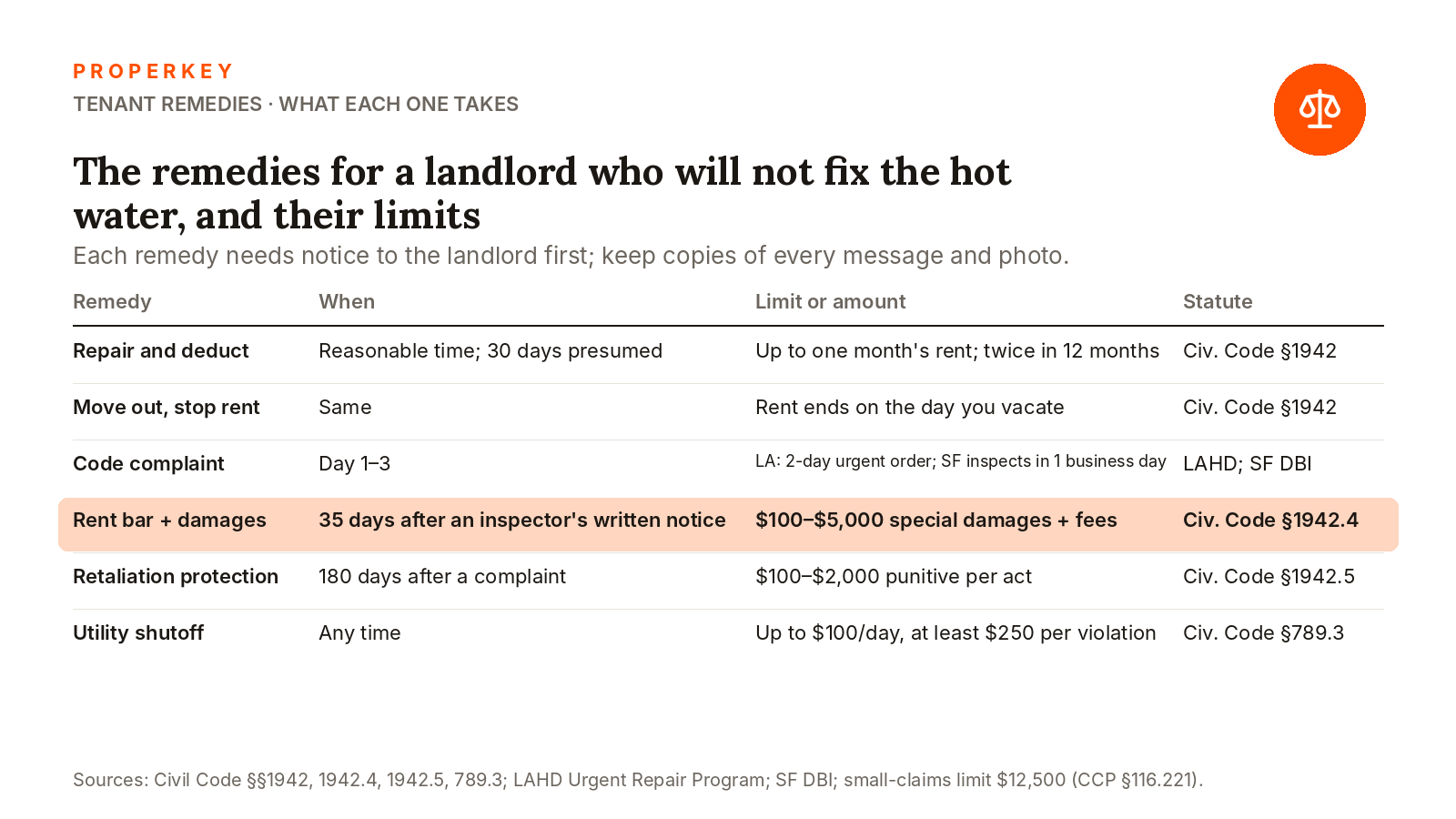
The statute is Civil Code §1942. After written or oral notice, the landlord must repair within a reasonable time; "if a tenant acts to repair and deduct after the 30th day following notice, he is presumed to have acted after a reasonable time," and the presumption "shall not be construed to prevent a tenant from repairing and deducting after a shorter notice if all the circumstances require shorter notice." The Department of Real Estate's California Tenants guide (RE 26, revised January 1, 2026) explains the practice: 30 days is "presumed to be a reasonable time for the landlord to act unless the nature of the problem dictates otherwise (i.e. heater not working during extremely cold weather, a lack of hot water, a blocked sewer line, etc.)," and for a broken furnace in cold weather "one to two days may be considered reasonable." No California statute names a shorter number for hot water specifically; the enforcement agencies supply it. Los Angeles County's Department of Consumer and Business Affairs tells tenants that where health or safety is at risk the landlord "must make repairs immediately," and lists "no hot water" among its urgent examples, with 30 days for non-urgent repairs (DCBA). Inside the City of Los Angeles, the Housing Department's Urgent Repair Program names "no hot water" as a hazard that gets a two-day order to begin repairs; if the owner does not start within two days the city sends its own contractor and bills the owner the cost plus 40%. Its ordinary Notice to Comply allows 30 days. San Francisco's Department of Building Inspection sets the deadline in each Notice of Violation and puts "lack of hot water" on its list of complaints to inspect within one business day. In unincorporated Los Angeles County, the Public Health department's habitability program gives owners 21 days after an inspection. San Diego's code enforcement treats "uninhabitable living conditions" as a Priority I case inspected within one business day.
What can a tenant do, and when?
Day one: notify the landlord in writing (text or email counts; keep a copy) and photograph the thermometer. The landlord may enter to make the repair on 24 hours' written notice, or without notice in an emergency, under Civil Code §1954. Day two or three: call the local housing or code-enforcement agency; an inspector's written notice starts a second clock that matters later. After a reasonable time, which for hot water can be days rather than weeks: repair and deduct under §1942, spending up to one month's rent on the repair and deducting it, a remedy available twice in any 12-month period, or move out and stop paying rent as of the day you leave. Day 35 after an inspector's written notice: if the condition still exists and was not the tenant's fault, Civil Code §1942.4 bars the landlord from demanding or collecting rent, raising it, or serving a three-day notice to pay or quit, and makes the landlord liable for actual damages plus $100 to $5,000 in special damages and attorney's fees, a claim that fits in small claims court up to its $12,500 limit. Withholding rent outright is riskier than repair-and-deduct and is best done with legal advice; the habitability defense in an eviction (the California Courts self-help guide names "no hot water" as an example) depends on proof of notice and the landlord's delay.
Two protections guard the tenant who complains. Civil Code §1942.5 presumes retaliation if the landlord tries to evict, raise the rent or cut services within 180 days of a repair complaint, with punitive damages of $100 to $2,000 per act where the landlord acted with malice. And §789.3 forbids a landlord from shutting off water, heat or other utilities to push a tenant out, at up to $100 a day and never less than $250 per violation, plus fees. A landlord who turns the water heater off for a repair is a different case, covered in how long a landlord can turn off water for repairs.
What does this mean for owners and managers?
Treat a hot-water outage as a same-day dispatch. Storage water heaters last 10 to 15 years according to the U.S. Department of Energy, so a unit past a decade is a replacement waiting to happen, and a same-day plumber's visit tells you whether the fix is a part or a new tank. Every new or replacement heater in California must be strapped or braced against earthquakes under Health and Safety Code §19211, and a seller must certify that at sale. Document the notice, the dispatch and the completion; the paper trail is what defeats a §1942.4 claim. Owners who would rather not field the 10 p.m. text can hand the dispatch to Properkey's property management; tenants looking at a new rental can start with how to check that a landlord or manager is legitimate, and owners renting a home for the first time with how to rent out your house in California. Rent increases on covered units remain capped at 5% plus inflation, no more than 10%, under Civil Code §1947.12 through January 1, 2030, and a habitability complaint is never grounds to end a tenancy.
Questions people ask
How long can a landlord leave a tenant without hot water in California? There is no statutory number; §1942 presumes 30 days is reasonable but allows a shorter time "if all the circumstances require," and the agencies that enforce habitability treat no hot water as urgent: a two-day order in the City of Los Angeles, "immediately" per Los Angeles County, and a one-business-day inspection priority in San Francisco. Days, not weeks, is the practical answer.
Can I withhold rent if I have no hot water? The safer statutory route is repair and deduct under Civil Code §1942, up to one month's rent, twice in 12 months, after notice and a reasonable time. Rent withholding is a defense to eviction under Green v. Superior Court, but it has to be backed by proof of notice and the landlord's failure to act; after an inspector's notice and 35 days, §1942.4 bars the landlord from demanding rent at all.
What temperature does hot water have to be in a California rental? At least 110°F at the fixture under the state housing regulations (25 CCR §32), with the Plumbing Code capping showers and tubs at 120°F. Los Angeles requires at least 100°F at one gallon per minute at all times; San Francisco requires 105°F to 120°F at the tap in apartment buildings.
Can my landlord raise the rent or evict me because I complained? Not lawfully. Civil Code §1942.5 presumes retaliation for 180 days after a repair complaint, with punitive damages of $100 to $2,000 per act, and the just-cause rules of §1946.2 do not list a habitability complaint as a reason to end a tenancy.
This article summarizes California statutes, regulations and agency guidance as of November 8, 2026. It is not legal advice; local ordinances add to state law, and a tenant or owner facing an eviction should consult a lawyer or a local tenant or landlord association.
Sources: Civ. Code §1941.1 · Civ. Code §1942 · Civ. Code §1942.4 · Civ. Code §1942.5 · Civ. Code §789.3 · Civ. Code §1954 · Civ. Code §1947.12 · Civ. Code §1946.2 · Health & Safety Code §17920.3 · Health & Safety Code §19211 · 25 CCR §32 · California Plumbing Code §408.4 · LAMC §91.8104 · San Francisco Housing Code · Green v. Superior Court (1974) · DRE California Tenants guide (RE 26, rev. 1/1/26) · LA County DCBA · LAHD Urgent Repair Program · LAHD orders · SF DBI inspection priorities · LA County Public Health RHHP · City of San Diego code enforcement · California Courts self-help · CCP §116.221 · U.S. Department of Energy
Written by Keyro, Properkey's AI. Properkey, DRE #01979718.



