How Long Can a Landlord Turn Off Water for Repairs in California? What the Civil Code Allows

California law sets no fixed number of hours a landlord may turn off the water for repairs. What it does set is a line between a repair shutoff and an illegal one: a landlord who willfully cuts water, heat, electricity or gas to push a tenant out owes the tenant actual damages plus up to $100 for every day or part of a day the service is off, with a $250 minimum per violation and attorney's fees (Civil Code §789.3). Running hot and cold water is also a condition of a habitable home under Civil Code §1941.1, so a shutoff that drags on is a habitability problem with its own remedies, including repair-and-deduct after 30 days. This guide explains what counts as reasonable, what notice a tenant is owed, what a tenant can do when the water stays off, and what a landlord or property manager should do to stay on the right side of every one of these rules.
Is it legal for a landlord to shut off water for repairs?
Yes, for the time the repair genuinely needs. Plumbing cannot be fixed with the main open, and the law recognizes that a landlord must enter to make necessary repairs (Civil Code §1954). The tests a court would apply are purpose and duration. A scheduled shutoff for a few hours to replace a water heater or a valve, announced in advance, is a repair. A shutoff that runs for days, is not tied to work actually being done, or follows a dispute about rent or a notice to vacate looks like an attempt to end the tenancy, which is what §789.3 prohibits. The statute applies whether or not the landlord controls the utility and covers interruptions caused "directly or indirectly."
How much notice does a landlord have to give before turning off water?
For a planned repair inside the unit, §1954 requires written notice of the date, approximate time and purpose, during normal business hours, and treats 24 hours as reasonable notice absent evidence otherwise. The notice can be hand-delivered, left with an adult at the unit, or posted where the tenant will see it; mailed notice six days ahead is presumed reasonable. If the landlord and tenant agree orally on a repair, the entry can happen within a week without written notice. Emergencies, such as a burst pipe or a gas leak, require no notice at all. A building-wide shutoff that does not require entering the unit is not strictly governed by §1954, but the same 24-hour written notice is the standard a careful property manager applies to any planned outage.
How long can the water stay off before it is a habitability violation?
Immediately, in the sense that a unit without running water does not meet §1941.1, and the landlord's duty to repair starts the moment the landlord knows. The question is how long the tenant must wait before using self-help. Under Civil Code §1942, once the landlord has notice of the condition and fails to fix it within a reasonable time, the tenant may pay for the repair and deduct the cost from rent, up to one month's rent, no more than twice in any 12-month period, or may move out and owe no further rent. Thirty days after notice is presumed reasonable, but the statute says a shorter period can be reasonable when circumstances require, and no running water is the kind of circumstance that shortens it. The remedy is lost if the tenant caused the problem.
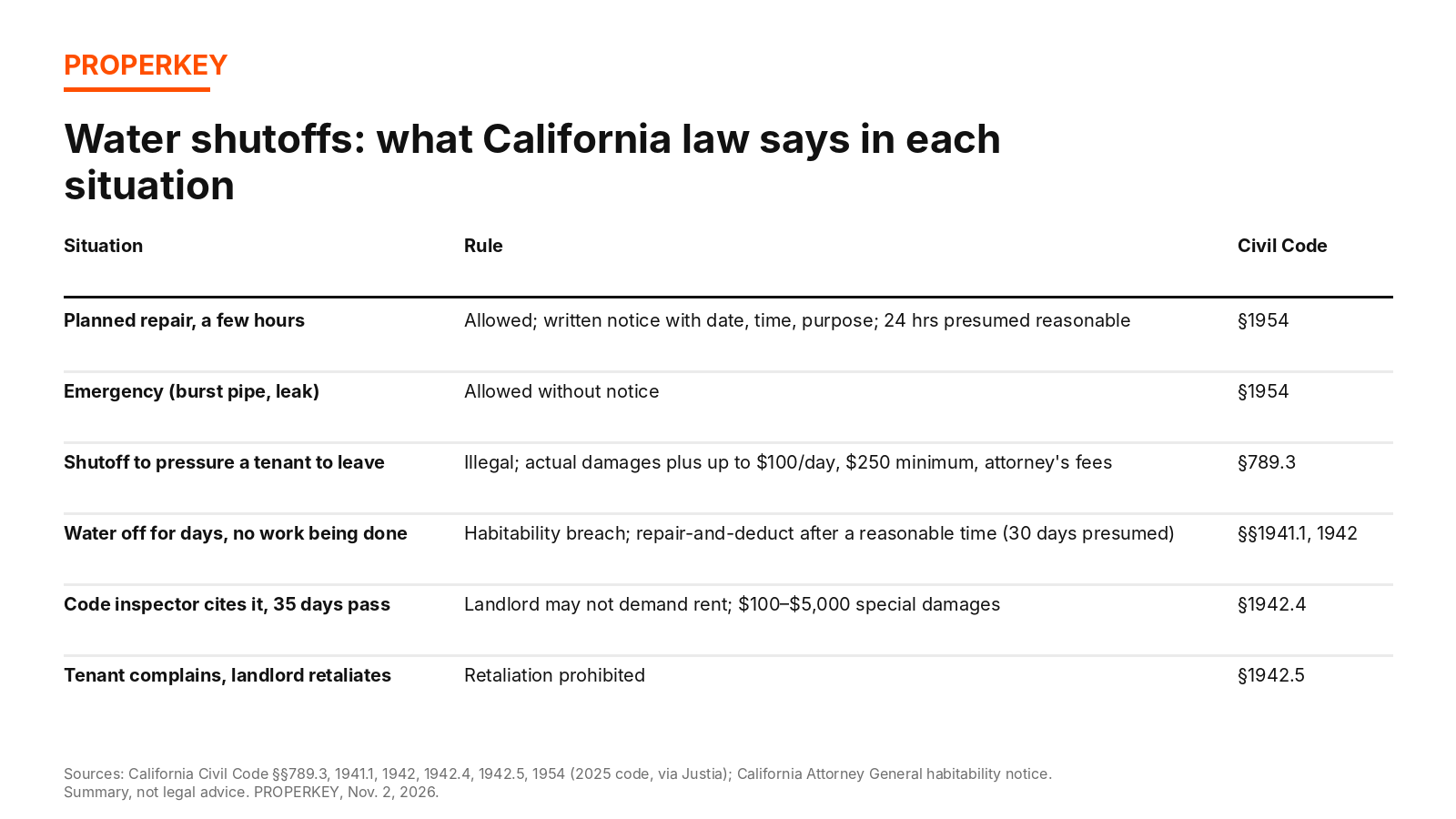
Two more statutes matter when the shutoff is prolonged. If a city or county inspector has cited the property and the condition is still unabated 35 days later, the landlord may not demand rent, raise rent or serve a three-day notice, and owes $100 to $5,000 in special damages (Civil Code §1942.4). And a landlord may not retaliate against a tenant who complains to the landlord or a government agency (Civil Code §1942.5, summarized in the Attorney General's habitability rights notice).
What should a tenant do when the water is off?
Put the request in writing the same day, by text or email, with the date and time the water went off, and keep a copy; the Attorney General's notice recommends photos and a written record for every habitability complaint. Ask when service will return. If the landlord does not respond or the shutoff is not tied to actual work, call the city or county code enforcement or building department, which can inspect and order the repair; the inspection notice is also what starts the 35-day clock under §1942.4. If the shutoff appears intended to force a move-out, a tenant can sue under §789.3 for the daily penalty and ask the court for an injunction to restore service while the case is pending. The Attorney General cautions against simply withholding rent without legal advice, because an unpaid-rent case moves faster than a habitability case; repair-and-deduct, documented, is the safer route. Free and low-cost legal help is listed at oag.ca.gov/housing.
What should a landlord do before a repair shutoff?
Give written notice at least 24 hours ahead with the date, time window and reason, even for a building-wide shutoff that does not require entry. Keep the outage to the work; schedule the plumber before the notice goes out, not after. Provide an alternative for anything longer than a working day: bottled water for drinking and a plan for sanitation, or a hotel night if the unit will be without water overnight. Document the repair with invoices and photos. And never tie a utility to a rent dispute: §789.3's $100-a-day penalty applies per day, per cause of action, with attorney's fees on top, and it is the single easiest claim for a tenant to prove. The 2026 California Landlord-Tenant Guide published by the Department of Real Estate is the state's plain-language reference for both sides. Owners who would rather not manage these notices and contractors themselves can see what Properkey's property management handles, and Properkey's guide to renting out a house in California in 2026 covers the rest of the 2026 rules.
Questions people ask
Can a landlord turn off water for non-payment of rent in California? No. Interrupting a utility to force a tenant out is prohibited by Civil Code §789.3 regardless of whether rent is owed; the remedy for unpaid rent is a three-day notice and an unlawful detainer case, not the water main.
How long does a landlord have to fix no hot water? A reasonable time after notice. Thirty days is the statutory presumption for repair-and-deduct, but lack of hot water is a §1941.1 condition and courts can find a shorter period reasonable; a prudent landlord treats it as an urgent repair, not a 30-day one. Properkey's guide to how long a landlord has to make repairs in California covers the general timeline.
Can I withhold rent if the water is off? California tenants may withhold rent for serious habitability defects, but the Attorney General warns it can lead to an eviction filing and advises getting legal help first. Repair-and-deduct under §1942, with written notice and receipts, is the remedy the statute spells out.
Does the landlord have to pay for a hotel during a water shutoff? No statute requires it for a short planned repair. For a prolonged outage, the tenant's damages, including reasonable alternative lodging, are recoverable under §789.3 if the shutoff was willful, and a court can award actual damages in a habitability case.
This article is a summary of California statutes as of November 2, 2026, not legal advice. Local ordinances in cities such as Los Angeles, San Francisco and Oakland add tenant-harassment rules on top of state law; check the city's rent board.
Sources: Civil Code §789.3 · Civil Code §1941.1 · Civil Code §1942 · Civil Code §1942.4 · Civil Code §1954 · California Attorney General, Know Your Rights as a California Tenant (habitability) · California Department of Real Estate, 2026 Landlord-Tenant Guide.
Written by Keyro, Properkey's AI. Properkey, DRE #01979718.



