What Background Check Do Landlords Use in California? What a Tenant Screening Report Shows, What It Costs and How to Dispute an Error

There is no single official background check for California rentals, and no law names a vendor. What a landlord actually orders is a tenant screening report from a consumer reporting agency. The Consumer Financial Protection Bureau's market report on tenant background checks says a standard report might include identity verification, credit history, criminal background records and eviction history, and many landlords also verify income and employment and call prior landlords. In California the applicant can be charged no more than the landlord's actual cost, capped at $65.86 by the California Apartment Association's December 2025 figure, and most negative items older than seven years cannot be reported at all. This guide covers the report itself. What a landlord may weigh once it arrives is in Properkey's companion guide, California tenant screening in 2026: what a landlord can and cannot consider.
What is in a tenant screening report?
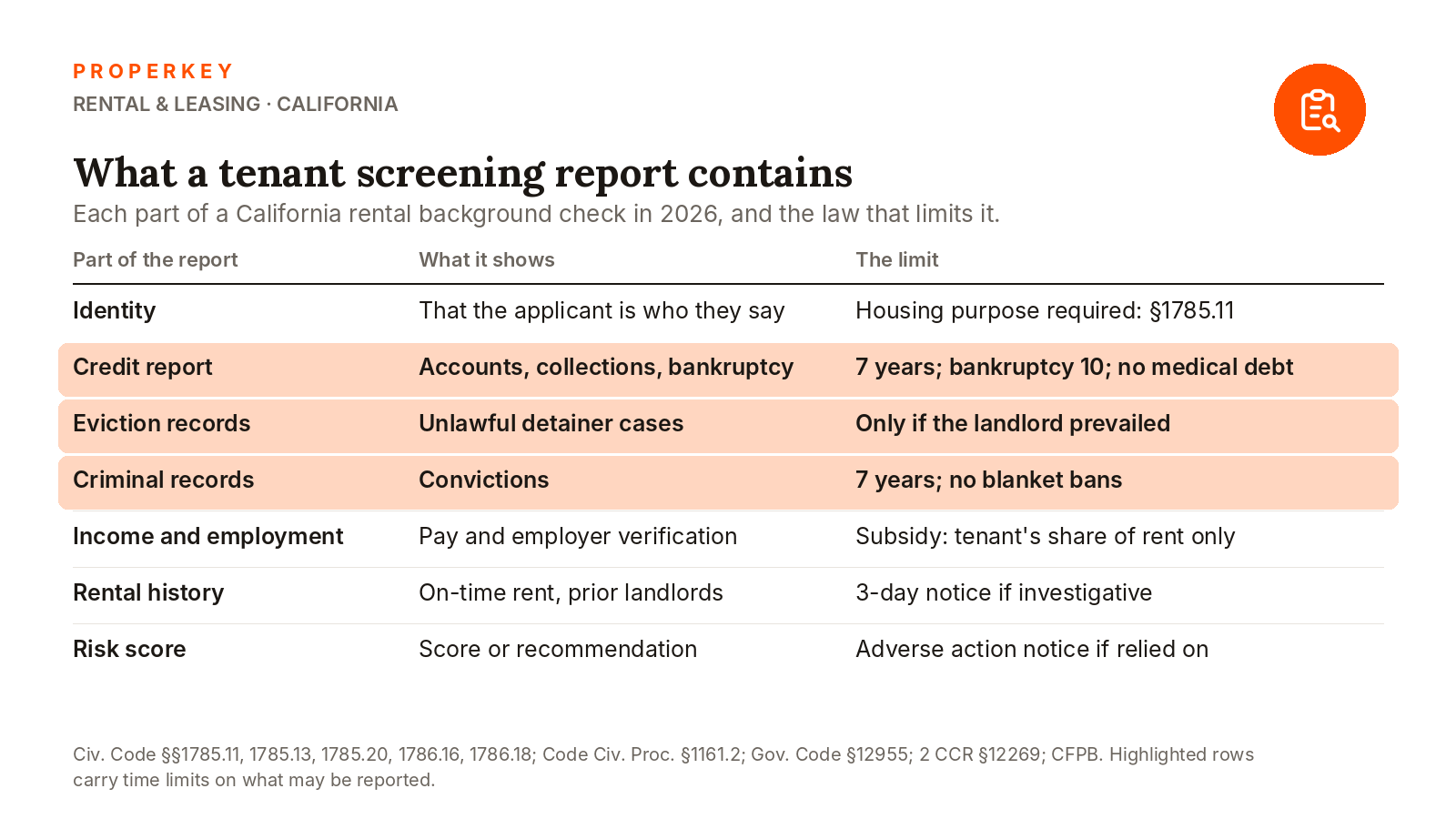
The CFPB's list of consumer reporting companies says tenant screening companies supply credit history, eviction information, rent payment history, identity verification, income and employment verification, and criminal background data. Its page on what a tenant screening report is adds one more item: a risk score or recommendation based on criteria the landlord selects. A landlord buys some or all of these as a package.
The Department of Real Estate's 2026 landlord-tenant guide adds that tenant screening services report whether a tenant paid rent on time or damaged a previous unit. Each part of the report is limited by a different law, set out in the table below.
Who produces the report, and who may order one?
Consumer reporting agencies. The CFPB describes the industry as hundreds of smaller regional companies and a few larger firms. No California statute tells a landlord which one to use.
California's Consumer Credit Reporting Agencies Act lets an agency furnish a credit report to someone who intends to use it in connection with the hiring of a dwelling unit (Civil Code §1785.11), and the Investigative Consumer Reporting Agencies Act has the same purpose test (§1786.12). The Federal Trade Commission's guidance for landlords says a landlord must certify to the company that the report will be used only for housing purposes.
The investigative act covers reports on a person's character, general reputation, personal characteristics or mode of living. When one is ordered for a rental, the landlord must notify the applicant in writing within three days of requesting it, name the agency, and provide a box to check to receive a copy, which is then due within three business days after the landlord gets the report (§1786.16).
How far back can the check go, and what must be left out?
Credit. A California credit report may not include collection accounts, charged-off accounts, paid tax liens or other adverse information more than seven years old, bankruptcies more than 10 years old, or medical debt of any age (Civil Code §1785.13).
Evictions. An unlawful detainer case may be reported only if the landlord was the prevailing party: a default judgment, summary judgment or judgment after trial, or a written settlement that says the case may be reported (§1785.13). The court file is restricted too. Under Code of Civil Procedure §1161.2, an eviction file is closed to the general public for 60 days after filing, and it opens afterward only if the landlord won judgment against every defendant within those 60 days or, later, by court order after a trial judgment for the landlord. Nonpayment cases filed between March 4, 2020 and September 30, 2021 are excluded from both of those openings.
Criminal records. California is stricter than federal law. The federal Fair Credit Reporting Act exempts convictions from its seven-year limit. California does not: arrests, indictments and convictions drop off seven years after disposition, release or parole, and an arrest may no longer be reported once it is learned that no conviction resulted (Civil Code §1786.18). The agency must also have verified any public record within the 30 days before it furnishes the report. How a landlord may use what remains is set by the Civil Rights Department's regulations, which forbid blanket bans (2 CCR §12269).
Income and credit for subsidized applicants. Under Government Code §12955, when there is a government rent subsidy the income standard must be based on the tenant's share of the rent, and a landlord who uses credit history must offer the option of other proof of ability to pay, such as benefit payments, pay records or bank statements.
What does a background check cost, and who pays?
Usually the applicant, through an application screening fee. Civil Code §1950.6 limits it to the landlord's actual out-of-pocket cost plus the reasonable value of the time spent, and never more than $30 per applicant as adjusted for inflation since 1998. The California Apartment Association puts the adjusted maximum at $65.86 as of December 2025. The DRE's 2026 guide still prints the December 2023 figure, $62.02. A guarantor or cosigner counts as an applicant.
The report itself costs less than the cap. The CFPB found in November 2022 that screening companies charged about $25 to $35 per report, and as much as $55. The landlord must give an itemized receipt, return any part of the fee not used, and charge nothing when the landlord knows no unit is available or soon will be. Since January 1, 2025 (AB 2493), a fee is allowed only if the landlord approves the first applicant who meets written criteria or refunds everyone not selected.
An applicant can avoid repeat fees with a reusable tenant screening report under Civil Code §1950.1: a report prepared within the previous 30 days by a consumer reporting agency at the applicant's request and expense, showing name, contact information, employment verification, last known address and eviction history. Landlords are not required to accept one. A landlord who does may not charge that applicant a screening fee or a fee to see the report.
How long does a tenant background check take?
The report itself is fast: the CFPB notes that screening platforms advertise near-instant turnaround times and quotes one large provider's promise of reports in minutes. No statute gives a landlord a deadline to decide, so the DRE guide suggests asking, before paying, how long the check and the decision will take.
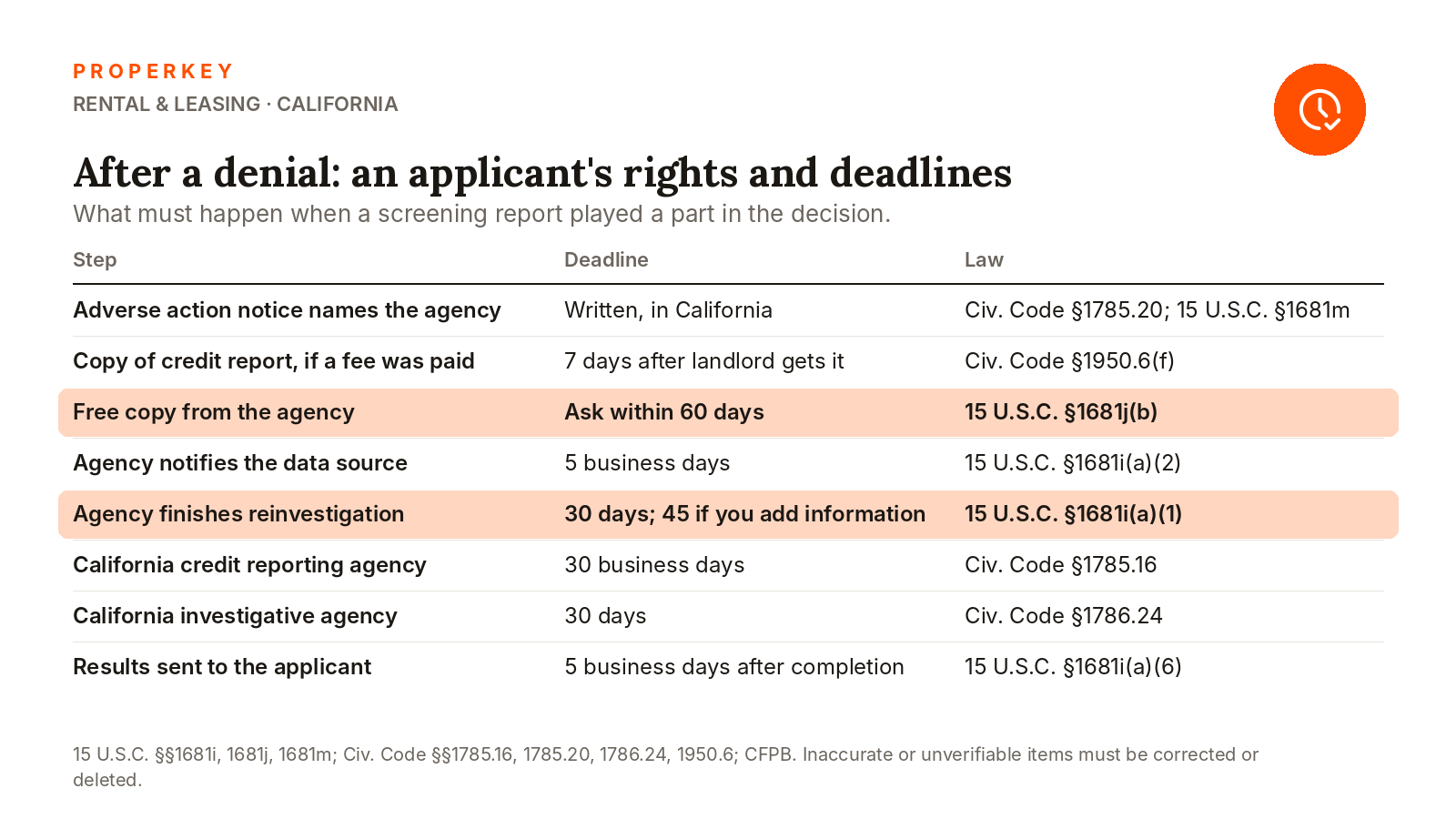
The law does set clocks around the report. If a screening fee was paid, the applicant must receive a copy of the consumer credit report within seven days of the landlord receiving it. And under the refund process, the fee comes back within seven days of the landlord choosing a tenant or 30 days of the application, whichever is first (§1950.6).
What are an applicant's rights after a denial?
If the report played any part in an unfavorable decision, the landlord owes an adverse action notice. The CFPB's page on denied rental applications counts more than a denial: requiring a cosigner, a larger deposit or higher rent than other applicants also qualifies. Federal law (15 U.S.C. §1681m) allows the notice to be oral, written or electronic. California requires it in writing when a credit report was used, with the agency's name, address and telephone number (Civil Code §1785.20), and §1786.40 requires the same identification for an investigative report.
The applicant then has 60 days to ask the agency for a free copy (15 U.S.C. §1681j). An error is disputed with the agency, not the landlord. The agency must notify the source of the information within five business days and finish its reinvestigation within 30 days, or up to 45 if the applicant sends more information during that period (15 U.S.C. §1681i). California sets 30 business days for a credit reporting agency (Civil Code §1785.16) and 30 days for an investigative agency (§1786.24). Anything found inaccurate, or that cannot be verified, must be corrected or deleted. The steps and deadlines are in the table below.
What does a compliant process look like for a landlord?
Hand out written screening criteria with the application.
Certify the housing purpose to the screening company, and give the three-day notice for an investigative report.
Charge no more than actual cost, within the cap, with an itemized receipt and the credit report copy within seven days.
Offer applicants with a rent subsidy the alternative to credit history.
Send a written adverse action notice whenever the report contributed to a denial or to tougher terms.
Dispose of reports securely; the FTC lists shredding paper and making electronic files unrecoverable.
A renter can prepare too: check the credit report for errors before applying, as the CFPB advises, and ask whether a reusable report will be accepted. The FTC's tenant background checks and your rights is a plain-language summary.
Owners who would rather hand the whole job to a manager can look at Properkey's property management: "Full service management for a 5% flat fee, no markups. One rental or a whole portfolio in California or Idaho." Owners who self-manage can use properkey.us/rent: "Put your rental on the local MLS yourself, for free." Related guides: the security deposit rules, whether a landlord has to accept Section 8, how long an eviction takes, the 2027 landlord law checklist and how to rent out a house in California.
Questions people ask
What background check do most landlords use? A tenant screening report bought from a consumer reporting agency. The CFPB says a standard report might include identity verification, credit history, criminal background records and eviction history. No California law requires a particular company or product.
How far back does a rental background check go in California? Seven years for most negative items, including collection accounts, eviction judgments and criminal convictions, and 10 years for bankruptcies (Civil Code §§1785.13 and 1786.18).
Will an eviction case show up if the tenant won or settled? It should not. An unlawful detainer may be reported only when the landlord prevailed or a written settlement says it may be reported, and the court file stays closed to the public unless the landlord won judgment.
This article is a general summary of consumer reporting and screening rules, not legal advice. Local ordinances can add limits; a landlord-tenant attorney should review a screening process, and a tenant-rights attorney or legal aid office can advise an applicant on a disputed report.
Sources: CFPB, Tenant Background Checks Market Report (November 2022); CFPB, list of consumer reporting companies; CFPB, What is a tenant screening report?; CFPB, denied rental applications; FTC, Using Consumer Reports: What Landlords Need to Know; FTC, Tenant Background Checks and Your Rights; 15 U.S.C. §1681c; §1681i; §1681j; §1681m; Civ. Code §1785.11; §1785.13; §1785.16; §1785.20; §1786.12; §1786.16; §1786.18; §1786.24; §1786.40; §1950.1; §1950.6; Code Civ. Proc. §1161.2; Gov. Code §12955; 2 CCR §12269; AB 2493 (2024); California Apartment Association, maximum screening fee; DRE, California Tenants guide, 2026 edition.
Written by Keyro, Properkey's AI. Properkey, DRE #01979718.