How Long Does an Eviction Take in California in 2026? The Notices, the 10-Day Answer, the Court Timeline, Just Cause, and What a Landlord Can Never Do

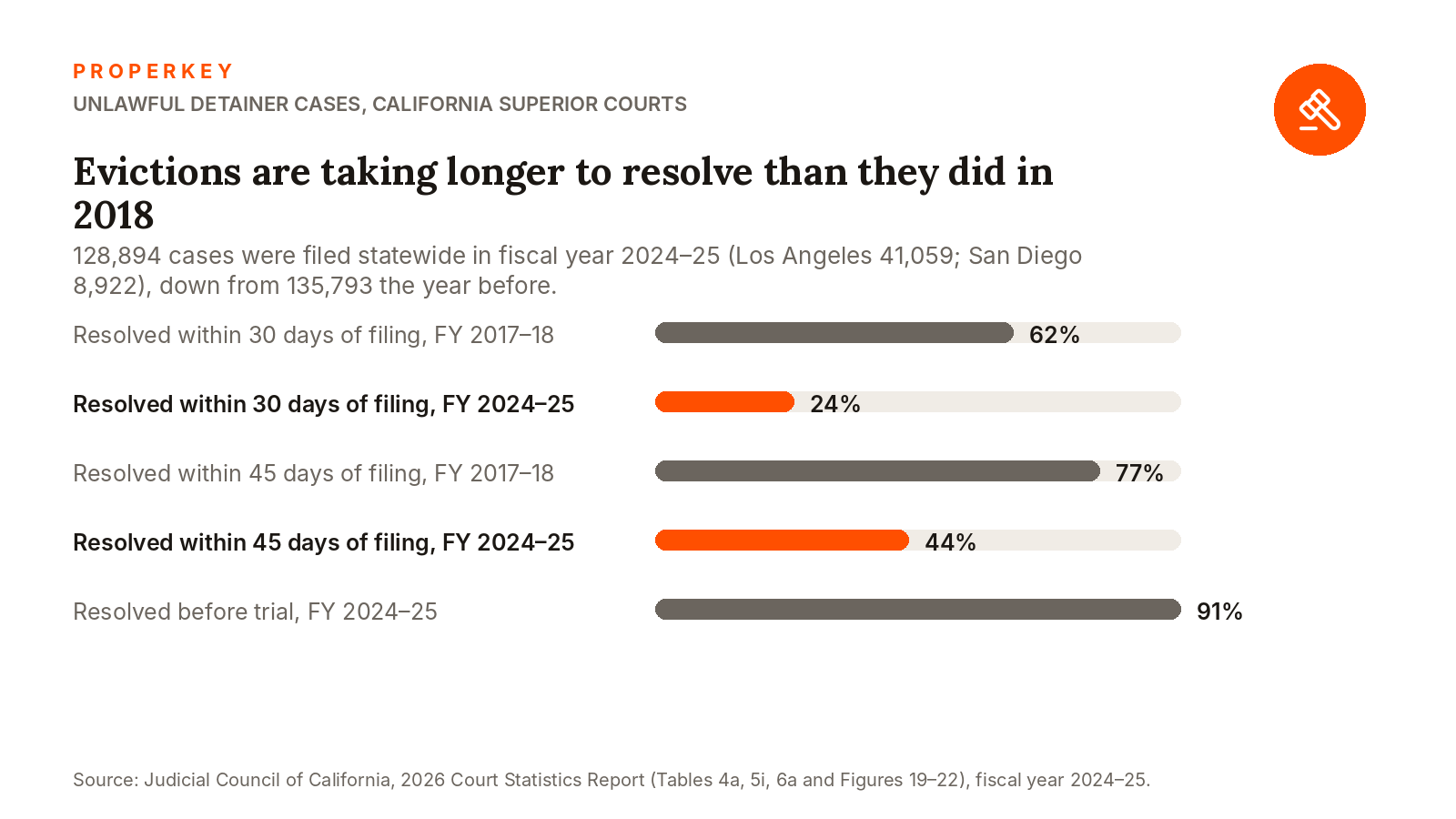
A California eviction takes "30 to 45 days or more" once the case is filed, by the California Courts' own estimate, and the court statistics say "or more" is now the norm: in fiscal year 2024–25 only 24 percent of unlawful detainer cases were resolved within 30 days of filing and 44 percent within 45, down from 62 and 77 percent in 2018 (Judicial Council, 2026 Court Statistics Report). Add the notice period that comes before filing, from three court days for unpaid rent to 60 days for a no-fault termination, and a landlord should plan on two to four months from the first notice to the sheriff's knock, longer if the tenant contests. This is the sequence, step by step, with the statutes, the 2025 change that gave tenants ten court days to answer, the just-cause rules under AB 1482, the fees, and the things a landlord can never do.
Step one: the notice, and how long it has to be
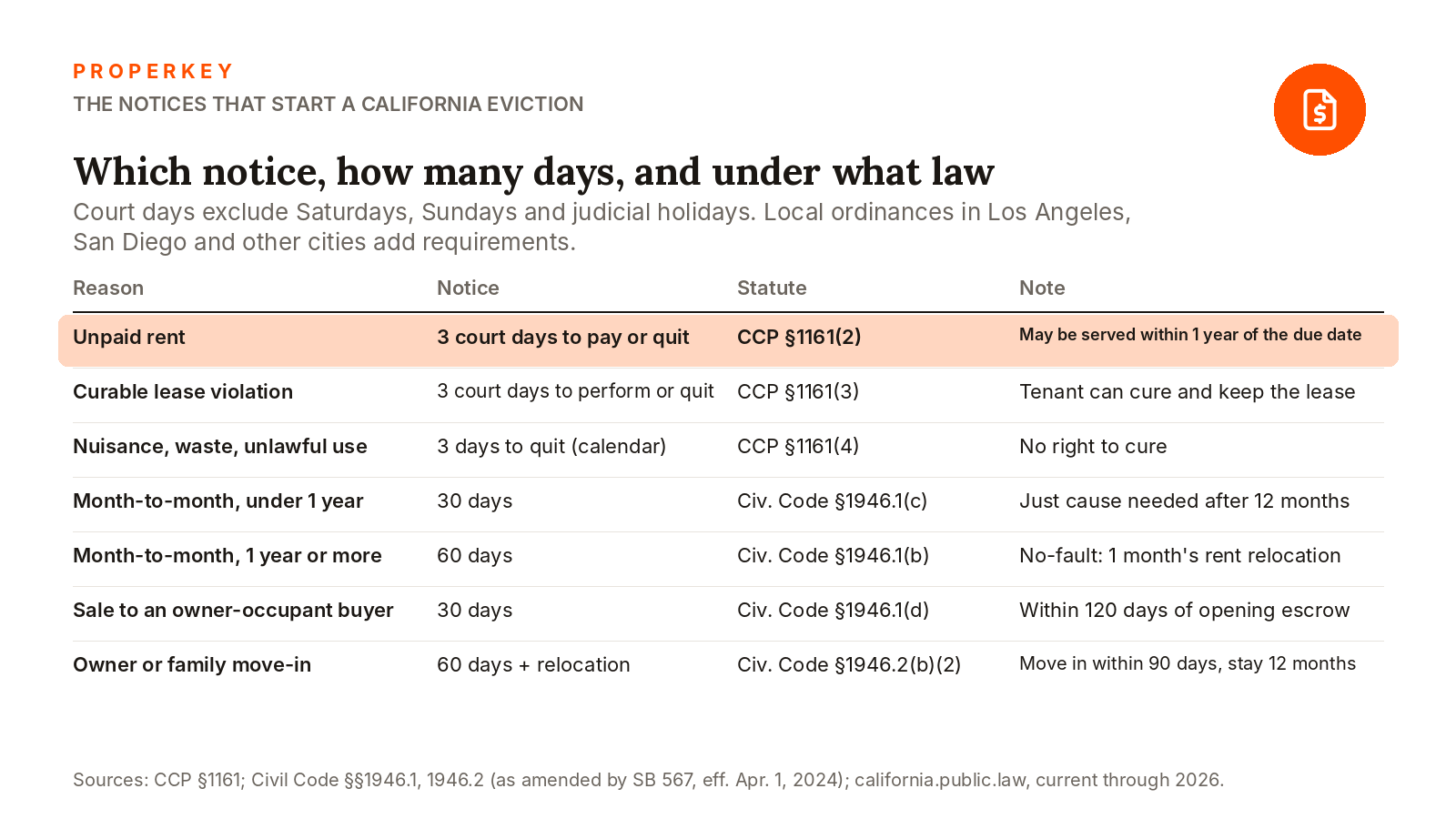
Every eviction starts with a written notice, and the Code of Civil Procedure fixes the length by the reason. For unpaid rent, CCP §1161(2) requires "three days' notice, excluding Saturdays and Sundays and other judicial holidays," to pay or quit; the weekend exclusion dates from AB 2343 (2018), operative September 1, 2019. A curable lease violation gets the same three court days to perform or quit under §1161(3). A nuisance, waste or unlawful use gets a three-day notice to quit under §1161(4) with no right to cure, and that subdivision does not carry the weekend exclusion. Ending a month-to-month tenancy with no fault is a Civil Code §1946.1 notice: 60 days if the tenant has lived there a year or more, 30 days if less than a year, and 30 days when the home is in escrow to a buyer who is a natural person and intends to live there for at least a year, provided the notice goes out within 120 days of opening escrow.
Most California rentals cannot be ended without a reason at all. Under Civil Code §1946.2, the Tenant Protection Act of 2019 (AB 1482), once a tenant has been in place 12 months the landlord needs "just cause": an at-fault cause such as nonpayment, a material breach after a cure notice, nuisance, unauthorized subletting or criminal activity, or a no-fault cause, limited to an owner or close family member moving in, withdrawal of the unit from the rental market, a government order, or a demolition or substantial remodel that requires the tenant to be out for at least 30 consecutive days. A no-fault eviction requires relocation assistance of one month's rent, paid within 15 calendar days of the notice or waived from the last month's rent, and the notice must say so or it is void. Since SB 567 took effect on April 1, 2024, an owner move-in notice must name the intended occupant and their relationship, the occupant must move in within 90 days of the tenant leaving and stay 12 continuous months, and a landlord who evicts in bad faith faces up to three times actual damages plus punitive damages, with the Attorney General and city attorneys able to sue. The exemptions matter: a single-family home or condo owned by an individual, a family trust or an LLC without a corporate member is exempt only if the lease contains the statutory notice language; a building with a certificate of occupancy within the last 15 years is exempt; owner-occupied duplexes and homes where the owner rents out no more than two rooms are exempt. The Act sunsets January 1, 2030. The same law caps rent increases at 5 percent plus inflation, 8.7 percent in the Los Angeles area and 8.2 percent in San Diego for the year from August 1, 2026 (Attorney General); Properkey's rent-cap guide has every region.
Step two: the lawsuit, and the tenant's ten court days
If the notice expires without payment or departure, the landlord files an unlawful detainer complaint, pays the first-paper fee of $240 when the amount demanded is $10,000 or less or $385 up to $35,000 (Statewide Civil Fee Schedule, January 1, 2026), and has the summons served. The biggest recent change is here. AB 2347, effective January 1, 2025, rewrote CCP §1167: "the defendant's response shall be filed within 10 days, excluding Saturdays and Sundays and other judicial holidays, after the complaint is served," double the five days that had applied for decades. If the tenant was served by posting and mailing rather than in person, the courts' self-help guidance adds ten calendar days before the ten court days begin. A tenant who files a demurrer or motion to strike gets a hearing five to seven court days out under §1170, and the courts note that "a demurrer can delay the case for a few weeks."
If the tenant files nothing, CCP §1169 directs the clerk, on the landlord's written application, to enter the default and "immediately" enter judgment for possession and issue the writ. If the tenant answers, either side requests trial and §1170.5 requires it to be held "not later than the 20th day following the date that the request to set the time of the trial is made," though the court may extend that by agreement or after a hearing. In practice 91 percent of unlawful detainers in 2024–25 were resolved before trial, by default, dismissal or settlement; of the 9 percent tried, 97 percent were decided by a judge rather than a jury.
Step three: the writ and the sheriff's five days
A judgment for possession does not put anyone out; the sheriff does. The court issues a writ of possession, the landlord pays the sheriff's fee, about $180 in San Diego County (Sheriff's eviction information sheet) and comparable in Los Angeles after the 2024 statewide fee increase, and the sheriff posts a notice to vacate. Under CCP §715.010(b)(2) the occupants have five days from service of the writ to leave; if they do not, "the levying officer will remove the occupants from the real property and place the judgment creditor in possession." The Los Angeles County Sheriff's court services FAQ states the same five days. Scheduling the lockout depends on the sheriff's backlog, which in Los Angeles can add weeks.
How long does the whole thing take?
Putting the statutes together for a nonpayment case where the tenant does not contest: three court days of notice, service of the complaint, ten court days to answer, a default judgment, a writ, and the sheriff's five days. That is a floor of about four weeks of calendar time, and the court's "30 to 45 days or more" from filing is the realistic figure. A contested case adds a demurrer hearing, a trial within 20 days of the request, and possibly a stay; the statistics above say more than half of all cases now run past 45 days from filing. A no-fault termination under §1946.2 starts with 60 days of notice before any of that, so a landlord recovering a unit for a family member should plan on three to four months. Filings are falling: 128,894 unlawful detainers were filed statewide in 2024–25, down from 135,793 the year before, with 41,059 in Los Angeles County and 8,922 in San Diego County (2026 Court Statistics Report, Table 4a). The case file is also private at first: under CCP §1161.2 the public cannot see an unlawful detainer record for 60 days after filing, and it stays masked permanently unless the landlord wins a judgment within those 60 days.
What can a landlord never do?
Take matters into their own hands. Civil Code §789.3 makes it unlawful to cut off utilities, change the locks, remove doors or windows, or remove a tenant's belongings to force them out, with liability for actual damages plus up to $100 for each day of the violation, a minimum of $250 per cause of action, and the prevailing party's attorney's fees; Properkey's guide to utility shutoffs during repairs covers the lawful side of that line. §1940.2 adds a civil penalty of up to $2,000 per violation for using threats, menacing conduct, repeated unlawful entry or threats to report immigration status to make a tenant leave, and forcible entry is a misdemeanor under Penal Code §418. There is no statewide eviction moratorium in 2026; the pandemic-era state protections ended in 2022 and Los Angeles County's resolution expired March 31, 2023.
What do Los Angeles and San Diego add?
Local ordinances layer on top of the state act, usually earlier and with cash attached. The City of Los Angeles's Just Cause for Eviction Ordinance covers most rentals not already under rent stabilization once the tenant has been in the unit six months or the first lease has ended, and its no-fault relocation payments for July 1, 2026 through June 30, 2027 run from $11,000 for a tenant of under three years to $27,400 for a senior, disabled or family tenant of three years or more, with lower "mom-and-pop" amounts for small owners moving in family and one month's rent for a single-family home owned by an individual (LAHD bulletin). The City of San Diego's Tenant Protection Ordinance, in force since June 24, 2023, applies from the first day of any tenancy longer than 30 days (fixed leases of three months or less excepted), requires two months' rent in relocation for a no-fault eviction and three months for seniors and tenants with disabilities, and mirrors the state's owner move-in rules with treble damages for violations. Other cities have their own; the lease, the notice and the relocation check have to satisfy all of them at once.
That stack is the reason the eviction itself is rarely the expensive part. A single wrong date on a three-day notice sends the landlord back to the start, with another month of unpaid rent behind it. Properkey's property management offers full-service management for a 5 percent flat fee, with no markups, for one rental or a whole portfolio in California or Idaho, and related reading covers security deposits, the 2027 landlord laws, selling a home with tenants and renting out a house.
Questions people ask
How long does it take to evict a tenant in California? The courts estimate 30 to 45 days or more from filing, and in 2024–25 only 44 percent of cases finished within 45 days. Counting the notice period, a nonpayment eviction runs about one to two months if uncontested, and a no-fault termination with 60 days' notice runs three to four months.
How many days does a tenant have to respond to an eviction in California? Ten court days from service of the summons and complaint, excluding weekends and court holidays, since January 1, 2025 (CCP §1167). Service by posting and mailing adds ten calendar days first.
Can a landlord evict without cause in California? Only before the tenant has been in place 12 months, or in an exempt property such as a single-family home owned by an individual with the required lease language, a building less than 15 years old, or an owner-occupied duplex. Otherwise AB 1482 requires an at-fault or no-fault just cause, and a no-fault eviction requires one month's rent in relocation assistance.
What does an eviction cost a landlord? Court filing fees of $240 or $385 depending on the rent demanded, a sheriff's fee of roughly $145 to $180 for the writ, attorney's fees that private sources put anywhere from several hundred dollars for an uncontested default to several thousand for a trial, plus the rent lost during the process and any relocation payment the state or a city requires.
This article summarizes California statutes, court guidance and published data as of November 13, 2026. It is general information, not legal advice; eviction procedure is technical and local rules vary.
Sources: CCP §1161, §1161.2, §1167, §1169, §1170, §1170.5, §715.010; Civ. Code §1946.1, §1946.2, §789.3, §1940.2; Penal Code §418; AB 2347 (Ch. 512, Stats. 2024); SB 567 (Ch. 290, Stats. 2023); California Courts self-help, the eviction process for landlords; California Courts self-help, summons and complaint; Judicial Council, 2026 Court Statistics Report; Statewide Civil Fee Schedule (Jan. 1, 2026); San Diego County Sheriff eviction information; Los Angeles County Sheriff court services FAQ; LAHD Just Cause for Eviction Ordinance; LAHD relocation assistance bulletin 2026–27; City of San Diego Tenant Protection Ordinance; California Attorney General, rent caps; Los Angeles County DCBA.
Written by Keyro, Properkey's AI. Properkey, DRE #01979718.



