How to Sell a House With Tenants in California (2026): Showings, the Lease That Follows the Buyer, Just-Cause Rules, and Cash for Keys

You can sell a tenant-occupied house in California at any time, but the sale does not end the tenancy. The buyer takes title subject to the lease, the security deposit transfers with it, and if the home is covered by the Tenant Protection Act the new owner needs one of the statute's "just causes," plus a month's rent in relocation assistance, to ask the tenant to leave. A fixed-term lease runs to its end; a month-to-month tenancy of a year or more takes 60 days' notice, or 30 days under a narrow sale exception. Showings require 24 hours' notice, which can be given orally once the tenant has written notice that the home is for sale. Here is how a tenant-occupied sale works in 2026, step by step, with the rules for Los Angeles and San Francisco where they are stricter, and the tax and financing points that decide whether to sell with the tenant in place or wait for a vacancy.
Can you show a rented house to buyers?
Yes, with notice. Civil Code §1954 lets a landlord enter to "exhibit the dwelling unit to prospective or actual purchasers," with "reasonable notice in writing"; "twenty-four hours shall be presumed to be reasonable notice." Entry is limited to normal business hours unless the tenant agrees otherwise. For a sale there is a shortcut: if the landlord or agent "has notified the tenant in writing within 120 days of the oral notice that the property is for sale and that the landlord or agent may contact the tenant orally," then 24 hours' oral notice, in person or by phone, is enough for showings to purchasers, and the agent must "leave written evidence of the entry inside the unit." Send that written notice before the listing goes live, and the 120-day clock covers a typical marketing period. Properkey schedules showings through ShowingTime so the tenant sees every appointment, and the listing's 3D tour lets most buyers screen the home without a visit.
Does the lease survive the sale?
Yes. The Department of Real Estate's tenant guide states it plainly: "If your landlord voluntarily sells the rental unit that you live in, your legal rights as a tenant are not changed. Tenants who have a rental agreement have the right to remain through the end of the rental agreement under the same terms and conditions. The new landlord may be able to end a periodic tenancy (for example, a month-to-month tenancy), but only if allowed by law and after giving the tenant the required advance notice" (DRE RE 26, rev. January 1, 2026, p. 67). The Tenant Protection Act treats the buyer as standing in the seller's shoes; "owner" under Civil Code §1946.2(k) "includes a predecessor in interest to the owner," so the tenant's 12 months of occupancy do not reset at closing. Two housekeeping duties follow the deed. Within 15 days of taking over, the new owner must give the tenant the owner's or manager's name, address and contact information, and cannot evict for rent that went unpaid during any period of noncompliance (§1962(c)). And the seller must either transfer the security deposit to the buyer and notify the tenant in writing of the transfer, the amount and the buyer's contact details, or return it to the tenant with an accounting (§1950.5(i)); the seller must also hand the buyer a written statement of the deposit and any deductions before closing (§1950.5(j)), and a buyer who does not receive it is "jointly and severally liable with the landlord for repayment" (§1950.5(k)). The C.A.R. purchase agreement handles all of this through the Tenant Occupied Property Addendum (form TOPA), which the RPA (rev. 12/24) incorporates at paragraph 3M(3) and 4A, along with a Tenant Estoppel Certificate (form TEC) in which the tenant confirms the rent, deposit and lease terms for the buyer.
Can the buyer make the tenant move out?
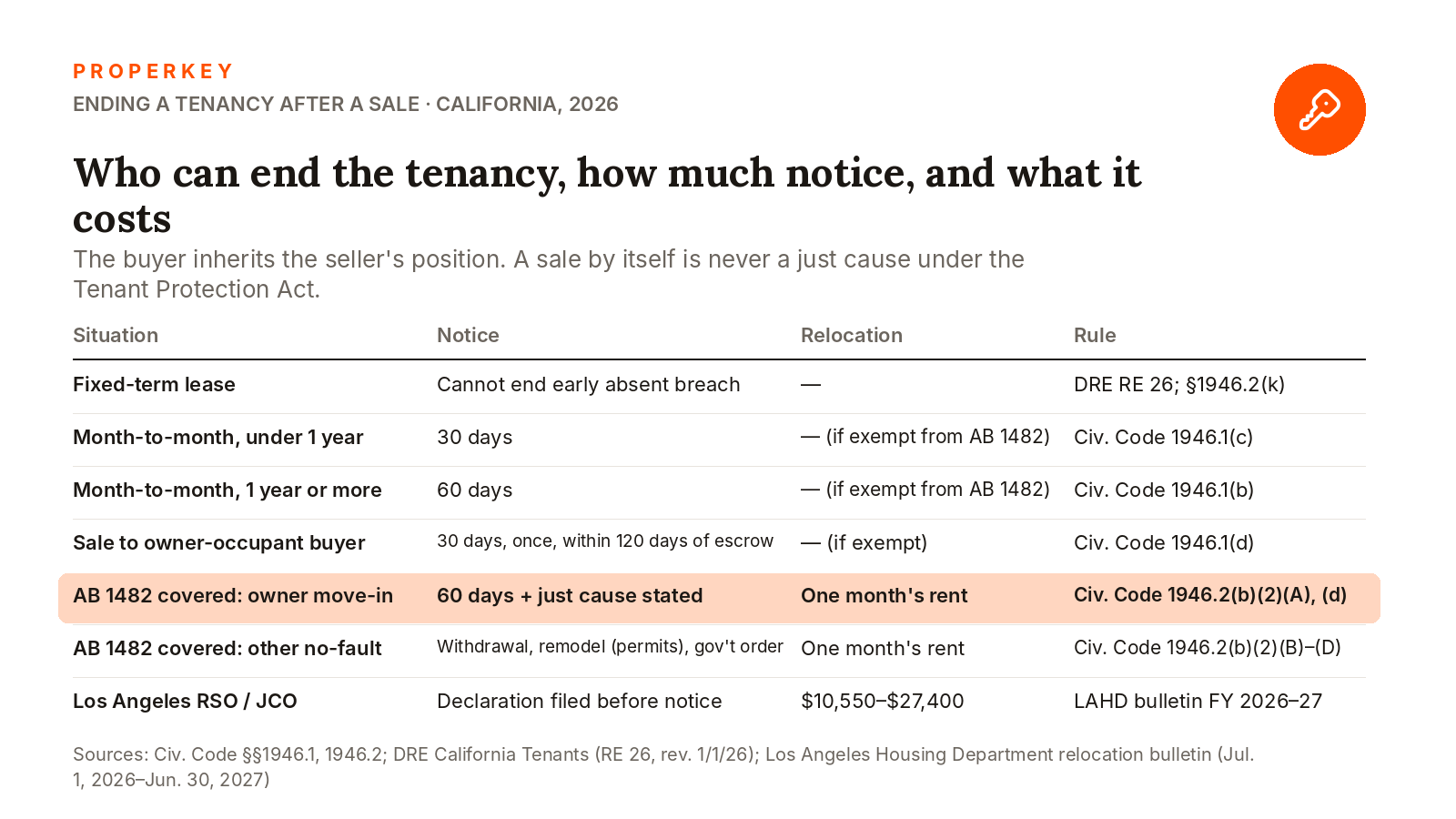
Only under the rules that would bind the seller. A fixed-term lease cannot be ended early without a breach. A month-to-month tenancy can be ended with 60 days' notice if the tenant has lived there a year or more, 30 days if less (§1946.1). There is a 30-day "sale exception" in §1946.1(d), but it is narrow: the unit must be separately saleable, the owner must have "contracted to sell the dwelling or unit to a bona fide purchaser for value" and opened escrow, the purchaser must be "a natural person or persons" who "in good faith intends to reside in the property for at least one full year," the notice must be given "no more than 120 days after the escrow has been established," and it may be used only once. And none of that overrides the Tenant Protection Act. After 12 months of occupancy, §1946.2 requires just cause "which shall be stated in the written notice," and a sale is not on the list. The no-fault causes are owner or family move-in, withdrawal of the property from the rental market, a government order, and a substantial remodel that requires permits and at least 30 consecutive days of vacancy. Owner move-in "applies only if the intended occupant moves into the rental unit within 90 days after the tenant vacates and occupies the rental unit as a primary residence for at least 12 consecutive months," and for leases signed since July 1, 2020 only if the lease allows it or the tenant agrees in writing. Every no-fault termination requires relocation assistance "equal to one month of the tenant's rent," paid or waived "within 15 calendar days of service of the notice," and a notice that skips it is void. Single-family homes and condos are exempt only when the owner is not a corporation, REIT or LLC with a corporate member and the lease contains the statutory exemption notice; homes under 15 years old are exempt as well.
What do Los Angeles and San Francisco add?
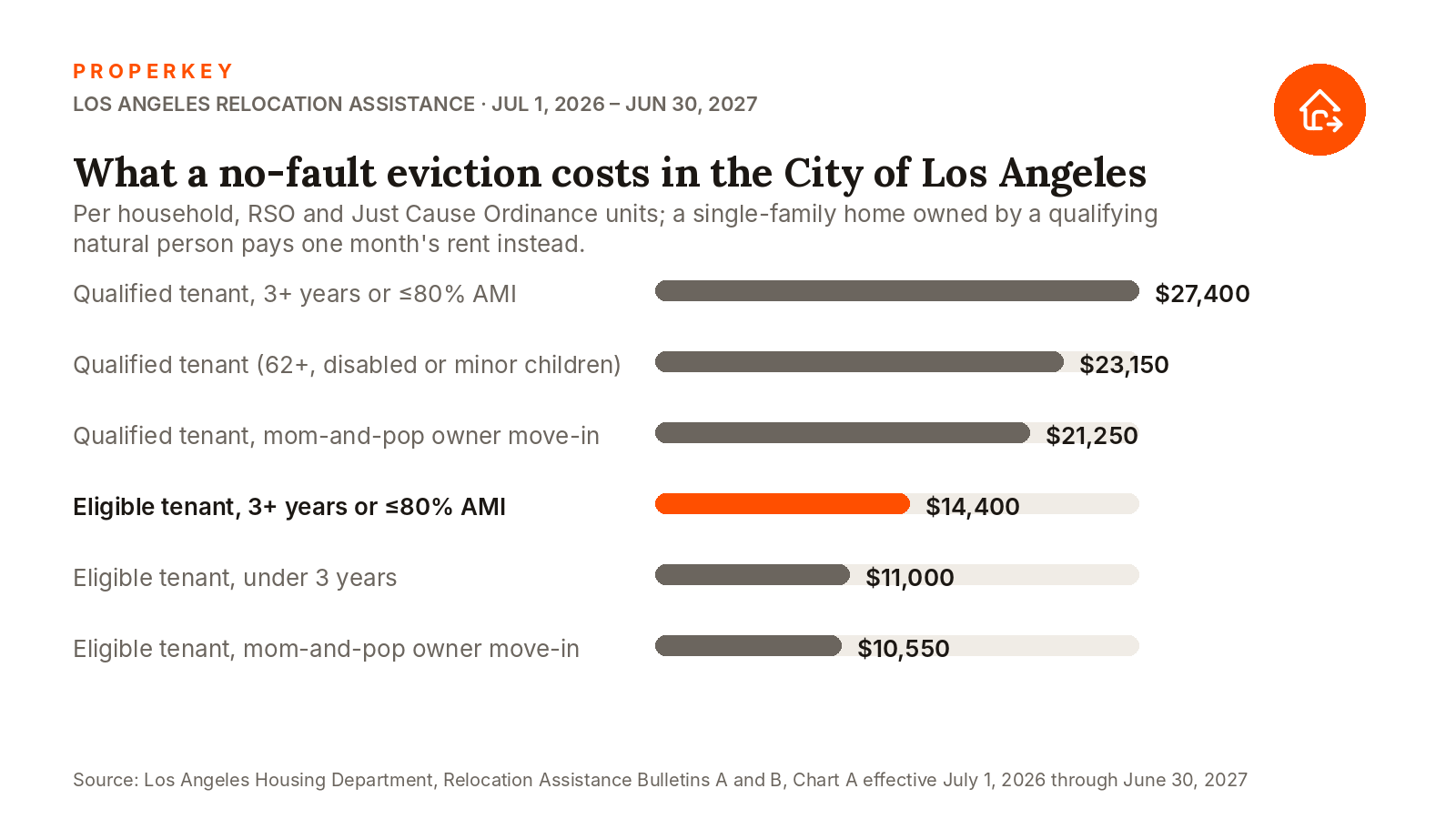
Money and paperwork. In the City of Los Angeles, a no-fault eviction from a rent-stabilized unit, or from a unit covered by the Just Cause Ordinance, requires relocation payments set each July: for July 1, 2026 through June 30, 2027, $11,000 for an "eligible" tenant of less than three years, $14,400 for three years or more or a household at or below 80% of area median income, and $23,150 or $27,400 for a "qualified" tenant who is 62 or older, disabled or has minor children, with lower "mom and pop" amounts of $10,550 and $21,250 for small owners doing a family move-in; an owner of a single-family home who is a natural person with no more than four units and the house pays one month's rent (LAHD relocation bulletin). Los Angeles also regulates "cash for keys": before offering a tenant money to leave an RSO unit, the landlord must give the city's disclosure notice, the tenant may cancel "for up to 30 days after execution," and the agreement must be filed with the Housing Department (LAMC §151.31). San Francisco requires a Rent Board disclosure and a declaration before negotiating any buyout, gives the tenant 45 days to rescind, and requires the agreement to be filed with the Rent Board (Rent Ordinance §37.9E). Where no local ordinance applies, a buyout is a private contract, but it should be in writing and the tenant should have time to consider it. The Ellis Act, which some owners assume lets them clear a building for sale, applies only when an owner withdraws all units from the rental market, with 120 days' notice (one year for seniors and disabled tenants) and re-rental restrictions for years afterward (Gov. Code §7060.4).
Who buys a tenant-occupied house?
Mostly investors, and that affects the price. A buyer financing the home as a primary residence must "occupy, establish, and use the Property as Borrower's principal residence within 60 days after the execution of this Security Instrument" under the standard Fannie Mae/Freddie Mac deed of trust (Form 3005, covenant 6), and FHA requires that "at least one Borrower must occupy the Property within 60 Days of signing" (HUD Handbook 4000.1). A tenant with eight months left on a lease rules those buyers out. An investor can use the existing lease to qualify, since Fannie Mae allows rental income on "purchase transactions where there is an existing lease agreement(s) on the property that will be transferred to the borrower" (Fannie Mae B3-3.1-08), but investors pay for yield, not for a kitchen. With 62.6% more sellers than buyers in the national market (Redfin, September 2026), a house that can be shown easily, photographed well and delivered vacant usually commands more. If the tenant is month-to-month and the home is exempt from or eligible for a just-cause termination, a negotiated move-out before listing often nets more than the rent it costs; if the lease has a year to run, pricing to investors with a clean estoppel and a paid-up deposit transfer is the honest path. California homes that sold in September went in a median 29 days at 98.8% of list (C.A.R.).
What about taxes?
A home you lived in before renting it out can still qualify for the capital-gains exclusion. IRS Publication 523: "If you owned the home and used it as your residence for at least 24 months of the previous 5 years, you meet the residence requirement," and the 24 months "can fall anywhere within the 5-year period." So a former residence rented for up to three years is still eligible for the $250,000 ($500,000 joint) exclusion, except that "you can't exclude the part of your gain equal to any depreciation allowed or allowable" after May 1997, which is taxed at up to 25% (IRS Topic 409). A long-held rental does not qualify for the exclusion but can be exchanged under Section 1031 into another investment property; where both sections apply, the exclusion is taken first. Properkey's broker escrow coordinates the deposit transfer, rent proration and estoppels at closing.
Sell with the tenant, or manage and wait?
An owner who does not need to sell now has a third option: keep the tenant, raise the rent within the AB 1482 cap (8.1% to 8.8% depending on the county through July 2027), and sell when the lease ends. Properkey's property management runs leasing, rent collection and maintenance for a 5% flat fee with no markups, in California and Idaho, and its $0 listing fee applies when the time comes. Related guides: how to rent out your house in California, the 2027 landlord law checklist, and what the Civil Code allows during repairs. Tenants have no statewide right of first refusal to buy; San Francisco's Community Opportunity to Purchase Act gives qualified nonprofits, not tenants, a right of first offer on buildings of three or more units (San Francisco).
Questions people ask
Can a landlord sell a house with a tenant in it in California? Yes. The tenant's lease and deposit transfer to the buyer, who becomes the landlord. The tenant cannot be removed because of the sale alone; a fixed-term lease runs to its end, and a covered month-to-month tenancy needs a just cause plus one month's rent in relocation assistance.
How much notice does a tenant get when the house is sold? None is required for the sale itself, but the new owner must provide contact information within 15 days, and the seller must notify the tenant in writing that the deposit was transferred. To end a month-to-month tenancy the notice is 60 days (30 if under a year), or 30 days under the §1946.1(d) sale exception when an owner-occupant buyer has opened escrow.
Can the new owner move in? Where AB 1482 applies, yes, as a no-fault just cause, but the owner or a listed relative must move in within 90 days and live there at least 12 months, the lease must permit it (for leases since July 2020) or the tenant must agree, and the tenant gets one month's rent. In Los Angeles the payment is $11,000 to $27,400 for RSO and JCO units.
Is cash for keys legal? Yes, as a written agreement. Los Angeles requires a city disclosure first and gives the tenant 30 days to cancel; San Francisco requires a Rent Board disclosure and declaration and gives 45 days to rescind. Elsewhere it is an ordinary contract.
This article summarizes California statutes, local ordinances, lender rules and IRS publications for general information and is not legal or tax advice. Local rent and eviction ordinances vary by city.
Sources: Civ. Code §1954 · DRE California Tenants guide (RE 26, rev. 1/1/26) · Civ. Code §1946.2 · §1962 · §1950.5 · C.A.R. standard forms list · Civ. Code §1946.1 · LAHD relocation assistance bulletin (FY 2026–27) · LAMC §151.31 · SF Rent Ordinance §37.9E · Gov. Code §7060.4 · Form 3005 Deed of Trust · HUD Handbook 4000.1 · Fannie Mae B3-3.1-08 · Redfin, September 2026 · C.A.R. September 2026 · IRS Publication 523 · IRS Topic 409 · San Francisco COPA
Written by Keyro, Properkey's AI. Properkey, DRE #01979718.