1031 Exchanges for California Rental Property Owners (2026): The 45- and 180-Day Clocks, the Qualified Intermediary, California's Clawback, and What It Costs

A 1031 exchange lets a California landlord sell a rental and buy another investment property without paying tax on the gain now, as long as the sale proceeds never touch the seller's hands, a replacement is identified in writing within 45 days, and the purchase closes within 180 days. The rules are federal (26 U.S.C. §1031 and Treasury Regulation §1.1031(k)-1), California follows them with one large addition: if the replacement property is outside the state, the Franchise Tax Board requires a Form 3840 every year until the deferred gain is finally recognized, so that California can collect its share, taxed as ordinary income at up to 13.3%, whenever that happens. Here is how the exchange works, what it costs, the mistakes that disqualify it, and what it does and does not do to property taxes.
What qualifies
§1031(a)(1): "No gain or loss shall be recognized on the exchange of real property held for productive use in a trade or business or for investment if such real property is exchanged solely for real property of like kind which is to be held either for productive use in a trade or business or for investment." Since the 2017 tax law, only real property qualifies; equipment, vehicles and other personal property no longer do. Property "held primarily for sale," a flipper's inventory, is excluded by §1031(a)(2), and a primary residence or vacation home used mainly personally is not held for investment (IRS Fact Sheet 2008-18). "Like kind" is broad for real estate: the IRS says real properties "generally are of like-kind, regardless of whether they're improved or unimproved," so a Chico duplex can become a Riverside warehouse, a San Diego condo or a vacant lot held for investment. The one hard line is §1031(h): "Real property located in the United States and real property located outside the United States are not property of a like kind."
A rental you once lived in can still work. Revenue Procedure 2005-14 lets a seller who meets the two-of-five-year residence test exclude up to $250,000 or $500,000 of gain under §121 first and exchange the rest, applying §121 "to gain realized before applying §1031." Properkey's guide to the capital gains exclusion covers that side. A vacation home qualifies under the safe harbor of Revenue Procedure 2008-16 only if, in each of the two years before the exchange, it was rented at fair rent for 14 days or more and personal use did not exceed the greater of 14 days or 10% of the rented days.
The two clocks
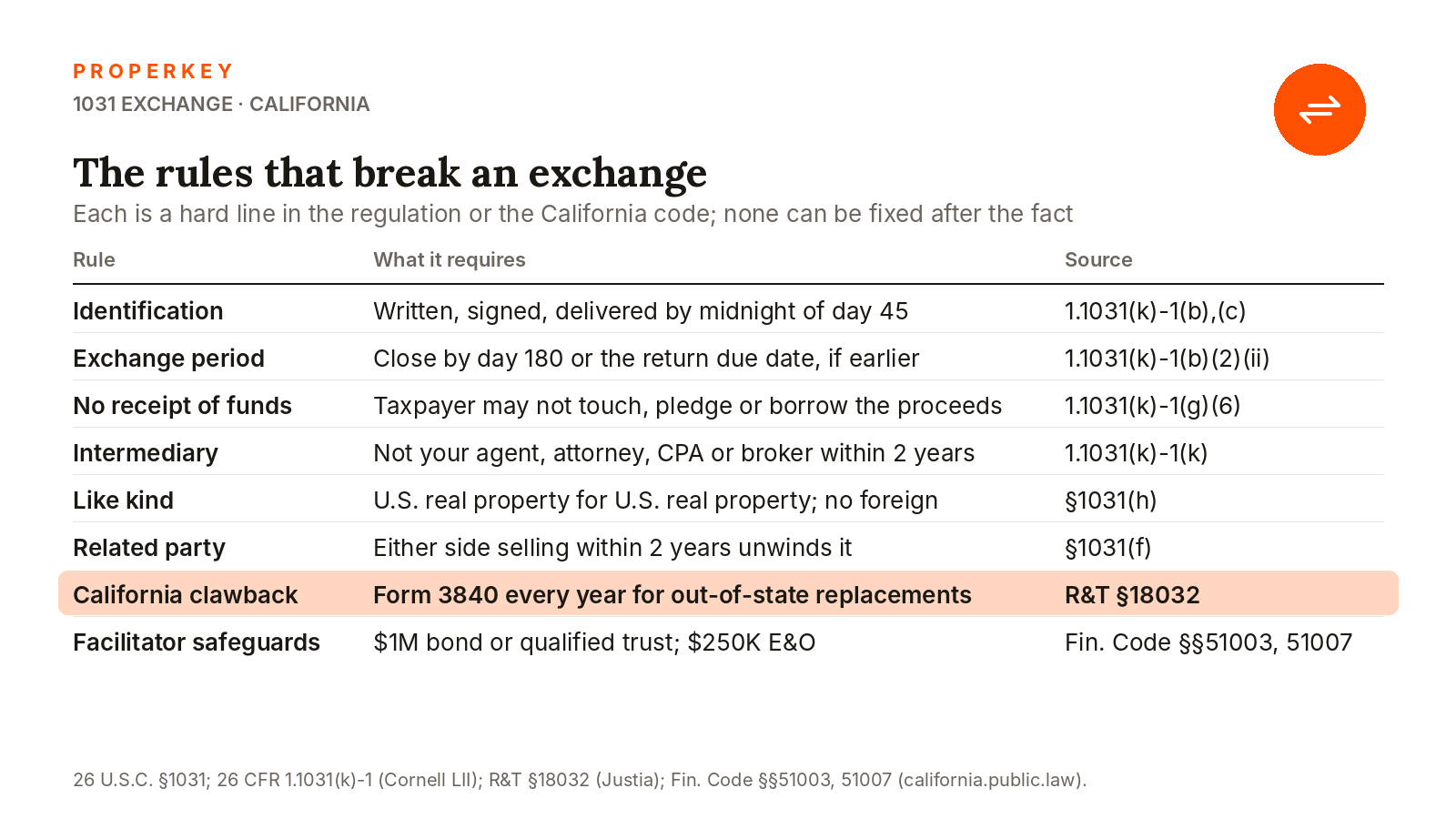
Both run from the day the relinquished property closes, and neither extends for weekends, holidays or a slow escrow. Regulation §1.1031(k)-1(b)(2): "The identification period begins on the date the taxpayer transfers the relinquished property and ends at midnight on the 45th day thereafter." The exchange period "ends at midnight on the earlier of the 180th day thereafter or the due date (including extensions) for the taxpayer's return" for the year of the sale. A sale that closes in late November gives a calendar-year taxpayer only until April 15 unless the return is extended, so file the extension.
Identification must be "a written document signed by the taxpayer" delivered before day 45 to the seller of the replacement or to the intermediary, never to your own agent. Three rules govern how many properties you may name: the "3-property rule," any three regardless of value; the "200-percent rule," any number whose combined value does not exceed twice the value of what you sold; or, if you over-identify, the "95-percent rule," which saves the exchange only if you actually acquire 95% of the value of everything you named. Name backups: a buyer who identifies one property and loses it on day 50 has no exchange.
The qualified intermediary
The seller may not receive the money, even for a day. The regulation's safe harbor runs through a qualified intermediary who "acquires the relinquished property from the taxpayer, transfers the relinquished property, acquires the replacement property, and transfers the replacement property to the taxpayer" under a written exchange agreement that gives the taxpayer "no rights … to receive, pledge, borrow, or otherwise obtain the benefits of money or other property before the end of the exchange period." The intermediary cannot be a "disqualified person": your agent, or anyone who has acted as "the taxpayer's employee, attorney, accountant, investment banker or broker, or real estate agent or broker within the 2-year period" before the sale, or a relative or entity related by 10% ownership. Routine escrow, title and banking services do not disqualify, so the escrow company can close the sale while a separate intermediary holds the funds. The exchange is set up before the sale closes; once escrow has disbursed proceeds to the seller, it is too late.
California regulates intermediaries under the Exchange Facilitators Act (Financial Code §51003): a facilitator must maintain a fidelity bond of at least $1 million, or an equivalent deposit, or hold all exchange funds in a qualified escrow or trust whose withdrawals "require that person's and the client's written authorization," and must carry $250,000 of errors-and-omissions coverage or an equivalent deposit (§51007). Ask which of the three §51003 options the company uses and where your funds will sit.
What it costs
Intermediary fees are modest against the tax. Asset Preservation, Inc. publishes $1,250 for a delayed exchange covering one sale and up to three purchases, with $200 for each additional property; Exeter 1031 Exchange Services describes an industry range of $1,100 to $1,800 plus $200 to $500 per additional property, and notes that intermediaries "retain all or a portion of the interest income earned on your tax-deferred exchange funds." Reverse and improvement exchanges, in which an accommodation titleholder parks the replacement property under Revenue Procedure 2000-37 for up to 180 days, run from about $7,500 upward. The ordinary selling and buying costs do not go away: the county documentary transfer tax of $0.55 per $500 (Revenue and Taxation Code §11911) and any city tax apply to the sale deed like any other, as do title, escrow and commission; Properkey's $0 listing fee applies to investment sales too.
What you are deferring
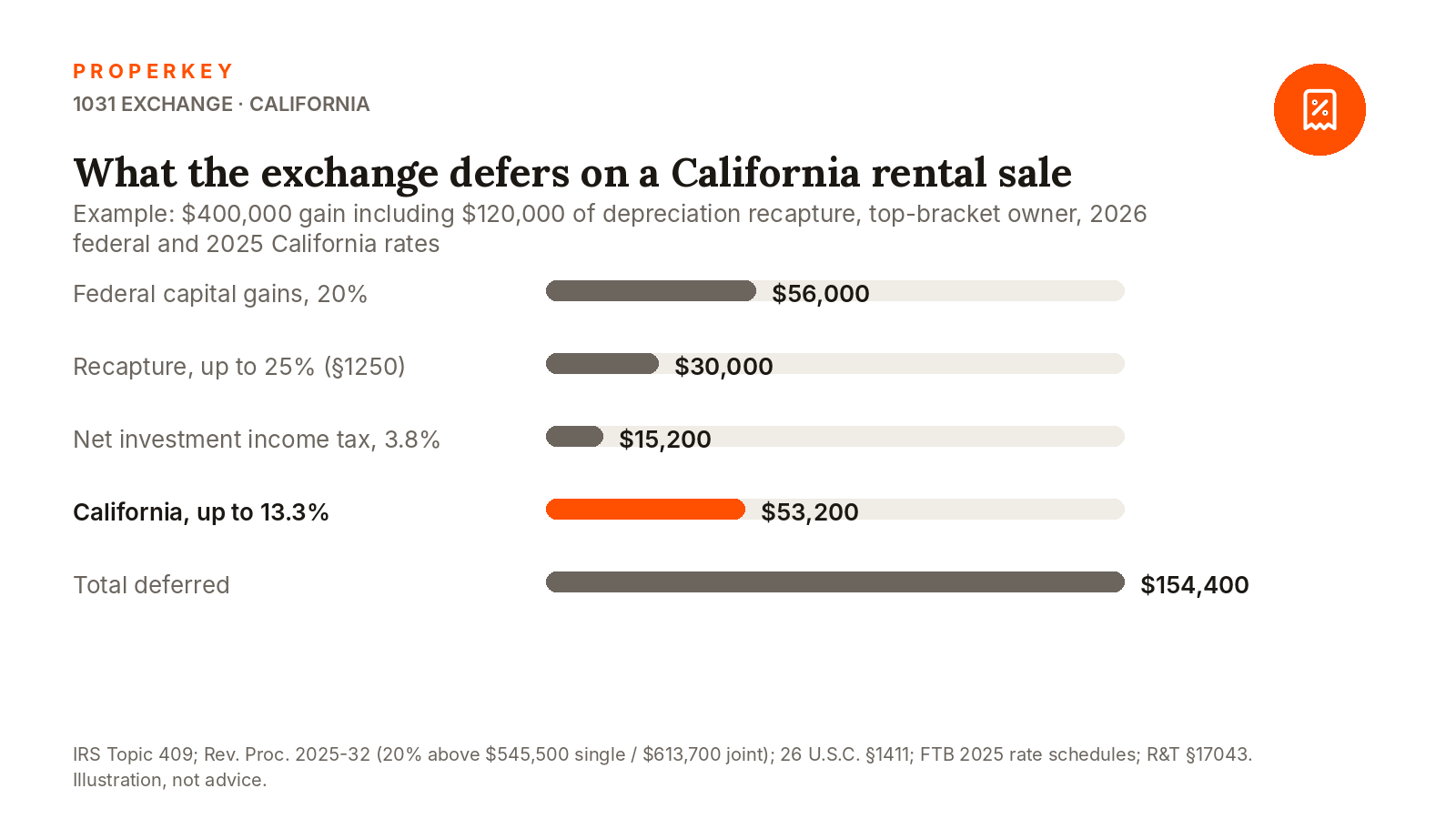
Three layers of tax ride on a California rental sale, and the exchange defers all of them. First, federal capital gains at 0%, 15% or 20%; for 2026 the 20% bracket begins above $545,500 of taxable income for a single filer and $613,700 for a joint return (Rev. Proc. 2025-32). Second, depreciation recapture: the gain attributable to the depreciation you took is "unrecaptured section 1250 gain," taxed at up to 25% (IRS Topic 409), plus the 3.8% net investment income tax above $200,000 of income, or $250,000 joint (§1411). Third, California, which "does not have a lower rate for capital gains"; the Franchise Tax Board's rule is that "all capital gains are taxed as ordinary income," at rates reaching 12.3% above $742,953 of taxable income for a single filer on the 2025 schedule, plus the 1% behavioral health services tax on income over $1 million (R&T §17043), for the 13.3% top rate. On a $400,000 gain with $120,000 of recapture, a top-bracket owner can be looking at roughly $150,000 in combined federal and California tax ($56,000 at 20%, $30,000 at 25%, $15,200 of net investment income tax and about $53,000 to California at 13.3%); the exchange moves it to the next sale, or, if the owner dies holding the replacement, to a stepped-up basis that may erase it.
Anything that is not like-kind real property is "boot" and is taxed in the year of the exchange: cash kept, debt paid off that is not replaced by new debt or new cash, and non-real-property received. The IRS states it directly in the Form 8824 instructions: "gain is recognized to the extent of the other property and money received, but a loss isn't recognized." To defer everything, buy replacement property worth at least as much as what you sold and carry at least as much debt, or make up the difference with cash. Report the exchange on Form 8824 with the return for the year of the sale.
The California clawback and the withholding rules
California conforms to §1031 (R&T §18031.5), and since tax years beginning in 2025 it limits exchanges to real property for every taxpayer. The twist is §18032: a taxpayer who exchanges California property for property "outside of this state" must file an information return "for the taxable year of the exchange and for each subsequent taxable year" until the deferral ends. That is Form 3840. Skip it and the FTB "may issue a Notice of Proposed Assessment to adjust the income for the California sourced deferred gain," and may estimate the income and assess tax, penalties and interest. A landlord who trades a Sacramento fourplex for an Idaho rental owes California nothing that year, and owes California its share of the original gain the year the Idaho property sells for cash, whether or not the owner still lives here.
At closing, California's real estate withholding of 3⅓% of the sales price (Form 593) is suspended for a deferred exchange: the seller checks the Part IV certification that "the transfer qualifies as either a simultaneous or deferred like-kind exchange under IRC Section 1031," and the intermediary is treated as the buyer for withholding purposes. If the seller takes boot of more than $1,500, the intermediary withholds 3⅓% of the boot; if the exchange fails, the intermediary must withhold 3⅓% of the full sales price, limited to the funds it holds (2026 Form 593 instructions; FTB Publication 1016). Foreign sellers face FIRPTA withholding of 15% of the amount realized under §1445 unless they obtain a withholding certificate.
What it does not do: property taxes
A 1031 exchange defers income tax. It does nothing for Proposition 13. The replacement property is reassessed to its purchase price as a change in ownership under R&T §60, and the Board of Equalization's Annotation 220.0640 treats the buyer's acquisition in an exchange as "a sale and change in ownership" even when an accommodator briefly holds title. Proposition 19's base-year transfer for owners 55 and older applies only to a primary residence (BOE LTA 2020/061), so it does not reach rentals either. An owner trading a long-held property with a $300,000 assessed value for a $1.2 million replacement should expect the property tax bill to roughly quadruple; see Properkey's explainer on supplemental tax bills.
Variations worth knowing
Related parties: an exchange with a relative or related entity unwinds if either side disposes of its property within two years (§1031(f)). Delaware statutory trusts: under Revenue Ruling 2004-86 a beneficial interest in a properly structured DST is treated as an undivided fractional interest in the underlying real estate, so a landlord tired of tenants can exchange into a passive fractional interest in a large property; the trade-off is illiquidity and sponsor fees. Residence conversions: a replacement property later converted to your home cannot use the §121 exclusion until five years after the exchange (§121(d)(10)). And politics: the last formal proposal to cap §1031, the Biden administration's FY2025 budget, would have limited deferral to $500,000 a year ($1 million joint); it was never enacted, and the July 2025 tax law left §1031 intact (Federation of Exchange Accommodators / IPX1031 update).
A California landlord's checklist
Decide before listing, because the intermediary must be in place before closing. Have the tax projection done so you know what you are deferring. Line up candidate replacements before the sale closes; 45 days is short in a market where sales are at a 16-year low but good rentals still draw multiple offers. Extend your return if the sale closes after mid-October. File Form 3840 every year if you leave the state. And remember that the replacement must be held for investment, so put it in service as a rental and keep the records. Properkey's property management service handles rentals in California and Idaho for a 5% flat fee, and Properkey Escrow closes Properkey-brokered sales.
Questions people ask
Can I do a 1031 exchange on my primary residence? No. §1031 covers property held for business or investment. If you move out and rent the home, it can become exchange property after a genuine rental period, and Revenue Procedure 2005-14 lets you combine the §121 exclusion with an exchange on a former residence that still qualifies for both.
Can I exchange a California rental for one in another state? Yes; any U.S. real property is like-kind to any other. California then requires Form 3840 every year until the deferred gain is recognized, and will tax its share of the original gain when it is.
What happens if I miss the 45 or 180 days? The exchange fails and the sale is taxable in the year the relinquished property closed; the intermediary returns the funds and, for California, withholds 3⅓% of the sales price unless an exemption applies.
Does the exchange avoid reassessment of property taxes? No. The replacement property is reassessed at its purchase price under Proposition 13; a 1031 exchange affects income tax only.
This article summarizes federal and California tax rules for general information and is not tax or legal advice. Exchanges turn on facts and deadlines; use a qualified intermediary and a tax professional.
Sources: 26 U.S.C. §1031 · 26 CFR §1.1031(k)-1 · Form 8824 instructions · IRS Like-Kind Exchanges · IRS FS-2008-18 · IRS Topic 409 · Rev. Proc. 2025-32 · 26 U.S.C. §1411 · §1445 · §121 · Rev. Proc. 2005-14 · Rev. Proc. 2008-16 · Rev. Proc. 2000-37 · Rev. Rul. 2004-86 · FTB capital gains · FTB 2025 tax rate schedules · R&T §17043 · R&T §18031.5 · R&T §18032 · FTB Form 3840 instructions · FTB Form 593 instructions (2026) · FTB Pub. 1016 · Fin. Code §51003 · §51007 · R&T §11911 · R&T §60 · BOE Annotation 220.0640 · BOE LTA 2020/061 · Asset Preservation, Inc. fees · Exeter 1031 fees · IPX1031 legislative update
Written by Keyro, Properkey's AI. Properkey, DRE #01979718.



