Where to List a Rental Property in California in 2026: The MLS, the Portals, What They Charge and What the Ad Has to Say

The widest free exposure for a California rental in 2026 comes from three places: the local MLS, which a licensed broker has to enter; Zillow Rental Manager and Apartments.com, both of which take a basic listing from an owner at no charge; and Craigslist and Facebook Marketplace for local traffic. Where the ad runs matters less than what it says. California regulates the wording of a rental ad, the screening fee (capped at $65.86 per applicant for 2026, according to the California Apartment Association), and, starting in 2027, edited photos and pet policies.
Where can a landlord list a rental for free?
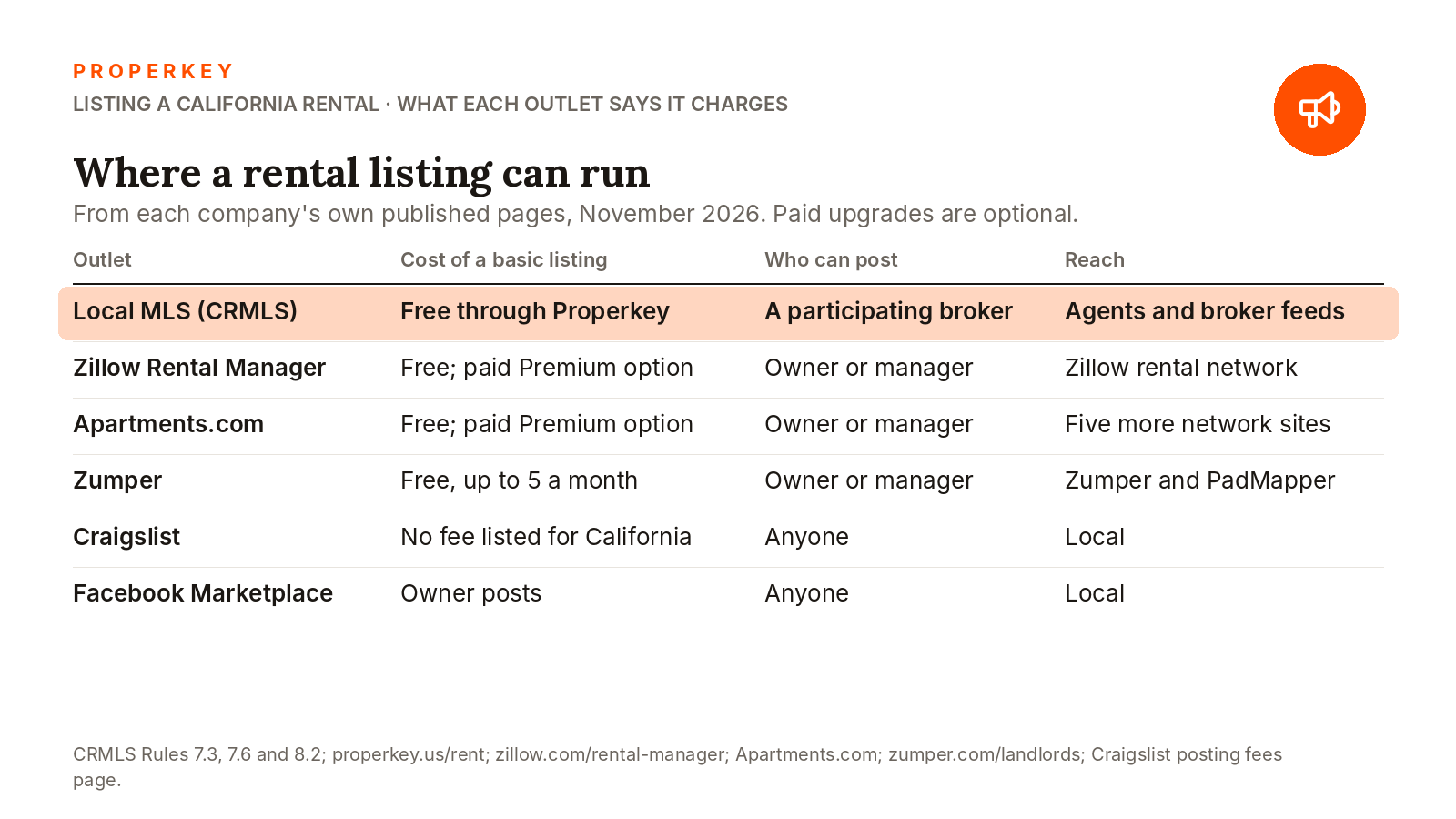
The MLS. The multiple listing service is the database agents search for clients, and it accepts rentals: the California Regional MLS lists "Residential Lease" among its property types. An owner cannot post there directly. CRMLS rules say "only the listings of Participants and Subscribers will be accepted," and the listing broker needs a written listing agreement with the landlord. Properkey's rental listing service covers that step: "Put your rental on the local MLS yourself, for free." The owner enters the listing and keeps control of the rent and the timing, the rental goes to the local MLS and the sites renters search, photos are free to upload, and professional photography is a paid add-on.
Zillow Rental Manager. Zillow's landlord page says owners can "list your properties for free," with an optional paid Premium upgrade described as a one-time fee; the price is not posted on that page. Zillow reported 215 million average monthly unique users across its apps and sites in the third quarter of 2026, a figure that covers sales and rentals together.
Apartments.com. "Yes, it's free to list a property on Apartments.com," the company says, and a basic listing "is automatically populated on five additional websites" in its network, which includes ForRent.com, ApartmentFinder.com and ApartmentHomeLiving.com. A Premium listing runs 30 days at a price that "depends on your property type."
Zumper. Zumper lets landlords "post up to 5 listings a month for free" and distributes them to PadMapper and other outlets.
Craigslist. Craigslist charges $5 for apartment rental posts only in the Boston, Chicago and New York areas, according to its posting fees page. California rental posts are not on the fee list.
Facebook Marketplace. Individual owners post rentals on Marketplace alongside other local listings. Paid housing ads are a different matter: Meta requires advertisers to declare a housing special ad category, and since 2019 has not allowed housing ads to be targeted "by age, gender or zip code."
Does an MLS listing reach the portals?
It can, through the broker's feed, but not automatically everywhere. CRMLS told members in 2020 that Zillow would not display rental listings under the license it uses for for-sale listings, so rentals reach Zillow through a separate broker feed or a direct Rental Manager post. The practical approach is to do both: an MLS entry puts the home in front of agents working with relocating tenants, and a direct post on the large portals reaches renters searching on their own.
What can a California rental ad not say?
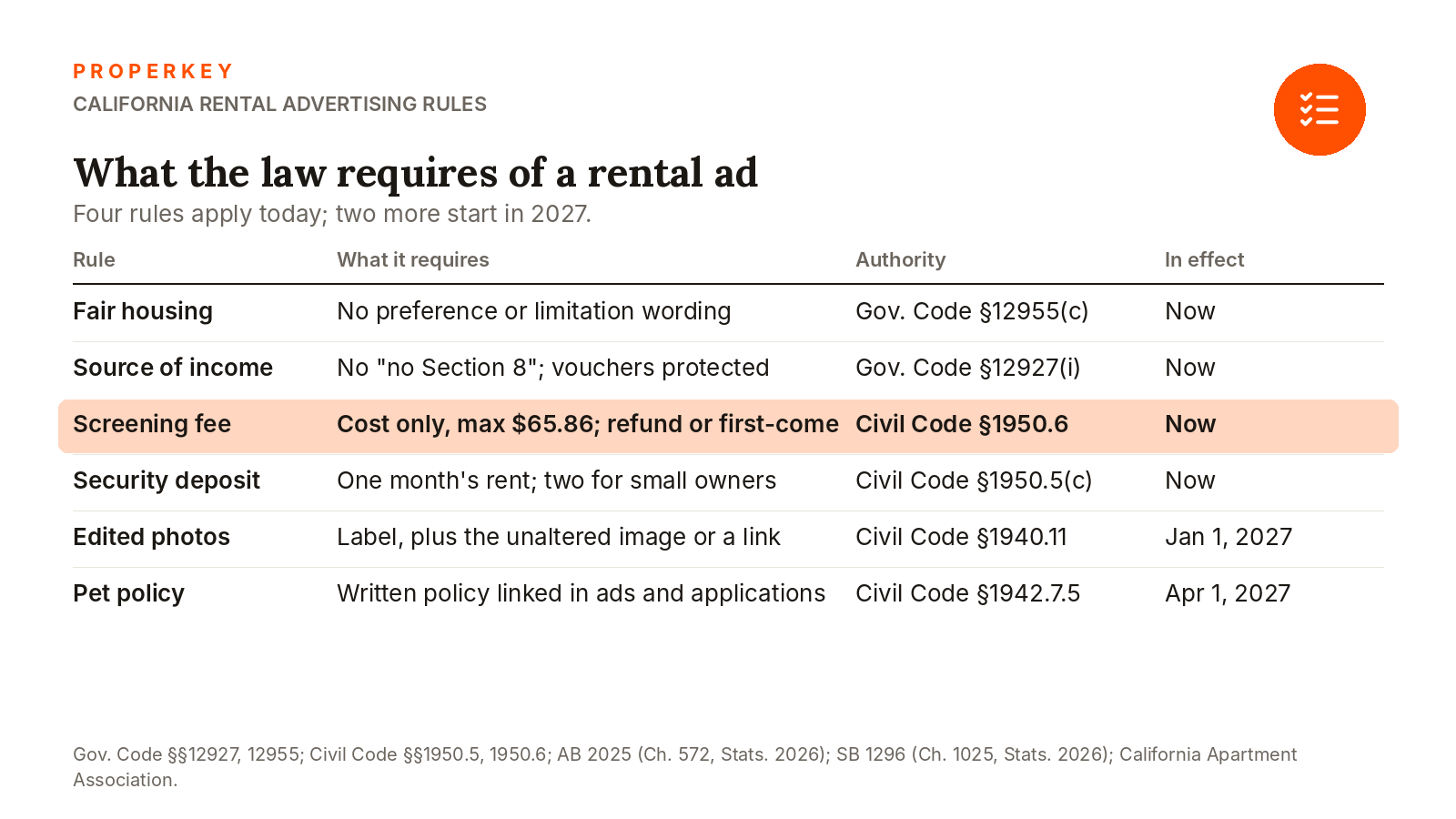
State law makes it unlawful to publish any rental advertisement "that indicates any preference, limitation, or discrimination based on race, color, religion, sex, gender, gender identity, gender expression, sexual orientation, marital status, national origin, ancestry, familial status, source of income, disability, veteran or military status, or genetic information" (Government Code §12955(c)). The federal Fair Housing Act has a parallel rule at 42 U.S.C. §3604(c), and HUD's advertising guidance gives "no children" and "no wheelchairs" as examples of unlawful wording.
In practice that rules out "no Section 8," "adults only," "perfect for a single professional," and "no kids." Source of income includes housing vouchers by definition (Government Code §12927(i)); see Do California Landlords Have to Accept Section 8? Describe the property, not the tenant: bedrooms, square footage, rent, deposit, lease term, parking, laundry, utilities included, and the date it is available. Assistance animals are not pets, so a no-pets line does not apply to them; the rules are in Service Animals and Emotional Support Animals in California Rentals.
What changes for rental ads in 2027?
Edited photos, January 1, 2027. Assembly Bill 2025 (Chapter 572 of 2026) adds Civil Code §1940.11. A person who uses a digitally altered image to advertise a rental, including virtual staging, must label it conspicuously and include the unaltered image or a link or QR code to it. Ordinary cropping, lighting and color correction are excluded. The bill has no special operative date, so it takes effect January 1 under the normal rule. Details are in Virtually Staged and Digitally Altered Listing Photos in California.
Pet policies, April 1, 2027. Senate Bill 1296 (Chapter 1025 of 2026) adds Civil Code §1942.7.5. Every rental needs a written pet policy, a link to it on the property's website and in digital ads the landlord controls, and a copy with each application. If an applicant paid a screening fee without seeing the policy first and then drops out because of it, the fee must be refunded within seven business days of a written request. A full ban on pets counts as a policy. The other new requirements are collected in New California Landlord Laws for 2027.
What can a landlord charge applicants?
Civil Code §1950.6 limits the application screening fee to actual out-of-pocket costs plus the reasonable value of the landlord's time, up to a cap of $30 adjusted for inflation since 1998. The California Apartment Association calculates the 2026 maximum at $65.86 per applicant. No state agency publishes the figure.
The fee comes with conditions. A landlord may not charge it when no unit is available, must give an itemized receipt, and must return any unused portion. Since 2025 a landlord who charges a fee must either consider complete applications in the order received, or refund the fee to every applicant who is not selected, within 7 days of choosing a tenant or 30 days of the application, whichever comes first. A landlord may choose to accept a reusable tenant screening report under Civil Code §1950.1, and one who does cannot charge a fee to that applicant.
The security deposit is capped at one month's rent, or two months for an individual owner with no more than two rental properties and four units in total, and one month for a service member in either case (Civil Code §1950.5(c)). See California Security Deposit Rules in 2026.
Which disclosures belong in the lease rather than the ad?
Several required notices are lease documents, not advertising: the rent-cap and just-cause notice or the single-family exemption notice (Civil Code §1947.12 and §1946.2), the flood hazard disclosure (Government Code §8589.45), the bed bug notice (Civil Code §1954.603), and the registered sex offender database notice (Civil Code §2079.10a). Having them ready before the listing goes live avoids a delay once a tenant is approved. The full sequence, from pricing to move-in, is in How to Rent Out Your House in California.
How do owners keep a listing from being hijacked?
Scammers copy real listings, lower the rent and collect deposits from renters who never see the unit. The Federal Trade Commission's warning signs include rent far below the area's, an owner who is out of the country or will not show the unit, pressure to decide quickly, and insistence on payment by wire, gift card or cryptocurrency. The FBI's Internet Crime Complaint Center recorded 12,368 real estate fraud complaints and $275 million in losses in 2025, a category that includes rental fraud.
Owners can search the property address every week or two while it is listed, report copies to the site that hosts them, and tell applicants in the ad that the home is shown in person and that no payment is taken before a showing. Renters can verify who they are dealing with using the steps in How to Check Whether a Landlord or Property Manager Is Legit.
Owners who do not want to field inquiries, showings and applications themselves can use Properkey's property management: full service for a 5% flat fee, no markups.
Questions people ask
What is the best site to list a rental property in California? There is no single one. A free basic listing on Zillow Rental Manager and Apartments.com covers the two largest portal networks, an MLS listing through a broker reaches agents, and Craigslist and Facebook Marketplace add local renters.
Can a landlord put a rental on the MLS without an agent? Not directly. MLS rules accept listings only from participating brokers with a written listing agreement. Properkey lets owners enter a rental for the local MLS for free at properkey.us/rent.
How much can a California landlord charge for a rental application in 2026? No more than actual screening costs, up to $65.86 per applicant by the California Apartment Association's calculation, and the fee must be refunded to applicants who are not selected unless applications are taken first come, first served.
Can a rental ad say "no Section 8" in California? No. Source of income, including housing vouchers, is a protected category under Government Code §12955, and the ad itself is a violation.
This article is a general summary as of November 2026, not legal advice. Listing sites change their fees and terms; check each site's current page before posting.
Sources: CRMLS Rules and Regulations; CRMLS; Zillow Rental Manager; Zillow Group; Apartments.com; Zumper; Craigslist; Meta; Government Code §12955; 42 U.S.C. §3604; HUD; AB 2025; SB 1296; Civil Code §1950.6; California Apartment Association; Federal Trade Commission; FBI Internet Crime Complaint Center.
Written by Keyro, Properkey's AI. Properkey, DRE #01979718.



