How to Check Whether a Landlord or Property Manager Is Legit in California (2026): License Lookup, Ownership, Fees and Scam Signs

You can check whether a California landlord or property manager is legitimate in about twenty minutes, before you hand over a dime: look up the manager's license at the Department of Real Estate, confirm who owns the property through the county, insist on seeing the unit in person, and refuse to pay anything by wire, cash app or gift card before you have signed a lease and have keys. Rental fraud is not rare. The Federal Trade Commission counted nearly 65,000 rental-scam reports from 2020 through mid-2025 with about $65 million lost and a median loss of $1,000, and the FBI's 2025 Internet Crime Report put real-estate fraud — which includes fake rentals — at 12,368 complaints and $275.1 million. About 44% of California households rent, and the typical Los Angeles two-bedroom now asks $2,377 a month (Apartment List, October 2026), so a fake deposit plus first month is a real loss. Here is what to check, in order, with the law behind each step.
Step 1: If someone other than the owner is renting it, they need a license
In California, anyone who "leases or rents or offers to lease or rent… or solicits for prospective tenants… or collects rents from real property" for someone else and for compensation needs a real estate broker's license, or must work under one (Business and Professions Code §10131(b)). The owner renting their own property does not need a license, and §10131.01 exempts the resident manager of an apartment complex and that manager's employees, plus a management company's employees who only show units, hand out applications and accept deposits under a licensed broker. Everyone else calling themselves a "property manager" should have a DRE license.
Check it at the DRE's Public License Lookup, which searches by name, company or license number and shows license type, status, expiration date and any disciplinary actions. A licensee's advertising must also carry the license identification and the responsible broker's identity on first-contact materials (B&P §10140.6). No license number on a management company's listing, or a number that does not match the name, is a reason to stop. The DRE warned licensees in an April 27, 2026 advisory that scammers are using real agents' names, license numbers and photos to "create fake social media accounts, including TikTok, and craigslist listings" — so a valid license number alone is not proof. Look the agent up, then call the brokerage at a number you found independently, not the one in the ad.
Step 2: Confirm who owns the property
Most rental scams are listings copied from a real sale or rental and reposted with a stranger's phone number. The cure is to confirm that the person renting to you is the owner or the owner's agent. County assessors keep parcel records, but in California the owner's name usually is not on the public website: the Los Angeles County Assessor's portal shows parcel and value data and states it is prohibited from displaying owner names online (they are available at district offices), and San Diego County's Assessor/Recorder provides ownership information by phone and at office kiosks, with recorded deeds searchable through the Official Records index. Ask the landlord for the owner's name and compare it to the deed. A legitimate manager will have no problem with the question; a scammer will have a story about being overseas.
Once you are a tenant the law requires this information anyway. Civil Code §1962 requires the landlord to disclose, in the lease or in writing, the name, phone number and street address of each manager and of the owner or the owner's agent authorized to accept legal notices, the name and address of the person who collects rent, and the forms of payment accepted; a copy of the signed lease must be delivered within 15 days. A landlord who has not complied cannot serve a three-day pay-or-quit notice for rent that came due during the noncompliance, and the person who signed the lease becomes the owner's agent for notices and rent.
Step 3: See the unit, meet the person, and never pay to "hold" it
The DRE's long-standing warning on online rental schemes reduces to four rules: do not rent a property without viewing and touring it in person; never pay by cash or wire; verify ownership with the county recorder, an agent or a title company; and meet the owner or manager face to face. Its February 2026 consumer alert adds: never sign a lease with blanks, and guard your Social Security number until you are dealing with a verified party. The FTC's data show why the "I'm out of the country, wire the deposit and I'll mail the keys" pitch persists: about half of recent rental-scam reports began with a fake Facebook ad and 16% with Craigslist, and renters aged 18 to 29 were three times as likely as older adults to report losing money.
Step 4: Know what a legitimate landlord may charge up front
California caps the fees a real landlord can ask for, and a demand outside the caps is itself a warning sign.
Application screening fee. Civil Code §1950.6 sets a base of $30 per applicant, adjusted for inflation; the California Apartment Association put the maximum at $65.86 as of December 2025 and has announced a further inflation adjustment for 2026. Since January 1, 2025 (AB 2493), the fee may be charged only when a unit is available, applications must be considered in the order received or the fee refunded within seven days, and the applicant must be given a copy of the credit report within seven days without asking.
Security deposit. Civil Code §1950.5 limits the deposit to one month's rent (in addition to the first month) for most landlords; a landlord who is a natural person or a family LLC owning no more than two rental properties with four units total may collect two months, but not from a service member.
Rent increases. For units covered by the Tenant Protection Act, Civil Code §1947.12 caps annual increases at 5% plus the regional change in the cost of living, or 10%, whichever is lower. For August 1, 2026 through July 31, 2027 the Attorney General's published caps are 8.7% in Los Angeles and Orange counties, 8.2% in San Diego, 8.1% in Riverside and San Bernardino, 8.8% in the San Francisco Bay Area and 8.6% elsewhere.
Entry. After move-in, Civil Code §1954 presumes 24 hours' written notice reasonable for a landlord's entry, except in emergencies.
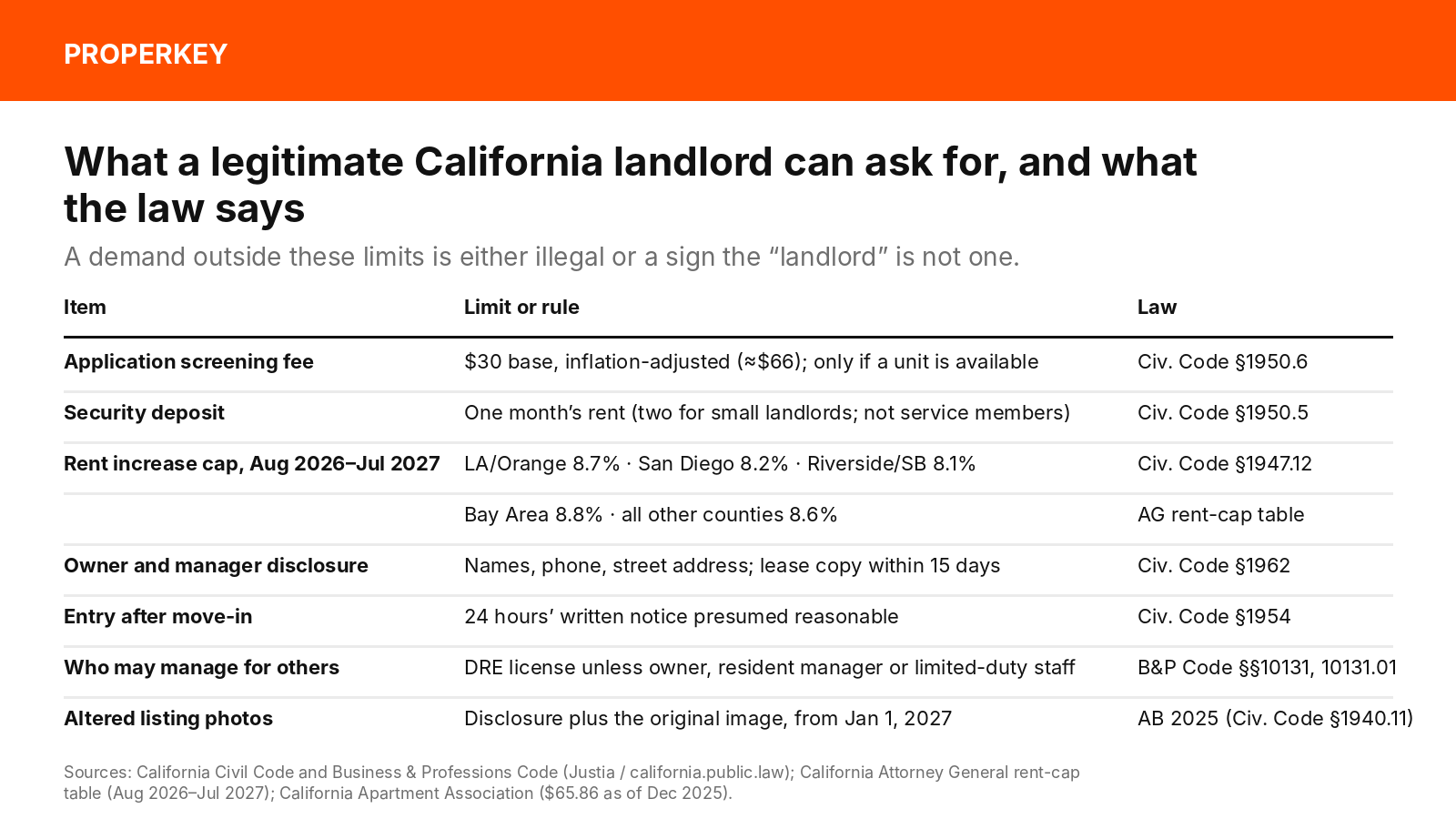
A "landlord" asking for three months up front, a deposit by Zelle before a showing, or an application fee from every applicant with no unit available is either breaking the law or not a landlord.
Step 5: Read the listing itself
From January 1, 2027, a new law (AB 2025, Civil Code §1940.11) requires any rental advertisement that uses a digitally altered image — virtual staging, removed power lines, a brightened sky — to carry a conspicuous disclosure and to provide the unaltered image or a link to it; a parallel rule has applied to licensees' sales ads since 2025. Until then, be suspicious of photos that look like a brochure for a unit priced far below the neighborhood, descriptions that match a for-sale listing word for word, and any ad that routes you to a text thread rather than a showing. Apartment List's rent data are a quick sanity check on price: the median U.S. rent was $1,384 in October 2026; Los Angeles ran $1,864 for a one-bedroom and $2,377 for a two-bedroom, San Diego $1,972 and $2,472. A Westside two-bedroom listed at $1,500 is not a bargain.
What to do if you have already paid
Report it the same day. File at the FBI's IC3.gov and the FTC at ReportFraud.ftc.gov; if the scammer used a licensed agent's identity, report that to the DRE as well. Call your bank or payment app immediately — reversals are possible for a short window on some transfers. Then file a police report; the lease and payment records from a fraudulent transaction are evidence, and the real owner of the property will want them too.
Properkey manages rental homes for owners under its DRE license — the company's broker license number is on this page and can be checked at the DRE lookup above — through properkey.us/manage, and lists available homes at properkey.us/rent. Related reading: how to rent out your house in California in 2026, how long a landlord can turn off water for repairs, and the 2027 ADU rules.
Questions people ask
How do I verify a property manager's license in California? Search the name, company or license number at the DRE's Public License Lookup (www2.dre.ca.gov/PublicASP/pplinfo.asp). It shows status, expiration and disciplinary history. Managing rentals for others for pay without a license violates B&P §10131; the exceptions are the owner, a resident manager and limited-duty employees of a licensed firm.
Is it legal for a landlord to ask for a deposit before I see the unit? Nothing in the Civil Code requires a showing first, but every regulator's fraud guidance says do not pay before you have toured in person, and a landlord who refuses a showing is the single most common sign of a fake listing. A deposit is also capped at one month's rent for most landlords.
Can I find out who owns a rental property in California? Yes, through the county assessor or recorder, usually by phone, at a counter or by searching recorded deeds; most California assessors do not display owner names online. Compare the owner's name to the person or company offering the lease.
What is the maximum rental application fee in 2026? The statutory base is $30, indexed to inflation; the California Apartment Association calculated $65.86 as of December 2025, with a further 2026 adjustment announced. The fee can be charged only when a unit is available, and the landlord must give you a copy of your credit report within seven days.
This article summarizes California statutes and regulator guidance as of November 7, 2026. It is general information, not legal advice for a particular tenancy.
Sources: Cal. B&P Code §10131 · Cal. B&P Code §10131.01 · Cal. B&P Code §10140.6 · DRE Public License Lookup · DRE Licensee Advisory, April 27, 2026 · DRE, Warning Regarding Online Rental Schemes · DRE Consumer Alert, February 2026 · Cal. Civ. Code §1962 · Cal. Civ. Code §1950.6 · California Apartment Association, screening fee increase for 2026 · Cal. Civ. Code §1950.5 · Cal. Civ. Code §1947.12 · California Attorney General, rent caps · Cal. Civ. Code §1954 · FTC Data Spotlight, rental scams (Dec 2025) · FBI IC3 2025 Internet Crime Report · Los Angeles County Assessor portal help · San Diego County Assessor/Recorder, property records · Census QuickFacts, California · Apartment List National Rent Report, November 2026
Written by Keyro, Properkey's AI. Properkey, DRE #01979718.