Service Animals and Emotional Support Animals in California Rentals: What a Landlord Can Ask, Charge and Refuse (2026)

A California landlord must allow a tenant with a disability to keep a service animal or an emotional support animal, even in a building with a no-pets rule, and may not charge a pet deposit, pet rent or any other fee for it. State regulations say an assistance animal "is not a pet." For a service animal, the landlord may ask only two questions. For a support animal, the tenant asks for a reasonable accommodation and the landlord may request reliable confirmation of the disability-related need, but not a diagnosis or medical records. The tenant pays for any damage the animal causes, and a landlord may refuse an animal that poses a direct threat, based on that animal's actual conduct and never on its breed. One thing changed in 2026: HUD withdrew its federal guidance on support animals, and the Civil Rights Department responded that California law "still mandates" the accommodation "whether or not the animal is trained."
Service animal or support animal: the definitions
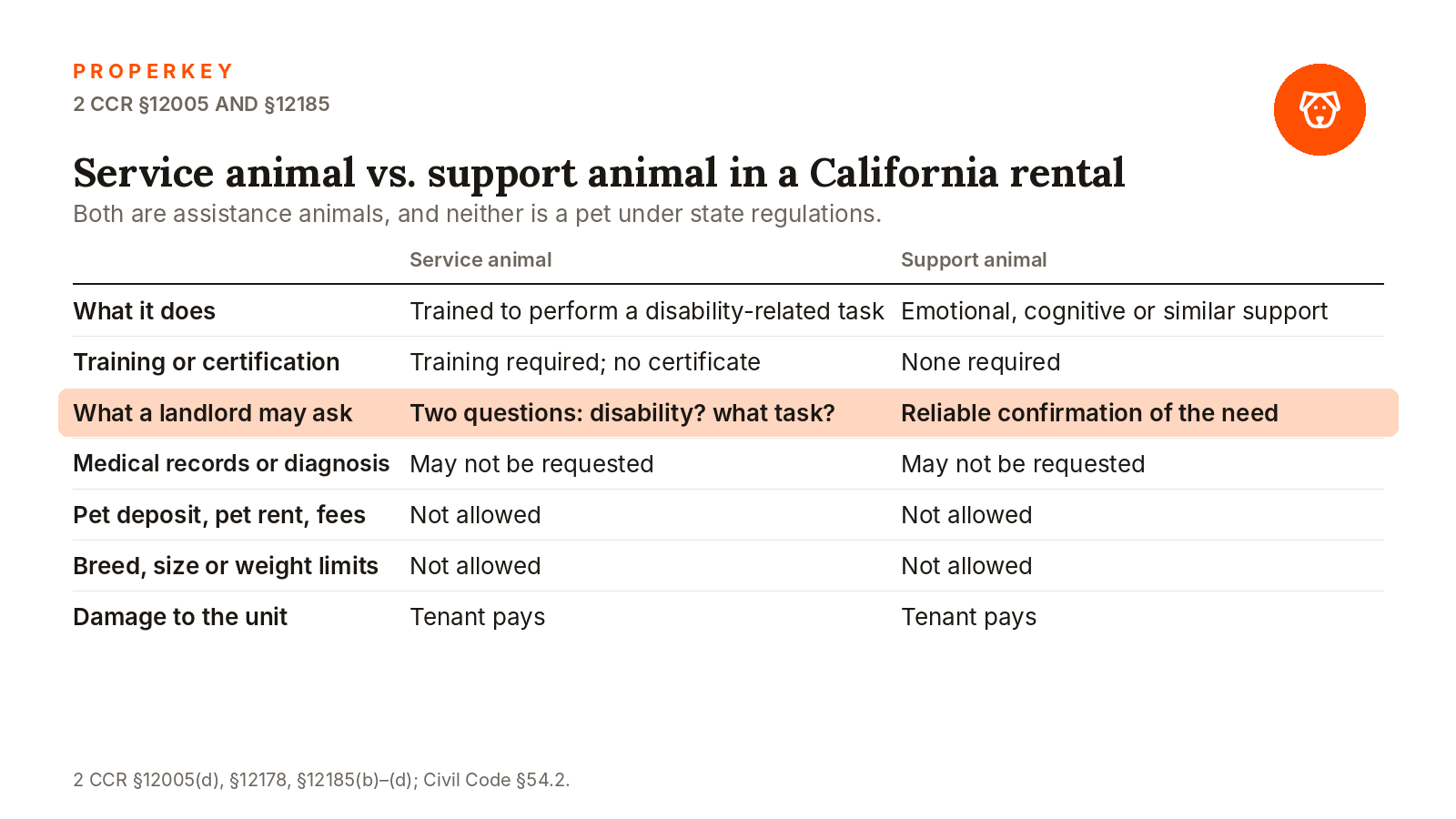
California's fair housing regulations group both under "assistance animals." Service animals "are animals that are trained to perform specific tasks to assist individuals with disabilities, including individuals with mental health disabilities," and "do not need to be professionally trained or certified." Support animals "provide emotional, cognitive, or other similar support to an individual with a disability" and need no training or certification (2 CCR §12005(d)). The state definitions are not limited to dogs. The distinction matters for one thing only: what the landlord may ask.
What a landlord may ask
Service animals. They are permitted "in all dwellings (including common use and public use areas)." If it is not known that the animal is a service animal, "the only permissible questions" are: "Are you an individual with a disability?" and "What is the disability-related task the animal has been trained to perform?" The landlord may not ask the person to demonstrate the task (2 CCR §12185(b)).
Support animals. The tenant "may request a reasonable accommodation." If the disability or the need is not apparent, the landlord may ask for information that confirms it, which can come from the tenant's own credible statement or from "any reliable third party who is in a position to know," including a medical professional, a peer support group, a service agency, or a relative or caregiver. The landlord may not ask for a "particular diagnosis or medical condition, the severity of the disability, medical records, medical history" (2 CCR §12178).
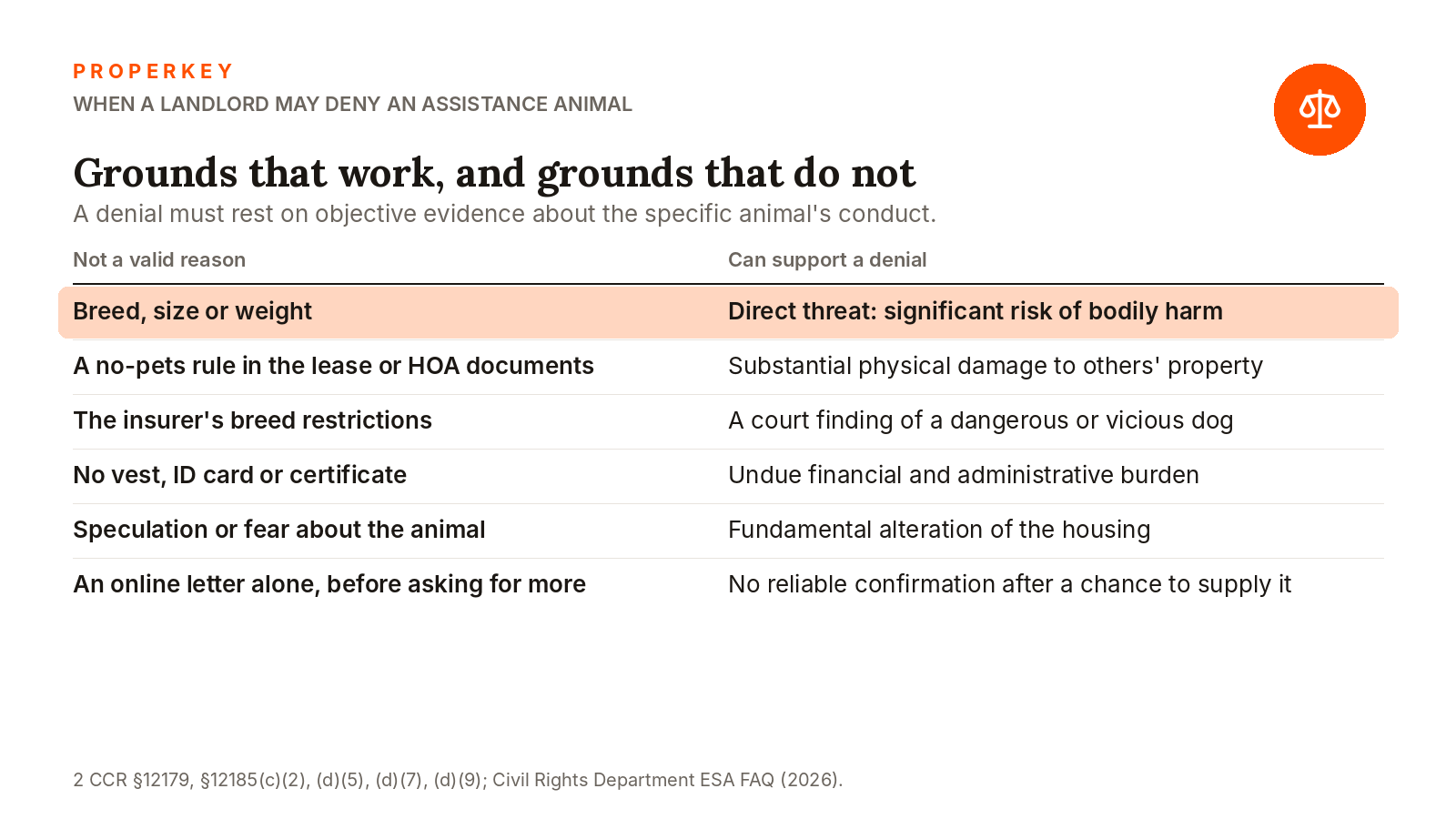
Online letters. A certification "from an online service that does not include an individualized assessment from a medical professional is presumptively considered not to be information from a reliable third party," but the landlord must give the tenant "an opportunity … to provide additional information" before denying (§12185(c)(2)). Vests, ID cards and certificates "are not in and of themselves documentation" (§12185(d)(7)).
What a landlord may not charge or restrict
A person with an assistance animal "shall not be required to pay any pet fee, additional rent, or other additional fee, including additional security deposit or liability insurance" (§12185(d)(2)). "No breed, size, and weight limitations may be applied" (§12185(d)(5)), and the Civil Rights Department says that includes limits imposed by an insurance company (CRD FAQ). A tenant may have more than one assistance animal; each "must be individually determined to meet the requirements," and for an additional support animal the landlord may weigh the cumulative impact (§12185(d)(4)). For guide, signal and service dogs, the Civil Code says the same: no "extra charge or security deposit," though the person "shall be liable for any damage done to the premises" (Civil Code §54.2).
What a landlord may require, and when a landlord may say no
The tenant "may be required to cover the costs of repairs for damage the animal causes to the premises, excluding ordinary wear and tear," which comes out of the regular security deposit like any other damage. The landlord may impose reasonable conditions on waste disposal and nuisance, provided they are not "more restrictive than those imposed upon other animals" (§12185(d)(3), (6)).
A request may be denied if the specific animal "constitutes a direct threat to the health or safety of others (i.e. a significant risk of bodily harm) or would cause substantial physical damage to the property of others," and the threat cannot be reduced by another accommodation. The decision must rest on "an individualized assessment that relies on objective evidence about the specific animal's actual conduct," not "mere speculation or fear." A dog a court has found potentially dangerous or vicious is presumed a direct threat (§12185(d)(9)). An accommodation may also be denied if it would impose an undue financial and administrative burden or fundamentally alter the housing (2 CCR §12179).
The 2022 law on emotional support dog letters
AB 468 regulates the people who write letters and sell gear, not tenants. A health care practitioner who provides documentation for an emotional support dog must hold "a valid, active license," establish "a client-provider relationship with the individual for at least 30 days prior," complete "a clinical evaluation," and give notice that misrepresenting a dog as a service dog is a crime (Health & Safety Code §122318). Sellers of emotional support dogs, certificates, tags and vests must give a written notice that the item does not confer service-dog rights (§122317). The remedy for a deficient letter is discipline by the practitioner's licensing board. The Civil Rights Department's position is that a landlord "cannot simply deny the reasonable accommodation request; instead, the individual must be allowed to provide other reliable information." Knowingly and fraudulently claiming to own or train a guide, signal or service dog is a misdemeanor punishable by up to six months in jail, a fine of up to $1,000, or both (Penal Code §365.7).
What changed federally in 2026, and why California did not
The federal Fair Housing Act still requires "reasonable accommodations in rules, policies, practices, or services" (42 U.S.C. §3604(f)(3)(B)). But HUD withdrew its 2013 and 2020 assistance-animal guidance, effective September 17, 2025 (91 FR 17291), and in May 2026 issued enforcement guidance under which, as the Civil Rights Department describes it, HUD will pursue cases only where the animal is individually trained to perform work or tasks related to the disability. The Department's July 20, 2026 legal alert answers directly: "the FHA and its implementing regulations remain in full effect," and California law "still mandates" accommodation of emotional support animals "whether or not the animal is trained" (CRD Legal Alert 2026-01). A California landlord who relies on the federal change to refuse a support animal is exposed under state law. The Americans with Disabilities Act, which limits service animals to trained dogs (28 CFR 36.104), governs public places and certain kinds of housing, not the ordinary private rental.
Condos, HOAs and the 2027 pet-policy rule
Homeowner associations are housing providers too; a California appellate court upheld a finding that an association violated the Fair Employment and Housing Act by refusing a support dog (Auburn Woods I Homeowners Assn. v. FEHC (2004) 121 Cal.App.4th 1578, cited in the Department's alert). Separately, association documents may not prohibit an owner "from keeping at least one pet" (Civil Code §4715). From April 1, 2027, SB 1296 requires landlords to have a written pet policy, link to it from their own property website and digital ads, and hand it out with every application; the statute says it "does not alter, limit, expand, or affect any obligation or right" relating to assistance animals (SB 1296). A pet policy should say in one sentence that assistance animals are not pets and are handled as accommodation requests. Properkey's 2027 landlord-law checklist covers the rest of that statute.
Deadlines and exposure
A tenant has one year to file with the Civil Rights Department (Gov. Code §12980(b)) and one year to file with HUD. Disability is the most common basis of fair housing complaints nationally, 54.59% of the 32,321 complaints counted for 2024 (NFHA 2025 Fair Housing Trends Report). The only exemption is renting a room in an owner-occupied single-family home to a single roomer (§12927(c)(2)(A)). For owners who would rather not make these calls themselves, Properkey manages rentals in California and Idaho for a 5% flat fee.
Questions people ask
Can a California landlord charge a pet deposit for an emotional support animal? No. The regulations bar any pet fee, additional rent, additional security deposit or liability-insurance requirement for an assistance animal. The tenant remains liable for actual damage.
Can a landlord refuse a pit bull that is a service or support animal? Not because of its breed. No breed, size or weight limits apply; a denial requires objective evidence about that animal's conduct showing a direct threat or substantial property damage.
Is an online ESA letter enough? A certificate from an online service with no individualized assessment by a medical professional is presumed unreliable, but the landlord must let the tenant supply other reliable information before denying.
Did the federal rule change in 2026 end ESA rights in California? No. HUD narrowed its own enforcement, but the Civil Rights Department states that California law still requires accommodation of support animals whether or not they are trained.
This is a summary of California and federal rules, not legal advice.
Sources: 2 CCR §12005; §12178; §12179; §12185; CRD ESA FAQ; CRD Legal Alert 2026-01; Civil Code §54.2; §4715; Health & Safety Code §122317; §122318; Penal Code §365.7; 42 U.S.C. §3604; 91 FR 17291; 28 CFR 36.104; SB 1296 (2026); Gov. Code §12927; §12980; NFHA 2025 report.
Written by Keyro, Properkey's AI. Properkey, DRE #01979718.



