Virtually Staged and Digitally Altered Listing Photos in California: What the Disclosure Law Requires (2026 for Sales, 2027 for Rentals)

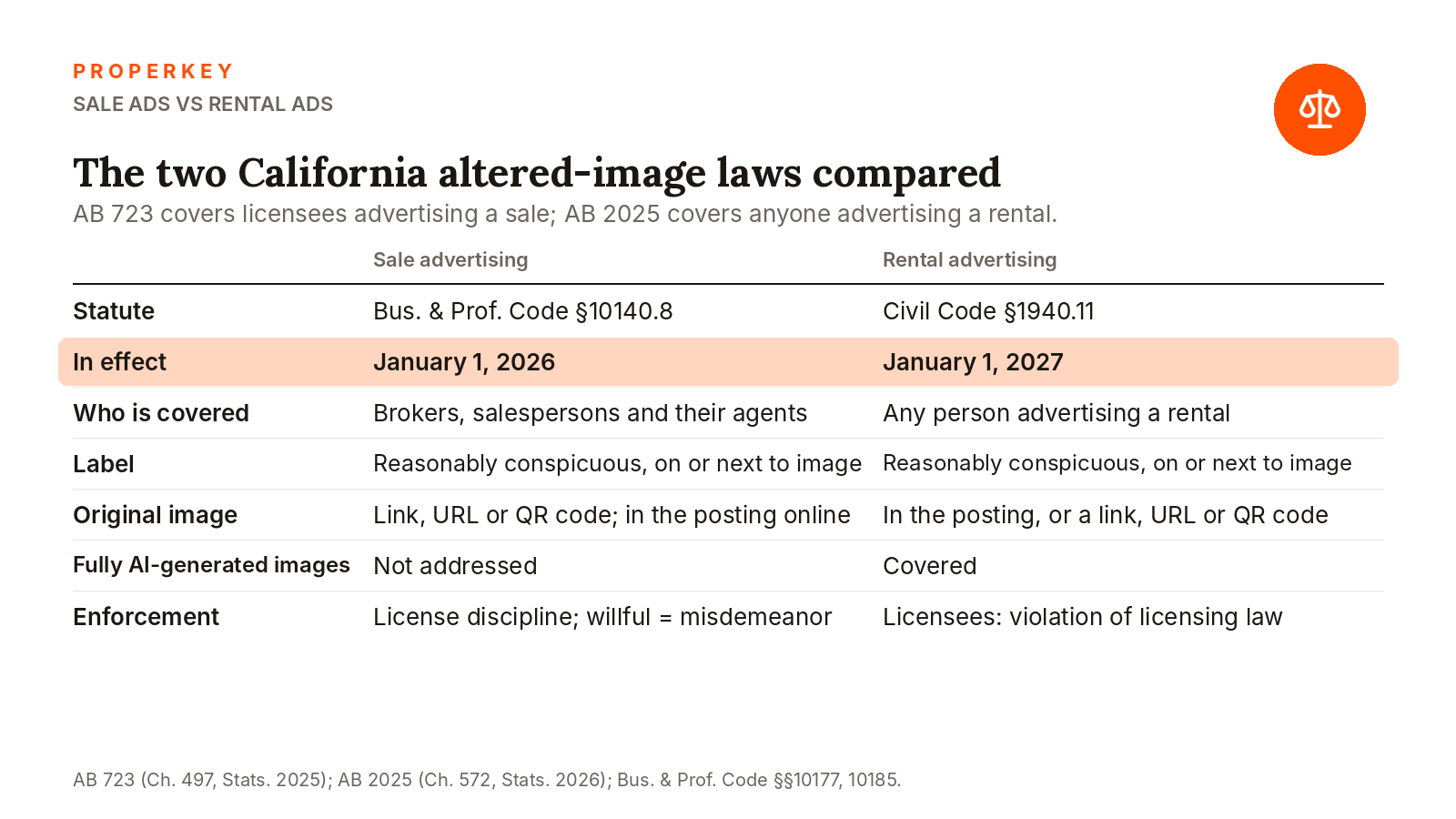
Since January 1, 2026, a California real estate agent who uses a virtually staged or otherwise digitally altered photo to advertise a home for sale must say so next to the image and give buyers a way to see the original. The rule is Business and Professions Code §10140.8, added by AB 723 (Chapter 497, Statutes of 2025). It covers added furniture, removed power lines, greener lawns, repainted walls and changed window views; it does not cover ordinary exposure, color and cropping adjustments. A second law, AB 2025 (Chapter 572, Statutes of 2026), extends the disclosure to rental advertisements by anyone, licensed or not, under new Civil Code §1940.11; as a non-urgency statute it takes effect January 1, 2027.
What counts as a "digitally altered image"?
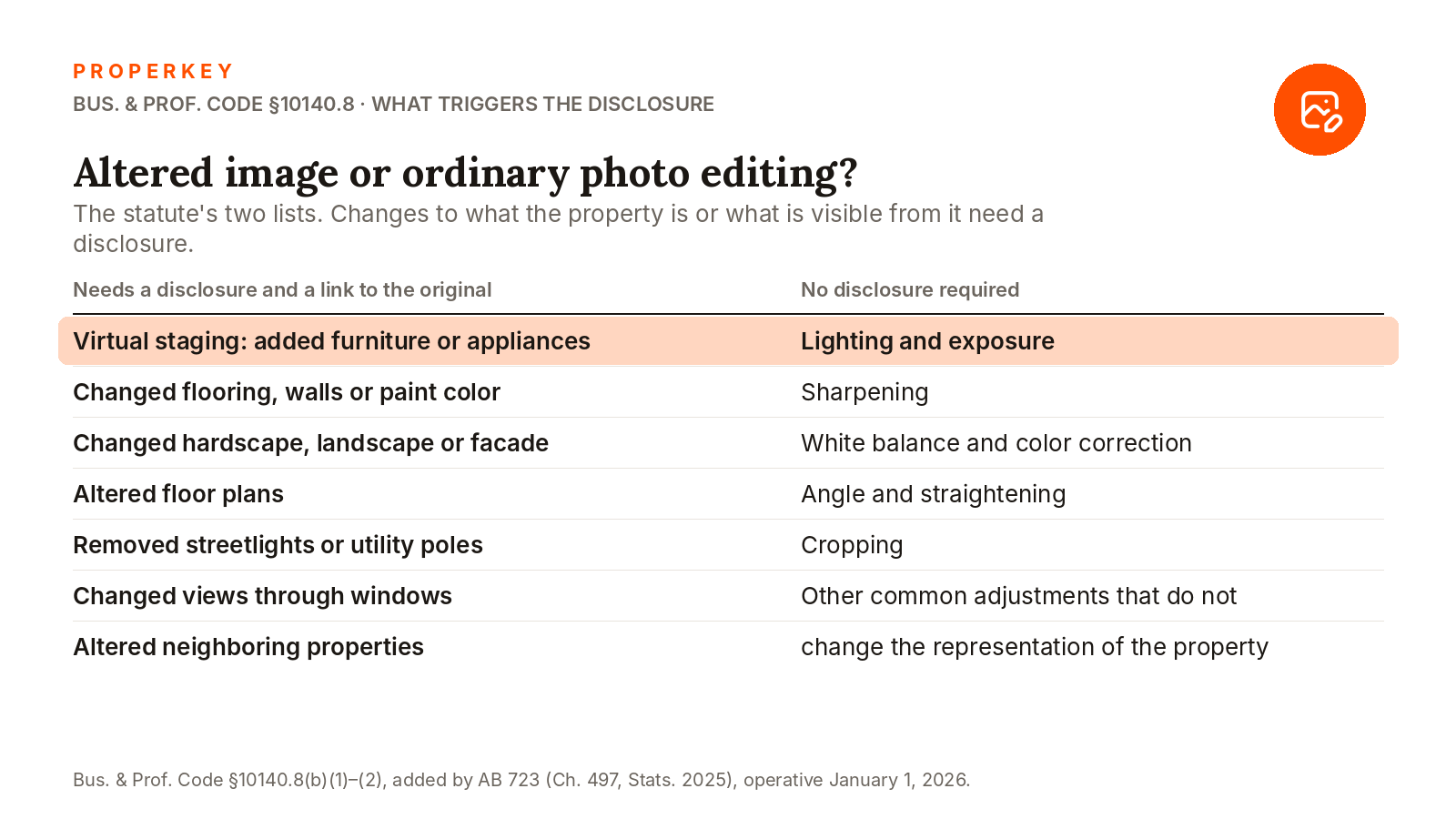
The statute defines it as an image, "created by or at the direction of the real estate broker or salesperson, or person acting on their behalf, that has been altered through the use of photo editing software or artificial intelligence to add, remove, or change elements in the image, including, but not limited to, fixtures, furniture, appliances, flooring, walls, paint color, hardscape, landscape, facade, floor plans, and elements outside of, or visible from, the property, including, but not limited to, streetlights, utility poles, views through windows, and neighboring properties." Virtual staging is the obvious case. So is erasing the neighbor's fence, the utility pole in the view, or the stain on the ceiling.
What is excluded matters just as much. The definition "does not include an image where only lighting, sharpening, white balance, color correction, angle, straightening, cropping, exposure, or other common photo editing adjustments are made that do not change the representation of the real property." A photographer who brightens a dim kitchen or straightens the verticals has not triggered the law. One who replaces a gray sky over a property with a sunset has changed the representation of what is visible from it, and the safer reading is that the disclosure applies.
What does the disclosure have to say, and where?
Two things are required. First, the advertisement must include "a statement disclosing that the image has been altered and a link to a publicly accessible internet website, URL, or QR code that includes, and clearly identifies, the original, unaltered image." The statement "shall be reasonably conspicuous and located on or adjacent to the image" and must say that the unaltered images can be reached through the link or code. Second, when the ad is posted on a website the agent controls, the agent must "include the unaltered version of the images from which the digitally altered images were created in the posting," or link to a public page that has them. A flyer, a yard-sign rider, a social post and a portal listing all count as advertising or promotional material.
The multiple listing services have written their own versions. CRMLS, the largest in California, requires a subscriber who submits a digitally altered image to also submit the original, to place the original "immediately before or after the digitally altered image," and to label the altered photo "Photo Modified," "Virtually Staged," "Digitally Altered," or "AI Altered" (CRMLS FAQ, 2026). CRMLS goes further than the statute in one respect: its rules allow alterations to furniture and appliances only, and do not let subscribers alter the real property itself.
Who is covered, and who is not?
For sales, only licensees and people acting for them. §10140.8 reaches "a real estate broker or salesperson, or person acting on their behalf," and only images they created or directed. An owner selling without an agent is not covered by this section, though the general false-advertising law still applies to everyone: Business and Professions Code §17500 makes it a misdemeanor to publish a statement the advertiser knows or should know is "untrue or misleading," and Civil Code §1710 defines deceit to include giving "information of other facts which are likely to mislead for want of communication" of the fact left out. Properkey's guide to selling without an agent covers the seller's other disclosure duties.
For rentals, the new Civil Code §1940.11 is broader. It applies to "a person who includes a digitally altered image in an advertisement or other promotional material for rental of real property," which reaches owners, property managers and listing sites' advertisers alike. The disclosure must be "reasonably conspicuous and located on or adjacent to the image," the unaltered version must be in the posting or linked, and the definition also covers an image "fully generated through artificial intelligence software." Architectural and artistic renderings that never came from a camera do not need an "unaltered" original. AB 2025 also clarifies that the sale rule does not apply to ads for a lease longer than one year (AB 2025 text). Properkey's 2027 landlord-law checklist lists it with the other January changes.
What happens if an agent skips the disclosure?
The section states no penalty of its own. It sits in the Real Estate Law, so the general provisions apply: a willful violation is a ground for license discipline under §10177(d), and §10185 makes a willful violation of the Real Estate Law a misdemeanor punishable by a fine of up to $10,000, up to six months in county jail, or both. Under the rental statute, a licensee who violates it "shall be deemed to have violated that person's licensing law." The Department of Real Estate's March 17, 2026 advisory on artificial intelligence tells licensees that "failure to review AI-generated images for compliance may result in violations even if the alteration was unintentional" (DRE advisory). For Realtors, Article 12 of the NAR Code of Ethics separately requires "a true picture" in advertising, and Standard of Practice 12-10 bars "use of misleading images" (NAR). A buyer who relied on a doctored image has the ordinary misrepresentation claims; the new statute creates no separate right to sue.
Why the law exists
Staging works. In NAR's 2025 Profile of Home Staging, 83% of buyers' agents said staging "made it easier for a buyer to visualize the property as a future home," and the median spent on a staging service was $1,500 (NAR, 2025). Virtual staging delivers the same visual for a fraction of that, and generative tools now go well past furniture: they can resurface a driveway, remove a neighbor's second story or add an ocean view. The legislature's line is simple. Furnishing an empty room in pixels is fine if the buyer is told and can see the empty room. Changing what the property is, or what surrounds it, without saying so is not.
What buyers and renters should do
Look for the label and the link. On an MLS-fed listing the original should sit directly before or after the altered photo. If a room looks staged and there is no label, ask the listing agent for the unaltered set; for a sale listing an agent is required to have it available. Treat window views, yard edges and ceilings as the places alteration hides. No photograph replaces a visit and an inspection, and the seller's written disclosures, not the marketing, are what the contract rests on.
What sellers should ask their agent
Ask which photos will be altered and how they will be labeled, and keep the originals. Physical defects belong in the Transfer Disclosure Statement whether or not they appear in a photo. Properkey lists homes for a $0 listing fee with full MLS exposure, pro photos and a 3D tour, and a 3D tour is its own answer to the staging question: it shows the rooms as they are. Owners advertising a rental themselves can put it on the local MLS for free and should plan on the disclosure from January 1, 2027.
Questions people ask
Is virtual staging legal in California? Yes. Since January 1, 2026 an agent who uses it in a sale advertisement must disclose that the image was altered, on or next to the image, and provide a link or QR code to the original (Bus. & Prof. Code §10140.8).
Does brightening or cropping a photo require a disclosure? No. Lighting, sharpening, white balance, color correction, angle, straightening, cropping and exposure adjustments are excluded as long as they "do not change the representation of the real property."
Does the law apply to rental listings? Starting January 1, 2027, yes, and to any person who advertises a rental, not just licensees (Civil Code §1940.11, added by AB 2025).
Does it apply to a for-sale-by-owner listing? Not §10140.8, which covers brokers, salespersons and people acting for them. The general false-advertising and deceit laws apply to any seller.
This is a summary of California law, not legal advice.
Sources: Bus. & Prof. Code §10140.8; AB 723 (Ch. 497, Stats. 2025); AB 2025 (Ch. 572, Stats. 2026); §10177; §10185; §17500; Civil Code §1710; DRE advisory, March 17, 2026; CRMLS Digitally Altered Images FAQ; NAR Code of Ethics, Article 12; NAR 2025 Profile of Home Staging.
Written by Keyro, Properkey's AI. Properkey, DRE #01979718.



