Do California Landlords Have to Accept Section 8? The Source-of-Income Law, the Income and Credit Rules, and How the Voucher Pays (2026)

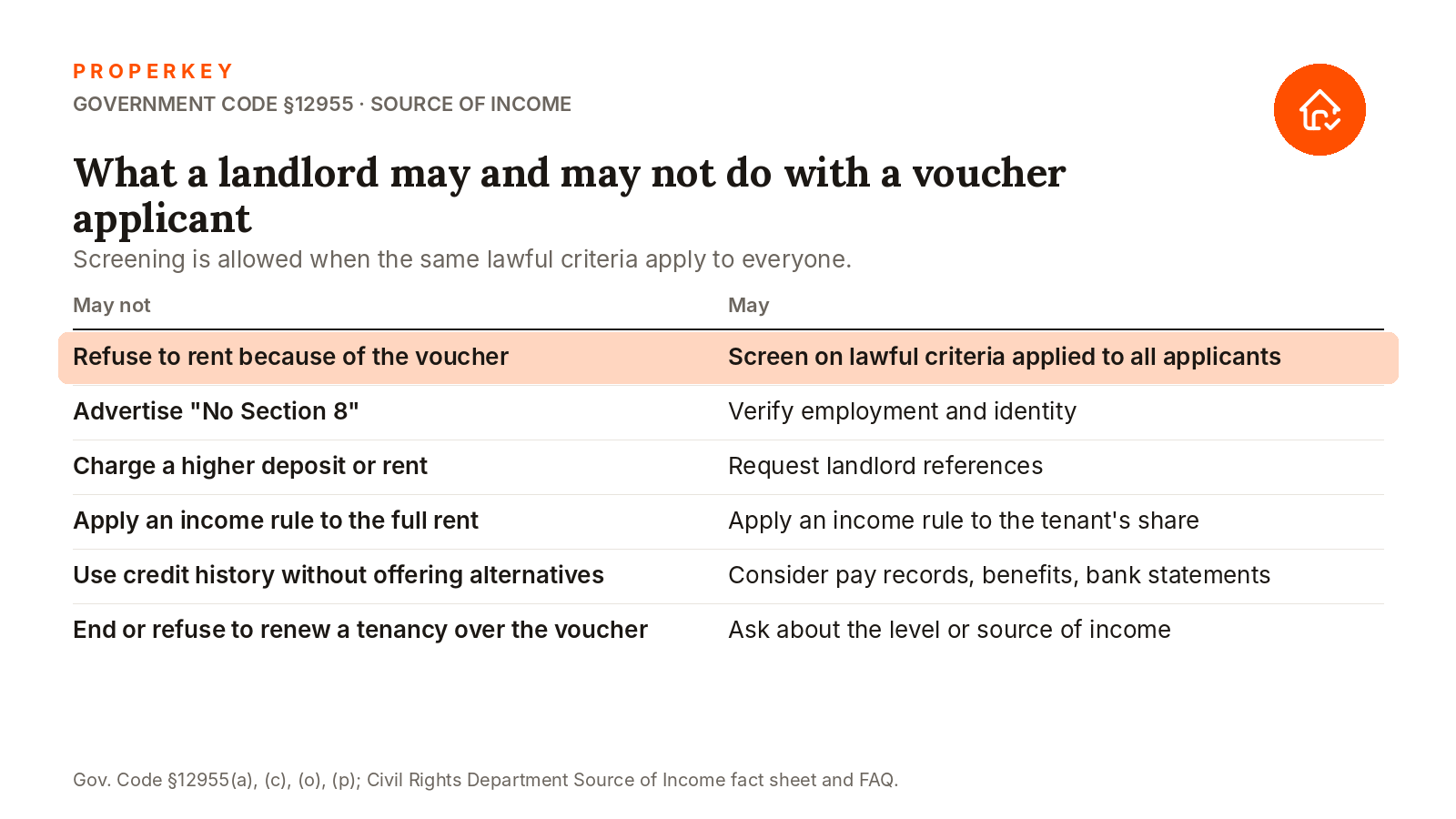
Yes. Since January 1, 2020, a California landlord may not refuse to rent to someone because they will pay with a Section 8 Housing Choice Voucher, may not advertise "No Section 8," and must measure the applicant's income against the tenant's share of the rent, not the full rent. The rule is in the Fair Employment and Housing Act, Government Code §12955, which defines protected "source of income" to include "federal, state, or local housing subsidies, including, but not limited to, federal housing assistance vouchers issued under Section 8." There is no exemption for small landlords. What the law does not do is force a landlord to take any particular applicant: lawful screening criteria still apply, as long as they are applied to everyone the same way. About 316,600 California households use a voucher (HUD Picture of Subsidized Households, 2025).
What the statute prohibits
Section 12955(a) makes it unlawful for the owner of any housing accommodation "to discriminate against or harass any person because of the … source of income" of that person. Subdivision (c) bars any "notice, statement, or advertisement" that "indicates any preference, limitation, or discrimination based on … source of income." The definition in subdivision (p) covers income "paid directly to a tenant, or to a representative of a tenant, or paid to a housing owner or landlord on behalf of a tenant," and expressly includes HUD-VASH vouchers for veterans. The Civil Rights Department's fact sheet spells out what that means in practice: a landlord "cannot refuse an application from you, charge a higher deposit or rent, or treat you differently in any other way" because of a voucher, cannot refuse to enter into or renew a lease, and cannot end a tenancy because the tenant uses one (CRD fact sheet).
The only housing outside the statute is a room in the owner's own home: refusing to rent "a portion of an owner-occupied single-family house to a person as a roomer or boarder living within the household," with no more than one roomer, is not discrimination, though the advertising rule still applies (§12927(c)(2)(A)).
What a landlord may still do
Screen. The Department's FAQ says providers "still have the right to screen all applicants according to their lawful tenant screening criteria" (CRD FAQ). The statute preserves the right to verify employment, request landlord references and verify identity, and it says asking about "the level or source of income" is not itself discrimination. Two screening tools are restricted for subsidized applicants, both in §12955(o).
The income standard. It is unlawful to "use a financial or income standard in assessing eligibility for the rental of housing that is not based on the portion of the rent to be paid by the tenant." The Department's example: rent is $2,500, the tenant's portion is $500, and the landlord requires income of three times the rent. The minimum income is $1,500, not $7,500.
Credit history. Since January 1, 2024 (SB 267), a landlord may not use a subsidized applicant's credit history without "offering the applicant the option, at the applicant's discretion, of providing lawful, verifiable alternative evidence of the applicant's reasonable ability to pay the portion of the rent to be paid by the tenant, including, but not limited to, government benefit payments, pay records, and bank statements." The landlord must give reasonable time to respond and "reasonably consider that alternative evidence in lieu of the person's credit history."
The security deposit is the same as for any tenant: one month's rent, or two for a qualifying small landlord (Civil Code §1950.5(c)), and never higher because of the voucher. Properkey's security-deposit guide has the details.
How the program pays
The tenant generally pays about 30% of adjusted monthly income toward rent and utilities, and the local housing authority pays the rest directly to the owner under a Housing Assistance Payments contract; the authority "must pay the housing assistance payment promptly when due to the owner" (24 CFR 982.451). Three steps come before the first payment. The authority must find the rent reasonable against comparable unassisted units (§982.507). The unit must pass inspection; HUD's new NSPIRE standard for vouchers is now due February 1, 2027, and authorities may use the older Housing Quality Standards until then (90 FR 46911). And the first lease term must be at least one year, with no rent increase during it (§982.309). If the rent is above the authority's payment standard, the family's share at move-in may not exceed 40% of adjusted income (§982.508).
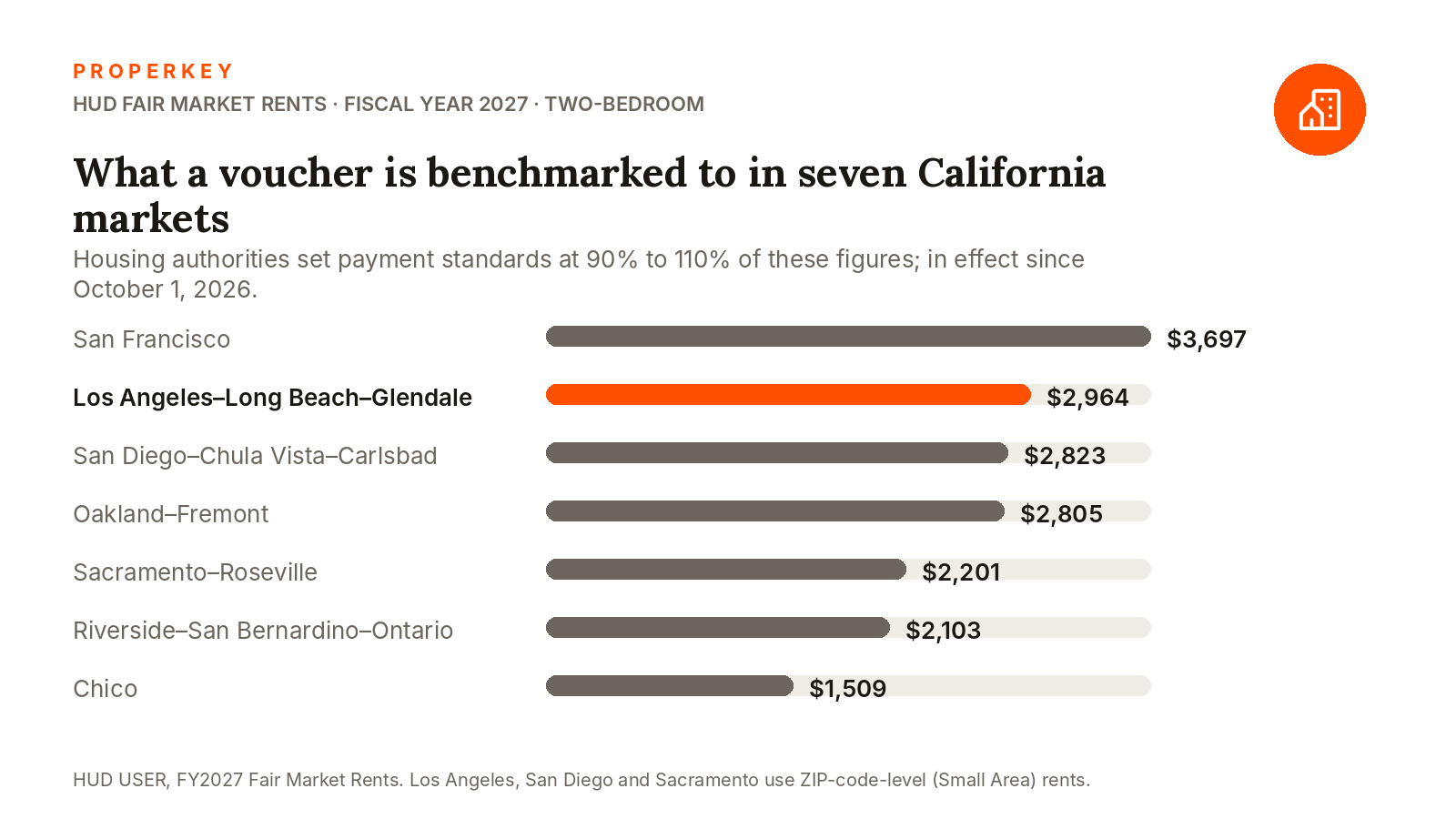
Payment standards are set between 90% and 110% of HUD's Fair Market Rent for the area. The fiscal-year 2027 two-bedroom figures, in effect since October 1, 2026: San Francisco $3,697; Los Angeles–Long Beach–Glendale $2,964; San Diego–Chula Vista–Carlsbad $2,823; Oakland–Fremont $2,805; Sacramento $2,201; Riverside–San Bernardino–Ontario $2,103; Chico $1,509 (HUD FMRs, FY2027). Los Angeles, San Diego and Sacramento use ZIP-code-level rents, so the standard is higher in costlier neighborhoods. A landlord whose asking rent is at the market for the ZIP code is usually within reach of the standard.
Leaving the program and ending a tenancy
A landlord cannot end a tenancy because the tenant holds a voucher. An owner who terminates or declines to renew the subsidy contract must give the tenant "at least 90 days' written notice," and for those 90 days the tenant owes no more than their own portion of the rent (Civil Code §1954.535). After that, California's just-cause rules apply as they would to any tenant covered by the Tenant Protection Act; leaving a subsidy program is not on the statute's list of causes. Properkey's guides to rent increases and the eviction timeline cover those rules.
What a violation costs
An applicant has one year to file a complaint with the Civil Rights Department (§12980(b)) and two years to sue directly. A court "may award the plaintiff actual and punitive damages," an injunction, and attorney's fees and costs (§12989.2). The usual evidence is the advertisement or a text message saying vouchers are not accepted.
The funding picture in 2026
The law guarantees that a voucher holder cannot be turned away for holding one. It does not guarantee a supply of vouchers. HUD's 2026 budget letter estimated funding at 99% of need, said it "cannot guarantee that funding will be available to resolve all shortfall needs," and encouraged housing authorities to stop issuing new vouchers other than veterans' and foster-youth vouchers (HUD, 2026 Budget Management Letter). The City of San Diego closed its waitlist on February 1, 2026 with about 76,000 names on it, and San Diego County closed its list of about 124,000 later that month (KPBS, March 2, 2026). Existing vouchers continue to pay.
For owners deciding how to handle it
Write one set of screening criteria, apply it to every applicant, and compute the income test on the tenant's share. Remove "no Section 8" from every ad, old template and voicemail. Budget two to four weeks for the housing authority's inspection and rent determination, and treat the authority's payment as what it is: the most reliable part of the rent. Properkey manages rentals in California and Idaho for a 5% flat fee with no markups, and owners who self-manage can list a rental on the local MLS for free. The broader checklist is in how to rent out your house in California.
Questions people ask
Can a California landlord say "no Section 8"? No. Since January 1, 2020 a voucher is a protected source of income under Government Code §12955, and an ad stating a preference against vouchers is itself a violation.
Can a landlord require income of three times the rent from a voucher holder? Only measured against the tenant's portion. On a $2,500 unit where the tenant pays $500, a three-times rule requires $1,500 of income.
Can a landlord reject a voucher applicant for bad credit? Not without first offering the option to show ability to pay the tenant's share another way, such as benefit payments, pay records or bank statements, and reasonably considering that evidence.
Are small landlords exempt? No. The only exception is renting a room in an owner-occupied single-family home to one roomer or boarder.
This is a summary of California and federal rules, not legal advice. Local housing authorities set their own payment standards and procedures.
Sources: Gov. Code §12955; §12927; §12980; §12989.2; CRD Source of Income fact sheet; CRD Source of Income FAQ; Civil Code §1950.5; §1954.535; 24 CFR 982.451; 982.507; 982.309; 982.508; 90 FR 46911 (NSPIRE); HUD Fair Market Rents; HUD Picture of Subsidized Households; HUD 2026 Budget Management Letter; KPBS.
Written by Keyro, Properkey's AI. Properkey, DRE #01979718.



