SB 9 Lot Splits and Starter-Home Subdivisions in 2027: What AB 2601 and SB 1116 Change for California Lot Owners

From January 1, 2027, a California homeowner who splits a single-family lot under SB 9 can file the parcel map and the building permits for the new homes at the same time, and can sell the resulting units as condominiums without forming a homeowners association. That is what AB 2601, signed September 30, 2026 as Chapter 955, adds to the lot-split law. It does not change who qualifies for SB 9, and it does not create the 60-day approval clock, which has been law since 2025. A second bill from the same session, SB 1116, widens the separate "starter home" subdivision law that lets a lot be split into as many as 10 parcels. Here is what each does, what has not changed, and whether a given lot qualifies.
What SB 9 already allowed
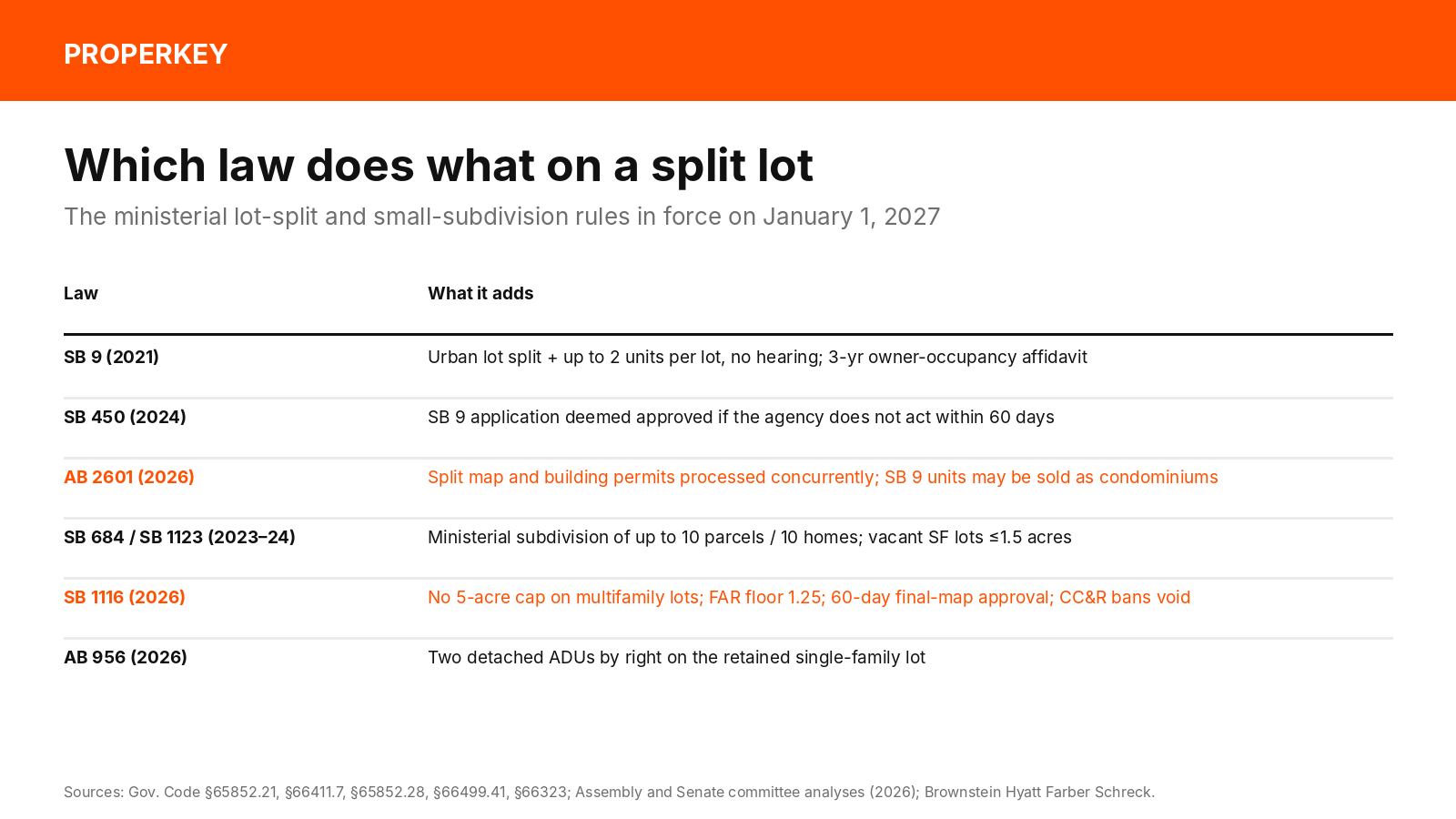
SB 9, in force since 2022, requires cities and counties to approve, without a public hearing, an urban lot split of a single-family parcel into two roughly equal lots and up to two units on each, for a maximum of four homes where there was one. Approval is ministerial, meaning the agency checks objective standards and cannot deny on discretion, and the owner must sign an affidavit promising to live on one of the lots for three years. SB 450, signed in 2024, added that an SB 9 application is deemed approved if the agency does not act within 60 days of a complete application. The Assembly Local Government Committee's analysis of AB 2601 is explicit that the new bill "does not expand the underlying eligibility or increase density for SB 9" projects.
What AB 2601 changes
Two things. First, concurrent processing: an application for a housing development of up to two units in a single-family zone "shall be eligible for concurrent processing with an application for a parcel map for an urban lot split," so the owner no longer has to record the split before applying to build. The agency may still condition the building, grading or occupancy permits on the map being approved and recorded first. The same concurrent track applies to starter-home subdivisions and their building permits. Second, condominiums: the bill defines "parcel map" to include a condominium plan if the subdivider proposes one, and where an urban lot split includes an existing home, the owner completes a condominium conversion to convey that unit separately; no HOA is required except where the Davis-Stirling Act already demands one. The author's statement, quoted in the committee analysis, is that concurrent review speeds approvals "without imposing new deadlines on approving agencies." The California Association of Realtors opposed an earlier version, arguing it would circumvent SB 9's consumer protections and local control; the owner-occupancy affidavit survived into the final bill.
What SB 1116 changes for starter-home subdivisions
The Starter Home Revitalization Act, built by SB 684 in 2023 and SB 1123 in 2024, requires ministerial approval of a subdivision of up to 10 parcels with up to 10 homes on a multifamily-zoned lot and, since 2025, on a vacant single-family lot of up to 1.5 acres. SB 1116, signed September 29, 2026, removes the five-acre cap for multifamily-zoned lots, keeps the 1.5-acre cap for vacant single-family lots, treats a lot with an uninhabitable structure as vacant, drops the minimum-density floor, sets a floor-area-ratio floor of 1.25 and front setbacks of no more than 10 feet, voids CC&R provisions that prohibit these projects outside Davis-Stirling common-interest developments, and deems a final map approved if the agency does not act within 60 days.
Does my lot qualify?
SB 9 applies only to a parcel in a Census-defined urbanized area or urban cluster, and excludes prime farmland, wetlands, very high fire hazard severity zones unless the project meets state mitigation standards, hazardous-waste sites, earthquake fault zones, the 100-year floodplain and floodway, conservation lands and easements, protected-species habitat and historic sites, per the Senate Local Government Committee's 2026 summary. It applies in cities and unincorporated county areas alike. A lot in central San Diego or the San Fernando Valley almost always qualifies; a lot in the Butte County foothills depends on whether it falls inside a Census urban area and outside a very high fire hazard zone, which has to be checked parcel by parcel. The state's reporting shows how little the law has been used: HCD's dashboard counted 1,671 SB 9 projects submitted statewide through June 2026, 862 of them in the City of Los Angeles. By comparison, HCD's ADU handbook reports 30,354 ADUs permitted in 2024, more than a quarter of all homes permitted in the state.
Why the condominium change matters
Before AB 2601, an SB 9 owner who wanted to sell one of the new units had to convey a separate lot; the lot-split map was the only path. Allowing a condominium plan on the split, and a conversion of the existing home, means a homeowner can keep the house, build a second unit, and sell it with its own title and its own financing without carving a new fee parcel. Combined with AB 956's two-detached-ADU rule, a single-family lot can now carry the original home, two ADUs, or a split with up to four units, with the units sellable individually. Each sold unit is a new home a Prop 37 borrower can buy, since the statute covers a newly constructed condominium where the borrower is the first purchaser.
What to do before January
Pull the parcel's zoning and hazard-zone status from the city or county GIS, confirm it sits inside a Census urban area, and check the recorded CC&Rs. Get a survey and a preliminary title report early; an urban lot split needs both, and a condominium plan needs a surveyor's plan. Price the project against the finished-home market: with the statewide median at $899,720 and sales down 6.5% from a year ago, the exit is the number to build toward. Properkey can list the finished units for a $0 listing fee and runs broker escrow on transactions in which it is the broker.
Questions people ask
Does AB 2601 make SB 9 lot splits ministerial? They already were. AB 2601 lets the split and the building permits be processed together and allows condominium sales; the 60-day deemed-approval rule came from SB 450 in 2024.
Can I split a lot in a very high fire hazard severity zone? Only if the project meets the state's fire mitigation standards; otherwise the parcel is excluded from SB 9. Check the CAL FIRE hazard map for the parcel first.
Do I still have to live on the lot? Yes. The three-year owner-occupancy affidavit in SB 9 was not changed by AB 2601.
What is the difference between an SB 9 split and a starter-home subdivision? SB 9 splits one single-family lot into two with up to four homes. The starter-home law divides a multifamily-zoned lot of any size, or a vacant single-family lot of up to 1.5 acres, into as many as 10 parcels with 10 homes, with a 60-day final-map clock under SB 1116.
This article summarizes new statutes as of November 6, 2026; it is not legal advice, and local objective standards still apply.
Sources: AB 2601 bill text; AB 2601 status, Chapter 955; Assembly Local Government Committee analysis; Assembly floor analysis; Brownstein Hyatt on SB 1116 and the 2026 bills; Senate Local Government Committee analysis of AB 2005; HCD ADU Handbook, March 2026; AB 956; Prop 37 legal text; C.A.R. September 2026 sales report.
Written by Keyro, Properkey's AI. Properkey, DRE #01979718.



