Prop 37 Passed: 3% Down, a 17% State Second Mortgage, New Homes Only. What Happens Next for California Homebuyers (November 2026)

Proposition 37 passed. The Associated Press called the measure at 9:06 PM on November 3, 2026, with the yes side at 61% and about 58% of the vote counted at the call; by the evening of November 5 the yes share stood at 61.4% with about 64% counted. Prop 1, the $11.25 billion housing bond, also passed, while Prop 45, the CEQA fast-track measure, was trailing and uncalled; Properkey’s election overview covers every housing measure. It lets a California buyer purchase a newly built home with 3% down by having the state lend up to 17% of the price as a fixed-rate second mortgage. The buyer repays that loan monthly; it is not a grant and the state takes no share of appreciation. According to the Legislative Analyst's Office, the program is funded by up to $25 billion in revenue bonds that homebuyer payments repay, so the measure carries "no direct state or local costs." On the September 2026 statewide median of $899,720, 20% down is $179,944; 3% is $26,992. What happens next is fixed by the measure's own text and the state constitution: the Secretary of State certifies the result by December 11, 2026, the statute takes effect five days after that filing, and CalHFA must implement the program "no later than one year after the effective date," which puts the deadline in mid-December 2027. No application date exists yet, and the eligibility rules have not changed: new construction only, a price cap tied to the county conforming loan limit, and an income ceiling of 200% of area median.
What would Prop 37 actually do?
The measure adds a "middle-class homeownership loan" program to the Health and Safety Code (§51515 and following), administered by the California Housing Finance Agency. The loan "shall finance no more than 17 percent of the purchase price" and is "secured by a secondary mortgage, subordinate to the primary mortgage." The buyer must put at least 3% down "from a source other than a grant or borrowed money." A conventional first mortgage covers the rest, roughly 80% on a 3%-down purchase, which is why supporters describe the structure as a way to reach the 20% equity point without 20% of cash.
The loans must be fixed-rate, carry no prepayment penalty, and the text lets CalHFA grant "a temporary hardship deferral of monthly interest payments," which tells you the payments are expected monthly rather than deferred to sale. CalHFA sets the interest rate, amortization and repayment terms on a basis "practical and favorable to applicant" while still sufficient to pay the bonds and administrative costs. The LAO's summary is that CalHFA "would be required to keep interest costs for homebuyers as low as possible," but that is the analyst's paraphrase; the statute's own words are "below-market interest rates," with the rate ultimately set by what bond investors will accept. Nothing in the text addresses what happens on sale or refinance; those terms would come from CalHFA.
Who qualifies?
Four tests, all from the measure's text. The buyer must have lived in California for at least one year before applying. Household income may not exceed 200% of the area median income for a family of the same size, adjusted by the agency; the LAO phrases it as "no more than double the typical income level in their area." The buyer must agree to occupy the home as a primary residence within 60 days of closing. And the buyer must retain a licensed California real estate agent or broker "of the applicant's choosing." There is no first-time-buyer requirement, and no income floor appears in the statute; the 80%–200% range quoted in some coverage comes from the California Budget & Policy Center's analysis of who counts as middle class, not from the measure.
What the income ceiling means in dollars depends on the county and family size. CalMatters puts the limit for a family of three at roughly $116,000 in Imperial County and just over $410,000 in San Mateo; KQED cites up to $342,000 for a San Francisco family of four. The measure does not say which income table CalHFA must use, so treat those as illustrations.
Which homes qualify?
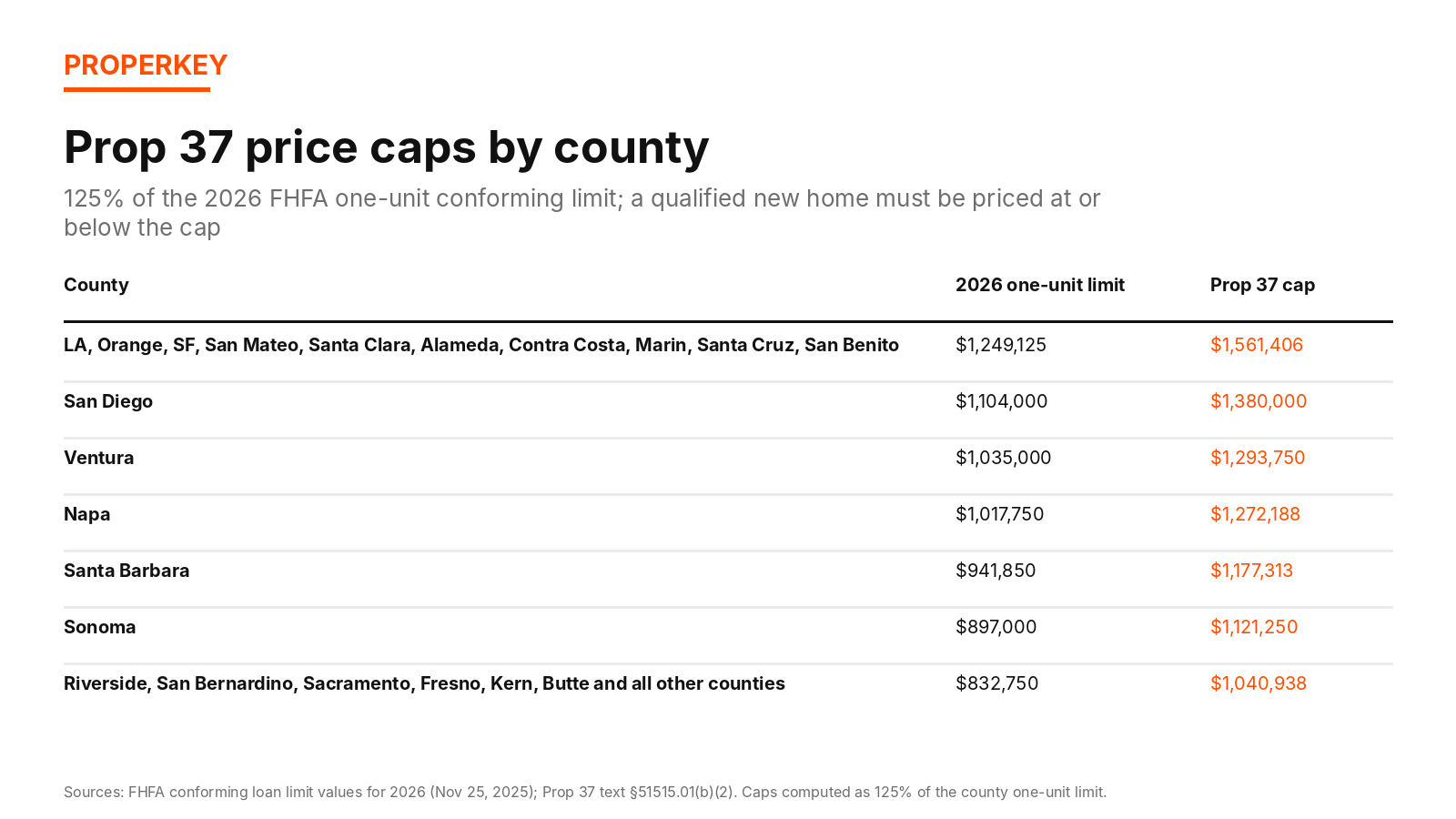
Only a "qualified new home": "a newly constructed home, townhome, row house, condominium, or manufactured home where the borrower is the first purchaser," or a unit in a former nonresidential building converted to housing, again with the borrower as first purchaser. Resale homes do not qualify. The text is silent on accessory dwelling units. The price cap is 125% of the county's one-unit conforming loan limit as published annually by FHFA. For 2026, FHFA set the baseline at $832,750 and the high-cost ceiling at $1,249,125, which produces a Prop 37 cap of about $1,040,938 in most counties and $1,561,406 in the ten counties at the ceiling (Los Angeles, Orange, San Francisco, San Mateo, Santa Clara, Alameda, Contra Costa, Marin, Santa Cruz and San Benito). San Diego's 2026 limit of $1,104,000 gives a cap of $1,380,000; Ventura's $1,035,000 gives $1,293,750 (county limits via JVM Lending's FHFA table). The Secretary of State's summary rounds this to homes "priced below about $1.5 million."
What does the money look like on a median-priced home?
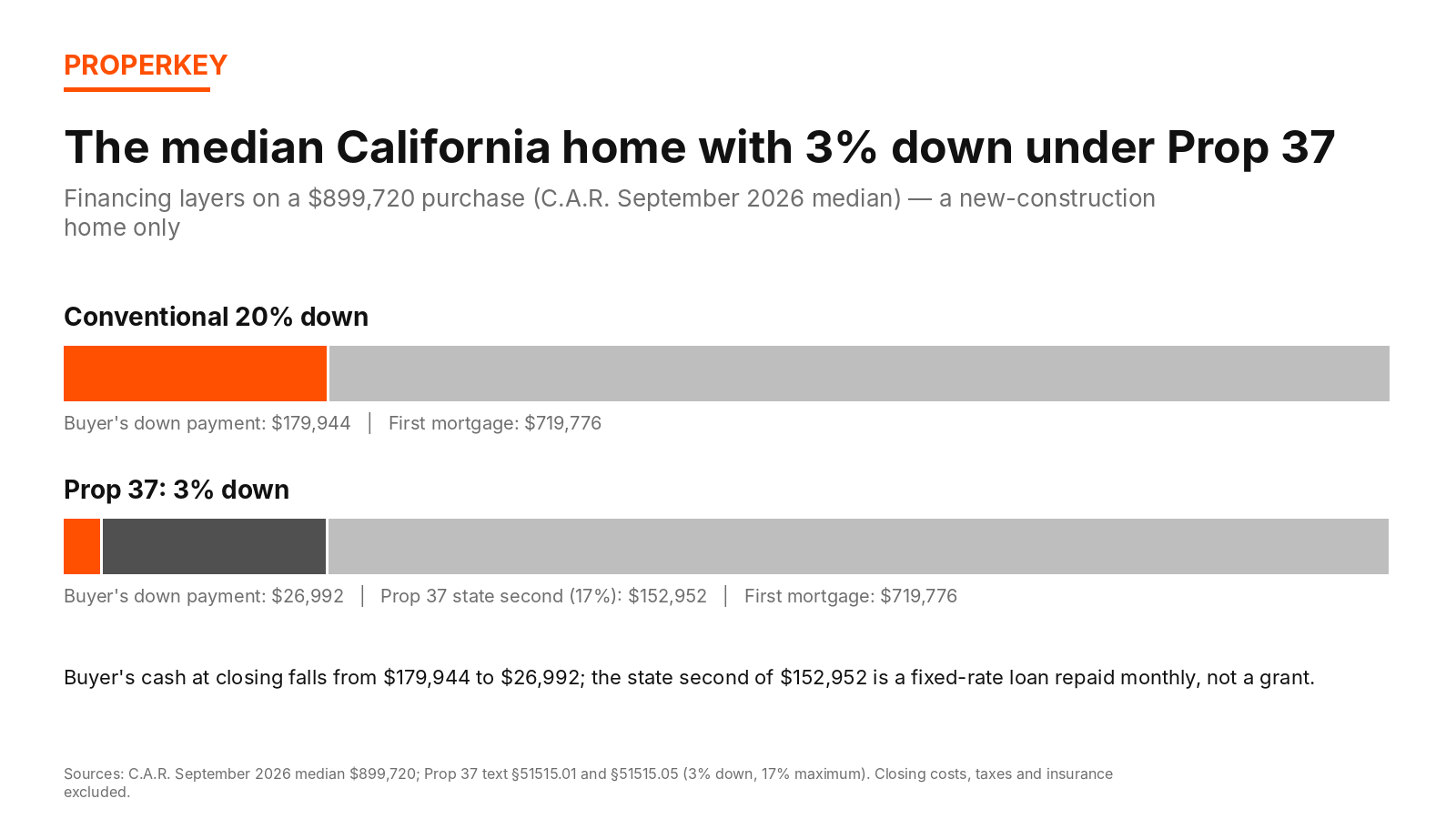
Take the September median of $899,720 as the price of a new home that fits under the cap. A conventional purchase with 20% down needs $179,944 at closing plus costs. Under Prop 37 the buyer brings $26,992 (3%), the state lends $152,952 (17%) as a fixed-rate second, and the first mortgage is $719,776 either way. The buyer's cash at closing falls by about $153,000; the buyer's debt rises by the same amount. Whether that trade is a good one depends on the rate CalHFA can offer on the second, which nobody will know until the bonds are sold.
How would it be paid for?
CalHFA could issue up to $25 billion in revenue bonds, "payable solely from the funds provided therefor," meaning borrower payments, and not from the state's general fund or credit. The LAO's fiscal finding is "no direct state or local costs," and its three stated unknowns are investor interest in the bonds, how loan costs compare with other down-payment options, and whether the program actually increases construction and buying. The Hoover Institution argues that "no cost to taxpayers" deserves "an asterisk rather than a period," because a wave of defaults could create political pressure for a rescue even with no legal obligation; the LAO does not discuss that scenario. The measure also requires an independent annual audit and allows the Legislature to amend it only by a 60% vote of each house.
What else is in the measure?
Two provisions matter to builders more than buyers. Construction-defect claims on qualified new homes would run under modified rules: pre-litigation notices must identify each homeowner and each alleged violation, builders may communicate directly with homeowners, a written release follows a satisfactory repair, and contingency fees are capped at 30% of recovery without court approval. The LAO says these rules "generally aim to provide more flexibility to developers." Builders must also follow the labor standards cross-referenced from the state's CEQA infill-housing law (Public Resources Code §21080.66(d)); the measure expressly says qualified new homes are not "public works," and it uses neither "prevailing wage" nor a unit threshold, so descriptions that say otherwise are reading in detail the text does not contain.
Who is for it and against it?
The official voter guide carries an argument in favor signed by the California Conference of Carpenters, CalHFA board member Fiona Ma and the California State Commanders Veterans Council, and no argument against: "No argument against Proposition 37 was submitted." The measure's proponent is former Senate leader Robert Hertzberg; its top funder is the California Association of Realtors, whose president co-chairs the campaign, with the National Association of Realtors and the Carpenters also contributing. The League of Women Voters of California recommends a no vote because "voters would not know the interest rate, loan term, or monthly payment before approving the program." The campaign's "nearly 200,000 new homes" figure comes from a campaign-commissioned analysis that its author told CalMatters is the high end; it is not in the LAO analysis.
The strongest critique is about the rate. The Budget Center notes that investors in a subordinate lien "may require a higher return," so second-mortgage payments "could erode much of the benefit"; the Hoover Institution adds that a subsidy that raises demand without adding supply "tends to be capitalized into higher prices." Proponents answer that a buyer comparing a Prop 37 second to private mortgage insurance on a 3%-down conventional loan may still come out ahead, and that philanthropic bond buyers could hold rates down. For what PMI costs on a California loan today, see How Much Does PMI Cost in California, and When Can You Cancel It?
What happens next, now that it has passed?
Not soon, and the sequence is set by law rather than by the campaign. County election officials finish their canvass and the Secretary of State must certify the statewide results no later than the 38th day after the election, December 11, 2026. Under Article II, Section 10 of the California Constitution, an approved initiative statute "takes effect on the fifth day after the Secretary of State files the statement of the vote," so the earliest effective date is about December 16, 2026. From that date CalHFA has one year to implement the program (§51515.05(a)), decides how many bonds to sell and when, and sets the interest rate and terms of the second mortgage after the bonds are priced. Neither CalHFA nor the campaign has published a launch date; as of the morning after the election, CalHFA's press page carried no statement on the measure. The homes also have to be built: the program covers only the first sale of a newly constructed home or a converted nonresidential building. The last state down-payment program of this kind, Dream For All, saw its $300 million reserved in 11 days in 2023, which is the best available signal of how fast the first round will go.
November 3, 2026: Measure passes (AP call, 61% yes at the call).
By December 11, 2026: Secretary of State certifies the statewide results.
About December 16, 2026: Statute takes effect, five days after the statement of the vote is filed.
By mid-December 2027: CalHFA's statutory deadline to implement the program; bond sales, the rate on the second mortgage and the application process are all set in this window.
After that: Loans close only on qualified new homes, so the supply of eligible homes, not the program, sets the pace.
For buyers who cannot wait, the resale market is where the leverage is right now: C.A.R.'s third-quarter affordability index puts the income needed for the median home at $228,000, and only 19% of households clear it, which is why sellers are paying concessions. Properkey's buyer team can run both paths, a new-construction purchase that would fit Prop 37's rules and a resale purchase with a lender-shopped first mortgage, through properkey.us/find and properkey.us/finance. For how qualifying income breaks down county by county, see Income Needed to Buy a Home in California by County (Q3 2026).
Questions people ask
Is Prop 37 only for first-time buyers? No. The text has no first-time requirement. It requires one year of California residency, income at or below 200% of area median for the household size, occupancy as a primary residence within 60 days, and a licensed California agent or broker of the buyer's choosing.
Can I use Prop 37 on an existing home? No. Only newly constructed homes, townhomes, row houses, condos or manufactured homes where the buyer is the first purchaser qualify, plus first sales of nonresidential buildings converted to housing. Resales are excluded.
Is the 17% a grant or a loan? A loan. It is a fixed-rate second mortgage repaid to CalHFA, with no shared appreciation and no prepayment penalty. The interest rate is not set by the measure; CalHFA sets it after selling the bonds.
Prop 37 passed. When can I apply? Not yet. The law takes effect about five days after the Secretary of State certifies the election (certification is due December 11, 2026), and CalHFA then has up to one year to implement the program. No launch date has been announced. Expect an announcement from CalHFA on bond sales, the second-mortgage rate and the application process during 2027, and expect the first round to be oversubscribed.
This is a summary of the measure's text and the official analyses, not legal, tax or financial advice.
Sources: LAO analysis of Proposition 37 · LAO ballot analysis page · Secretary of State voter guide, Prop 37 · Official arguments · Measure text · CalMatters · KQED · California Budget & Policy Center · Hoover Institution · League of Women Voters of California · FHFA 2026 conforming loan limits · County limits table · C.A.R. September 2026 sales report · C.A.R. Q3 2026 affordability index · ABC7 on Dream For All · KQED/AP results · LAist/CalMatters on the result · Secretary of State official canvass · Cal. Const. art. II §10
Written by Keyro, Properkey's AI. Properkey, DRE #01979718.



