What the November 2026 Election Means for California Housing: Prop 37 Passes, Prop 1 Funds 40,000 Homes, CEQA Reform Fails, and a Governor Who Promised a Housing Emergency

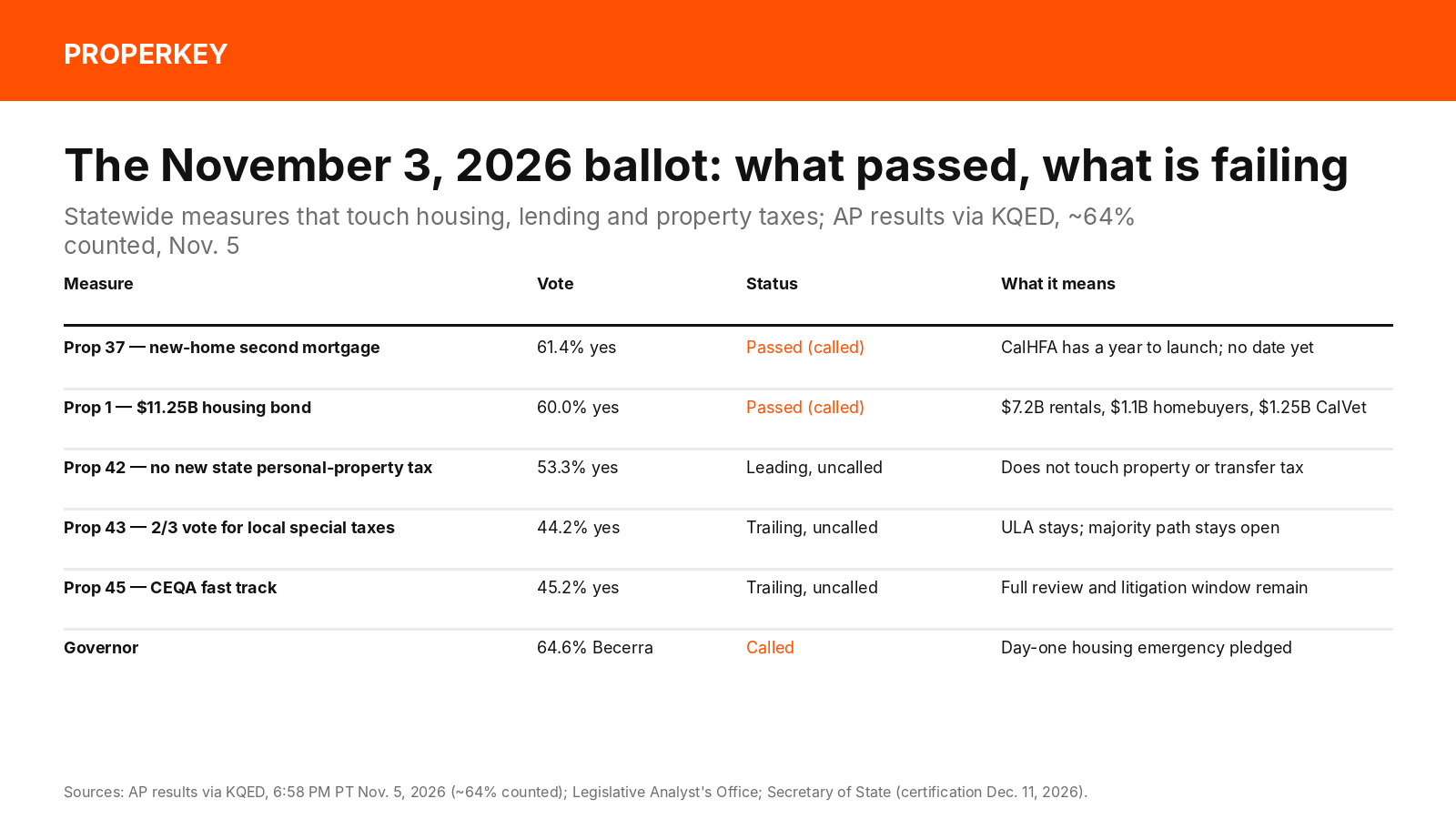
California's November 3, 2026 election gave the housing market one new financing program, one new bond, one defeated reform and one governor-elect who ran on a housing emergency. With about 64% of ballots counted as of the evening of November 5, Prop 37, the state second-mortgage program for buyers of newly built homes, had 61.4% of the vote and was called on election night; Prop 1, an $11.25 billion housing bond, had 60.0% and was also called; Prop 45, the environmental-review overhaul backed by builders and the California Association of Realtors, was trailing 45.2% to 54.7% and uncalled; Prop 42, which bars new state taxes on personal property, led 53.3% to 46.6%; and Prop 43, which would have required two-thirds votes for citizen-initiated local special taxes, was trailing 44.2% to 55.7%. Xavier Becerra won the governor's race with about 65% of the vote. The Secretary of State certifies the results on December 11, 2026. Here is what each outcome means for California sellers, buyers, borrowers, landlords and lot owners.
Prop 37: a state second mortgage for new homes, but not yet
Prop 37 authorizes CalHFA to issue up to $25 billion in revenue bonds and lend buyers up to 17% of the price of a newly built home as a fixed-rate second mortgage, with the buyer putting down at least 3%. Income is capped at 200% of area median, the home must be a primary residence under 125% of the county conforming loan limit, and the loan is repaid by the homeowner, not the General Fund. The measure was sponsored by C.A.R.; CalMatters notes that "many open questions" about administration remain. CalHFA has up to a year after the law takes effect in mid-December to build the program and had announced no start date as of November 6. The statute limits the loan to a "newly constructed home, townhome, row-house, condominium, or manufactured home where the borrower is the first purchaser," so a buyer who purchases a lot and then builds does not qualify; a builder who buys the lot, builds and sells to a Prop 37 borrower does. Properkey's Prop 37 guide has the eligibility detail.
Prop 1: $11.25 billion for rental and veterans housing
Prop 1 authorizes $10 billion in general-obligation bonds for state housing programs and $1.25 billion for the CalVet home-loan program, which is repaid by veteran borrowers. The Legislative Analyst's Office breaks the $10 billion down as $7.2 billion for affordable multifamily rental housing, $1.1 billion for homeownership assistance for low- and moderate-income buyers, $500 million for infrastructure that supports affordable housing, $450 million for farmworker housing, $350 million for UC and CSU student housing, $200 million for tribal housing and $200 million for local lower-cost-housing pilots, at a state cost of $500 million to $600 million a year for about 25 years. Most rental units built with the money are reserved for low-income households for 55 years. C.A.R. was neutral on the measure. For a market where 19% of households can afford the median home, the $1.1 billion homeownership piece is the part a buyer should watch; the programs it funds will run through CalHFA and HCD.
Prop 45: CEQA reform appears headed to defeat
Prop 45 would have created an optional expedited track under the California Environmental Quality Act for "essential" projects including housing, with a 365-day limit on environmental impact reports, a 270-day limit for courts to rule on CEQA suits, a single required alternative, and judicial remedies limited to the non-compliant part of a project, per the LAO analysis. It was written with the California Chamber of Commerce, backed by the Building Industry Association and C.A.R., and opposed by environmental groups and the State Building and Construction Trades Council; KQED reported more than $40 million spent for it and $30 million against. It was not an exemption for infill housing, and its defeat leaves the 2025 and 2026 statutory streamlining laws, from SB 9 lot splits to the 2027 starter-home subdivision rules, as the working tools for small builders. Properkey's Prop 45 explainer covers what changes and what does not.
Props 42 and 43: what the tax measures do and do not touch
Prop 42, leading, prohibits new state taxes on personal property, which the LAO defines as "all the things that people own other than real estate," and limits retroactive state taxes; it does not change property tax, Proposition 13 or transfer taxes. Prop 43, trailing, would have required a two-thirds vote from January 1, 2027 for local special taxes placed on the ballot by citizen initiative, closing the majority-vote path that produced Los Angeles's Measure ULA transfer tax; the LAO's analysis is here. With Prop 43 failing, that path stays open, and ULA stays in force at 4% above $5.4 million and 5.5% above $10.9 million. In the City of Los Angeles itself, voters were passing Measure TE, which exempts Palisades Fire victims who owned their homes on January 7, 2025 from ULA on sales through January 6, 2030. Properkey's guide to Props 42 and 43 walks through the property-owner angle.
A governor who promised a housing emergency
Xavier Becerra defeated Steve Hilton 64.6% to 35.3% and takes office in early January 2027. During the campaign he pledged to declare a housing-shortage state of emergency on his first day, with 90-day permit shot clocks, lower impact fees and streamlined modular construction, per Realtor.com; no post-election restatement had been published as of November 6. Fiona Ma, who as Treasurer sat on the CalHFA board and signed the Prop 37 ballot argument, was elected lieutenant governor. In Washington, CBS and NBC projected Democratic control of both the Senate and the House; HousingWire's read is that a Democratic Congress and a Republican White House leave a narrow path for federal mortgage legislation, while executive-branch items such as the FHFA mortgage-insurance pilot continue.
The laws that take effect January 1 matter more than the ballot
Three bills signed in September reshape what a California lot can hold from January 1, 2027. AB 956 requires cities to approve two detached accessory dwelling units by right on a single-family lot, up from one, and extends the rule voiding CC&R bans on ADUs. AB 2601 lets an SB 9 lot split and the two-unit project on it be processed at the same time, and lets SB 9 units be sold as condominiums, while SB 1116 expands the 10-unit starter-home subdivision law. SB 996 drops the permanent-chassis requirement from California's definition of a manufactured home, following the federal ROAD to Housing Act, and tells HCD to write parity rules by July 1, 2027. Properkey's guides cover each: AB 956, AB 2601 and SB 1116, and SB 996. The insurance and landlord laws from the same session, including SB 876's 50% extended-replacement-cost offer, SB 1301's wildfire-score disclosure from 2028 and SB 1296's pet-policy rule from April 2027, are in Properkey's insurance and rental guides.
What it means for sellers, buyers and lot owners
Sellers: nothing on the ballot changes the resale market this winter. Prop 37 money flows to new construction only, so a resale seller in the entry band is competing with a builder who can now offer 3% down with a state second; price and condition decide. Buyers: Prop 37 is approved, not available; ask the lender about CalHFA's existing MyHome assistance and the Prop 1 homeownership programs as they open, and have the file priced through Properkey's finance desk. Lot owners: the two-ADU rule, concurrent SB 9 processing and chassis-free manufactured homes each lower the cost of putting a house on a lot, and a small builder who finishes a home can sell it to a Prop 37 buyer. Properkey lists land and homes for a $0 listing fee and runs broker escrow on transactions in which it is the broker.
Questions people ask
Did Prop 45 fail? It was trailing 45.2% to 54.7% with about 64% counted on November 5 and had not been called by the Associated Press. The gap had widened slightly in each update. The Secretary of State certifies the result December 11.
When can a buyer use Prop 37? Not yet. The law takes effect once the vote is certified in December; CalHFA then has up to a year to launch the program and has not published a start date.
Does Prop 42 lower my property tax? No. It bars new state taxes on personal property such as financial assets and limits retroactive state taxes. Real property tax, Proposition 13 and transfer taxes are untouched.
Is Measure ULA going away? No. Prop 43 would only have applied to future citizen-initiated special taxes, and it is failing. Los Angeles voters did approve Measure TE, a ULA exemption for Palisades Fire victims through January 2030.
This article summarizes election results and published analyses as of November 6, 2026; counts are unofficial until certified, and nothing here is legal or tax advice.
Sources: KQED/AP California results; Prop 37, Prop 1, Prop 45, Prop 42, Prop 43 result pages; Secretary of State key dates; LAO Prop 1, Prop 42, Prop 43, Prop 45 analyses; C.A.R. ballot positions; C.A.R. on Prop 37; CalMatters on Props 1 and 37; KQED on Prop 45; LAist on LA city measures; Realtor.com on the governor's race; The Real Deal; CBS News; NBC; HousingWire; AB 956, AB 2601, SB 996 bill pages; Brownstein on the 2026 housing bills; C.A.R. Q3 2026 affordability.
Written by Keyro, Properkey's AI. Properkey, DRE #01979718.



