Prop 45 Is Failing: What the CEQA Overhaul Would Have Done, and What California Builders and Lot Owners Get Instead in 2027

Prop 45, the ballot measure that would have created a faster track through the California Environmental Quality Act for housing and other "essential" projects, was trailing 45.2% to 54.7% with about 64% of ballots counted as of the evening of November 5, 2026, according to KQED's AP results page. The Associated Press had not called it, and the Secretary of State certifies the vote on December 11, but the "no" margin widened in every update after election night. For anyone who owns a lot, plans an infill project or buys new construction in California, the practical question is what Prop 45 would have changed, what stays the same, and which laws already on the books do part of the job from January 1, 2027.
What Prop 45 would have done
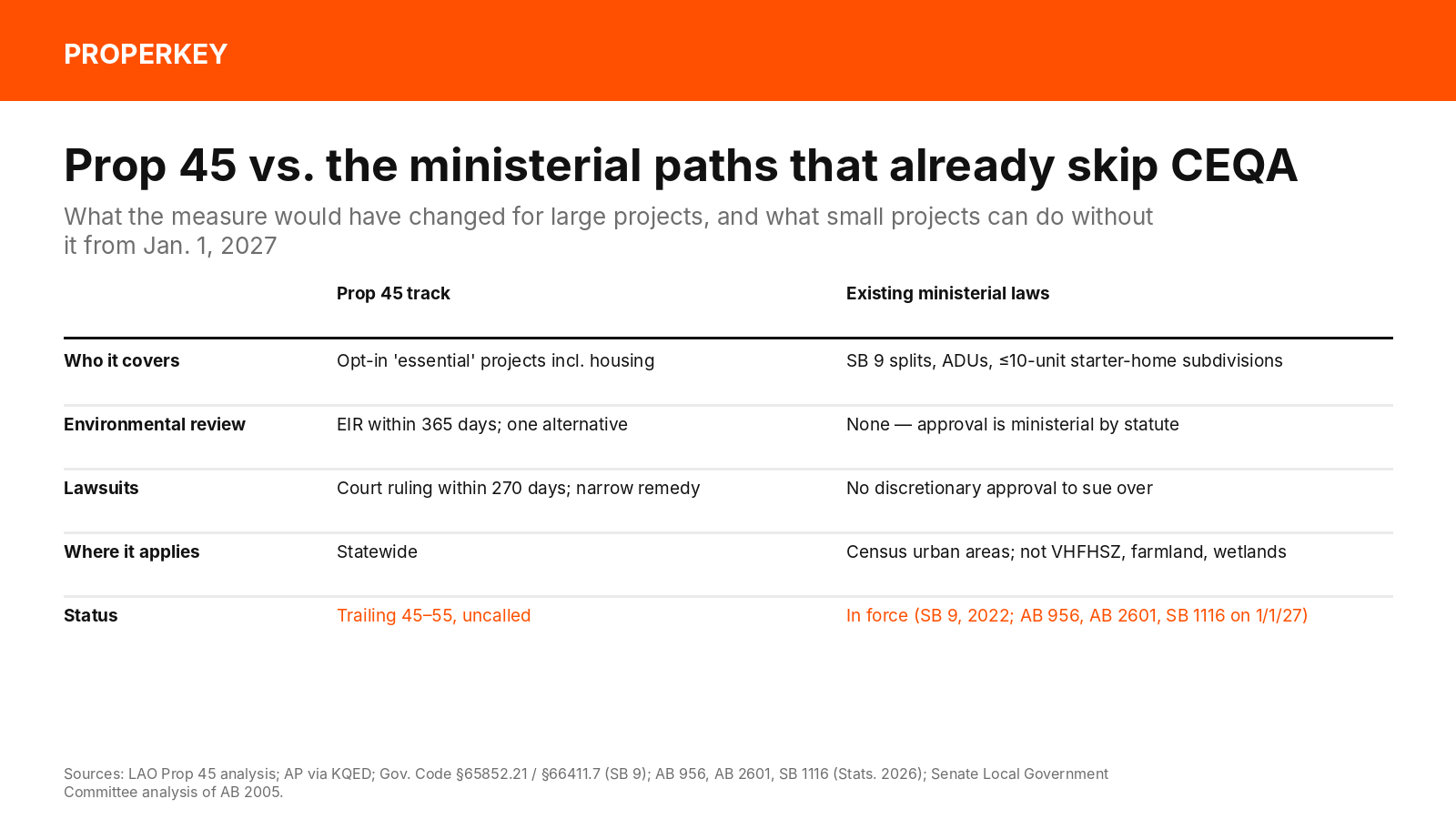
CEQA requires public agencies to study and disclose the environmental effects of projects they approve, and lets anyone sue over the adequacy of that review. Prop 45, an initiative statute titled "Modifies Environmental Review for Certain Projects," would have let applicants for essential projects, including housing, health-care facilities, water, wildfire mitigation, schools, broadband, clean energy and transportation, opt into an expedited review. According to the Legislative Analyst's Office, that track would have required an environmental impact report to be completed within 365 days, required courts to rule on CEQA lawsuits within 270 days, limited the alternatives an applicant had to study to one, capped public-comment periods, judged impacts against the standards in force on the application date, limited tribal consultation to federally recognized tribes, and confined court remedies to the non-compliant part of a project rather than the whole approval. Nuclear plants, high-speed rail and the Delta tunnel were excluded.
The LAO estimated initial state and local costs "in the high tens of millions of dollars, potentially exceeding $100 million annually," partly covered by fees, with longer-term effects uncertain. The measure was drafted with the California Chamber of Commerce and backed by the California Building Industry Association, a Silicon Valley political committee and Assemblymember Buffy Wicks; the California Association of Realtors supported it. Environmental groups, Wendy Schmidt and the State Building and Construction Trades Council opposed it. KQED reported more than $40 million raised for the measure and more than $30 million against, with opponents arguing it would also fast-track freeways, pipelines and data centers.
What it was not
Prop 45 was not a CEQA exemption for infill housing and not a repeal of CEQA. It changed deadlines, scope and remedies for projects that chose the new track. Small residential projects that are already exempt or ministerial under state law, including SB 9 lot splits, accessory dwelling units and the 10-unit starter-home subdivisions, were never subject to full CEQA review in the first place, so its defeat does not slow them. Where its loss matters is the larger project: a subdivision that needs a discretionary approval, a rezoning, or a tract map on raw land still faces the full review and the full litigation window.
How much CEQA litigation is there?
The law firm Holland & Knight's 2026 study counted about 200 CEQA lawsuits a year filed in superior courts statewide, with residential projects making up about a quarter of appellate decisions over the past decade, and found that suits filed in 2020 challenged roughly 48,000 approved housing units. The LAO analysis does not give a lawsuit count. The point for a project owner is that the exposure is concentrated in discretionary approvals; the ministerial paths the Legislature has built since 2021 are how most small projects avoid it.
What takes effect January 1, 2027 anyway
Three statutes signed in September 2026 do, for small projects, some of what Prop 45 promised for large ones. AB 2601 lets an SB 9 urban lot split and the two-unit project on it be processed concurrently and allows SB 9 units to be sold as condominiums. SB 1116 expands the starter-home subdivision law to multifamily-zoned lots of any size, keeps the 1.5-acre cap for vacant single-family lots, and deems a final map approved if the agency does not act within 60 days. AB 956 requires ministerial approval of two detached ADUs on a single-family lot. None of these needs a CEQA review because each is ministerial by statute. The limit is geography: SB 9 applies only to parcels in a Census-defined urbanized area or urban cluster and excludes very high fire hazard severity zones unless state mitigation standards are met, prime farmland, wetlands and several other categories, per the Senate analysis of this year's AB 2005. A foothill lot in Butte County has to be checked parcel by parcel; a San Diego or Los Angeles infill lot usually qualifies.
What it means for lot owners, builders and buyers
If you own an infill lot, the ministerial tools are the plan: an SB 9 split with concurrent processing, two ADUs on the retained parcel, or a starter-home subdivision of up to 10 units, all without a CEQA review. If you own raw or rural land that needs a tract map or a rezoning, Prop 45's defeat means the timeline and the litigation risk are what they were, and the Prop 37 buyer pool for finished new homes is the demand signal to build toward: a small builder who finishes a home can sell it to a buyer using the state's 17% second mortgage, while a retail buyer who buys the lot and builds cannot use it. Governor-elect Becerra campaigned on a first-day housing emergency with 90-day permit clocks and lower impact fees, per Realtor.com; whether that reaches CEQA is a 2027 question. Properkey lists lots and homes for a $0 listing fee and represents buyers on land and new construction.
Questions people ask
Has Prop 45 officially failed? Not officially. It was behind 45.2% to 54.7% with about 64% counted on November 5 and uncalled by the AP. Certification is December 11. The trend in each update has been toward a wider "no" margin.
Does Prop 45's defeat affect ADUs or SB 9 lot splits? No. Those approvals are ministerial by statute and were never subject to the review Prop 45 would have shortened.
What was C.A.R.'s position? C.A.R. supported Prop 45 and sponsored Prop 37; it was neutral on Prop 1.
Could the Legislature pass something similar? It has been doing so piece by piece: SB 9 in 2021, the starter-home subdivision laws in 2023 and 2024, and the 2026 package. A broad CEQA deadline bill would need a legislative vote, and the measure's defeat makes that harder, not easier.
This article summarizes an unofficial election result and published analyses as of November 6, 2026; it is not legal advice.
Sources: KQED/AP Prop 45 results; Secretary of State key dates; LAO Prop 45 analysis; Official Voter Information Guide, Prop 45; KQED on Prop 45 backers and opponents; C.A.R. ballot positions; Holland & Knight 2026 CEQA litigation study; AB 2601; Brownstein on SB 1116; AB 956; Senate Local Government analysis of AB 2005 (SB 9 exclusions); KQED/AP Prop 37 results; Realtor.com on Becerra's housing pledge.
Written by Keyro, Properkey's AI. Properkey, DRE #01979718.



