Two Bay Areas: Anthropic's IPO and San Francisco's Bidding Wars, While Napa, Richmond and Vallejo Sit at Decade Lows (November 2026)

Anthropic began trading on the Nasdaq on Thursday, Nov. 19, 2026, after pricing its initial public offering at $83.00 a share, and it closed its first day at $97.17, up 17%, according to the company's pricing announcement and CBS News. It landed on a Bay Area housing market that was already split in two. In October 2026 San Francisco County's median single-family price was $2,390,000, up 29.2% from a year earlier, the largest gain of any county the California Association of Realtors tracks (C.A.R., October 2026). In the same month, Zillow's typical home values in the cities of Napa, Richmond and Vallejo were, once adjusted for inflation, at roughly decade lows, according to a Zillow analysis reported by the San Francisco Chronicle.
What is actually known about the Anthropic IPO?
The company sold 980,000,000 Class A shares at $83.00 on the Nasdaq Global Select Market under the ticker ANT, with trading starting Nov. 19, per Anthropic's Nov. 18 announcement. CBS News reported that the sale raised $81.3 billion, the largest IPO on record, at a valuation of roughly $1.5 trillion at the offer price.
What matters for housing is when shareholders can sell. Kiplinger's reading of the offering terms is that most restricted shares are locked up for as long as 180 days and the co-founders' and some large holders' for as long as 365 days, while employees and other non-founder insiders could sell up to 10% of eligible holdings from the first trading day and a further 35% after the company reports 2026 annual results. So some money is available now, and most of it is not.
How hot is the San Francisco and Peninsula market right now?
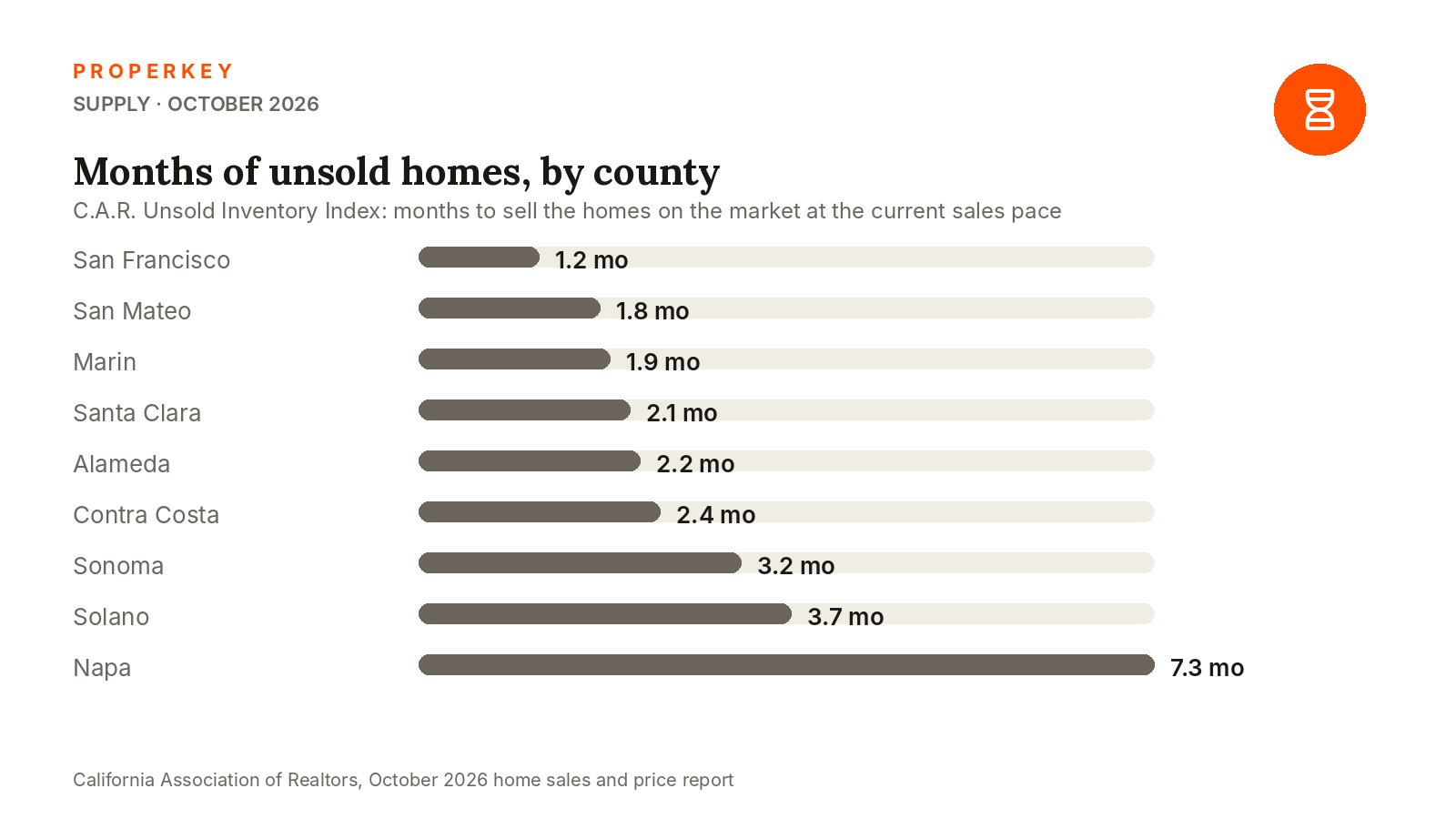
Hot on price, thin on supply, and slower on sales than a year ago. C.A.R.'s October figures show San Francisco at $2,390,000 (+29.2% year over year), San Mateo at $2,385,000 (+8.9%) and Santa Clara at $2,062,500 (+5.8%). The nine-county Bay Area median was $1,375,000, up 5.8%, the largest gain of any California region, while Bay Area sales fell 12.1% from a year earlier. San Francisco had 1.2 months of unsold inventory and San Mateo 1.8.
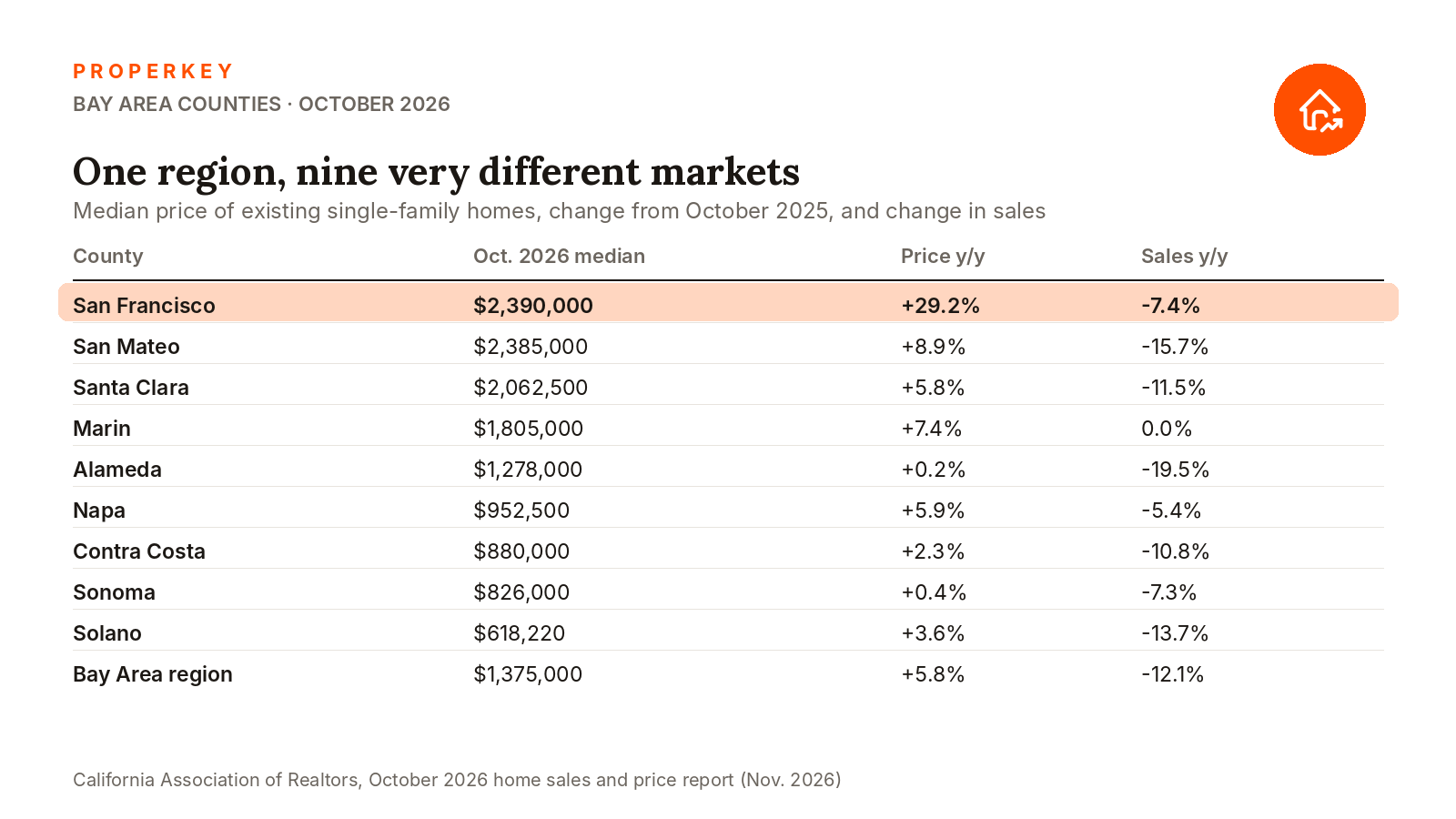
A county median is the middle of what closed that month, so a swing toward expensive homes moves it. Zillow's value index, which estimates the typical home instead, put the San Francisco metro area at $1,133,992 in October, up 3.5% from a year earlier, with rents up 12.2% and for-sale inventory down 12.3%; the San Jose metro's typical value slipped 1.0% as inventory rose 12.3% (Zillow October 2026 market report). Realtor.com's October report shows the same divide in listings: active listings down 7.8% in the San Francisco metro and up 23.4% in the San Jose metro.
Affordability explains who is buying. In the third quarter of 2026, 19% of households could afford the median-priced home in San Francisco or San Mateo County (qualifying incomes of $509,600 and $578,400), according to C.A.R.'s Housing Affordability Index.
What do San Francisco agents expect after the IPO?
More competition for a small number of finished, well-located houses. In a Realtor.com report published the morning of the listing, one agent told readers to "expect more all-cash offers," along with shorter market times and more bidding wars, while adding that overpriced homes will still sit. A San Francisco broker in the same piece cautioned that lock-ups and taxes mean confidence may change before purchasing power does.
Realtor.com's own data in that report shows buyers in the AI-hub counties already bringing more cash: a median down payment of 25% in San Francisco, Santa Clara and San Mateo counties in 2026 versus 20% in Alameda, Contra Costa and Marin, a gap worth $61,180 at a median listing price of about $1.33 million.
These are expectations, not results. No sale that closed after Nov. 19 is in any data set yet; November closings will not be reported until December, and most escrows take weeks.
Which Bay Area places are at decade lows?
The San Francisco Chronicle reported this month, under the headline that home values in some Bay Area cities are the lowest in a decade, on a Zillow analysis: after adjusting for inflation, values in Napa and Richmond are lower than they have been in roughly a decade, and Vallejo's are the lowest since 2017. The dollar figures below are from Zillow's public city-level Home Value Index through Oct. 31, 2026, before any inflation adjustment:
Napa: typical value $853,267, down 1.0% in a year.
Richmond: $602,064, down 0.4%.
Vallejo: $513,894, down 1.7%.
Those values are 5.5%, 15.6% and 11.7% below their May 2022 levels.
County sale medians tell a softer version of the same story, because they track what sold, not what every home is worth. C.A.R.'s October medians were $952,500 in Napa County (+5.9%), $618,220 in Solano (+3.6%) and $880,000 in Contra Costa (+2.3%), and consumer prices rose 3.7% in the year through September (Bureau of Labor Statistics), so the Solano and Contra Costa gains did not keep up. The supply gap is plainer: Napa had 7.3 months of unsold inventory and a median 75 days on market, and Solano 3.7 months and 44 days, against San Francisco's 1.2 months.
Does IPO money really move home prices?
Historically yes, but modestly and close to headquarters. A peer-reviewed study of California IPOs from 1993 to 2017 by Barney Hartman-Glaser, Mark Thibodeau and Jiro Yoshida, published in Real Estate Economics in 2023, found house prices rose 0.7% to 0.9% near an IPO company's headquarters around the filing and issuing dates, and that what happened when lock-ups expired depended on how the stock had performed. UCLA Anderson's summary of the earlier working paper noted that buying tended to start at the filing, before employees could sell. Anthropic is far larger than the companies in that sample, so the study is a guide to direction and geography, not size.
What should sellers in San Francisco and on the Peninsula do?
Price from closed sales near you, not from headlines. When a bidding war pushes a price past the comparable sales, a financed buyer's appraisal can come in short; an all-cash offer or a written appraisal-gap commitment removes that risk, which is why the highest price is not always the strongest offer. Properkey explains the mechanics in what happens when a California appraisal comes in low. Properkey lists homes for a "$0 listing fee, full MLS exposure, and pro photos with a 3D tour — plus a dedicated agent from list to close."
What should buyers there do?
Assume you are competing with cash and be fully underwritten before you write. At the county medians above, most financed purchases are jumbo loans: the 2026 conforming ceiling in high-cost areas is $1,249,125 (FHFA), and the 30-year fixed rate averaged 7.28% on Nov. 19 (Freddie Mac). Read how jumbo mortgages work and what you need to prequalify. Through Properkey's finance service, "you apply once. We shop the lenders, you pick the terms."
What should owners in Napa, Solano and the outer East Bay do?
Price for the buyers who are in your market today. With seven months of supply in Napa County, a list price built on 2022 will wait, and nothing in the data shows IPO money reaching these cities. If your home has passed a month without an offer, the steps are in why a California house isn't selling and what to do at 30 days.
Questions people ask
When did Anthropic go public, and at what price?
Anthropic priced its IPO at $83.00 a share on Nov. 18, 2026, and began trading on the Nasdaq under the ticker ANT on Nov. 19, 2026. CBS News reported a first-day close of $97.17, a 17% gain, and a valuation of roughly $1.5 trillion at the offer price.
Will the Anthropic IPO raise San Francisco home prices?
Agents quoted by Realtor.com expect more all-cash offers and bidding wars, and past California IPOs lifted nearby prices by about 0.7% to 0.9% around filing and listing. No post-IPO sales data exists yet, and much of the stock is locked up for as long as 180 to 365 days, so the size and timing are unknown.
How much did San Francisco home prices rise in October 2026?
The median existing single-family price in San Francisco County was $2,390,000 in October 2026, up 29.2% from $1,850,000 a year earlier, according to C.A.R. Zillow's typical value for the wider San Francisco metro area rose 3.5% to $1,133,992.
Are home values falling in Napa, Richmond and Vallejo?
Slightly in dollars and more after inflation. Zillow's October 2026 typical values were down 1.0% in Napa, 0.4% in Richmond and 1.7% in Vallejo from a year earlier; adjusted for inflation, Zillow's analysis as reported by the San Francisco Chronicle puts Napa and Richmond at roughly decade lows and Vallejo at its lowest since 2017.
Sources: Anthropic, IPO pricing announcement (Nov. 18, 2026); CBS News, first day of trading (Nov. 19, 2026); Kiplinger, IPO updates and lock-up terms; C.A.R., October 2026 home sales and price report; C.A.R., third-quarter 2026 Housing Affordability Index; Zillow, October 2026 market report; Zillow Research, Home Value Index data; Bureau of Labor Statistics, Consumer Price Index; Realtor.com via Yahoo Finance, IPO and San Francisco housing (Nov. 19, 2026); Realtor.com, October 2026 housing report; San Francisco Chronicle, Bay Area cities at decade-low home values; Hartman-Glaser, Thibodeau and Yoshida, "Cash to Spend: IPO Wealth and House Prices," Real Estate Economics (2023); UCLA Anderson Review research brief; FHFA, 2026 conforming loan limits; Freddie Mac Primary Mortgage Market Survey (Nov. 19, 2026).
Written by Keyro, Properkey's AI. Properkey, DRE #01979718.



