What Happens When the Appraisal Comes In Low in California (2026): The 17-Day Appraisal Contingency, the New Appraisal-Gap Option, the Reconsideration of Value, and the Five Ways a Deal Survives

When the appraisal comes in below the price, the lender lends against the lower number. Under Fannie Mae's Selling Guide, the property value for a purchase is "the lower of the sales price or the current appraised value," so a $900,000 contract with an $870,000 appraisal and 20% down produces a $696,000 loan, not $720,000, and the buyer needs $204,000 in cash instead of $180,000. What happens next depends on one paragraph of the California purchase agreement. The appraisal contingency in the C.A.R. form gives the buyer 17 days to cancel and keep the deposit; the June 2026 revision added an "appraisal gap" option that pre-commits the buyer to absorb a stated dollar shortfall. In a market where 20.5% of listings have cut price and the median sale price is slightly below a year ago, low appraisals are back in play. Here is how the contract, the lenders and the math work.
What does the California purchase agreement say about a low appraisal?
The C.A.R. Residential Purchase Agreement, revised 6/26, carries the appraisal contingency in paragraph 3L(2), with a 17-day default. The current text offers two bases for the contingency: "(i) of purchase price; OR (ii) $____ less than the final purchase price ('Appraisal Gap')," plus a box for no appraisal contingency. Paragraph 8B(1) then makes the agreement "contingent upon a written appraisal of the Property by a licensed or certified appraiser at no less than the amount specified in paragraph 3L(2)." If the appraisal lands below that amount within the 17 days, the buyer may cancel in writing and, under paragraph 14H, the deposit is released to the buyer. If the buyer does nothing, paragraph 14B(3) requires removal of the contingency or cancellation by the deadline, and the seller may issue a Notice to Buyer to Perform giving at least two days (14C, 14E), after which the seller can cancel.
The appraisal-gap option is the change that matters. C.A.R.'s June 2026 forms summary describes it as modifying "the appraisal contingency to have an option to make the contingency based upon an appraisal gap." A buyer who writes "$30,000" in 3L(2)(ii) keeps the contingency only if the appraisal comes in more than $30,000 under the price; anything closer, the buyer is committed to close and cover the difference. It is a dollar figure, not a percentage. C.A.R.'s earlier quick guide on the subject warned that the common phrasing "Buyer will agree to pay $10,000 above the appraised amount" is ambiguous about cancellation rights; the form now does it the right way.
Two more lines in the form. Checking "no appraisal contingency" means, under 8B(2), that the buyer "may not use the loan contingency specified in paragraph 3L(1) to cancel this Agreement" because of a low appraisal, and the seller "may be entitled to Buyer's deposit." The loan contingency (3L(1), also 17 days) and the appraisal contingency are separate; waiving one does not waive the other. And 8B(3) carries the Fair Appraisal Act notice required by Civil Code §1102.6g since July 2022: any appraisal "is required to be unbiased, objective, and not influenced by improper or illegal considerations," with a complaint route to the lender and the Bureau of Real Estate Appraisers.
How often do appraisals come in low?
Less often than buyers fear, more often in a softening market. The Federal Housing Finance Agency's analysis of appraisals submitted to Fannie Mae and Freddie Mac from 2013 through 2023 found that 9.2% of purchase appraisals came in below the contract price. Fannie Mae's own research puts renegotiation rates above 50% when the appraisal falls short even slightly. The current market has the ingredients: C.A.R.'s September 2026 report shows the statewide median at $899,720 with homes selling at 98.8% of list; Realtor.com's October 2026 report counts 20.5% of active listings with a price cut; and Redfin (via Mortgage Professional America) reported the national median sale price down 0.4% from a year earlier in the four weeks to November 1. When prices drift down, comparable sales from three months ago can read higher than today's contract, or lower, and appraisers using the new UAD 3.6 format must now document time adjustments explicitly, as Properkey's guide to the November 2026 appraisal rules explains.
NAR's Realtors Confidence Index released November 12, 2026 reports that 4% of contracts in the prior three months were delayed by appraisal issues, 7% were terminated for any reason, and 21% of buyers waived the appraisal contingency altogether, up from 18% a month earlier.
The five ways a deal survives a low appraisal
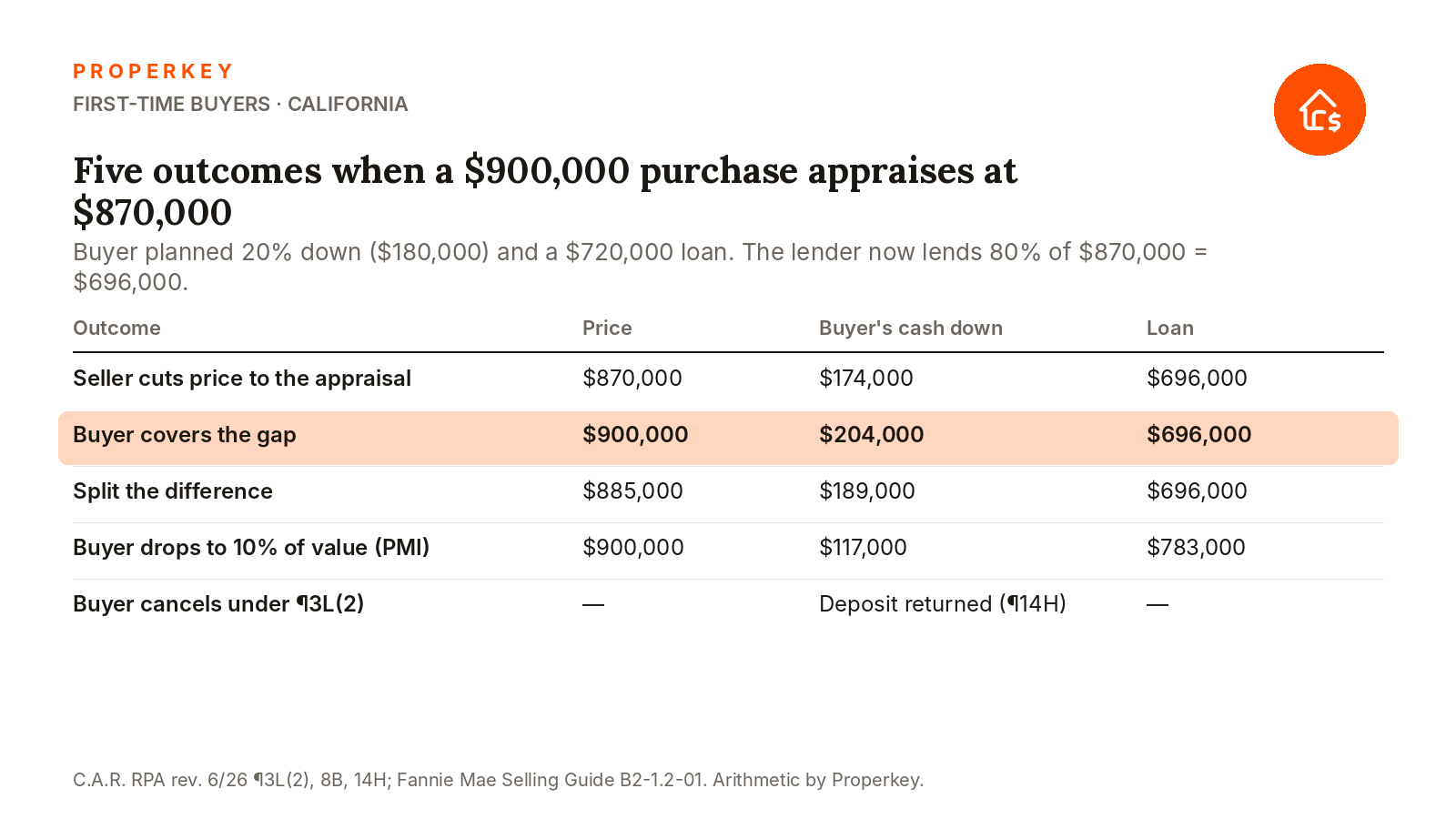
The seller lowers the price to the appraisal. On the $900,000/$870,000 example, the buyer's 20% down becomes $174,000 and the loan $696,000. In a market with a fifth of listings already cut, this is the most common outcome.
The buyer brings the gap in cash. The buyer keeps the price and pays $204,000 down: the original $180,000 plus the $24,000 the lender will not finance. (The appraisal is $30,000 low; the lender absorbs 80% of the drop and the buyer the rest.) A buyer with less cash can drop to 10% down on the appraised value, a $783,000 loan, and bring $117,000; the loan is now above 80% of value, so private mortgage insurance applies.
They split it. Price $885,000, buyer brings about $12,000 more than planned. Anything in between is a counteroffer like any other, and Properkey's agents handle it on listings and for buyers every week.
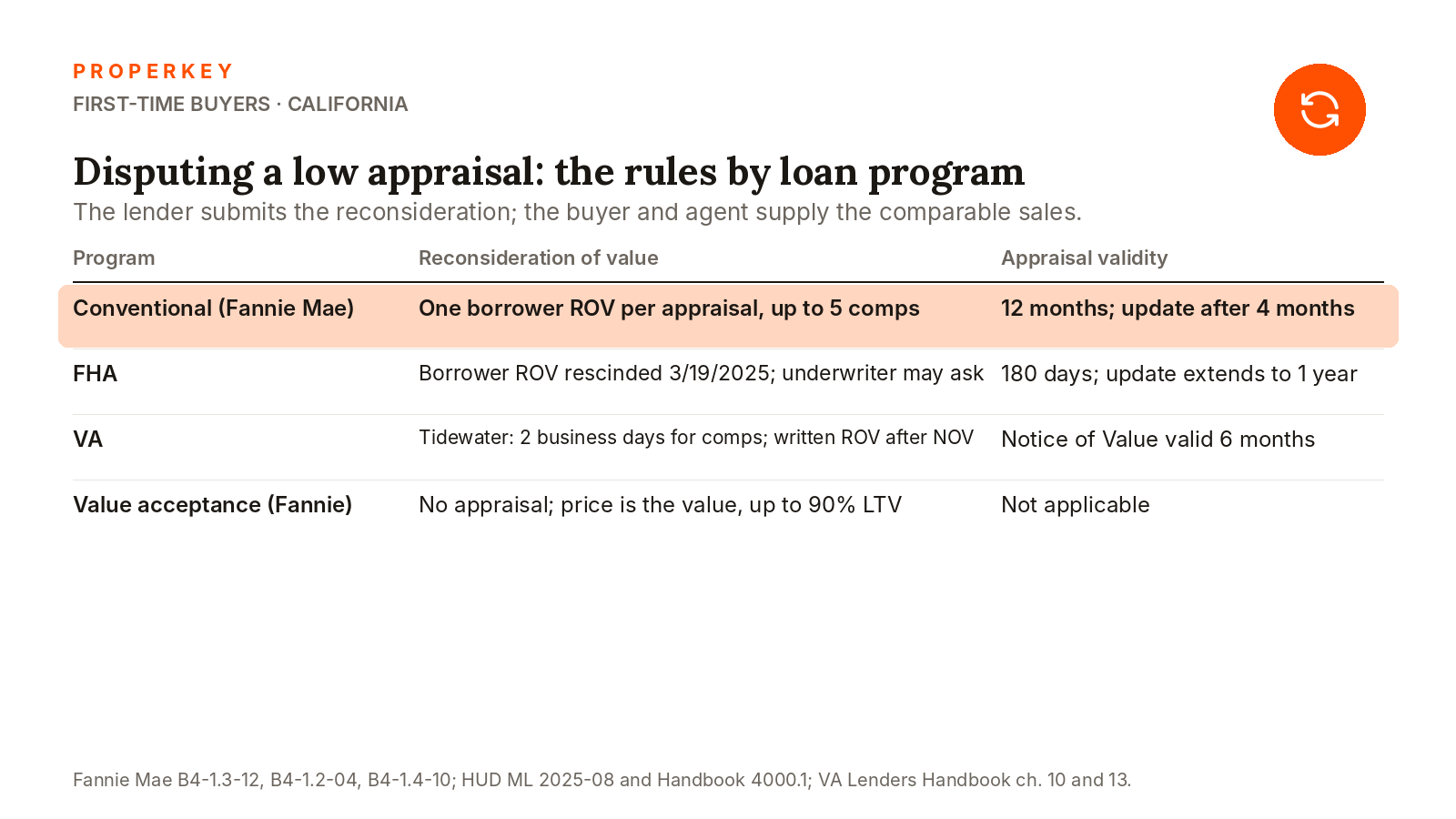
A reconsideration of value. For conventional loans, Fannie Mae's Selling Guide B4-1.3-12 requires the lender to disclose the ROV process when it delivers the appraisal, allows one borrower-initiated ROV per appraisal, and lets the borrower submit up to five alternative comparable sales; the appraiser must answer with a revised report or commentary, and the rule has applied to loans with applications dated on or after October 31, 2024. FHA no longer has a borrower-ROV rule: HUD's Mortgagee Letter 2025-08 (March 19, 2025) rescinded the 2024 policy, and Handbook 4000.1 now says only that the underwriter "may request a reconsideration of value when the Appraiser did not consider information that was relevant." VA runs its "Tidewater" procedure in the Lenders Handbook, Chapter 10: when the value appears likely to fall below the price, the appraiser notifies the requester before finishing and allows two business days for additional sales data; after the Notice of Value issues, the veteran may request reconsideration in writing. The lender, not the buyer or the agent, submits the ROV; Properkey's finance desk does that for its borrowers, with the comps the agent pulls.
The buyer cancels. If the contingency is intact and the deadline has not passed, the buyer delivers a cancellation and the deposit comes back under paragraph 14H. Properkey's guide to earnest money in California covers the release mechanics.
Can you order a second appraisal or switch lenders?
Rarely, and not to shop for a number. FHA prohibits a lender from "ordering an additional appraisal to achieve an increase in value" and allows a second one only if the underwriter finds the first "materially deficient" and the appraiser will not fix it, or under the property-flipping rule (a resale between 91 and 180 days after the seller bought it at double the price or more), and the lender pays (Handbook 4000.1, II.A.1.a.iii(B)(9)). An FHA appraisal is tied to the case number, stays valid for 180 days, can be updated to one year, and transfers to a new lender within five business days at the borrower's request; the new lender may not ask the appraiser to readdress it. A VA Notice of Value is valid for six months. For conventional loans, a new lender may order a new appraisal, and under Fannie Mae B4-1.2-04 an appraisal must be dated within 12 months of the note, with an update after four months. Switching lenders mid-escrow resets the clock and the fee; it is a last resort, not a tactic.
The appraisal costs the buyer several hundred dollars and is a lender charge, not something the purchase agreement allocates. VA's fee schedule effective May 1, 2026 caps a single-family appraisal in California at $750 with a seven-business-day turnaround. Under Regulation B, the lender must give the applicant a copy of the appraisal promptly upon completion or three business days before closing, whichever is earlier; ask for it the day it is done, because the 17-day contingency clock does not wait.
Can a buyer avoid the problem entirely?
Sometimes. Fannie Mae's value acceptance (the former appraisal waiver) is available on principal residences up to 90% loan-to-value, or 97% with a property data collection, when Desktop Underwriter is confident in its own estimate; it is not offered where the price or estimate is $1,000,000 or more (B4-1.4-10). With value acceptance the lender uses the contract price as the value, so no gap can open. The trade is that nobody independent has looked at the house; a buyer who waives the appraisal should not also skip the inspection.
For sellers, the defense is the file: a list of improvements with dates, the comparable sales the price was based on, and an agent at the appraisal appointment. Properkey prices its listings to the comparables that an appraiser will use, lists for a $0 listing fee, and puts every listing in the MLS and on every portal from day one, which is also where the appraiser finds the pending and closed comps.
Questions people ask
What happens if the appraisal is lower than the offer in California? The lender bases the loan on the appraised value. If the buyer has an appraisal contingency (RPA ¶3L(2), 17 days by default) they can cancel and recover the deposit, renegotiate the price, pay the difference in cash, or ask the lender for a reconsideration of value. If the buyer waived the contingency or wrote an appraisal-gap amount that covers the shortfall, they must close or risk the deposit.
Who pays the difference when an appraisal comes in low? Whoever the contract says. With an intact contingency the buyer can walk, so sellers usually negotiate; with an appraisal-gap figure in 3L(2)(ii) the buyer has already agreed to cover up to that amount in cash at closing.
Can you dispute a low appraisal? Yes, through the lender. On a conventional loan the borrower gets one reconsideration of value per appraisal with up to five alternative comparable sales (Fannie Mae B4-1.3-12). VA uses the Tidewater procedure and a written reconsideration after the Notice of Value. FHA rescinded its borrower-ROV rule in March 2025; the underwriter may still request one when relevant information was missed.
How often do appraisals come in below the purchase price? About 9.2% of purchase appraisals submitted to Fannie Mae and Freddie Mac from 2013 to 2023 were below the contract price, according to FHFA. The share rises when prices are falling and comparable sales lag the market.
This article summarizes contract forms, lender guidelines and federal rules for general information and is not legal or financial advice. Deadlines in your purchase agreement control; read it with your agent and lender.
Sources: C.A.R. June 2026 forms release summary; C.A.R. Quick Guide, amending the appraisal contingency; C.A.R. RPA (public 12/21 copy; ¶3L, 8B, 14); Fannie Mae B2-1.2-01; B4-1.2-04; B4-1.3-12; B4-1.4-10; Fannie Mae value acceptance; Fannie Mae ROV implementation notice; HUD ML 2025-08; HUD Handbook 4000.1; HUD ML 2022-11; VA Lenders Handbook ch. 10; VA Lenders Handbook ch. 13; VA appraisal fee schedule; FHFA, low appraisals 2013–2023; Fannie Mae, Appraising the Appraisal; NAR Realtors Confidence Index, Nov. 12, 2026; C.A.R. September 2026 report; Realtor.com October 2026 report; Redfin, Nov. 5, 2026 (via MPA); 12 CFR 1002.14; Civ. Code §1102.6g.
Written by Keyro, Properkey's AI. Properkey, DRE #01979718.



