The Home Inspection Contingency in California (2026): The 17-Day Default, What an Inspection Covers, the Request for Repair, and What Happens If You Walk

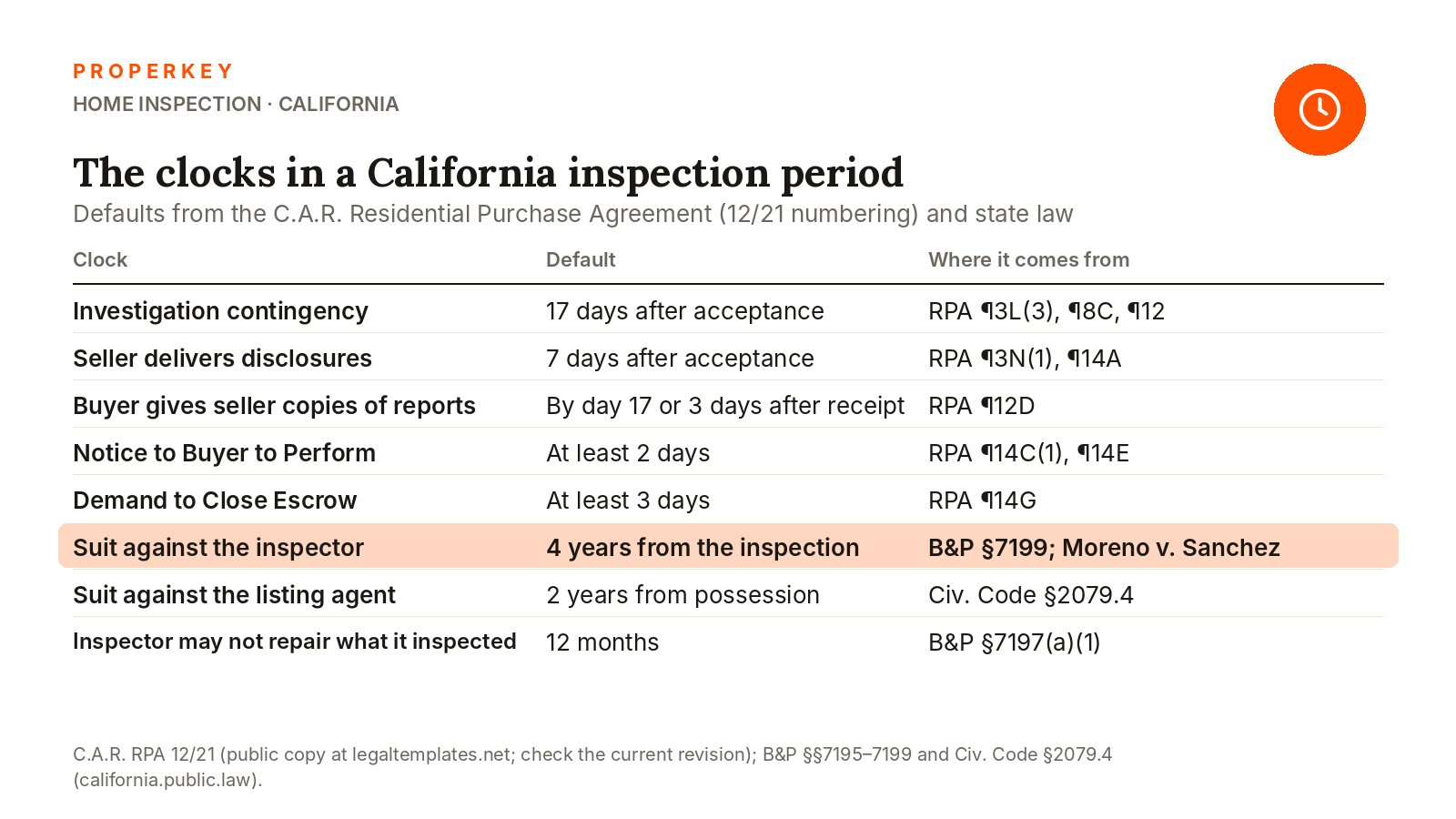
Under the California Association of Realtors purchase agreement, a buyer has 17 days after acceptance, unless the parties write in a different number, to inspect the property and either remove the investigation contingency or cancel and get the deposit back. That is paragraph 3L(3) of the Residential Purchase Agreement (public 12/21 copy; the form has been revised since, most recently in 2025, with the structure intact). In October 2026, 19% of buyers nationally waived the inspection contingency and 7% of contracts were terminated, according to the National Association of Realtors' Realtors Confidence Index released November 12. Here is what the contingency lets you do, what a California home inspection is and is not, how the request for repair works, what the seller must and need not do, and the clocks that run when either side stops performing.
What the contingency covers
Paragraph 8C makes the contract "contingent upon Buyer's acceptance of the condition of, and any other matter affecting the Property," and paragraph 12 spells out the buyer's investigation: "the right, at Buyer's expense unless Otherwise Agreed, to conduct inspections, investigations, tests, surveys and other studies." Paragraph 12B lists them: a general home inspection; an inspection for lead-based paint; an inspection "specifically for wood destroying pests and organisms," which must be done by a registered structural pest control company and reported in Section 1 (evident infestation) and Section 2 (conditions likely to lead to it); "any other specific inspections"; and a review of the seller's reports and disclosures, including the Transfer Disclosure Statement. One item buyers forget is in paragraph 8A(2): "Buyer's ability to obtain insurance for the Property, including fire insurance, is part of Buyer's Investigation of Property contingency." In a fire-zone purchase, the insurance quote is an inspection.
There are limits. Paragraph 12C: "Without Seller's prior written consent, Buyer shall neither make nor cause to be made: (i) invasive or destructive Buyer Investigations, except for minimally invasive testing required to prepare a Pest Control Report … or (ii) inspections by any governmental building or zoning inspector or government employee, unless required by Law." A buyer who wants to open a wall, core a slab or call the city needs the seller's permission. Paragraph 12D obliges the seller to "have water, gas, electricity and all operable pilot lights on for Buyer's Investigations and through the date possession is delivered," and obliges the buyer to give the seller free copies of every report by the contingency deadline or three days after receiving it, whichever is later, "which obligation shall survive the termination of this Agreement." Paragraph 12E requires the buyer to "repair all damage arising from Buyer Investigations" and indemnify the seller.
What a California home inspection is
California defines it by statute. Business and Professions Code §7195: a home inspection is "a noninvasive, physical examination, performed for a fee in connection with a transfer … of the mechanical, electrical, or plumbing systems or the structural and essential components of a residential dwelling of one to four units designed to identify material defects in those systems, structures, and components." A "material defect" is "a condition that significantly affects the value, desirability, habitability, or safety of the dwelling"; "style or aesthetics shall not be considered." For a home with a pool or spa, the inspection must also report which of the seven state drowning-prevention features it has. The inspector owes "the degree of care that a reasonably prudent home inspector would exercise" (§7196), and may not waive it: §7198 voids any contract clause that "purport[s] to waive the duty … or limit the liability of the home inspector to the cost of the home inspection report." California does not license home inspectors; the trade group CREIA states that plainly, and the statute reaches "any individual who performs a home inspection." Ask for certifications, sample reports and insurance.
Two conflict rules protect the buyer. Under §7197 an inspector may not "perform or offer to perform, for an additional fee, any repairs to a structure on which the inspector, or the inspector's company, has prepared a home inspection report in the past 12 months," may not inspect property in which the inspector has a financial interest, may not pay referral inducements to agents, and may not accept a job whose fee depends on the findings or on the close of escrow. Roofers doing roof certifications and plumbers doing sewer-lateral repairs have narrow exemptions with required disclosures.
The general inspection is the start. In California the termite report is a separate inspection by a licensed pest operator; Section 1 items (active infestation, dry rot, fungus) are the ones lenders and buyers usually want cleared, and the Structural Pest Control Board's public search shows whether a property was inspected in the past two years. Common add-ons are a sewer camera, a roof inspection, a chimney inspection, a pool inspection, and in rural areas septic and well tests; Santa Cruz County, for example, has required a septic inspection report at the transfer of rural property since July 1, 2023. In the East Bay, the regional private sewer lateral program requires a compliance certificate to close escrow in Oakland, Alameda, Albany, Emeryville, Piedmont and the Stege district. Los Angeles has no sewer-lateral requirement at sale; its seller requirements are the residential property report, water-conservation fixtures, a seismic gas shutoff valve and smoke and CO detectors.
What it costs
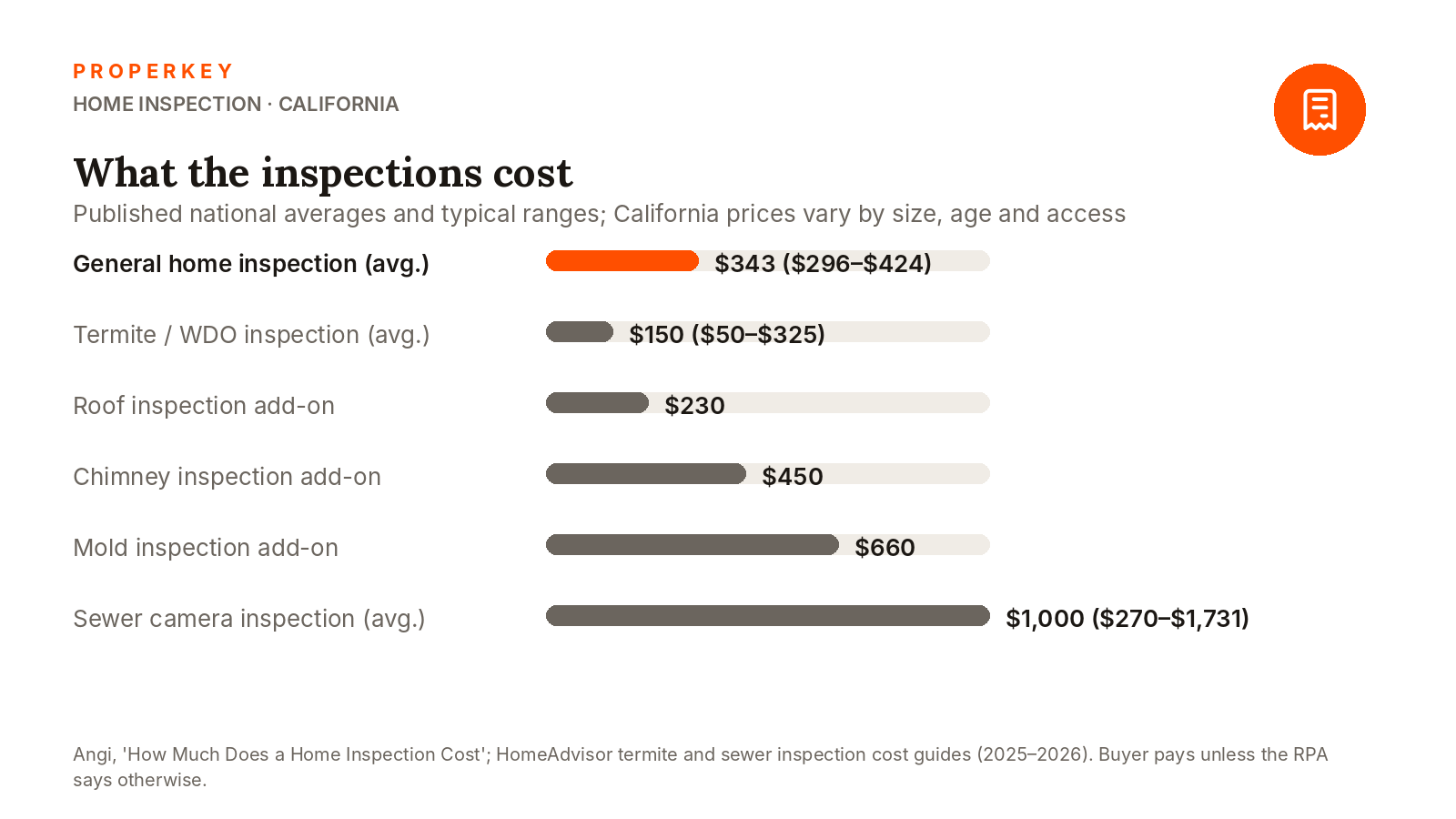
Angi puts the national average home inspection at $343, with a typical range of $296 to $424, with roof, chimney, mold and pest add-ons priced separately. Termite inspections average about $150 and are often free when the operator hopes to do the repairs (HomeAdvisor). A sewer camera inspection is the expensive one; HomeAdvisor's typical range is $270 to $1,731. On a $900,000 California home the whole inspection round is a fraction of a percent of the price and routinely finds items worth far more. The buyer pays unless the contract says otherwise; who pays for the pest report and any Section 1 work is written into the cost-allocation lines of paragraph 3Q, which have no preprinted default.
The request for repair
When the reports come back, the buyer has three choices inside the contingency period: remove the contingency, cancel, or ask. Paragraph 14B(2): "Buyer may, within the time specified in paragraph 3L(3), request that Seller make repairs or take any other action regarding the Property (C.A.R. Form RR). Seller has no obligation to agree to or respond to Buyer's requests." The request for repair is not a counteroffer and it does not extend the deadline; C.A.R.'s own guide tells agents that "no response from a seller should be interpreted as 'NO' to all repairs." A seller who agrees signs the RR; one who wants to offer something different responds on the RRRR form; and once the buyer accepts the seller's response, that signature also removes the inspection contingency. If the seller says no, paragraph 14B(2) is blunt: the buyer "is not contractually entitled to have the repairs or other requests made and may only cancel based on contingencies in this Agreement."
Three ways to resolve a repair list each have consequences. Seller-performed repairs must be finished before the final walk-through, with invoices, receipts and a written statement of what was done (paragraph 15). A price reduction is the cleanest for a financed buyer. A closing-cost credit is the most common, and it has lender limits: Fannie Mae caps interested-party contributions at 3% of the price above 90% loan-to-value, 6% from 75.01% to 90% and 9% at 75% or less (Selling Guide B3-4.1-02), and a credit cannot exceed the buyer's actual closing costs. FHA allows 6% toward closing costs, prepaids and points, and treats "repair allowances" as inducements that reduce the price used to size the loan (HUD Handbook 4000.1). FHA also requires that defects affecting health, safety or structural soundness be corrected before closing; the lender "may only approve a Property after the Mortgagee confirms that all defects reported by the Appraiser have been corrected."
The clocks after day 17
The contingency does not expire on its own. Paragraph 14B(4): even after the deadline, "Buyer retains the right, in writing, to either (i) remove remaining contingencies, or (ii) cancel this Agreement based on a remaining contingency" until the seller acts. To act, the seller must first deliver a Notice to Buyer to Perform, which must "give the other Party at least 2 Days after Delivery" and may not be sent earlier than two days before the deadline (paragraph 14E). If the buyer still does nothing, the seller may cancel, and in that case "Seller shall authorize the return of Buyer's deposit, except for fees incurred by Buyer." A buyer who cancels inside the contingency, in writing on the Contingency Removal or cancellation form, is entitled to the deposit under paragraph 14H, and a party who refuses to sign cancellation instructions without a good-faith dispute faces a civil penalty of up to $1,000 under Civil Code §1057.3 (see Properkey's guide to earnest money deposits). The ordinary close-of-escrow fight uses a different notice, the Demand to Close Escrow, with a three-day minimum.
What the seller is selling
The RPA sells the property "As-Is," but the form defines the term carefully in paragraph 25D: the seller "shall make full disclosure of known material facts and defects as of the date of Acceptance and perform only those repairs specified in this Agreement, and Buyer shall have the right to inspect the Property and exercise any contingency cancellation." As-is means no promise of condition, not a license to hide defects. The seller's TDS and the agent's visual inspection under Civil Code §2079 remain mandatory, and the buyer keeps a duty too: §2079.5 says nothing "relieves a buyer … of the duty to exercise reasonable care to protect himself or herself." For a new home, the Right to Repair Act gives the original buyer component-specific warranties, four years for plumbing and electrical, one year for irrigation, five for paint, and an outside limit of ten years after substantial completion (Civil Code §941).
If something is found after closing
A claim against the inspector must be brought within four years of the inspection (§7199); the court in Moreno v. Sanchez (2003) 106 Cal.App.4th 1415 held the clock starts when the buyer discovers the problem, with four years as the outside cap, and struck a one-year contractual limit as unreasonable. Claims against the listing agent for the visual inspection run two years from possession (§2079.4); claims against the seller for nondisclosure run on the fraud and negligence statutes. None of that is a substitute for reading the report before day 17.
How Properkey handles it
A Properkey agent structures the offer's price, terms and contingencies and negotiates directly with the listing side. The approach Properkey recommends: keep the 17 days, order the general and pest inspections in the first week, price the Section 1 items and the big-ticket findings, and decide by day 14 whether to ask, remove or cancel. Sellers listing with Properkey for a $0 listing fee get the same advice in reverse: a pre-listing pest report and a complete TDS take most of the surprise out of the buyer's inspection period, and Properkey Escrow closes Properkey-brokered transactions.
Questions people ask
Can I cancel for any reason during the inspection contingency? In practice, yes. The contingency is on the buyer's "acceptance of the condition of, and any other matter affecting the Property," exercised "in good faith" and in writing. A buyer who cancels within the period on the proper form recovers the deposit less escrow fees.
Does the seller have to fix what the inspection finds? No. The RPA gives the seller "no obligation to agree to or respond" to a request for repair. The buyer's leverage is the right to cancel, and the lender's requirements, which can force health-and-safety repairs on an FHA or VA loan.
Is 17 days firm? It is a default. Buyers in competitive situations shorten it to 7 or 10 days or waive it; sellers can insist on a shorter period. Whatever the number, the seller cannot cancel without first sending the two-day Notice to Buyer to Perform.
Should I waive the inspection to win the house? One in five buyers did in October 2026, and the RPA still lets a buyer inspect for information only without a cancellation right. Waiving on a California home with a pre-1980 sewer lateral, a flat roof or a hillside lot is a different bet than waiving on a five-year-old tract house with a transferable builder warranty.
This article summarizes California law and the C.A.R. form for general information and is not legal advice. Paragraph numbers follow the 12/21 form; check the current revision.
Sources: C.A.R. RPA 12/21 (public copy) · C.A.R. Quick Guide, Buyer Requests for Repairs · B&P §7195 · §7196 · §7197 · §7198 · §7199 · CREIA on California inspection law · 16 CCR §1990 · B&P §8516 · Structural Pest Control Board WDO search · Civ. Code §2079 · §2079.4 · §2079.5 · §941 · EBMUD private sewer laterals · LADBS requirements when selling · Santa Cruz County rural real estate sales · Angi inspection cost · HomeAdvisor termite inspection cost · HomeAdvisor sewer inspection cost · NAR Realtors Confidence Index, October 2026 · Fannie Mae B3-4.1-02 · HUD Handbook 4000.1 · Moreno v. Sanchez (2003)
Written by Keyro, Properkey's AI. Properkey, DRE #01979718.



