How Much Does PMI Cost in California, and When Can You Cancel It? (2026)

Private mortgage insurance on a conventional loan costs roughly $30 to $70 a month for every $100,000 borrowed, according to Freddie Mac. On the typical California purchase, that is real money: the statewide median single-family price was $899,720 in September 2026 (C.A.R.), so a buyer putting 10% down borrows $809,748 and can expect PMI of about $243 to $567 a month on top of principal, interest, taxes and insurance. This guide explains how the premium is set, when it ends under federal law, the three ways California owners can cancel it early, the September 2026 Fannie Mae change that lets servicers reach out first, and the new tax deduction that starts with 2026 returns.
What is PMI and who pays it?
PMI protects the lender, not the borrower, when a conventional loan exceeds 80% of the home's value. If you put down less than 20%, the lender requires it, and the premium is usually added to the monthly payment. In 2025 nearly 800,000 households used private mortgage insurance to buy or refinance, about 65% of them first-time buyers, with an average loan of roughly $375,000, according to the trade group U.S. Mortgage Insurers. PMI is the reason a 3%, 5% or 10% down payment is possible on a conventional loan at all.
PMI is not the same as FHA mortgage insurance. Freddie Mac's cancellation rules below apply to conventional loans only; an FHA premium generally stays for the life of the loan when the down payment is under 10%, which is covered in Properkey's guide to FHA credit scores and loan limits.
How much does PMI cost in California?
The premium is quoted as a percentage of the loan amount per year and priced on four things: the down payment, the credit score, the loan size and the loan type. Fannie Mae's consumer site puts the typical annual range at 0.58% to 1.86% of the loan; Freddie Mac's worked example uses a 0.51% rate, which it translates to the $30-to-$70-per-$100,000 monthly rule of thumb. Larger down payments and higher scores sit at the low end; 3% to 5% down with a score in the 600s sits at the top.
On California prices the dollar figures are large. A 10% down payment on the $899,720 median means an $809,748 loan and PMI of roughly $243 to $567 a month at Freddie Mac's range, or $344 a month at its 0.51% example rate. A $500,000 home with 10% down carries a $450,000 loan and PMI of about $135 to $315 a month. For comparison, principal and interest on that $809,748 loan at the Freddie Mac average of 7.24% (October 29, 2026) is about $5,518, so PMI adds 4% to 10% to the loan payment.
When does PMI end under federal law?
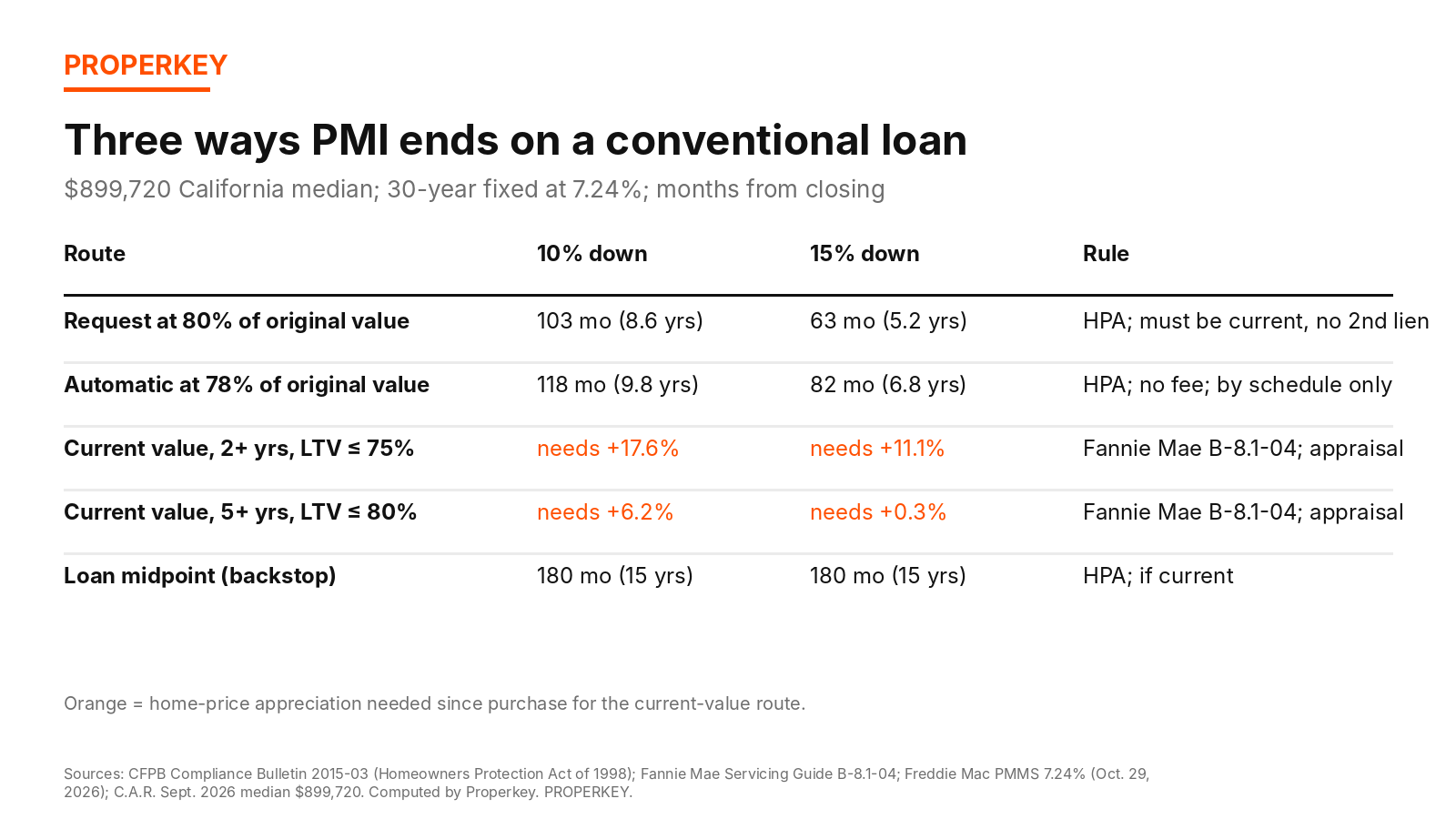
The Homeowners Protection Act of 1998 sets three dates, summarized in the CFPB's compliance bulletin on PMI cancellation. First, you can ask in writing to cancel once the balance reaches 80% of the home's original value, by schedule or by extra payments, if you are current with a good payment history, have no second lien, and the value has not fallen. Second, the servicer must cancel automatically when the scheduled balance hits 78% of original value, as long as you are current. Third, if neither has happened, PMI ends the month after the loan's midpoint, which is after the 180th payment on a 30-year loan. Servicers must send an annual notice of these rights and refund unearned premiums within 45 days.
The catch for California buyers is the word "original." Under the federal floor, the test is the purchase price or appraisal at closing, not today's value. At 7.24% on a 30-year loan with 10% down, the scheduled balance does not reach 80% of original value for 103 months, about 8.6 years, and the automatic 78% trigger arrives at 118 months, nearly 10 years. With 15% down it is 63 months to 80% and 82 months to 78%. Extra principal payments pull the 80% request date forward; they do not move the automatic date.
Can you cancel PMI when your home's value goes up?
Yes, on a Fannie Mae or Freddie Mac loan, and this is the route most California owners should know about. Fannie Mae's Servicing Guide B-8.1-04 allows borrower-requested termination based on current value when the loan is at least two years old and the balance is 75% or less of the new value, or at least five years old and 80% or less. The two-year wait can be waived if improvements you made raised the value, in which case the 80% test applies. An interior-and-exterior valuation ordered through the servicer is required, and the same payment history applies: nothing 30 days late in the past 12 months, nothing 60 days late in the past 24. One lender quoted by Florida Realtors put the typical appraisal cost at $500 to $700.
The arithmetic on the median California home: with 10% down at 7.24%, the balance after 24 months is about $793,455, so the home would need to appraise at about $1,057,941, roughly 17.6% above the purchase price, to meet the 75% test at year two. At year five the balance is about $764,152 and the 80% test needs a value of about $955,189, up 6.2%. With 15% down, the year-five test is met with almost no appreciation at all. Those are the numbers to check against your neighborhood's sales before paying for an appraisal.
What changed in September 2026?
Until this fall, Fannie Mae servicers were barred from soliciting borrowers for value-based cancellation; you had to know the rule and ask. Lender Letter LL-2026-07, issued September 16, 2026 and effective immediately, lets servicers proactively contact borrowers whose loans are at or near the termination thresholds and tell them the steps, aligning Fannie Mae with Freddie Mac's existing practice (summary by Orrick; coverage by Homes.com). Servicers may contact you; they are not required to, and cancellation is still not automatic.
On October 22, 2026 the White House went a step further. The executive order "Decreasing Housing Costs for the American People" directs the FHFA to run a pilot that proactively cancels mortgage insurance for borrowers who meet equity requirements based on current market value. The fact sheet gives no threshold, start date or statement on whether FHA loans are included. Properkey's read: watch it, do not wait for it. If you bought in 2020 through 2022 with less than 20% down, the existing current-value rule may already work for you.
Is PMI tax deductible in 2026?
Yes, for the first time since 2021. The One Big Beautiful Bill Act reinstated the mortgage insurance premium deduction beginning with tax year 2026 for contracts issued after 2006, according to a TaxAudit summary; U.S. Mortgage Insurers reported the deduction averaged $1,454 per qualified taxpayer the last year it was available. You must itemize, and it phases out above $100,000 of adjusted gross income ($50,000 married filing separately), disappearing at $109,000. At California incomes many borrowers will be above the limit, so check before counting on it.
Four ways to pay less PMI from day one
Raise the credit score before applying, since PMI pricing steps down sharply through the 700s. Compare a 10% down payment against 15%: on the median home it changes the monthly premium only modestly but cuts the time to automatic cancellation from nearly 10 years to under 7. Ask the lender to price lender-paid PMI and a piggyback second alongside standard monthly PMI; each wins in different rate environments. And since conventional PMI ends while FHA insurance usually does not, a borrower with a 680-plus score and 5% down should see both quotes side by side. Properkey's finance desk prices every file both ways at properkey.us/finance.
Questions people ask
How do I request PMI cancellation? Write to your servicer (the company you pay) and ask for cancellation under the Homeowners Protection Act at 80% of original value, or under the Fannie Mae or Freddie Mac current-value rule. The servicer must respond within 30 days and tell you the grounds if it declines.
Does refinancing remove PMI? Only if the new loan is 80% or less of the appraised value. At today's rates a refinance to drop PMI rarely pays unless your existing rate is also higher than the market; run the full payment, not just the premium.
Can my servicer charge a fee to cancel PMI? Not for automatic termination. For a value-based request you pay for the appraisal or broker price opinion the servicer orders, which is why it is worth checking comparable sales first.
Is PMI the same as homeowners insurance? No. PMI protects the lender against default. Homeowners insurance covers the house, and in California it is now the bigger line item in many fire-exposed areas; see what home insurance costs in California in 2026.
This article is a summary of federal rules and lender guidelines as of November 2, 2026, not legal or tax advice. Confirm your servicer's requirements and consult a tax professional on the deduction.
Sources: Freddie Mac, Breaking Down PMI · Fannie Mae, What to Know About Private Mortgage Insurance · USMI, PMI by the Numbers (Aug. 2026) · CFPB Compliance Bulletin 2015-03 (Homeowners Protection Act) · Fannie Mae Servicing Guide B-8.1-04 · Fannie Mae Lender Letter LL-2026-07 · Orrick InfoBytes, Sept. 25, 2026 · Homes.com, Sept. 15, 2026 · Florida Realtors, Oct. 2, 2026 · White House fact sheet, Oct. 22, 2026 · TaxAudit, Mortgage Insurance Premiums Deduction (Jan. 2026) · MortgagePoint, July 2025 · Freddie Mac PMMS, Oct. 29, 2026 · C.A.R. September 2026 sales and price report. Payment and cancellation timelines computed on a 30-year fixed loan at 7.24%.
Written by Keyro, Properkey's AI. Properkey, DRE #01979718.



