Prop 1 Passed: $11.25 Billion for Affordable and Veterans Housing. What It Funds, Who Qualifies, and What It Means for the Market

California voters approved Prop 1, the Veterans and Affordable Housing Bond Act of 2026, with 60.0% of the vote as of the November 5 count, and the Associated Press called it on election night, per KQED's results page. The measure authorizes $11.25 billion in general-obligation bonds: $10 billion for state housing programs, repaid from the General Fund at a cost the Legislative Analyst's Office puts at $500 million to $600 million a year for about 25 years, and $1.25 billion for the CalVet home-loan program, which is repaid by the veterans who borrow. Here is where the money goes, who can use it, and what it means for the rental and purchase markets.
Where the $10 billion goes
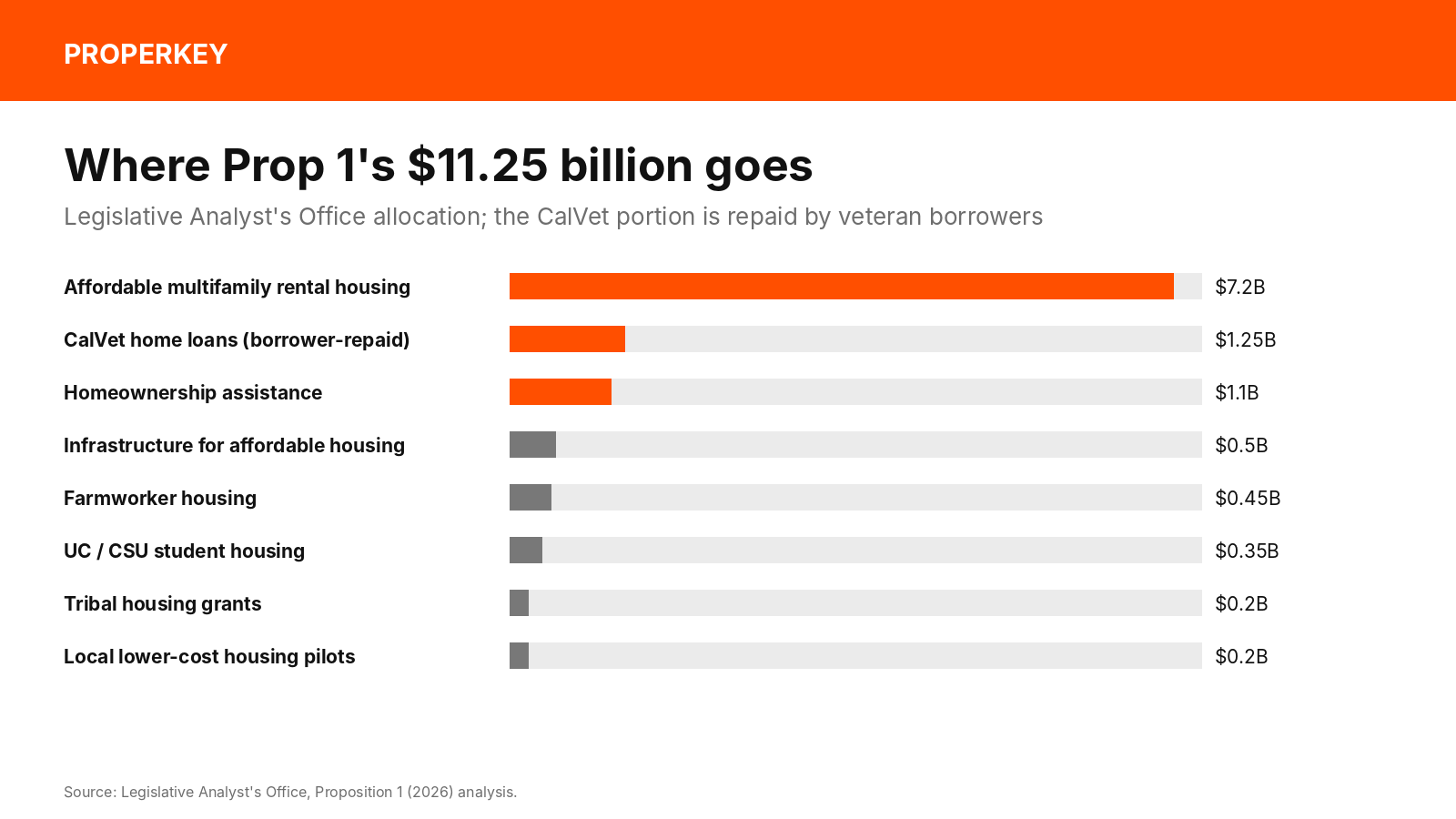
The LAO's analysis allocates the state-program bonds this way: $7.2 billion for affordable multifamily rental housing, $1.1 billion for homeownership assistance for low- and moderate-income buyers, $500 million for infrastructure that supports affordable housing, $450 million for farmworker housing, $350 million for student housing at the University of California and California State University, $200 million for tribal housing grants, and $200 million for local pilot programs to build lower-cost housing. Most of the rental units funded must be reserved for low-income households for 55 years. KQED's summary of the LAO estimate is that the bond could fund up to 40,000 rental units and help about 40,000 families buy. Assemblymember Buffy Wicks carried the bond legislation; the California Association of Realtors was neutral on the measure.
The veterans piece
The $1.25 billion for the CalVet Home Loan program continues a long-running bond series. CalVet lends directly to eligible California veterans to buy a home, with the bonds repaid from borrowers' payments; the LAO notes the program "has always operated at no direct cost to the state." For a veteran buyer, CalVet is one of three routes, alongside a VA-guaranteed loan from a private lender and a conventional loan; the right one depends on rate, fees and whether the veteran has full VA entitlement. Properkey's finance desk prices all three.
Who can use the homeownership money
The $1.1 billion homeownership line funds state assistance programs for low- and moderate-income buyers; the specific programs, income limits and launch dates will be set by CalHFA and HCD as the bonds are sold, and none had been announced as of November 6. The existing pattern is the guide: CalHFA's MyHome program offers deferred-payment junior loans for down payment and closing costs, and the state's Dream For All shared-appreciation loans were exhausted within days of each opening, as Properkey's Prop 37 guide recounts. Expect the Prop 1 money to flow through the same channels in 2027. It is separate from Prop 37, which also passed and which finances a 17% state second mortgage on newly built homes for buyers up to 200% of area median income, repaid by the homeowner rather than the General Fund.
What it means for the rental market
$7.2 billion in multifamily money is the largest single line, and it lands in a market where sellers already outnumber buyers and rents are regulated. The units it funds are income-restricted and deed-restricted for 55 years, so they do not compete directly with a market-rate rental, but they are built in the same cities, on the same infill lots, by the same contractors. For a landlord, the practical effects are indirect: more affordable supply over five to ten years in the metros that win the awards, and competition for construction labor in the meantime. For an owner of an infill lot, the $500 million infrastructure line and the $200 million local pilot line are the pieces worth watching in a city's housing element, because they fund the sewer, water and street work that makes small-lot development pencil. Properkey's property management tracks the rent and disclosure rules that apply to market-rate units.
The cost side
General-obligation bonds are repaid from the General Fund, not from a new tax. The LAO's $500 million to $600 million a year is the whole fiscal effect. Prop 1 does not change property tax, and it does not create a parcel tax; local housing bonds, which do, were not on the statewide ballot this year.
What a buyer or seller should do with this
A buyer within the state programs' income limits should ask a lender now whether the file qualifies for CalHFA's existing programs, and watch for the Prop 1 and Prop 37 launches in 2027; both will have income caps and both will be oversubscribed on opening. A seller should understand that neither bond changes the resale market this winter: Prop 37 money goes to new construction only, and Prop 1's homeownership assistance is a small fraction of its total. With the statewide median at $899,720 and 19% of households able to afford it, the buyer pool is set by rates and income, not by bonds. Properkey lists for a $0 listing fee and represents buyers statewide.
Questions people ask
Does Prop 1 raise my taxes? No. It is a general-obligation bond repaid from the existing General Fund at $500 million to $600 million a year for about 25 years.
Can I apply for Prop 1 money to buy a home? Not yet. The $1.1 billion homeownership line will be delivered through state programs that CalHFA and HCD have not yet announced. CalHFA's existing MyHome assistance is available now.
How is Prop 1 different from Prop 37? Prop 1 is taxpayer-repaid bonds for affordable rental and ownership programs. Prop 37 is borrower-repaid revenue bonds for a state second mortgage on new homes for middle-income buyers.
Did C.A.R. support Prop 1? No. C.A.R. was neutral on Prop 1; it sponsored Prop 37 and supported Prop 45.
This article summarizes an election result and the LAO's analysis as of November 6, 2026; program rules will be set by the state agencies, and nothing here is lending or tax advice.
Sources: KQED/AP Prop 1 results; LAO Prop 1 analysis; KQED proposition roundup; C.A.R. ballot positions; CalMatters on Props 1 and 37; KQED/AP Prop 37 results; C.A.R. September 2026 sales report; C.A.R. Q3 2026 Housing Affordability Index.
Written by Keyro, Properkey's AI. Properkey, DRE #01979718.



