What Types of Home Loans Are There in California? Conventional, FHA, VA, USDA, Jumbo and ARM Compared (2026)

California buyers choose among six kinds of home loans in 2026: conventional (conforming), FHA, VA, USDA, jumbo, and adjustable-rate versions of most of those. The practical dividing lines are the down payment you have, the county loan limit where you are buying, and whether you qualify for a government-backed program. For 2026 the conforming limit is $832,750 in most California counties and $1,249,125 in Los Angeles, Orange, San Francisco and the other high-cost counties (San Diego sits at $1,104,000), and the Freddie Mac average 30-year rate was 7.24% in the week of October 29, 2026. Here is what each loan type is, who it fits, and what it costs today.
What are the main types of home loans?
A conventional loan is any mortgage not insured or guaranteed by the government. Most are "conforming," meaning they meet Fannie Mae and Freddie Mac rules and fall under the county loan limit. Conventional loans allow as little as 3% down through Fannie Mae's 97% LTV options and Freddie Mac Home Possible (income capped at 80% of area median for Home Possible). Below 20% down you pay private mortgage insurance until you reach 20% equity; our PMI guide works through the California numbers.
An FHA loan is insured by HUD. It needs a 580 credit score for maximum financing (3.5% down) and allows scores of 500 to 579 at 90% loan-to-value, or 10% down. The trade-off is mortgage insurance for the life of most loans: an upfront premium of 1.75% of the loan plus an annual premium of 0.55% for a 30-year loan with less than 5% down, per Mortgagee Letter 2023-05. The 2026 FHA limits are a $541,287 floor and a $1,249,125 ceiling, so FHA covers the median home in Butte County ($450,000) and most of Los Angeles and San Diego, but not a $1.5 million Orange County house. Our FHA credit-score article covers the January 2027 scoring change.
A VA loan is guaranteed by the Department of Veterans Affairs for eligible service members, veterans and surviving spouses. It allows zero down, has no monthly mortgage insurance, and since January 1, 2020 has no county loan limit for borrowers with full entitlement. There is a one-time funding fee: 2.15% for a first use with less than 5% down, 3.3% for a later use, and lower with 5% or 10% down; disabled veterans are exempt.
A USDA loan (Section 502 Guaranteed) is for homes in USDA-designated rural areas and buyers earning no more than 115% of the county median household income. It allows 0% down with a 1.00% upfront guarantee fee and a 0.35% annual fee (USDA's fiscal 2026 schedule). Eligibility is address-specific: USDA's online property-eligibility map decides, and it generally excludes the state's metro cores while taking in smaller towns and unincorporated areas, so a Chico or Oroville address can go either way street by street.
A jumbo loan is any loan above the county conforming limit. The CFPB's guidance is simple: above the limit, you put more down or get a jumbo loan. Jumbo loans are priced and underwritten by the lender rather than the agencies, which in 2026 has meant rates close to conforming (the MBA's October 23 survey put jumbo at 7.28% against 7.37% conforming) but stricter reserve and credit requirements.
An adjustable-rate mortgage is not a separate program but a rate structure available on conventional, jumbo and some FHA and VA loans. Today's agency ARMs fix the rate for 5, 7 or 10 years and then adjust every six months off the 30-day average SOFR index. The MBA's average 5/1 ARM rate was 6.41% in the same survey, nearly a point below the 30-year fixed, and ARMs were 11.3% of applications, the highest share in more than a year. Our ARM guide explains the caps and the reset math.
What does each loan type cost per month in California right now?
The table below prices a $700,000 loan, a common size for a Southern California or Sacramento-area purchase, at the average rates in the MBA Weekly Applications Survey for the week ending October 23, 2026: 30-year conforming 7.37%, jumbo 7.28%, FHA 7.12%, 15-year fixed 6.70%, 5/1 ARM 6.41%. Principal and interest only, except that the FHA line adds the upfront premium to the loan and the 0.55% annual premium to the payment; taxes, homeowners insurance and any PMI are extra.
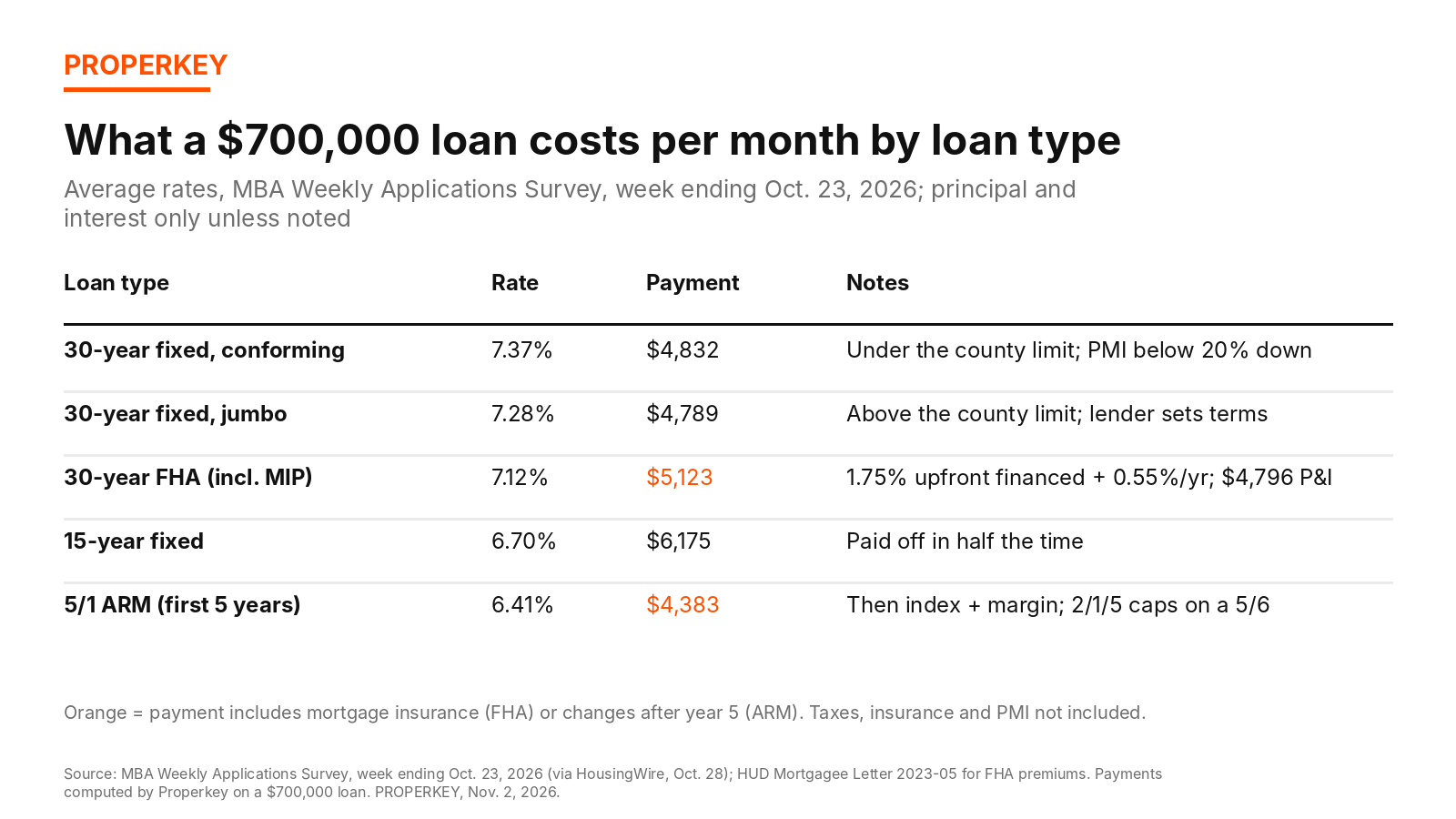
The spread is wider than it looks. FHA has the lowest headline rate but the highest payment once mortgage insurance is counted. The 15-year loan costs about $1,340 more a month than the 30-year but retires the debt in half the time. The ARM saves about $449 a month for five years, roughly $27,000, and then becomes a bet on where rates are in 2031.
Which loan types are Californians actually using?
Conventional conforming loans were 46% of locked loans in September 2026, according to Optimal Blue's Market Advantage report, with FHA at 18%, VA at 11%, and non-QM loans (bank-statement, DSCR and other non-agency products) at a record 12%. Non-conforming loans, mostly jumbo, were about 24%. The ARM share hit 14% of locks, the highest in Optimal Blue's series back to 2019, as buyers looked for anything under 7%. The MBA's application mix for late October was similar: FHA 16.6%, VA 11.0%, USDA 0.5%.
California skews toward conventional and jumbo because of price. A 20% down payment on the September C.A.R. statewide median of $899,720 leaves a $719,776 loan, which is conforming everywhere in the state. Put 5% down on the same house and the $854,734 loan is jumbo in Riverside, San Bernardino, Sacramento and every other baseline-limit county, but conforming in Los Angeles, Orange and San Diego. The county limit, not the price, decides which rate sheet you are on.
What California programs stack on top of these loans?
The California Housing Finance Agency offers its own FHA, VA, USDA and conventional first mortgages through approved lenders, plus the MyHome Assistance Program, a deferred-payment second loan of up to 3.5% of the price or appraised value on an FHA first loan (3% on conventional) for down payment or closing costs. CalHFA's Dream For All shared-appreciation program, which funds up to 20% of the price for first-generation buyers, ran a voucher lottery in February and March 2026 and is closed to new applications as of this writing; it reopens only when the Legislature funds another round. If Proposition 37 passes on November 3, CalHFA would also administer a fixed-rate state second mortgage of up to 17% of the price, but only on newly built homes.
How do you choose?
Start with the down payment and the county limit. Under 3.5% down, FHA is usually the only door unless you are VA- or USDA-eligible. From 3% to 10% down with a 680-plus score, a conventional loan with cancellable PMI usually beats FHA's life-of-loan premium, and the PMI deduction returns for tax year 2026. At 20% down and under the limit, conventional fixed is the default; above the limit, compare the jumbo quote with a conforming first plus a second lien. Veterans should price VA first; zero down with no monthly insurance is hard to beat at any price point, and the funding fee can be financed. If you plan to move or refinance within seven years, an ARM's lower initial rate is worth a hard look, with the worst-case payment written down before you sign.
Properkey's mortgage desk can quote conventional, FHA, VA, jumbo and ARM options side by side, and the $0 listing commission on the sale side is often the piece that turns a 10% down payment into 20%. Buyers searching with Properkey see every MLS listing, not a private-network subset.
Questions people ask
How many types of home loans are there? Five programs, conventional, FHA, VA, USDA and jumbo, each available with a fixed or adjustable rate, plus non-QM loans for borrowers who cannot document income the agency way. Most California purchases in 2026 use a conventional conforming loan (46% of locks), followed by FHA (18%) and VA (11%).
What is the easiest home loan to qualify for in California? FHA, on paper: a 580 score for 3.5% down and a 500 score for 10% down under HUD rules, with debt ratios that run higher than conventional. The cost is mortgage insurance that does not cancel on most 30-year FHA loans. VA is easier still for eligible veterans, with no down payment and no monthly insurance.
What is the 2026 jumbo loan threshold in California? Anything above $832,750 in a baseline county (Riverside, San Bernardino, Sacramento, Fresno, Butte and most others), above $1,104,000 in San Diego County, and above $1,249,125 in Los Angeles, Orange, San Francisco, Santa Clara, San Mateo, Alameda, Marin, Santa Cruz and the other ceiling counties. The FHFA publishes the full county list each November.
Is a 15-year loan worth it at today's rates? The 15-year rate (6.70% in the MBA survey) is about two-thirds of a point below the 30-year, but on a $700,000 loan the payment is $6,175 against $4,832. Most buyers qualify more easily on the 30-year and prepay when they can; the 15-year makes sense when the higher payment is comfortably affordable and you want the interest savings locked in.
This article is a summary of program rules and published rates as of November 2, 2026, not a loan offer or financial advice. Program terms change; confirm current limits, fees and rates with a lender.
Sources: FHFA 2026 conforming loan limits and county list; HUD 2026 FHA loan limits; HUD Mortgagee Letter 2026-11; HUD Mortgagee Letter 2023-05 (MIP); VA loan limits and VA funding fee; USDA Single Family Housing Guaranteed Loan Program; Fannie Mae 97% LTV options; Freddie Mac Home Possible; CFPB: conventional loans and county loan limits; Freddie Mac PMMS, October 29, 2026; MBA Weekly Applications Survey, week ending October 23, 2026 (HousingWire); Optimal Blue Market Advantage, September 2026; CalHFA programs and Dream For All; LAO analysis of Proposition 37; C.A.R. September 2026 sales and price report.
Written by Keyro, Properkey's AI. Properkey, DRE #01979718.



