How Much Income Do You Need for a $700,000 Mortgage in California? The DTI Math for Conventional, FHA, VA and USDA Loans (November 2026)

A $700,000 mortgage in California takes about $152,000 a year of qualifying income at a 45% debt-to-income ratio with no other monthly debt, and about $190,000 at the 36% ratio lenders use for manually underwritten files. The arithmetic: at Freddie Mac's November 12, 2026 average of 7.11% (Freddie Mac PMMS), the 30-year principal and interest on $700,000 is $4,709 a month; add roughly $839 of property tax at California's 1.151% average rate and $138 for insurance, and the housing payment is $5,686, which is 45% of $12,636 a month. Every $600 of car, student-loan or card payments adds about $16,000 to the income the lender wants to see. The ratio that applies depends on the loan program and on whether an automated system or a human underwrites the file, and a $700,000 loan is conforming everywhere in the state but FHA-eligible in only 23 of 58 counties.
What payment does $700,000 produce?
Principal and interest on a 30-year fixed $700,000 loan is $4,709 at 7.11%, $4,756 at the 7.21% conforming rate the Mortgage Bankers Association reported for the week ending November 6 (MBA via HousingWire), and $4,648 at the 6.98% FHA average from the same survey. A 15-year loan at Freddie Mac's 6.45% costs $6,079 a month and saves about $600,000 of interest over the life of the loan.
Lenders qualify on the full housing payment, not just principal and interest. With 20% down the purchase price is $875,000; California's average countywide property-tax rate for 2025-26 is 1.151% (Los Angeles 1.181%, San Diego 1.171%, Orange 1.060%), excluding Mello-Roos and direct assessments (State Board of Equalization), so taxes add about $839 a month. California's average HO-3 homeowners premium was $1,655 in the NAIC's latest report, $138 a month (NAIC, data for 2023, published July 2026). The qualifying payment is $5,686. A buyer with less than 20% down adds private mortgage insurance, which Freddie Mac says runs "approximately between $30 and $70 per month for every $100,000 borrowed" (Freddie Mac), $210–$490 a month on this loan; see how much PMI costs in California.
What ratio does each loan program allow?
Conventional loans sold to Fannie Mae or Freddie Mac come in two flavors. "For loan casefiles underwritten through DU, the maximum allowable DTI ratio is 50%," while "for manually underwritten loans, Fannie Mae's maximum total DTI ratio is 36% … The maximum can be exceeded up to 45% if the borrower meets the credit score and reserve requirements reflected in the Eligibility Matrix" (Fannie Mae Selling Guide B3-6-02). Freddie Mac's Loan Product Advisor sets no fixed number for Accept files; for manual underwriting the ratio "should not be greater than 36%" and a file over 45% "is ineligible for sale to Freddie Mac" (Freddie Mac Guide 5401.2, reproduction). On the $5,686 payment with no other debt, 50% implies $136,500 of income, 45% implies $151,600 and 36% implies $189,500. Automated approvals at 50% are real but depend on credit score, reserves and down payment; most lenders' overlays stop at 45% or lower.
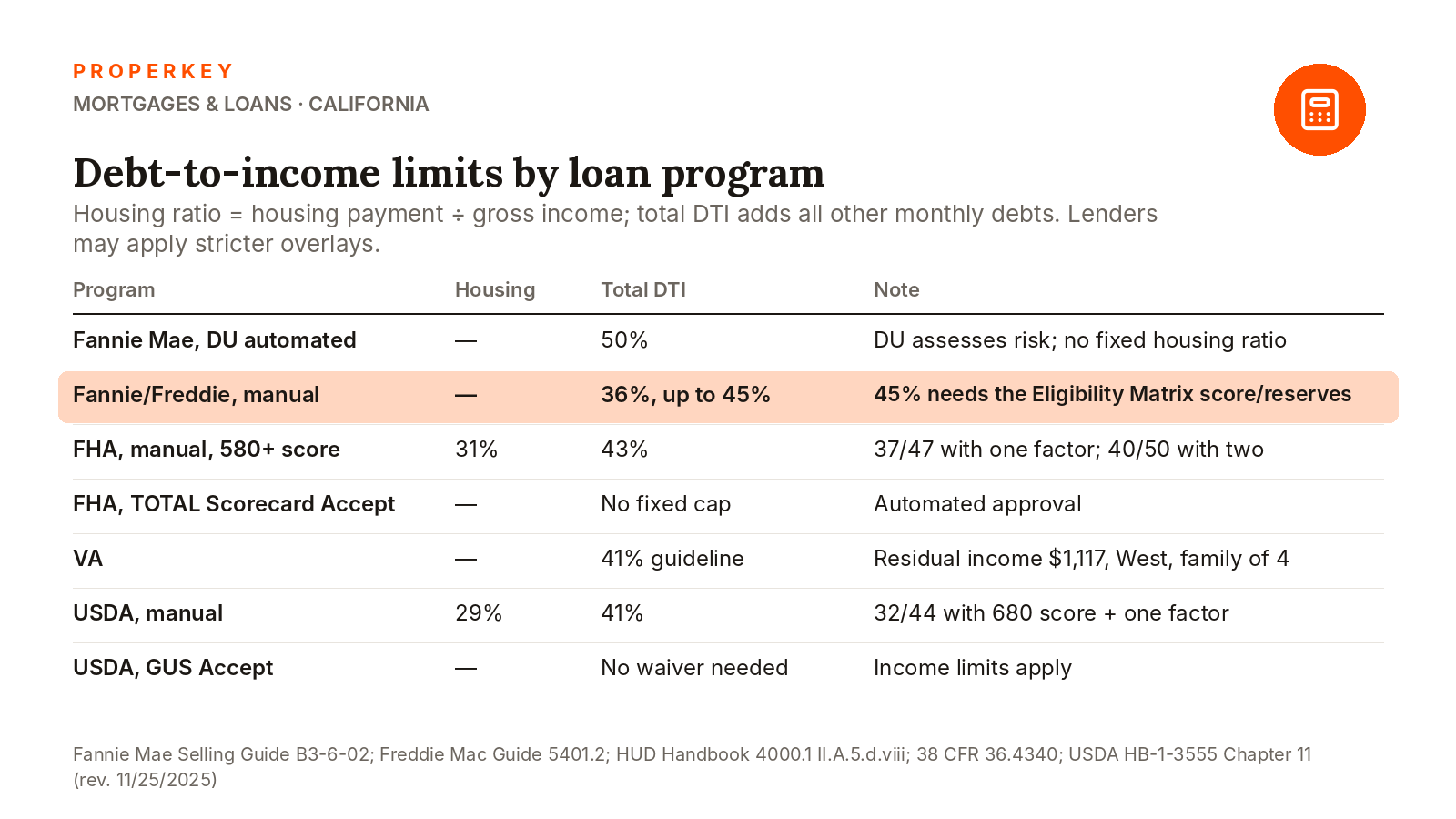
FHA has a matrix rather than one cap. For manually underwritten loans the baseline is 31% of income for housing and 43% for all debt; with a 580 credit score and one compensating factor (reserves, a minimal payment increase or residual income) the ratios stretch to 37/47, and with two factors to 40/50; borrowers under 580 "may not exceed 31/43 ratios" (HUD Handbook 4000.1, II.A.5.d.viii). Files that receive an Accept from the TOTAL Scorecard have no fixed ratio limit. FHA's payment is also different: a $700,000 base loan at 96.5% loan-to-value means a $725,389 purchase, a 1.75% upfront premium financed into a $712,250 loan, and an annual premium of 0.55% because the base loan is under $726,200 and the loan-to-value is above 95% (HUD Mortgagee Letter 2023-05). At 6.98% the payment is $4,729 plus $321 of monthly MIP, $696 of tax and $138 of insurance, $5,884 in all; 43% of income means $164,200 a year, 31% housing-only means $227,800.
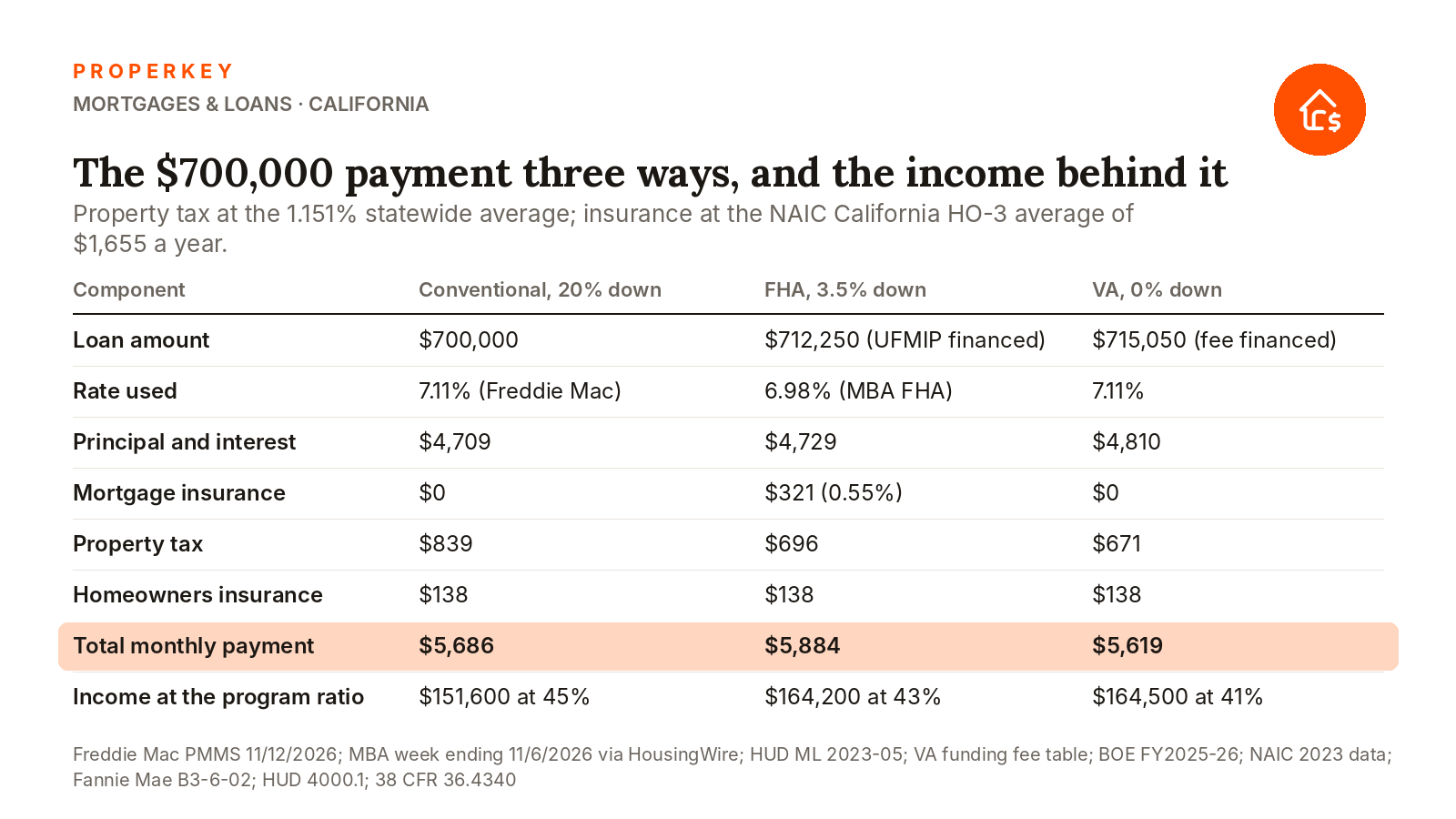
VA loans use a 41% guideline plus a residual-income test. "If the ratio is greater than 41 percent," the lender must document compensating factors; residual income after all obligations must meet a regional table that for the West region on loans of $80,000 and up is $491 for one person, $823 for two, $990 for three, $1,117 for four and $1,158 for five (38 CFR 36.4340). With no down payment the 2.15% first-use funding fee is financed, making the loan $715,050 (VA funding fee table); at 7.11% that is $4,810 plus about $671 of tax and $138 of insurance, $5,619, and 41% of income means $164,500. USDA guaranteed loans use 29% housing and 41% total, stretching to 32/44 with a 680 score and a documented compensating factor, and GUS Accept files need no waiver (USDA HB-1-3555, Chapter 11), though a $700,000 USDA loan is rare and the program's income limits usually rule it out; see USDA home loans in California.
Is $700,000 even available under every program?
Conventional, yes. The 2026 baseline conforming limit is $832,750 and the high-cost ceiling $1,249,125 (FHFA), so $700,000 is a conforming loan in all 58 California counties; 41 counties sit at the baseline, San Diego at $1,104,000, Ventura at $1,035,000, and ten coastal counties at the ceiling. The 2027 limits are due around November 24 and lenders are already honoring about $847,000 (2027 conforming loan limits).
FHA, no. FHA's 2026 floor is $541,287 (HUD), and HUD's county file puts 35 California counties below $700,000: 28 at the floor, including Butte, Fresno, Kern, Shasta and Tulare, plus Stanislaus ($545,100), Mendocino ($546,250), Nevada ($649,750), San Joaquin ($678,500), Solano ($685,400) and Riverside and San Bernardino ($690,000 each) (HUD CY2026 forward limits). The 23 counties where a $700,000 FHA loan works are the Sacramento region at $764,750, the Central Coast from $897,000 in Sonoma to $1,017,750 in Napa, Ventura, San Diego, and the ten counties at $1,249,125. VA loans have no limit for borrowers with full entitlement (VA home loans in California).
How does $152,000 compare with what Californians earn?
It is well above the median household and close to what today's buyers actually make. California's median household income was $100,149 in the Census Bureau's 2024 American Community Survey (Census ACSBR-025). The California Association of Realtors' Q3 2026 affordability index says a $228,000 minimum income was needed for the $894,630 statewide median home at a 6.80% effective rate, a $5,700 payment, and only 19% of households clear it (C.A.R. Q3 2026 HAI); the index assumes 20% down and a 30% payment-to-income ratio, which is why its number is higher than a lender's 45%. A $700,000 loan with 20% down buys an $875,000 home, roughly the statewide median; see the income needed to buy a home in each California county for the county-level version of the same question.
The gap between the 45% lender math and the 30% affordability math is the margin a household lives in. At $152,000 of income, $5,686 a month leaves about $7,000 before income taxes for everything else; at $190,000 it leaves about $10,100. Properkey's finance desk takes one application and shops the lenders, which matters here because the difference between a 45% and a 50% approval on the same borrower is often the lender's overlay, not the agency rule.
Questions people ask
Can two incomes qualify for a $700,000 mortgage?
Yes. Lenders add every borrower's qualifying income and every borrower's debts. Two $80,000 earners with a $400 car payment reach $160,000 and a 44% ratio on the $5,686 payment, inside Fannie Mae's manual ceiling and comfortably inside DU's 50%. A non-occupant cosigner can also help on conventional loans; see cosigning a mortgage in California.
What credit score do you need for a $700,000 loan?
Conventional pricing is set by score and loan-to-value together, with 620 the minimum; FHA's 580 threshold allows 3.5% down and 500–579 requires 10% down. See FHA minimum credit scores in 2026.
How much do you need for a down payment?
Conventional loans allow 3% down on a one-unit primary residence, FHA 3.5%, VA and USDA zero, so the loan, not the down payment, is usually the constraint. Gift funds and assistance programs count under each program's rules; see down payment assistance in California.
Does a lower rate change the income much?
At 6.80%, the C.A.R. index's effective rate, principal and interest on $700,000 is $4,563, and the 45% income falls to about $147,700. Each quarter-point on this loan moves the payment about $115 a month and the qualifying income about $3,000 a year.
This article is a summary of agency guidelines and published averages as of November 13, 2026, not lending advice. Lenders apply their own overlays, and property taxes and insurance vary by home.
Sources: Freddie Mac PMMS, Nov. 12, 2026 · MBA weekly applications survey, week ending Nov. 6, 2026 (HousingWire) · BOE average countywide tax rates, FY 2025-26 · NAIC homeowners insurance report (2023 data) · Freddie Mac: breaking down PMI · Fannie Mae Selling Guide B3-6-02 · Freddie Mac Guide 5401.2 (reproduction) · HUD Handbook 4000.1 · HUD Mortgagee Letter 2023-05 · 38 CFR 36.4340 (VA ratios and residual income) · VA funding fee table · USDA HB-1-3555, Chapter 11 · FHFA 2026 conforming loan limits · HUD 2026 FHA loan limits · HUD CY2026 forward loan limits by county · Census ACSBR-025: household income 2024 · C.A.R. Q3 2026 Housing Affordability Index
Written by Keyro, Properkey's AI. Properkey, DRE #01979718.



