2027 Conforming Loan Limits: Lenders Are Already at $845,000–$850,000, FHFA Decides November 24. What It Means County by County in California

The 2027 conforming loan limit does not exist yet, and California lenders are already lending to it. Since mid-September, Rocket, Rate, CrossCountry, Newrez, Fairway, Guild and Movement have been underwriting one-unit loans up to $845,000 as conforming; United Wholesale Mortgage went to $847,440 on September 16, and Pennymac to $850,000 the same day. The official 2026 baseline is $832,750, with a ceiling of $1,249,125 in high-cost counties. The Federal Housing Finance Agency will set the real 2027 number on Tuesday, November 24, when it releases its third-quarter house price index, and the data published so far point to a figure in the high $840,000s to low $850,000s, slightly above most of the early guesses. Here is how the limit is calculated, why lenders jump the gun, what each California county's limit is now, and what the difference between a conforming and a jumbo loan is worth to a borrower in November 2026.
How does FHFA set the conforming loan limit?
By formula. The Housing and Economic Recovery Act of 2008 (12 U.S.C. §1717(b)(2)) adjusts the baseline each year by "the percentage increase, during the most recent 12-month or 4-quarter period," in FHFA's house price index. FHFA's conforming-limit FAQ says it uses its national, seasonally adjusted, expanded-data index, comparing the third quarter of the current year with the third quarter of the prior year. For 2026 that change was 3.26%, which took the baseline from $806,500 to $832,750 (FHFA, November 25, 2025). High-cost areas get 115% of the area's median home price, measured on the highest-priced county in the metro area, up to a ceiling of 150% of the baseline, which is $1,249,125 for 2026. The 2027 limits will be announced with the Q3 index on November 24, 2026, as the 2026 limits were announced with the Q3 2025 index last year.
What will the 2027 number be?
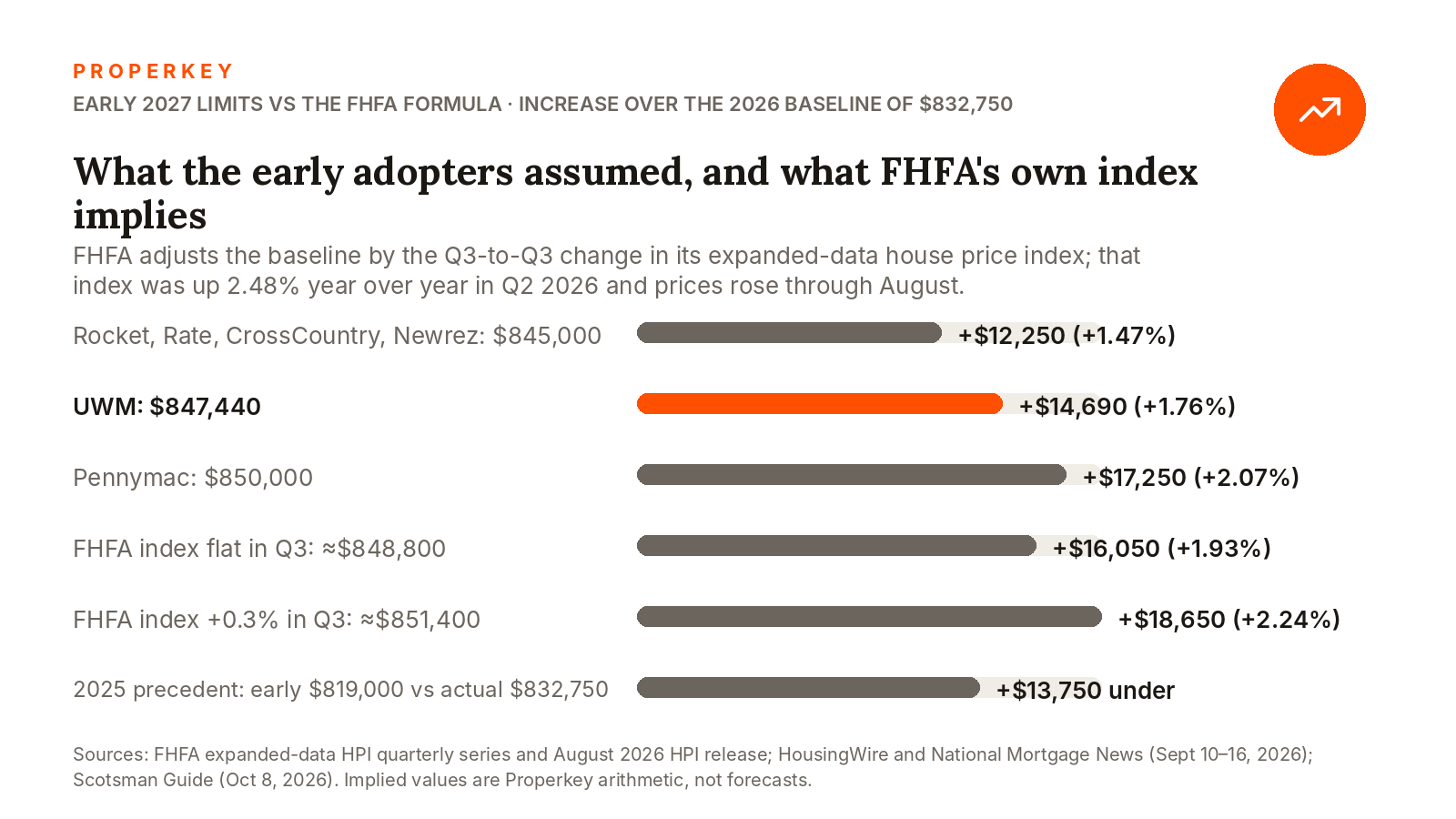
The expanded-data index that drives the formula was up 2.48% year over year in the second quarter of 2026, computed from FHFA's published quarterly series, and FHFA's monthly index rose 0.2% in July and 0.3% in August, 2.4% above a year earlier. If the third quarter simply held the second quarter's level, the year-over-year change would be about 1.9% and the baseline about $848,800; a quarter-over-quarter gain of 0.3%, the recent monthly pace, would put it near $851,400. The early adopters are below that range: $845,000 implies a 1.47% increase, UWM's $847,440 a 1.76% increase and Pennymac's $850,000 a 2.07% increase. Last year the same lenders guessed $819,000, a 1.5% rise, and FHFA came in at $832,750, so last year the borrower who waited for the official number did better than one who relied on the early figure, though only by a few thousand dollars of loan amount. The ceiling moves with the baseline: 150% of $848,800 is about $1,273,000.
Why do lenders adopt a limit before it exists?
Because a loan written today at $845,000 can be sold to Fannie Mae or Freddie Mac after January 1 if the new limit covers it, and in the meantime the lender holds it. Rocket moved first on September 10 at $845,000, Rate followed on September 14 and CrossCountry with its "Early Bird" program, then UWM at $847,440 and Pennymac at $850,000 on September 16 (HousingWire, National Mortgage News); Newrez, Fairway, Guild and Movement adopted $845,000 by October (Scotsman Guide). Pennymac's pitch was the point: it "lets homebuyers avoid jumbo loan territory now, instead of waiting until January 2027." For a buyer with 20% down, the $17,250 between $832,750 and $850,000 is $21,560 of purchase price; for the many buyers who were going to be a few thousand dollars over the line, it is the difference between an agency loan and a jumbo underwrite.
What are the 2026 limits by California county?
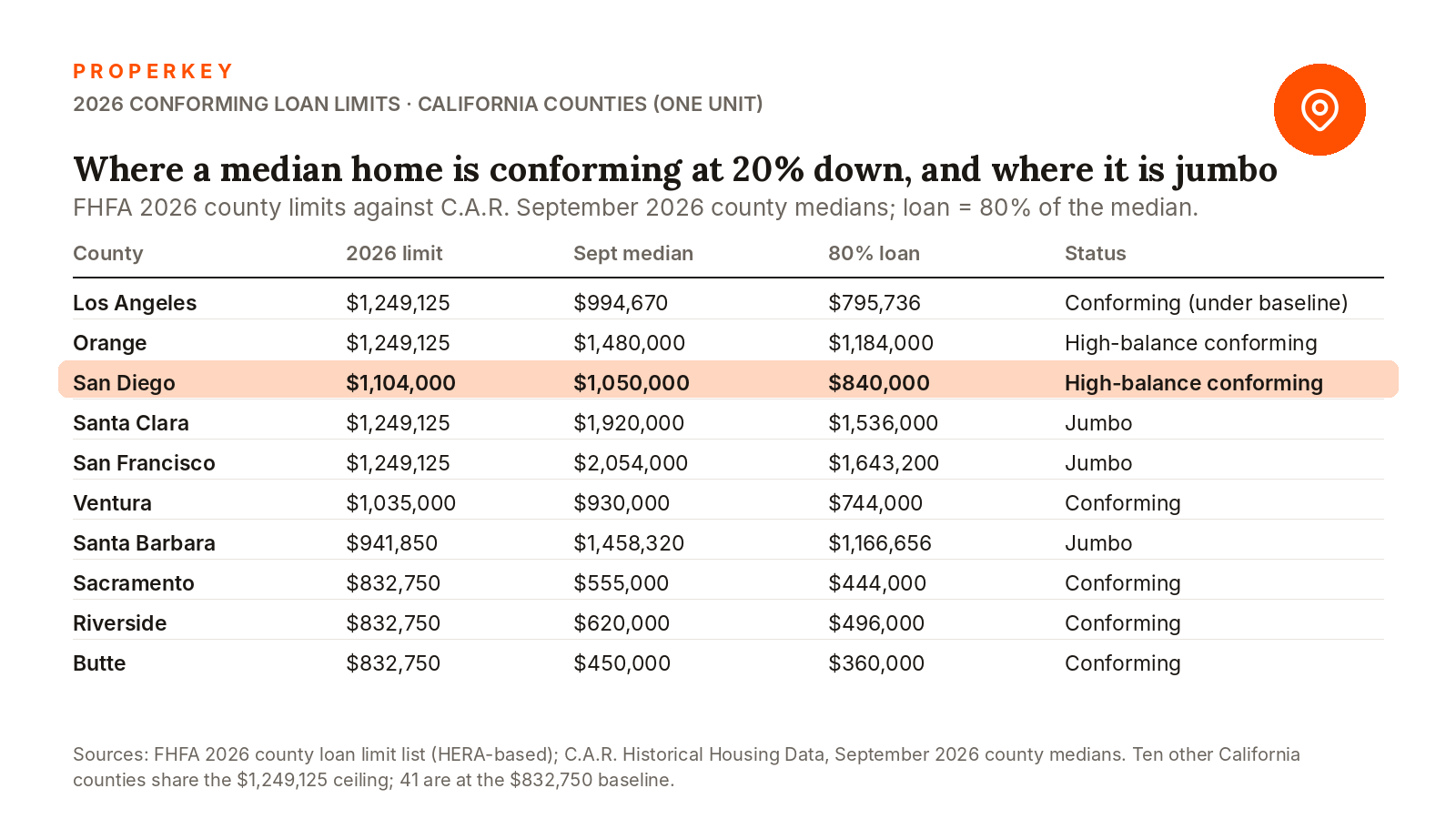
From FHFA's county list: Alameda, Contra Costa, Los Angeles, Marin, Orange, San Benito, San Francisco, San Mateo, Santa Clara and Santa Cruz are at the $1,249,125 ceiling. San Diego is $1,104,000; Ventura $1,035,000; Napa $1,017,750; San Luis Obispo $1,000,500; Monterey $994,750; Santa Barbara $941,850; Sonoma $897,000. The other 41 counties, including Sacramento, Placer, El Dorado, Yolo, Riverside, San Bernardino, Butte, Fresno and Kern, are at the $832,750 baseline. Measured against C.A.R.'s September medians with 20% down, a median-priced home is a conforming loan in Los Angeles ($994,670 price, $795,736 loan), Ventura, Sacramento, Riverside, Butte, Contra Costa, Napa, Sonoma, Monterey and San Luis Obispo; in San Diego the median ($1,050,000, an $840,000 loan) is under the county's $1,104,000; in Orange ($1,480,000, a $1,184,000 loan) it fits under the ceiling. Santa Barbara's median of $1,458,320 produces a $1,166,656 loan against a county limit of $941,850, so a median home there is a jumbo. In Santa Clara ($1,920,000), San Francisco ($2,054,000), San Mateo ($2,327,500) and Marin ($1,678,750), a median home is a jumbo even at the ceiling. The only county where the early-adopter number changes the picture at the median is none of them: San Diego's $840,000 loan fits under $847,440 but was already under its county limit.
What does the conforming line buy you?
Less than it used to in rate, more in flexibility. Jumbo and conforming rates are nearly equal: in the Mortgage Bankers Association's survey for the week ending October 30, the jumbo rate was 7.20% against 7.30% for conforming (via MPA), while Optimal Blue's locked-rate index on November 5 had jumbo at 7.254% and conforming at 7.089% (FRED) and Bankrate on November 8 had 7.32% against 7.20%. Banks hold jumbos in portfolio and pay no guarantee fee, which keeps them competitive. Where conforming wins is underwriting: Fannie Mae and Freddie Mac accept 3% to 5% down, debt ratios up to 50% with an automated approval, and, since November 2025, no minimum credit score on an automated approval, while jumbo lenders typically want 700 or better, 10% to 20% down, a debt ratio of 43% or less and six to twelve months of payments in reserve (Bankrate; JVM Lending). Loans between the baseline and the county ceiling, the "high-balance" tier, carry their own Fannie Mae adjustments of 0.50% to 1.00% of the loan on fixed-rate purchases by loan-to-value (LLPA matrix, September 9, 2026), must be run through Desktop Underwriter and are capped at 95% loan-to-value (Eligibility Matrix), so the 3%-down programs stop at the baseline. The FHA limits follow the same arithmetic, a floor of 65% of the baseline ($541,287 for 2026) and a ceiling equal to the conforming ceiling, and HUD typically announces them in December (HUD, December 11, 2025).
How many California loans are jumbo?
No state breakdown is published. Nationally, Optimal Blue reported that non-conforming loans, a bucket that combines jumbo and non-QM, were 23.6% of September rate locks, with non-QM alone at 12%, so jumbo was roughly 12% (HousingWire); Inside Mortgage Finance put non-agency jumbo at 15.4% of 2025 originations. California's share is certainly higher given its prices, which is why the limit matters more here than in any other state, and why the November 24 announcement is the one date on the mortgage calendar that moves California buyers' options without moving rates.
What should a buyer do between now and November 24?
If the loan you need is between $832,750 and $850,000, ask whether the lender has adopted an early 2027 limit and at what number; the three tiers are $845,000, $847,440 and $850,000. If it is above $850,000 and below your county's limit, you are high-balance today and should compare that pricing with a jumbo quote, since the two can cross. If you are closing after January 1, the official limit will apply and will probably be a little higher than the early figures. Properkey's finance desk shops one application across lenders, which in this window means asking each lender the same question about its limit. Related: the loan types compared, how ARMs reset and the 2027 rate forecasts. At the November 5 Freddie Mac rate of 7.18%, the payment on $832,750 is $5,641 and on $847,440 it is $5,741.
Questions people ask
What is the conforming loan limit in California for 2026? $832,750 in 41 counties, $1,249,125 in Alameda, Contra Costa, Los Angeles, Marin, Orange, San Benito, San Francisco, San Mateo, Santa Clara and Santa Cruz, and between those figures in San Diego ($1,104,000), Ventura, Napa, San Luis Obispo, Monterey, Santa Barbara and Sonoma.
What will the 2027 conforming loan limit be? FHFA announces it on November 24, 2026. The expanded-data index it uses was up 2.48% year over year in Q2 and prices rose through August, which implies a baseline around $848,000 to $851,000; lenders have pre-adopted $845,000, $847,440 and $850,000.
Is a jumbo loan more expensive than a conforming loan? In rate, barely, and sometimes it is cheaper: MBA's late-October survey had jumbo 10 basis points below conforming while other indexes had it 12 to 16 points above. The real difference is qualification: bigger down payments, higher scores, lower debt ratios and reserves.
Can I get a conforming loan above $832,750 right now? Yes, from lenders that have adopted an early 2027 limit, up to $845,000, $847,440 or $850,000 depending on the lender, and in high-cost counties up to the county limit through the high-balance program.
This article summarizes FHFA, HUD, GSE and lender announcements as of November 8, 2026. It is not lending advice; the 2027 limits are not official until FHFA publishes them.
Sources: FHFA 2026 conforming loan limits · FHFA CLL FAQ · FHFA county list 2026 · 12 U.S.C. §1717 · FHFA HPI release calendar · FHFA HPI August 2026 · FHFA HPI Q2 2026 · FHFA expanded-data HPI series · HousingWire, Sept 16, 2026 · National Mortgage News, Sept 16, 2026 · National Mortgage News, Sept 10, 2026 · Scotsman Guide, Oct 8, 2026 · HousingWire on the 2025 early adoption · C.A.R. county sales and prices, September 2026 · MBA weekly survey via MPA · Optimal Blue OBMMI jumbo via FRED · OBMMI conforming · Bankrate jumbo rates · JVM Lending · Fannie Mae LLPA matrix · Fannie Mae Eligibility Matrix · Fannie Mae B3-5.1-01 · HUD 2026 FHA limits · Optimal Blue September 2026 via HousingWire · Inside Mortgage Finance · Freddie Mac PMMS
Written by Keyro, Properkey's AI. Properkey, DRE #01979718.



