USDA Home Loans in California (2026): 0% Down, Where They Work, the Income Limits by County, and the New Rented-ADU Rule

A USDA Rural Development home loan is the only mainstream mortgage in California that requires no down payment at all, and in early November 2026 it was also the cheapest: Optimal Blue's index put the USDA 30-year rate at 6.82% on November 6 against 7.09% for a conforming loan and 6.89% for FHA. The program is limited by geography and income, not by price: the home must sit in an area USDA classifies as rural, which in California takes in Oroville, Paradise, Magalia and Gridley in Butte County, Red Bluff, Ramona, Fallbrook, Julian and Yucca Valley, but not Chico, Redding, Hemet or Temecula proper, and household income must stay under a county limit that runs from $124,900 for a family of four in Butte, Shasta or Fresno to $201,100 in San Diego County. Starting December 28, 2026, a new federal rule also lets a USDA borrower buy a home with a rented accessory dwelling unit. Here is how the Section 502 Guaranteed program works, what it costs next to FHA and conventional financing on a $450,000 Butte County home, and where the ADU rule stops short.
What a USDA guaranteed loan is
The Single Family Housing Guaranteed Loan Program is a 30-year fixed-rate mortgage made by a private lender and guaranteed by the U.S. Department of Agriculture's Rural Housing Service. USDA's program page says it provides "100% financing" with "no money down for those who qualify," and the regulation, 7 CFR part 3555, allows only fixed rates and terms of no more than 30 years; adjustable-rate, balloon and prepayment-penalty loans are ineligible. The home must be the borrower's principal residence; USDA "will not guarantee loans for investment properties." There is no maximum purchase price and no acreage limit "as long as acreage is considered common for the area," per USDA's program fact sheet; the loan may not exceed the appraised value plus the financed guarantee fee. Sellers and other interested parties may contribute up to 6% of the price toward the buyer's closing costs.
USDA charges no monthly mortgage insurance in the FHA sense. Instead there is an upfront guarantee fee of 1.00% of the loan, which can be financed, and an annual fee of 0.35% of the outstanding balance, paid monthly. USDA's fiscal-year 2027 notice (September 16, 2026) keeps both fees unchanged for loans committed October 1, 2026 through September 30, 2027. By comparison FHA charges 1.75% upfront and 0.55% a year on a minimum-down loan under HUD Mortgagee Letter 2023-05, and FHA requires 3.5% down.
USDA sets no minimum credit score. The current Chapter 10 of its handbook (revised August 5, 2025) says "GUS will determine the acceptable credit score to be used for the underwriting recommendation," and lenders "may impose additional criteria/overlays at their discretion"; the old 640 threshold was removed from the handbook, though many lenders still use it as an overlay. Manually underwritten files need at least one applicant with a validated score.
Where USDA loans work in California
Eligibility is decided address by address on USDA's property eligibility map, which is drawn from the "rural area" definition in Section 520 of the Housing Act of 1949 (42 U.S.C. §1490): open country and places of up to 10,000 people that are rural in character, places of 10,000 to 20,000 outside a metropolitan statistical area with a serious lack of mortgage credit, and, under a grandfather clause running until the 2030 census data arrive, places of 10,000 to 35,000 that were rural before 1990 and remain rural in character. The current map boundaries date from July 2023.
Checked against that map in November 2026, the following were eligible at the test addresses used: Oroville (downtown, Thermalito and the east side), Paradise, Magalia and Gridley in Butte County; Red Bluff in Tehama County; Ramona, Fallbrook, Julian and Borrego Springs in San Diego County; and Yucca Valley in San Bernardino County. Not eligible: Chico, Redding, Sacramento, Hemet, Lake Elsinore, Hesperia, Lancaster and the city of Temecula, although a point in the unincorporated wine country east of Temecula was eligible. Town edges can differ from town centers, so treat these as "most of" each place and run the exact address before writing an offer.
The income limits by county
Adjusted household income may not exceed the "moderate income" limit, which USDA defines in §3555.10 as the greater of 115% of the U.S. median family income, the average of the statewide and state non-metro medians, or 115/80ths of the area low-income limit for the household size. In practice that creates a national floor of $124,900 for one to four people and $164,900 for five to eight in fiscal 2026, with higher limits in expensive metros. USDA's limits took effect July 13, 2026 (Procedure Notice 657) and are published in Appendix 5 of the handbook; read through USDA's own income eligibility tool on November 10, 2026, the California figures are:
Butte, Shasta, Tehama and Fresno counties: $124,900 (1–4 people) / $164,900 (5–8)
Riverside and San Bernardino counties: $141,450 / $186,750
Sacramento County: $151,100 / $199,500
Los Angeles County (almost entirely ineligible by geography): $193,500 / $255,450
San Diego County: $201,100 / $265,500
Each person beyond eight adds 8% of the four-person limit. "Adjusted" income subtracts the deductions the regulation allows for dependents and certain expenses, so a household slightly over the gross figure can still qualify. Income counts for everyone who will live in the home, not just the borrowers, which is the rule that most often surprises applicants.
What it costs on a $450,000 Butte County home
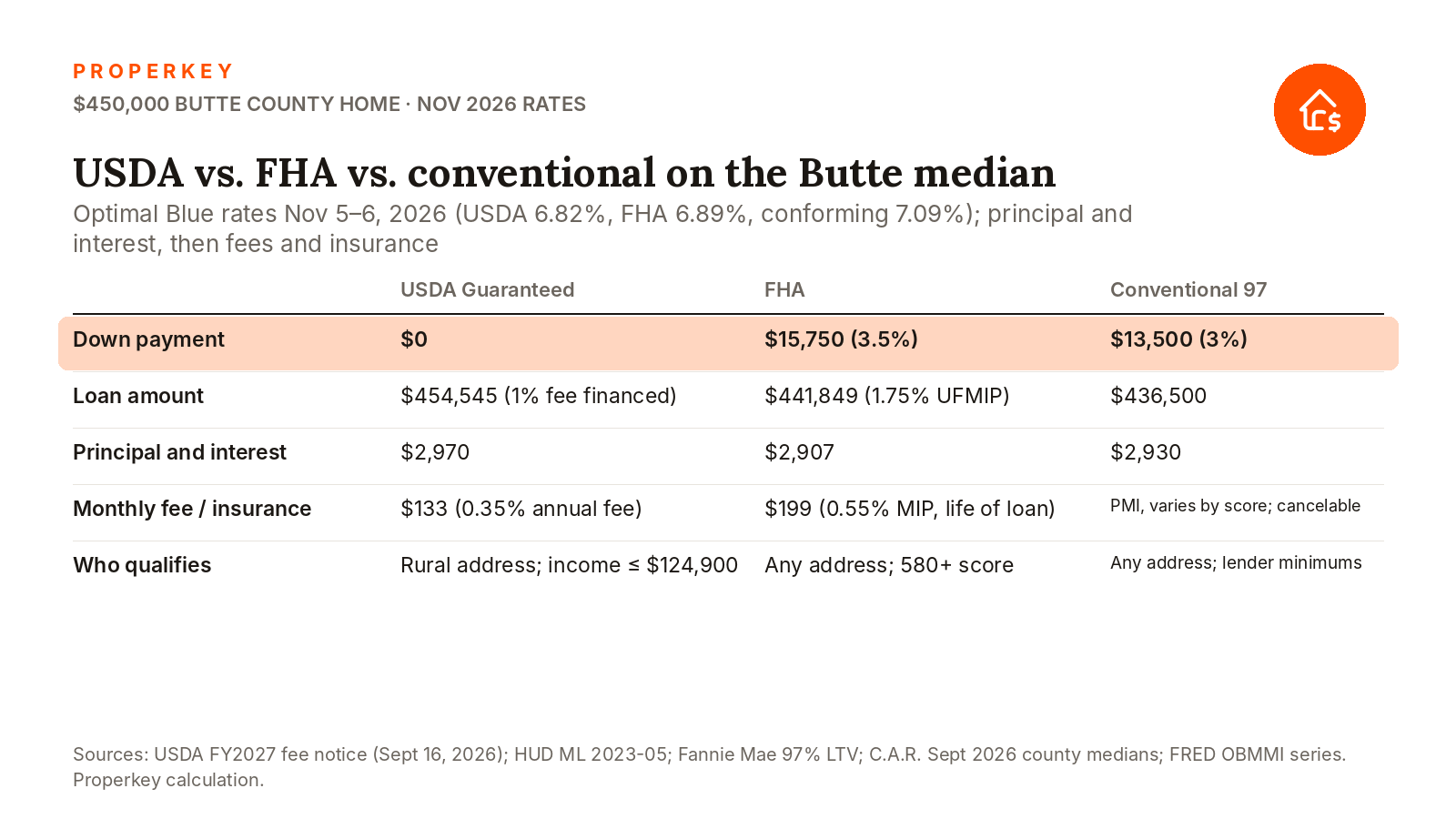
Butte County's September median single-family price was $450,000 (C.A.R.); Shasta's was $385,000 and Tehama's $309,000, so the example travels. Using the November 5–6 Optimal Blue rates from FRED (USDA 6.82%, FHA 6.89%, conforming 7.09%), principal and interest only:
USDA, 0% down: loan $454,545 including the financed 1% fee; P&I about $2,970, plus an annual fee of about $133 a month in year one (falling as the balance falls). Cash to close: closing costs only.
FHA, 3.5% down ($15,750): base loan $434,250 plus 1.75% upfront MIP = $441,849; P&I about $2,907, plus $199 a month in annual MIP that, at this down payment, lasts the life of the loan.
Conventional 97, 3% down ($13,500): loan $436,500; P&I about $2,930, plus private mortgage insurance that varies with credit score and can be cancelled at 80% loan-to-value.
All-in, the USDA payment runs about $3,100 a month against roughly $3,106 for FHA and $2,930 plus PMI for conventional, with $0 down instead of $13,500–$15,750. The trade-offs are the geography and income tests, and a slower underwriting path: USDA itself reviews the file after the lender and issues a conditional commitment, subject to funding availability, which runs short in the first weeks of each fiscal year. Properkey's loan-types guide compares all of these side by side, and at its finance desk you apply once and the lenders are shopped for you, USDA included where the address qualifies.
For context, the Section 502 Direct program, which USDA funds itself for low- and very-low-income buyers, carries a 6.25% note rate as of November 1, 2026, which payment assistance can reduce to as low as 1%, with terms up to 33 or 38 years. It is a different program with its own application through USDA offices.
The ADU rule, effective December 28, 2026
USDA has long barred guaranteed loans on property "used principally for income-producing purposes," which lenders read to exclude a house with a rented granny flat. On October 29, 2026 the Rural Housing Service published a final rule, "Single Family Housing Guaranteed Loan Program—Income Producing Accessory Dwelling Unit (ADU) Provisions" (91 FR 68025), that carves out an exception: the restriction "shall not apply when loan funds are used for the financing of an otherwise qualifying property which contains, or will contain, a single or multiple accessory dwelling units." The rule adds definitions of "Accessory Dwelling Unit" (a habitable unit "located within or detached from a single family dwelling, subordinate in size," with separate ingress and egress, forming "a single interest in real estate" with the main house) and "Living Unit," and separately allows home-based operations such as child care or craft production that do not need commercial features. It adopts the March 31, 2026 proposal without change and is effective December 28, 2026.
What it does not do is count the rent. USDA's preamble says potential ADU income is not stable or verifiable enough under §3555.152(a)(3) "and will not include it in income calculations." The buyer must qualify on wages alone, and the ADU rent cannot push the household over the income limit either, since it is not counted at all. That sits awkwardly with Congress: Section 502 of the 21st Century ROAD to Housing Act, Public Law 119-101, which became law July 11, 2026, says nothing in the guaranteed-loan statute "shall be construed to prohibit the leasing of an accessory dwelling unit or the use of rental income derived from such a lease to qualify" for a guaranteed loan, but only for homes built before the Act's enactment. The October rule does not cite the Act, so until USDA issues guidance implementing it, lenders will follow the rule: the ADU may be rented, but its rent does not help you qualify. The National Association of Realtors, which supported the rule, flagged the same gap in its Washington Report.
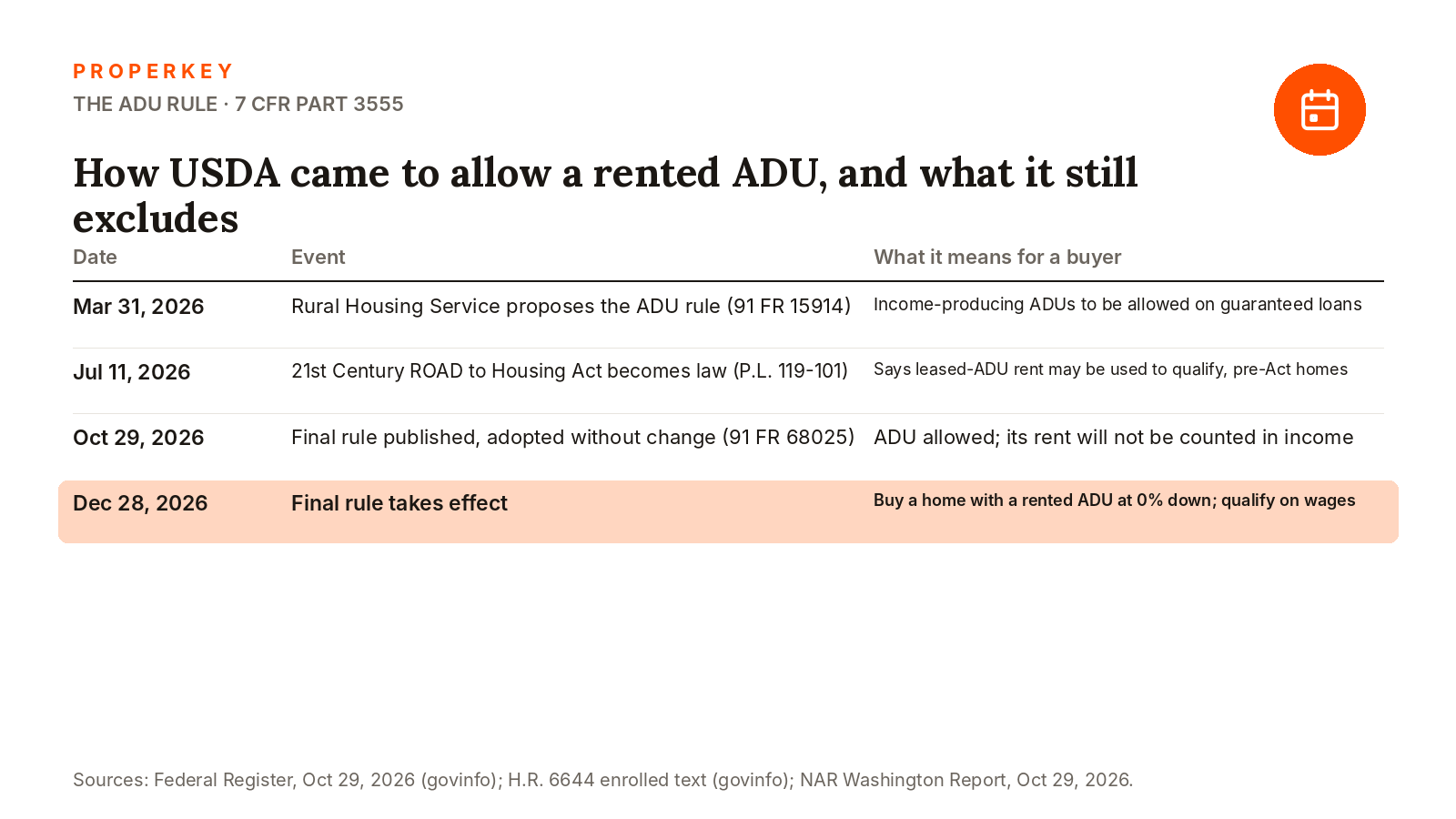
For Butte County, where Paradise and Magalia rebuilds often include a detached unit and AB 956 allows two detached ADUs by right from January 1, 2027, the practical effect is that a seller with a rented ADU can now market to zero-down buyers who were shut out before, and a buyer can keep the tenant through closing.
How big the program is
USDA guaranteed about $8.35 billion of Section 502 loans nationally in fiscal 2025 and projects $11.4 billion for fiscal 2026, per the agency's fiscal 2027 budget justification; California's share was $82.3 million in fiscal 2025, up from $55.3 million the year before, a few hundred loans in a state where USDA-eligible areas are the exception. USDA loans were 0.6% of mortgage applications in the Mortgage Bankers Association's week-of-October-30 survey (reported by HousingWire), against 16.0% for FHA and 11.2% for VA. The program is small because its map is small, not because its terms are; in the towns where it applies, it is usually the best financing available to a moderate-income buyer.
Questions people ask
What are the income limits for a USDA loan in California in 2026? For one to four people: $124,900 in Butte, Shasta, Tehama, Fresno and most rural counties; $141,450 in Riverside and San Bernardino; $151,100 in Sacramento; $201,100 in San Diego County. Five- to eight-person households get higher limits ($164,900 to $265,500). The limits took effect July 13, 2026 and apply to adjusted household income for everyone living in the home.
Which California towns qualify for USDA loans? Eligibility is by address, but Oroville, Paradise, Magalia, Gridley, Red Bluff, Ramona, Fallbrook, Julian, Borrego Springs and Yucca Valley tested eligible on USDA's map in November 2026, while Chico, Redding, Sacramento, Hemet, Lake Elsinore, Temecula, Hesperia and Lancaster did not. Check the exact parcel on USDA's property eligibility map before making an offer.
Can I buy a house with an ADU using a USDA loan? From December 28, 2026, yes, including an ADU that is rented out. The ADU's rental income cannot be used to qualify, however; USDA's final rule excludes it, even though a July 2026 federal law permits counting it for older homes. Expect lenders to follow USDA's rule until the agency issues further guidance.
What is the USDA guarantee fee in 2027? Unchanged: 1.00% of the loan upfront, which may be financed, and 0.35% of the balance per year, paid monthly, for loans committed in fiscal 2027 (October 1, 2026 through September 30, 2027). There is no separate mortgage insurance premium.
This is a summary of USDA program rules, the Federal Register and market data as of November 10, 2026, not lending advice. Eligibility is determined by USDA and the lender on the specific property and household.
Sources: USDA RD, Single Family Housing Guaranteed Loan Program · 7 CFR part 3555 · USDA FY2027 conditional commitment notice · USDA HB-1-3555 Chapter 10 · USDA HB-1-3555 Chapter 6 · USDA income limits, Appendix 5 · USDA property eligibility map · USDA income eligibility tool · 42 U.S.C. §1490 · Federal Register, 91 FR 68025 (Oct 29, 2026) · NAR Washington Report, Oct 29, 2026 · 21st Century ROAD to Housing Act (P.L. 119-101) · USDA Section 502 Direct · Optimal Blue USDA rate (FRED) · Optimal Blue conforming rate (FRED) · HUD ML 2023-05 · MBA weekly survey (HousingWire, Nov 4) · USDA FY2027 budget justification, RHS · C.A.R. September 2026 sales
Written by Keyro, Properkey's AI. Properkey, DRE #01979718.



