VA Home Loans in California, Veterans Day 2026: No Loan Limit, the 2.15% Funding Fee, Rates Under 7%, and a Property-Tax Break That Doubles in 2027

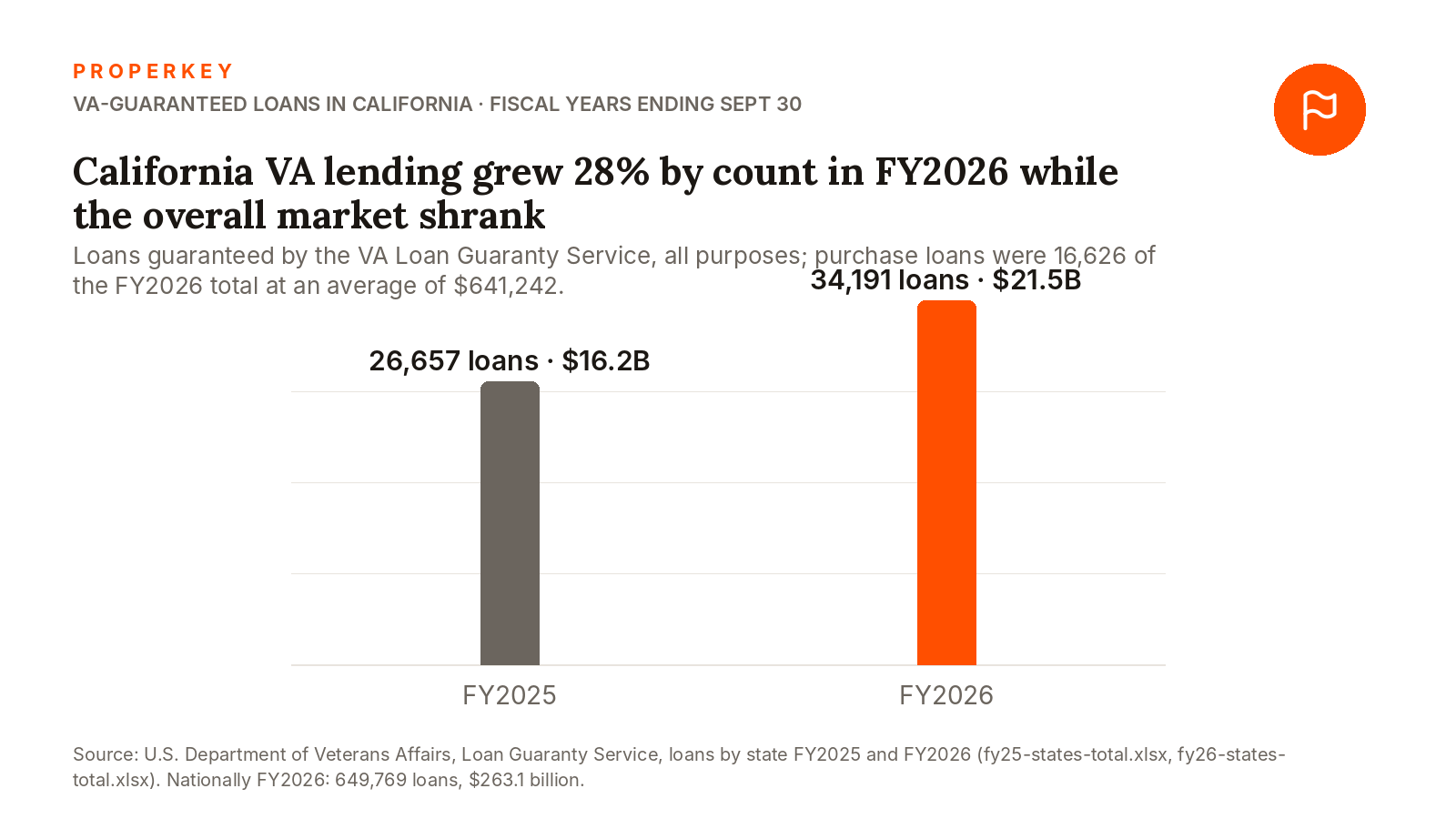
California's roughly 1.47 million veterans hold the cheapest mortgage available in the state, and most of the ones who can use it have not. The VA guaranteed 34,191 California loans worth $21.5 billion in the fiscal year that ended September 30, 2026, an average loan of $628,357, up from 26,657 loans the year before. A VA loan needs no down payment and carries no mortgage insurance with full entitlement, has had no VA-imposed loan limit since January 1, 2020, and priced at 6.712% on Optimal Blue's locked-rate index on November 5 against 7.089% for a conforming loan and 6.889% for FHA. The costs are a funding fee of 2.15% on a first purchase with less than 5% down, waived for veterans receiving disability compensation, and a set of rules about fees, appraisals and termite inspections that trip up agents who do not see many VA offers. On Veterans Day week, here is the whole program as it stands in California, including a property-tax exemption that will double in 2027.
What does a VA loan cost, and what does it skip?
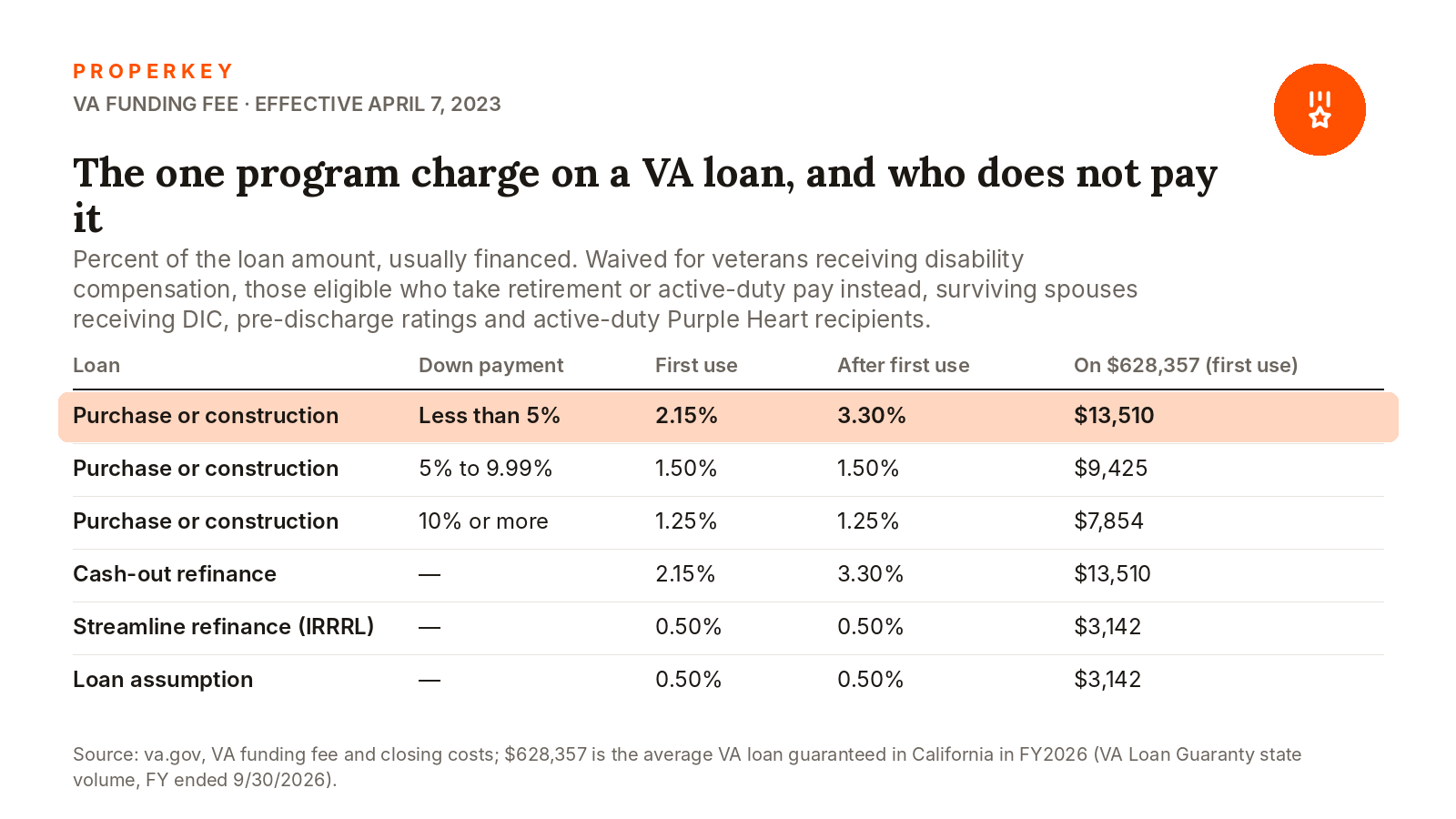
There is no monthly mortgage insurance and no minimum down payment for a veteran with full entitlement. The one program charge is the funding fee, set by statute and listed on va.gov: for a purchase, 2.15% of the loan on a first use with less than 5% down, 1.5% with 5% to 9.99% down and 1.25% with 10% or more; on a later use, 3.3% with less than 5% down and the same 1.5% and 1.25% above that. On California's average VA loan of $628,357, the first-use fee is $13,510, usually financed into the loan. The fee is waived for veterans receiving VA disability compensation, for those entitled to it who receive retirement or active-duty pay instead, for surviving spouses receiving Dependency and Indemnity Compensation, for service members with a pre-discharge proposed or memorandum rating issued before closing, and for active-duty Purple Heart recipients. Compare that with a conventional loan at 5% down, where a 620–639 borrower pays about 1.42% a year in private mortgage insurance, or an FHA loan, where the premium is 1.75% upfront and 0.55% a year for the life of the loan (see what a low credit score costs in each program). The rate advantage is real but modest: at 6.712% the payment on $628,357 is $4,060 a month; at the conforming 7.089% it would be $4,218.
Is there a loan limit?
Not for a veteran with full entitlement. The Blue Water Navy Vietnam Veterans Act removed the cap on January 1, 2020; va.gov now says "you don't have a loan limit," subject to the lender's approval and the appraisal. A veteran with remaining entitlement, usually because an earlier VA loan is still outstanding, is measured against the county conforming limit: 25% of that limit minus the entitlement already used. For 2026 the limits are $832,750 in most California counties, $1,104,000 in San Diego and $1,249,125 in Los Angeles, Orange, San Francisco and the core Bay Area counties (FHFA). At the state's median single-family price of $899,720 (C.A.R.), a zero-down VA loan is simply a $899,720 loan, which is where the lender's income rules take over.
Is there a minimum credit score?
The VA sets none. Its underwriting regulation, 38 CFR 36.4340, asks for a credit-history analysis, a debt-to-income ratio of 41% or less as the standard, and residual income after housing and debts, which for a family of four in the West region on a loan over $80,000 is $1,117 a month; a ratio above 41% can be approved with residual income at least 20% above the guideline or a supervisor's justification. Lenders add their own score overlays, commonly in the 580-to-620 range, which is why the same veteran can be declined at one lender and approved at another.
What is different about a VA appraisal in California?
Three things. The appraisal must meet the VA's Minimum Property Requirements for a safe, sound and sanitary home; the MPR chapter of the Lenders Handbook was revised on February 27, 2026 and applies to appraisals ordered after May 1, 2026. If the appraiser expects to come in below the price, the "Tidewater" procedure requires notice to the lender's point of contact and allows two business days to submit more sales data before the value is set. And the Notice of Value is good for six months. California is on the VA's list of states where a wood-destroying insect inspection is required statewide, and the question of who pays it has a 2026 answer: VA Circular 26-22-11 lets veterans pay the inspection fee and any repairs the MPRs require, a variance now carried on the VA's state fee deviations list dated February 17, 2026. In the C.A.R. purchase agreement the pest report is allocated on a blank report line in paragraph 3Q, and paragraph 10A says allocating the report does not allocate the work, so Section 1 repairs are a separate negotiation.
Which fees can a veteran not pay?
Chapter 8 of the VA Lenders Handbook lets the veteran pay reasonable and customary amounts for the VA's itemized fees, a lender's flat charge of up to 1% of the loan, and reasonable discount points. The lender's attorney fees, prepayment penalties on the seller's loans and, under the handbook's text, real-estate brokerage commissions are not chargeable to the veteran. The commission rule has a current exception: Circular 26-24-14, issued June 11, 2024 after the NAR settlement and still in force, lets veterans pay reasonable and customary buyer-broker charges where the listing broker cannot set them through the MLS, which describes California's Realtor-affiliated MLSs today. Seller concessions, meaning anything the seller is not customarily expected to pay, such as the funding fee, prepaid taxes and insurance or rate buydowns, are capped at 4% of the home's reasonable value; payment of the buyer's closing costs and normal discount points does not count toward the 4%. How to write those credits into the contract is covered in seller credits for closing costs.
What about refinancing, assuming or paying off a VA loan?
The streamline refinance (IRRRL) is governed by 38 U.S.C. §3709: the new fixed rate must be at least 0.5 percentage point lower, the fees must be recouped within 36 months, and the loan must be seasoned by both six payments and 210 days from the first payment due date; the funding fee is 0.5%. A VA loan can be assumed by a veteran or a non-veteran who qualifies, with a 0.5% fee and a decision due within 45 days under Circular 26-23-10, which releases the seller from liability; only a veteran assumer can substitute entitlement, so a seller whose loan is assumed by a civilian keeps that entitlement tied up. VA loans carry no prepayment penalty (38 CFR 36.4311), and a mortgage taken out before active service is capped at 6% interest during service and for a year after under the Servicemembers Civil Relief Act.
What does California add for veteran homeowners?
The disabled veterans' property tax exemption. For 2026 it removes $180,671 of assessed value from the home of a veteran rated totally disabled, or $271,009 where household income is $81,131 or less (BOE Letter to Assessors 2025/014). SB 296, signed September 28, 2026 as Chapter 727, replaces it from the January 1, 2027 lien date through 2031 with an exemption of 50% of the home's value up to $1 million, or 100% of that value where household income is $83,474 or less, with both figures indexed; a qualifying veteran in a $900,000 home goes from about $2,100 a year in savings to about $5,200. The ordinary veterans' exemption of $4,000 exists but is limited to owners with less than $5,000 in total assets ($10,000 married), so it rarely applies, and it cannot be combined with the $7,000 homeowners' exemption (R&T §218). The state also runs its own lender, CalVet Home Loans, which sells the home to the veteran under a contract of sale and holds title until the loan is paid (Mil. & Vet. Code §987.69), with an initial payment of at least 2% that may be waived when a VA guaranty is used (§987.71); its current rates are on calvet.ca.gov. See also California's property-tax deadlines and exemptions and how VA compares with the other loan types.
How does a VA buyer compete in California?
By looking like any other buyer. The seller's real concerns, appraisal risk and repair demands, are addressed by the Tidewater process, by the veteran's new ability to pay for the pest inspection and MPR repairs, and by a lender who has closed VA loans before. VA's share of mortgage applications nationally was 11.2% in the week ending October 30 (MBA), and California's VA volume grew 28% by count last fiscal year while the overall market shrank. Properkey's finance desk works from one application and shops it across lenders, which for a VA borrower means comparing overlays and fees, not just rates; a Properkey agent can write the pest, appraisal and credit terms into the offer so they are settled in the contract rather than at the closing table.
Questions people ask
Is there a maximum VA loan amount in California? Not for a veteran with full entitlement; the lender's income and residual-income rules set the ceiling. With remaining entitlement, the 2026 county limits apply: $832,750 in most counties, $1,104,000 in San Diego, $1,249,125 in Los Angeles, Orange and the core Bay Area.
Who pays the termite inspection on a VA loan in California? Either side. Since Circular 26-22-11 the veteran may pay the inspection fee and MPR repairs; the C.A.R. contract allocates the report on a blank line in paragraph 3Q and leaves the repair work to a separate agreement.
Can a VA buyer pay their own agent? Yes, under Circular 26-24-14, where the listing broker cannot offer compensation through the MLS. The handbook's older ban on brokerage fees is suspended for that situation.
How much does the disabled veterans' exemption save? About $2,100 a year on the 2026 basic exemption at a 1.157% tax rate, rising to roughly half the tax bill on a home worth up to $1 million from the 2027 lien date under SB 296, and the whole bill for lower-income veterans.
This article summarizes VA, FHFA, BOE and California statutory rules as of November 8, 2026. It is not lending or tax advice; lender overlays and county assessor procedures vary.
Sources: VA loans by state, FY2026 and FY2025 · VA Annual Benefits Report, Loan Guaranty FY2025 · VA VetPop2023 state table · VA funding fee · VA loan limits · VA on the Blue Water Navy Act · FHFA 2026 limits · 38 CFR 36.4340 · 38 CFR 36.4311 · VA Lenders Handbook (Pamphlet 26-7) · VA local requirements (WDI states) · VA Circular 26-22-11 · VA fee deviations list (2/17/2026) · VA Circular 26-24-14 · VA Circular 26-23-10 · 38 U.S.C. §3709 · 50 U.S.C. §3937 · C.A.R. RPA rev. 6/26 (public copy) · Freddie Mac PMMS · Optimal Blue OBMMI VA via FRED · OBMMI conforming · OBMMI FHA · MBA weekly survey · BOE LTA 2025/014 · BOE LTA 2026/019 · R&T §205.5.1 (SB 296) · SB 296 history · BOE veterans' exemption · R&T §218 · Mil. & Vet. Code §987.69 · §987.71 · Arch MI rate card · HUD ML 2023-05 · C.A.R. September 2026
Written by Keyro, Properkey's AI. Properkey, DRE #01979718.



