How to Get a Mortgage With a Low Credit Score in California (2026): FHA, VA, Conventional and Non-QM Minimums, and What a 620 Costs

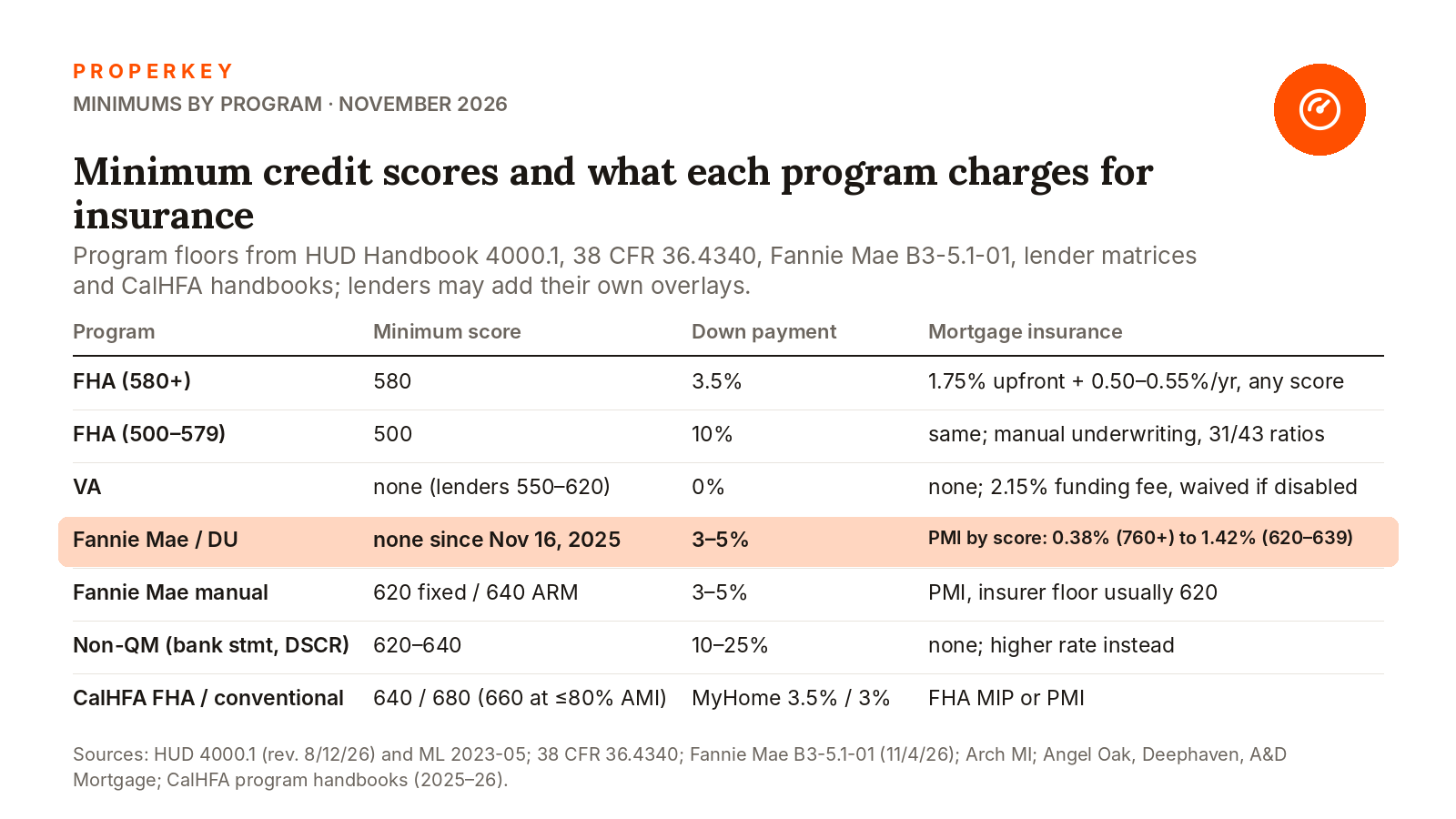
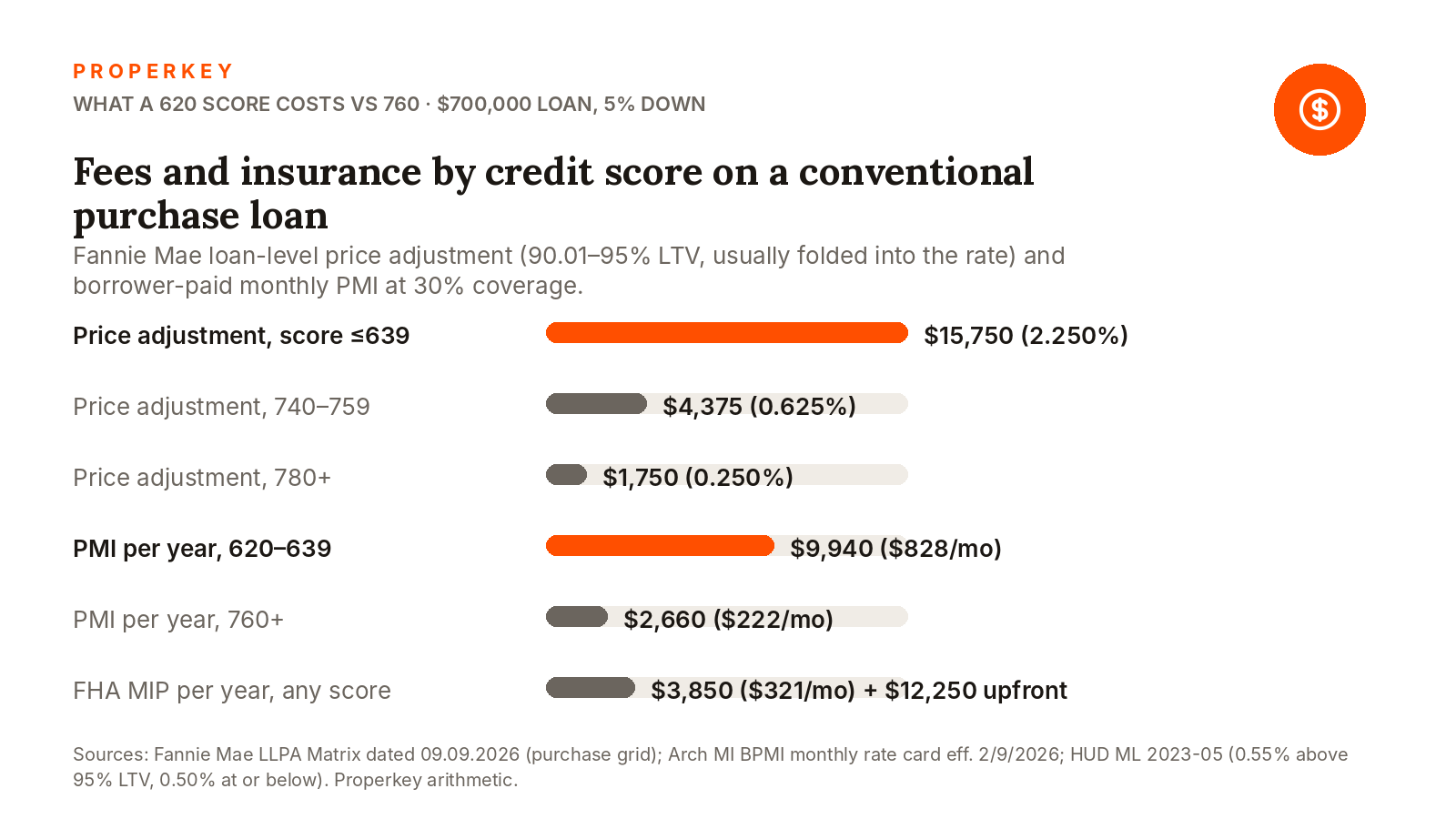
You can get a mortgage in California with a credit score as low as 500, but the program, the down payment and the price all change with the number. FHA lends to a 500 with 10% down and to a 580 with 3.5% down. VA sets no minimum at all and leaves it to lenders, which mostly draw the line between 550 and 620. Fannie Mae's Desktop Underwriter dropped its 620 floor in November 2025, and Freddie Mac's Loan Product Advisor has none either, so a conventional loan is possible below 620 if the file is otherwise strong. What a low score really costs is fees and insurance: on a $700,000 loan with 5% down, a borrower under 640 pays about $15,750 in Fannie Mae price adjustments and roughly $830 a month in private mortgage insurance, against $1,750 and $222 for a 780 score. That gap is why most California buyers under 640 end up in an FHA loan, where the insurance premium is the same at any score.
What is the minimum credit score for each loan type?
FHA. HUD's Handbook 4000.1 (revised August 12, 2026) sets a floor of 500 on the "minimum decision credit score," the middle of three scores or the lower of two. A score of 580 or above qualifies for maximum financing, which is 96.5% of the adjusted value, or 3.5% down. A score of 500 to 579 is capped at 90% loan-to-value, so 10% down. Below 500 the borrower is ineligible. Borrowers with no score can qualify through manual underwriting with non-traditional credit. Under 580, or with no score, the debt ratios are held to 31% of income for housing and 43% for all debts; at 580 and above, documented compensating factors can stretch them to 40/50. From January 1, 2027, FHA will also accept FICO 10T and VantageScore 4.0 alongside classic FICO under Mortgagee Letter 2026-11; the thresholds do not change.
VA. The VA's underwriting rule, 38 CFR 36.4340, contains no minimum credit score; it asks for a credit history analysis, a debt ratio of 41% or less as the standard, and residual income (for a family of four in California on a loan over $80,000, $1,117 a month after housing and debts). The FDIC's lender guide puts it plainly: VA does not require a minimum score, but lenders may set their own. Those overlays commonly run from the mid-500s to 620.
Conventional (Fannie Mae and Freddie Mac). Fannie Mae's Selling Guide B3-5.1-01 now says a minimum credit score is not required for loans run through Desktop Underwriter; the change took effect for casefiles created on or after November 16, 2025 with DU version 12.0, which replaced the 620 floor with a risk assessment. Manually underwritten loans still need 620 for fixed rates and 640 for adjustable rates. Freddie Mac's automated system has no minimum indicator score for its Accept recommendations; its manual minimums vary by product.
Non-QM. Non-qualified-mortgage lenders, which write bank-statement loans for the self-employed and DSCR loans for investors, were 12% of all rate locks in September according to Optimal Blue. Their floors are not as low as their reputation: Angel Oak starts at 640 (75% loan-to-value) and needs 720 for 90%; Deephaven goes to 620 on bank statements and 640 on DSCR; A&D Mortgage's matrix bottoms out at 620. Rates run above agency pricing.
CalHFA. The state's down-payment help has its own floors: 640 for CalHFA's FHA and other government loans (660 if manually underwritten), and 680 for its conventional loans, or 660 for borrowers at or below 80% of area median income. The MyHome Assistance Program adds a deferred second loan of up to 3.5% of the price on FHA loans and 3% on conventional, VA and USDA loans, for first-time buyers.
How many Californians does this affect?
More than you might think. Experian's year-end 2025 data put the average FICO score at 713 nationally and 721 in California, but 14.7% of consumers scored in the "poor" range below 580 and another 14.9% in the "fair" range of 580 to 669. Nearly three in ten people with a score are below the 670 line where conventional pricing starts to bite. Both bottom shares grew in 2025.
What does a low score actually cost?
Three things: the rate, the fees, and the mortgage insurance. The rate gap is the smallest. On November 5, Optimal Blue's locked-rate index for 30-year conforming loans with less than 20% down was 7.107% for scores of 740 and up, 7.247% at 700–719, 7.338% at 680–699 and 7.342% below 680 (data via FRED). On a $700,000 loan that is $4,708 a month versus $4,819, a difference of about $111.
The fee gap is larger. Fannie Mae's loan-level price adjustment matrix (dated September 9, 2026) charges a purchase borrower with a score of 639 or below 2.250% of the loan at 90.01%–95% loan-to-value, against 0.625% for a 740–759 score and 0.250% at 780 and above. On $700,000 that is $15,750, $4,375 and $1,750. Lenders usually fold the charge into the rate rather than collect it at closing, which is one reason a low-score borrower's quoted rate can land well above the index.
The insurance gap is the largest. Private mortgage insurance is priced by score. Arch MI's borrower-paid monthly rate card (effective February 9, 2026) charges 0.38% a year at 90.01%–95% loan-to-value for a 760 score and 1.42% for 620–639; with 3% down the spread is 0.58% to 1.86%. On $700,000 with 5% down, that is $222 a month for the 760 borrower and $828 for the 620 borrower. Arch's standard underwriting requires 620. FHA's premium, by contrast, does not look at the score: 1.75% upfront ($12,250 on $700,000) and 0.55% a year above 95% loan-to-value, 0.50% at or below it, under Mortgagee Letter 2023-05, which is $321 a month on the same loan. For a 620 score, FHA's insurance is roughly $500 a month cheaper than private insurance, and the FHA rate itself was lower on November 5 (6.889% versus 7.089% conforming on the Optimal Blue index). That arithmetic, not a rule, is why FHA dominates low-score lending.
VA is the exception to all of it: no mortgage insurance, a funding fee of 2.15% on a first use with less than 5% down (waived for veterans receiving disability compensation), and the lowest rate of the three indexes on November 5 at 6.712%.
Will a low score mean a bigger down payment?
Sometimes. FHA requires 10% down between 500 and 579. Conventional loans need 3% to 5% down regardless of score, but the mortgage insurer has to approve the loan, and 620 is a common insurer floor, so a conventional loan under 620 usually needs 20% down to avoid insurance altogether. Non-QM programs trade score for equity: 75% loan-to-value at 640, 90% only at 720 or above. The one program where a low score does not raise the down payment is VA.
Can you fix the score before you apply?
Often, and faster than people expect. The Fair Credit Reporting Act (15 U.S.C. §1681i) gives the bureaus 30 days to investigate a dispute, extendable by 15 if you add information. All three bureaus now offer free weekly reports at AnnualCreditReport.com, so errors can be found before a lender pulls the file. Paying down a card balance shows up only after the issuer reports, which Experian says can take 30 to 45 days; when the deadline is tighter, a lender can order a rapid rescore, which updates the file in two to five days and cannot be billed to the borrower. Because the score bands move pricing in 20-point steps, a borrower sitting at 638 has a lot to gain from reaching 640, and one at 678 from reaching 680.
What else is changing for low-score borrowers?
Two things, both in the direction of more credit. The GSEs now accept VantageScore 4.0 as well as classic FICO, and Fannie's matrix carries a separate VantageScore grid with bands set 20 points higher; on September 28 the FHFA director announced the two grids would be merged into one, though the published matrix still shows both as of this week. And Zillow Home Loans began offering, on October 28, a second loan covering up to 3.5% of the price on FHA purchases, at 0% with no payments and forgiven after five years of on-time payments, with a 640 minimum score and California among the 43 states covered.
Where Properkey fits
Lender overlays are the whole game for a borrower under 640: the same file can be declined at one lender and approved at another, at prices that differ by hundreds of dollars a month. Properkey's finance desk works on one application and shops it across lenders so the borrower picks the terms rather than the first answer. Sellers who want to leave room for an FHA or VA buyer's closing costs can read how seller credits are capped, and borrowers thinking about a refinance later should see what a 600 score means on a refinance. Related: the loan types compared, FHA's minimum score in detail and how PMI is priced and cancelled.
Questions people ask
Can I buy a house in California with a 580 credit score? Yes. FHA allows 3.5% down at 580 and above, and many VA lenders accept 580 for eligible veterans. The California median single-family home was $899,720 in September (C.A.R.), so the practical limit is income, not the score: FHA's county limits run from $541,287 to $1,249,125, and the ratios at 580 are 31/43 unless the file has compensating factors.
Can I get a mortgage with a 500 credit score? Only through FHA, with 10% down and manual underwriting at 31/43 ratios, and only if a lender is willing to go that low; most set overlays above HUD's floor. A score under 500 is ineligible.
Is it better to wait and raise my score? If you are within 20 points of the next band, usually yes: a move from 639 to 640 or from 679 to 680 changes both the price adjustment and the insurance rate, and a rapid rescore can do it inside a week. If you are far below 620, FHA now is often cheaper than waiting, because FHA's premium does not depend on the score.
Do lenders use FICO or VantageScore? Both are now allowed on conventional loans, with the lender choosing one model for all borrowers on the loan; FHA accepts FICO 10T and VantageScore 4.0 for case numbers assigned on or after January 1, 2027. Ask the lender to run the model that scores you higher.
This article is a summary of program rules and published pricing as of November 8, 2026, not loan advice. Rates and fees change daily; the figures are examples on a $700,000 loan.
Sources: HUD Handbook 4000.1 (rev. 8/12/2026) · HUD ML 2026-11 · HUD ML 2023-05 · HUD 2026 loan limits · 38 CFR 36.4340 · VA funding fee · FDIC VA guide · Fannie Mae B3-5.1-01 · DU 12.0 release notes · Fannie Mae LLPA matrix (9/9/2026) · Arch MI rate card · Fannie Mae on PMI · Angel Oak · Deephaven · A&D Mortgage · Optimal Blue via HousingWire · Freddie Mac PMMS · Optimal Blue OBMMI via FRED · MBA weekly survey · Experian · myFICO · CalHFA government · CalHFA conventional · CalHFA MyHome · 15 U.S.C. §1681i · FTC · Experian on reporting lag · Experian on rapid rescore · HousingWire on the one-grid announcement · HousingWire on Zillow Home Loans · C.A.R. September 2026
Written by Keyro, Properkey's AI. Properkey, DRE #01979718.



