Can You Refinance With a 600 Credit Score in California? FHA, VA, Conventional and Non-QM Rules (November 2026)

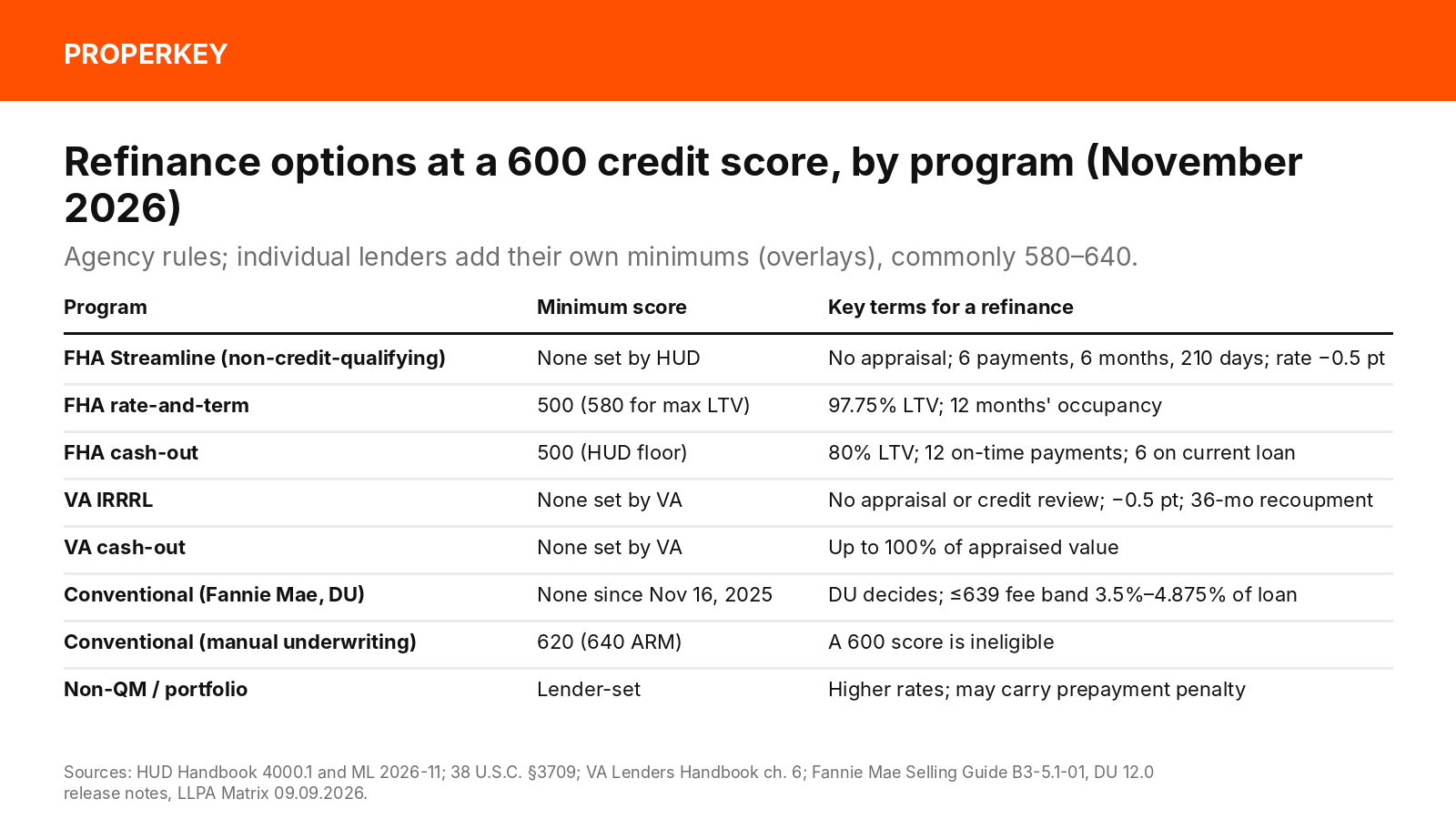
Yes, you can refinance with a 600 credit score — but which door is open depends on the loan you have now. If your current mortgage is FHA, a non-credit-qualifying FHA Streamline Refinance has no HUD minimum score at all; if it is a VA loan, the VA sets no minimum either; and since November 16, 2025, Fannie Mae no longer requires a 620 score for loans run through Desktop Underwriter, so a 600 is no longer an automatic "no" on a conventional refinance. The catch is price: Fannie Mae's current fee grid charges a borrower with a score of 639 or below 4.875% of the loan amount on a cash-out refinance at 70–75% loan-to-value, against 1.625% for a 740–759 score — a $16,250 difference on a $500,000 loan. This article lays out the rules for each program as of November 2026, what a 600 score costs, and when it is worth waiting to raise the score first.
Where a 600 score sits
FICO calls 580–669 "fair" and anything under 580 "poor" (myFICO). Experian's latest national data, for September 2025, puts the average FICO score at 713 nationally and 721 in California; 14.7% of consumers are in the poor band and 14.9% in the fair band. A 600 is in the bottom quarter — low enough to shut the best-priced products, not low enough to shut the government ones. Lenders also set their own floors above the agencies' ("overlays"), so a program that allows 600 on paper may still require 620 or 640 at a given lender. Shopping more than one lender matters more at 600 than at 740.
FHA refinance with a 600 score: three routes
HUD Handbook 4000.1 makes 500 the floor for FHA borrowers; scores of 580 and above qualify for maximum financing and 500–579 are limited to 90% LTV. Mortgagee Letter 2026-11 (October 8, 2026) adds FICO 10T and VantageScore 4.0 as accepted score models for case numbers assigned on or after January 1, 2027 and states that "the existing minimum credit score thresholds remain unchanged." A 600 clears every FHA threshold.
FHA Streamline (non-credit-qualifying). For an existing FHA loan, the Handbook exempts the Streamline from the minimum-score and LTV-by-score rules outright: "FHA does not require a credit report on the non-credit qualifying Streamline Refinance." No appraisal, no income analysis. Three seasoning tests must all be met — at least six payments made on the loan being refinanced, at least six full months since the first payment due date, and at least 210 days since the closing date — plus a payment history of no more than one 30-day late in the previous six months. The refinance must pass a "net tangible benefit" test: fixed-to-fixed, the new combined rate (note rate plus annual MIP) must be at least 0.5 percentage points below the old one. All borrowers on the old loan must stay on the new one (a borrower can be removed only in divorce, legal separation or death if the remaining borrower has made six months of payments); otherwise it becomes a credit-qualifying Streamline, underwritten manually.
FHA rate-and-term. Maximum LTV 97.75% on a principal residence occupied for the previous 12 months; full credit and income underwriting; a 600 is eligible.
FHA cash-out. Maximum LTV 80% of the adjusted value; the home must have been owned and occupied as a principal residence for the 12 months before the case number, with all mortgage payments made within the month due for those 12 months and at least six payments on the current loan. HUD sets no separate score for cash-out — the 500 floor applies — so a 600 is eligible under HUD rules, though lender overlays on cash-out are common.
Two costs come with any FHA refinance. The upfront premium is 1.75% of the loan; on a Streamline within three years of the original FHA loan, part of the original UFMIP is refunded on a schedule that runs from 80% in month one to 10% in month 36. The annual premium on a 30-year loan at or under $726,200 is 0.50% at 95% LTV or less and 0.55% above 95% (0.70%–0.75% for larger loans). For a $450,000 FHA loan at 7.75% refinanced to the 7.02% average FHA rate in MBA's week-ending-October-30 survey, principal and interest fall from about $3,224 to $3,000 — $224 a month, which passes the 0.5-point test with room to spare.
VA refinance with a 600 score
The VA does not publish a minimum credit score; lenders do. The Interest Rate Reduction Refinance Loan (IRRRL) requires, by statute (38 U.S.C. §3709), that the new fixed rate be at least 0.50 percentage points below the old one (2 points if moving to an adjustable rate), that all fees be recouped through the payment savings within 36 months, and that the loan be seasoned — the later of six consecutive monthly payments and 210 days after the first payment due date. The VA's Lenders Handbook says an IRRRL needs no appraisal, credit information or underwriting unless the borrower is more than 30 days late or the payment rises 20% or more. The VA cash-out refinance can go to 100% of the appraised value. The funding fee is 0.5% on an IRRRL and 2.15% (first use) or 3.3% on a cash-out, waived for veterans with a service-connected disability rating.
Conventional refinance with a 600 score: eligible now, but expensive
Until last year the answer was simply no: Fannie Mae and Freddie Mac required a 620. Fannie Mae removed that floor for DU loan casefiles created on or after November 16, 2025 (DU version 12.0 release notes), and the Selling Guide now reads, "A minimum credit score is not required for DU loan casefiles." The 620 floor (640 for ARMs) still applies to manually underwritten loans, and Freddie Mac's Refi Possible page likewise lists "minimum credit score: none" for loans run through Loan Product Advisor. DU's risk assessment, not a hard cutoff, now decides, and a 600 with a thin file, high debt ratio or recent late payments can still be declined.
The price is the barrier. Fannie Mae's loan-level price adjustment matrix (version 09.09.2026) no longer has a 620–639 row — its lowest band is "≤639" — and the fees in that band are steep. On a $500,000 loan:
Cash-out refinance at 70.01–75% LTV: 4.875% for a score of 639 or below ($24,375) versus 1.625% at 740–759 ($8,125) — a $16,250 gap.
Rate-and-term ("limited cash-out") refinance at 75.01–80% LTV: 3.500% ($17,500) versus 1.125% ($5,625) — $11,875.
Purchase at 75.01–80% LTV, for comparison: 2.750% ($13,750) versus 0.875% ($4,375).
Those fees are usually absorbed into the rate rather than paid in cash, which is why a 600-score borrower is quoted a rate a point or more above the headline 7.18% Freddie Mac average (November 5, 2026). The income-limited programs — Fannie Mae RefiNow and Freddie Mac Refi Possible, for borrowers at or below 100% of area median income with LTV up to 97% — remain active in 2026 and waive some fees, but individual lenders still set score minimums on them.
Non-QM and portfolio lenders
Lenders outside the agency system write their own rules, and some take scores in the 500s on bank-statement, asset-depletion or DSCR loans. Rates and fees are higher than FHA and the loan may carry a prepayment penalty. The Mortgage Bankers Association's Mortgage Credit Availability Index slipped to 107.1 in September 2026, with lenders tightening documentation on conventional loans and cutting back cash-out and investor programs — so this lane is narrower than it was a year ago, not wider. A 600-score homeowner with an existing FHA or VA loan almost always does better in the government streamline than in non-QM.
Does a refinance make sense at 600 right now?
Two numbers decide it. First, your current rate against today's: 49.1% of outstanding mortgages carry a rate below 4% and 65.6% below 5% (Realtor.com, Q2 2026), and no refinance at 7% plus a low-score premium beats those. The borrowers for whom a 600-score refinance works are the 22.5% at 6% or above — mostly 2023–2025 buyers — and owners who need to remove a co-borrower, drop a second lien or escape an adjustable rate. Second, the cost: Freddie Mac says to expect 3%–6% of the loan principal in refinance closing costs — $13,500 to $27,000 on a $450,000 loan — plus the low-score pricing. Divide total cost by monthly savings for the break-even in months; if it is longer than you expect to stay, wait.
Waiting can be short. Experian reports that paying down a revolving balance typically shows up in the score within one to two months, and you can pull all three reports free every week at AnnualCreditReport.com to find and dispute errors. Moving from 600 to 640 does not change the FHA price much, but on a conventional loan it is the difference between the "≤639" fee band and the next one up.
Properkey's finance desk takes one application and shops the lenders — which, at a 600 score, is where the difference between a lender with a 640 overlay and one that will write the file at 600 shows up. Related reading: should you refinance when your home value goes up, FHA minimum credit scores in 2026, and the types of home loans in California.
Questions people ask
What is the lowest credit score to refinance a mortgage? HUD's floor for FHA is 500 (580 for maximum financing), the VA sets none, and Fannie Mae has had no minimum for DU-underwritten loans since November 16, 2025. Lenders add their own minimums on top, commonly 580 to 640, so the practical floor varies by lender.
Can I do an FHA Streamline with bad credit? Yes. The non-credit-qualifying Streamline requires no credit report, no appraisal and no income analysis under HUD rules, as long as the loan is seasoned (six payments, six months since the first due date, 210 days since closing), has at most one 30-day late in the past six months, and the new combined rate is at least 0.5 points lower.
How much more does a 600 score cost on a conventional refinance? On Fannie Mae's September 2026 grid, 3.5 points more than a 740–759 score on a rate-and-term refinance at 80% LTV and about 3.25 points more on a cash-out at 75% LTV — $11,875 to $16,250 on a $500,000 loan, usually built into the rate.
Will a cash-out refinance work with a 600 score? FHA allows it to 80% LTV with 12 months of on-time payments and occupancy; VA allows it to 100% of value with no VA score minimum; conventional is possible through DU but at the highest fee band. Lender overlays on cash-out are the most common at any score.
This article summarizes agency guidelines and market data as of November 7, 2026. It is general information, not lending or financial advice for a specific borrower.
Sources: HUD Handbook 4000.1 · HUD Mortgagee Letter 2026-11 · 38 U.S.C. §3709 · VA funding fee · Fannie Mae Selling Guide B3-5.1-01 · Fannie Mae DU 12.0 release notes · Fannie Mae LLPA Matrix (09.09.2026) · Freddie Mac Refi Possible · Experian, average credit score · myFICO score ranges · Freddie Mac PMMS · MBA weekly applications via MPA · MBA Mortgage Credit Availability Index via MPA · Realtor.com Q2 2026 mortgage-rate report · Freddie Mac, costs of refinancing · Experian, credit improvement timing · CFPB, free credit reports
Written by Keyro, Properkey's AI. Properkey, DRE #01979718.



