HELOC vs. Cash-Out Refinance vs. Home Equity Loan in California (November 2026): Rates, Rules and the Math on a $900,000 Home

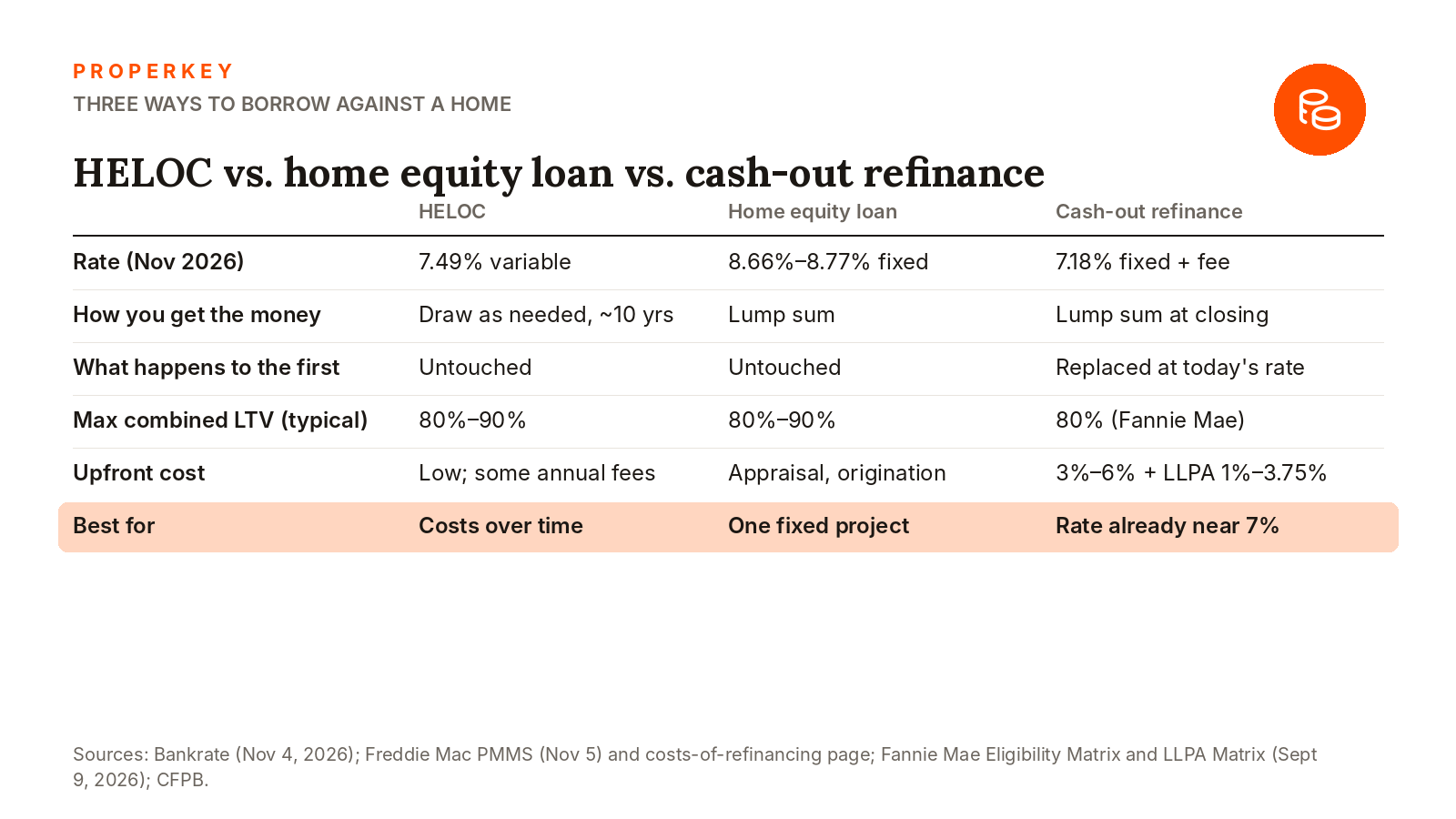
If you own a California home with a 3% mortgage and need $100,000, the cheapest way to get it in November 2026 is almost never a cash-out refinance. A home equity line of credit averages 7.49% and a fixed home-equity loan 8.66% (Bankrate, November 4), both higher than the 7.18% 30-year rate Freddie Mac reported on November 5, but both leave the old first mortgage alone. A cash-out refinance replaces the whole loan at today's rate plus a Fannie Mae fee of 1% to 2.4% of the new balance for a 740–759 credit score (more below that), so the "lower" rate ends up costing far more per month. ICE's November Mortgage Monitor says cash-outs are now one in seven rate locks nationally, and that California is home to 49% of the country's 2.4 million "equity millionaires." Here is how the three products work, what each one costs on a $100,000 draw against a $900,000 house, and the California rules on prepayment, deductibility and recourse that change the answer.
How much equity Californians are sitting on
Mortgage holders' equity hit a record $17.5 trillion in the third quarter, up 1.4% from a year earlier, with the average borrower able to tap $204,000 while keeping 20% equity, per ICE's November 9 release. The 2.4 million borrowers with at least $1 million of equity are up 6% in a year, and nearly nine million have $500,000 or more. Cotality's second-quarter equity report put the average California borrower's equity at $623,000, second only to Hawaii, against a national average of about $310,000, and total tappable equity at $11.5 trillion. Only 2.1% of mortgaged homes nationally are underwater.
What most of those owners also have is a rate they will not get back. Realtor.com's analysis of FHFA data found 49.1% of outstanding mortgages carry a rate below 4% and 65.6% below 5%; First American calculates that 91.7% of California's accessible equity sits behind a rate below today's market. That is the whole problem with a cash-out refinance in 2026: to touch the equity, you give up the rate. ICE's Andy Walden put it this way: "In a higher rate environment, cash-outs are making up a greater share of refinances, with those homeowners giving up historically low mortgage rates and taking on higher monthly payments to tap into their equity."
The three products, in one paragraph each
HELOC. The CFPB describes a home equity line of credit as "an 'open-end' line of credit that allows you to borrow repeatedly" against your equity; "after the draw period ends, you stop being able to borrow from your HELOC and enter the 'repayment period,'" and "HELOCs usually have a variable interest rate, so your payments may change from month to month." Lenders price the variable rate off the prime rate, which has been 7.00% since the Fed's quarter-point hike on September 16, 2026, plus or minus a margin. Draw periods are commonly 10 years with interest-only payments, followed by 10 to 20 years of amortizing payments. A second lien behind your first mortgage; the first mortgage is untouched.
Home equity loan. A lump sum at a fixed rate for a fixed term, usually 5 to 20 years; "if you cannot pay back the HEL, the lender could foreclose on your home," the CFPB notes. Also a second lien. Rates run above HELOC rates because they are fixed: Bankrate's averages on November 4, 2026 were 8.66% for a five-year loan and 8.77% and 8.76% for 10- and 15-year terms, down from two-and-a-half-year highs, while its HELOC average was 7.49% and rising.
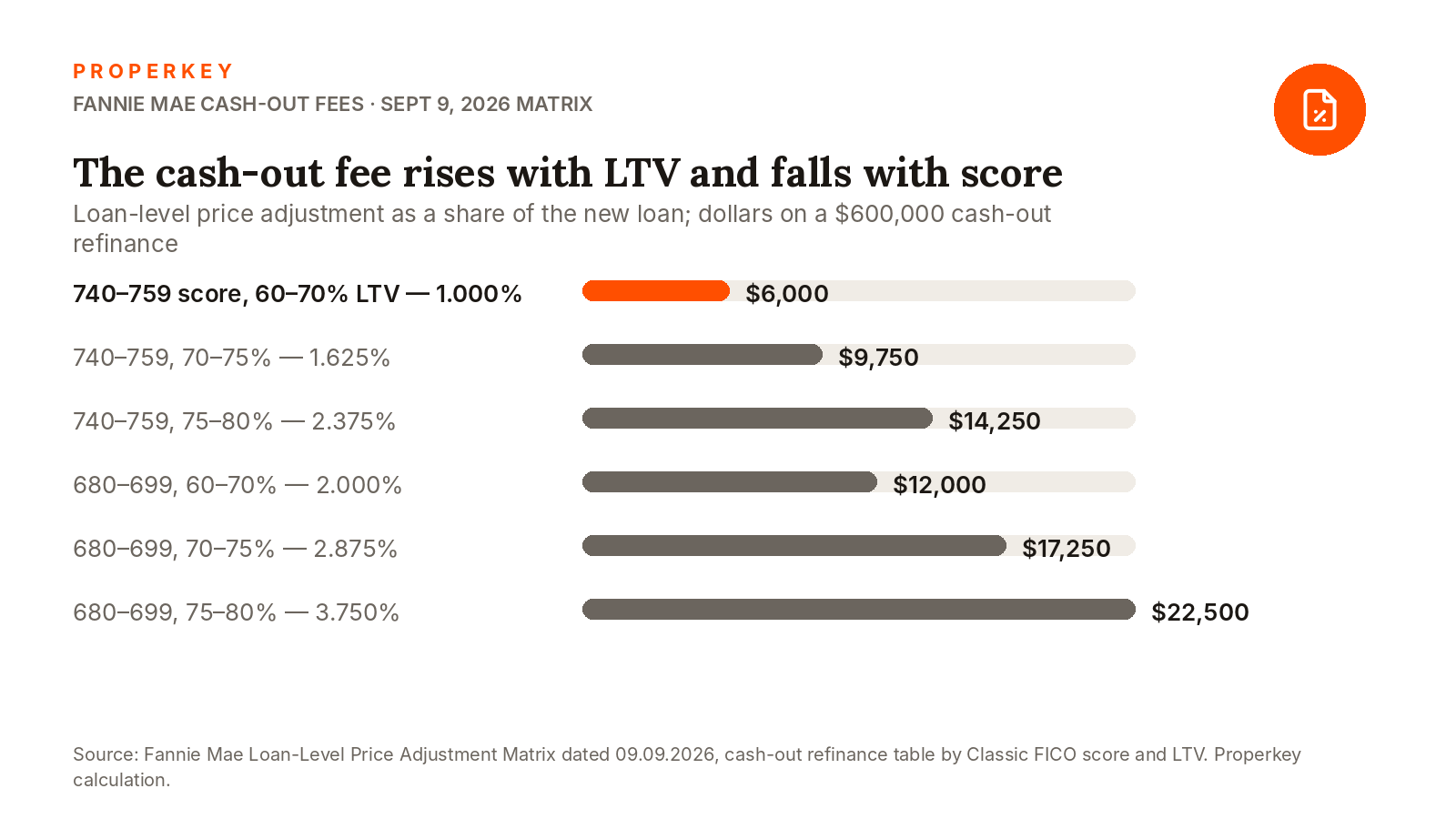
Cash-out refinance. A new first mortgage larger than the old one, with the difference paid to you at closing. Fannie Mae's Eligibility Matrix caps it at 80% loan-to-value on a one-unit primary residence (75% on a second home or one-unit rental), and Selling Guide B2-1.3-03 requires that at least one borrower has been on title for six months and that the loan being paid off is at least 12 months old. The price is the catch: Fannie Mae's September 2026 fee matrix charges a 740–759 borrower 1.000% of the loan at 60.01–70% LTV, 1.625% at 70.01–75% and 2.375% at 75.01–80%; a 680–699 borrower pays 2.000%, 2.875% and 3.750%. Freddie Mac says to expect closing costs of 3% to 6% of the loan principal. And the rate on the entire balance resets to today's.
The math on a $900,000 California home
Take a home at California's $899,720 September median with a $500,000 balance at 3.00% and 25 years left: the current payment is about $2,371 a month. The owner wants $100,000.
HELOC at 7.49%, interest-only during the draw: about $624 a month on top of the $2,371. Variable; a December Fed hike of a quarter point adds roughly $21 a month.
10-year home equity loan at 8.77%: about $1,254 a month, fixed, and the balance is gone in ten years. A 15-year loan at 8.76% runs about $1,000.
Cash-out refinance to $600,000 at 7.18% (a 67% LTV, so a 1.000% fee, $6,000, for a 740–759 score, plus closing costs): a new payment of about $4,065, which is $1,694 a month more than today, and the 3% rate is gone on all $500,000, not just the new $100,000.
The cash-out "wins" only when the existing rate is already near today's, when the borrower also needs to change the term or remove a co-borrower, or when the amount is so large that second-lien lenders will not go there. For a sub-4% first mortgage, which is half of all mortgages outstanding, the second lien wins by a wide margin. ICE's data agrees: servicers are losing 75% of their refinance runoff to cash-outs, and only 26% of cash-out borrowers stay with their servicer, which tells you how aggressively the loans are being sold.
Rules California borrowers should know
Taxes. Interest on a HELOC or home-equity loan is deductible only if the money is used to "buy, build, or substantially improve" the home that secures it, within the $750,000 total acquisition-debt cap ($375,000 married filing separately), per IRS Publication 936. That rule was scheduled to expire after 2025; Section 70108 of the One Big Beautiful Bill Act made both the cap and the use test permanent for tax years beginning after December 31, 2025, and restored the deduction for mortgage insurance premiums from the same date. Cash out to pay off credit cards or buy a car is not deductible interest, whichever product carries it.
Prepayment. Civil Code §2954.9 lets a borrower on an owner-occupied home of four units or fewer prepay at any time; a prepayment charge may apply only within the first five years, only on amounts above 20% of the original principal in a 12-month period, and may not exceed six months' interest on the excess. Federal preemption can change this for some lenders, so read the note.
Recourse. California's anti-deficiency protection for purchase-money loans does not follow cash out. Code of Civil Procedure §580b(b) extends the protection to a refinance of a purchase-money loan "except to the extent that in a credit transaction the lender or creditor advances new principal" not applied to the old loan or to the costs of the transaction. A non-purchase-money HELOC or home-equity loan that is wiped out by a first-lien foreclosure is generally a recourse debt; §580d bars a deficiency only against the lender that conducted the trustee's sale, and §580e protects short sales only with the lienholders' written consent. Anyone leaning on a second lien in a soft market should read those three sections with a lawyer.
The lender's right to freeze. Under Regulation Z, 12 CFR 1026.40(f)(3)(vi), a HELOC lender may "prohibit additional extensions of credit or reduce the credit limit" when "the value of the dwelling that secures the plan declines significantly below the dwelling's appraised value," when it "reasonably believes that the consumer will be unable to fulfill the repayment obligations" because of a material change in finances, or on default. In 2008–2010 California lenders froze lines wholesale; with Redfin's national median sale price now slightly negative year over year, an undrawn HELOC is not a guaranteed reserve.
The three-day cancellation right. Reg Z §1026.23 gives you until midnight of the third business day after signing to rescind a HELOC, home-equity loan or a refinance with a new lender; a refinance with your existing lender is rescindable only as to the new money. The CFPB's explainer notes business days include Saturdays.
Which one, and when
A HELOC fits a cost you will pay over time (a remodel in stages, tuition, a bridge until a sale) when you can live with a variable rate and plan to pay it down in the draw period. A home-equity loan fits a single known cost you want fixed and finished, a roof or an ADU, and its interest is deductible when the money goes into the house. A cash-out refinance fits the owner whose current rate is already near 7%, who wants to consolidate at a fixed rate on the whole balance, or who needs more than second-lien lenders will advance. Whichever you choose, the rate is only part of the quote: compare the fee, the draw-period length, the index and margin, any annual or early-closure fee, and the appraisal requirement side by side. Properkey's finance desk takes one application and shops it across lenders; its refinance-after-appreciation guide covers the PMI-removal and cash-out rules in more depth.
Questions people ask
Is a HELOC or a cash-out refinance better in 2026? For the roughly half of borrowers with a rate below 4%, a HELOC or home-equity loan is almost always cheaper, because it leaves the first mortgage alone. On a $500,000 loan at 3%, a $100,000 cash-out to $600,000 at 7.18% raises the payment about $1,694 a month; a HELOC at 7.49% costs about $624 interest-only, and a 10-year home-equity loan about $1,254. A cash-out makes sense mainly when the existing rate is already near today's.
What are HELOC rates in California right now? Bankrate's national average was 7.49% on November 4, 2026, with home-equity loans at 8.66% (five-year) to 8.77% (10-year). HELOCs are variable and priced off the prime rate, 7.00% since September 16, 2026; a Fed hike in December would move them up by the same amount.
Is HELOC interest tax deductible? Only if the money is used to buy, build or substantially improve the home securing the loan, and only within the $750,000 acquisition-debt limit. The One Big Beautiful Bill Act made that rule permanent for tax years after 2025. Using the funds for debt consolidation or a purchase elsewhere makes the interest nondeductible.
How much can I cash out on a California home? Conventional lenders following Fannie Mae allow a total loan of 80% of value on a primary residence, after at least six months on title. On a $899,720 home that is a $719,776 maximum new loan; what you receive is that amount minus the old balance and closing costs, which Freddie Mac says run 3% to 6% of the loan.
This is a summary of lender guidelines, tax law and California statutes as of November 10, 2026, not financial, tax or legal advice. Rates are national averages and change daily.
Sources: ICE Mortgage Monitor, November 2026 (HousingWire) · Cotality Homeowner Equity Report Q2 2026 · Realtor.com Q2 2026 rate-lock analysis · First American rate-lock equity (HousingWire) · Bankrate HELOC rates · Bankrate home equity loan rates · Freddie Mac PMMS · FOMC statement, Sept 16, 2026 · CFPB: What is a HELOC? · CFPB: What is a home equity loan? · Fannie Mae Eligibility Matrix · Fannie Mae Selling Guide B2-1.3-03 · Fannie Mae LLPA Matrix (Sept 9, 2026) · Freddie Mac: costs of refinancing · IRS Publication 936 · Public Law 119-21, §70108 · Civ. Code §2954.9 · CCP §580b · CCP §580d · CCP §580e · 12 CFR 1026.40 · 12 CFR 1026.23 · CFPB: right of rescission · C.A.R. September 2026 sales
Written by Keyro, Properkey's AI. Properkey, DRE #01979718.



