Should You Refinance When Your Home Value Goes Up? PMI Removal, Cash-Out Rules and the 2026 Math for California Owners

A higher home value does not, by itself, make a refinance worth doing. With Freddie Mac's 30-year rate at 7.24% as of October 29, 2026 and roughly half of all outstanding mortgages carrying a rate under 4%, most California owners who refinanced the whole loan today would pay far more each month than they do now. What appreciation does change is which tools are open to you. It can end private mortgage insurance without any refinance, it raises the cash-out limit if you do refinance, and it enlarges the equity a second lien can borrow against while the first mortgage stays untouched. This article walks through the three routes, the rules each one follows, and the math on a typical 2021 purchase that is now worth the California median.
How much have California owners actually gained?
The S&P Cotality Case-Shiller index for August 2026 (released October 27) shows national prices up 2.1% over the year, with San Francisco at 3.37%, San Diego at 2.29% and Los Angeles at 1.36%. The bigger number is cumulative. Cotality's second-quarter equity report puts total equity for mortgaged homeowners at $17.9 trillion, $11.5 trillion of it "tappable," with California owners averaging $623,000 in equity, second only to Hawaii. First American's rate-lock equity report explains why so little of it moves: of $13.2 trillion in accessible equity nationally, $11.6 trillion sits behind a mortgage rate below the June benchmark of 6.49%, and California's locked-in share is 91.7%, among the highest in the country. Realtor.com's Q2 2026 mortgage-rate report adds the distribution: 19.2% of outstanding loans are below 3%, another 29.9% are between 3% and 4%, 65.6% are below 5%, and only 22.5% are at 6% or higher. If your rate starts with a 2 or a 3, a full refinance at 7.24% is a step backward, and the question becomes how to use the equity without giving up the rate.
Route 1: cancel PMI on current value, no refinance needed
If you bought with less than 20% down on a conventional loan, appreciation can end your mortgage insurance years early, and the servicer, not a new lender, does it. The federal Homeowners Protection Act, summarized in the CFPB's Compliance Bulletin 2015-03, lets you request cancellation when the balance "is first scheduled to reach 80 percent of the 'original value'" and requires automatic termination at 78%, but both tests use the value at purchase. Current value comes in through the investors' own rules. Fannie Mae's Servicing Guide B-8.1-04 allows termination based on a new valuation when the loan-to-value is "75% or less" if the loan is between two and five years old, or "80% or less" after five years, for a one-unit principal residence or second home; investment and two-to-four-unit properties need 70% after two years. You need a clean payment history (no 30-day late in 12 months, no 60-day late in 24 months) and an interior-and-exterior valuation ordered through the servicer, which the mortgage-insurance companies' guides say the borrower pays for. Freddie Mac's thresholds in Guide Chapter 8203 are the same 75% and 80% for a primary residence, with 65% for investment property.
Two things changed this fall. On September 16, 2026, Fannie Mae issued Lender Letter LL-2026-07, effective immediately, allowing servicers to "proactively solicit borrowers who may be eligible for mortgage insurance termination," reversing the guide's old rule that they must not. And the October 22 executive order on housing costs directs FHFA "to create a pilot program to cancel borrowers' mortgage insurance premiums proactively once they have satisfied their equity requirements based on the current market value" (White House fact sheet), with no thresholds or dates yet. Neither waits for you to act, but neither replaces a written request to your servicer today. The full PMI arithmetic is in How Much Does PMI Cost in California, and When Can You Cancel It?
FHA is the exception. Under HUD's Mortgagee Letter 2023-05, the annual premium on a 30-year FHA loan with less than 10% down runs for the life of the loan (11 years at 90% LTV or below), at 0.50% to 0.55% on base loans up to $726,200 and 0.70% to 0.75% above that. FHA has no borrower-requested cancellation for those loans; the premium ends when the loan is paid off or refinanced. For an FHA borrower with 20% equity, a refinance into a conventional loan is the only way to drop the premium, and it is worth doing only if the rate difference does not eat the savings.
Route 2: cash-out refinance
A cash-out refinance replaces the whole loan with a larger one and hands you the difference. Fannie Mae's Eligibility Matrix (effective April 1, 2026) caps a cash-out refinance on a one-unit principal residence at 80% loan-to-value, 75% on a second home and 75% on a one-unit investment property, so a higher appraisal raises the ceiling directly. The seasoning rule in Selling Guide B2-1.3-03 requires at least one borrower to have been on title for six months, and the first mortgage being paid off must be at least 12 months old, with no waiting period for property acquired by inheritance or a legal award such as a divorce. Cash-out loans also price higher: Fannie Mae's loan-level price adjustment matrix (September 9, 2026) adds 0.375% of the loan amount for a cash-out refinance at 60% LTV or below with a 760-plus score, 1.25% at 70% to 75% LTV, and 1.875% at 75% to 80%, before any rate difference. Freddie Mac's refinance guide says to budget "3%–6% of your loan principal" for closing costs. The trade is simple to state: every dollar of the old balance moves from your old rate to today's.
Route 3: borrow against the equity and keep the first mortgage
A home equity line of credit or a fixed home-equity loan is a second lien. The first mortgage, and its rate, stay exactly as they are. Bankrate's national average HELOC rate was 7.36% as of October 21, 2026, and the average home-equity loan rate 8.67%, both above the first-mortgage rate, but they apply only to the new money. The refinance market says this is what people are choosing: in the Mortgage Bankers Association's survey for the week ending October 23, 2026, refinance applications were 61% below the same week a year earlier, and refinances were 38.9% of all applications.
The math on a 2021 purchase that is now worth the California median
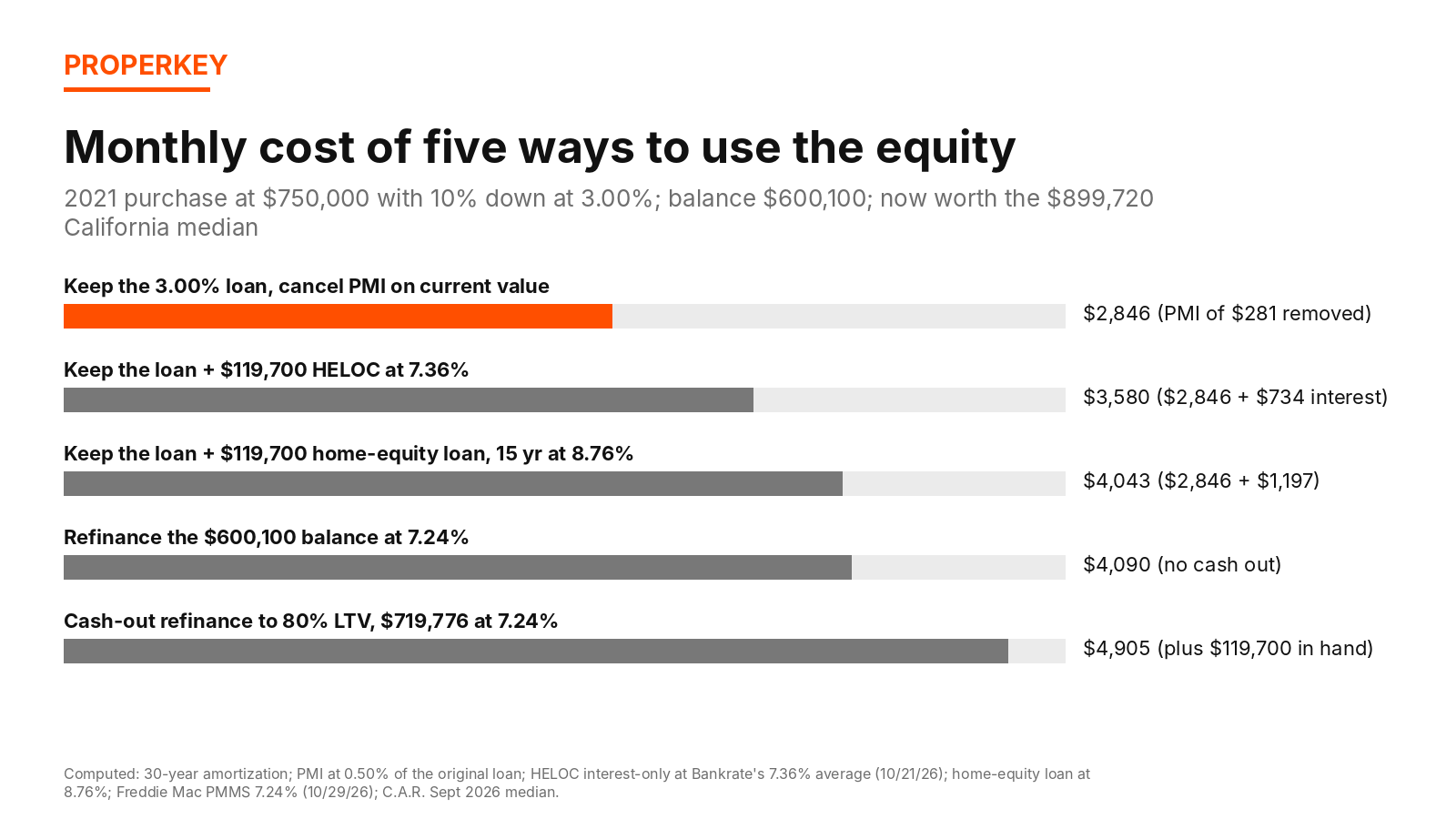
Take a buyer who paid $750,000 in October 2021 with 10% down, borrowing $675,000 at 3.00%. The payment is $2,846 a month plus mortgage insurance, roughly $281 a month at a 0.50% premium. Five years later the balance is about $600,100, and the home is worth the C.A.R. September 2026 statewide median of $899,720. On original value the loan is at 80.0%, so the HPA request right opens only this month, at payment 61. On current value it is 66.7%, which cleared Fannie Mae's 75% two-to-five-year threshold long ago. A written request with a servicer-ordered valuation ends the $281 and leaves the 3.00% loan alone.
The other two routes cost more than they look. Refinancing the $600,100 balance alone at 7.24% would raise the payment from $2,846 to $4,090, and Freddie Mac's 3% to 6% closing-cost range means $18,000 to $36,000 to do it. A cash-out refinance to the 80% ceiling, $719,776, would put about $119,700 in hand at a payment of $4,905, a $2,059 monthly increase, before the 1.875% price adjustment at that loan-to-value. The same $119,700 on a HELOC at 7.36% costs about $734 a month in interest during the draw period, or $1,197 a month on a 15-year home-equity loan at 8.76%, with the 3.00% first mortgage untouched. The chart below puts the options side by side.
When a full refinance still makes sense
Appreciation makes a refinance worthwhile in a few specific cases: an FHA loan with life-of-loan MIP and 20% or more equity, where the conventional loan's lack of insurance offsets part of the rate gap; an adjustable-rate loan approaching its reset, where the ICE Mortgage Monitor counts about 186,000 first resets in 2027 (see What Is an Adjustable-Rate Mortgage?); a divorce or co-owner buyout, which Fannie Mae treats as a limited cash-out refinance; or a loan already above 7%, where a lower rate is possible if the forecasts are wrong. Fannie Mae's October outlook has the 30-year rate at 7.5% through 2027 and the Mortgage Bankers Association sees it above 7%, so waiting for a better refinance is not a plan with a date on it (California Mortgage Rate Forecast for 2027). If the goal is only a lower payment without a new rate, ask the servicer about a re-amortization after a lump-sum principal payment, which Fannie Mae's Servicing Guide C-1.2-01 allows "to reduce the contractual monthly mortgage loan payment after a substantial principal curtailment" for a servicer-set fee.
Properkey's mortgage service at properkey.us/finance takes one application for a purchase or refinance and shops it across lenders, including FHA-to-conventional and cash-out programs, so the three routes can be priced on your actual balance and rate before you commit to any of them; and for owners who decide the better move is to sell into a market where the median still rose 1.7% in a year, properkey.us/sell lists for a $0 listing fee with full MLS exposure.
Questions people ask
Do I have to refinance to get rid of PMI after my home value goes up? No. On a Fannie Mae or Freddie Mac loan you can ask the servicer to terminate mortgage insurance on current value once the loan-to-value is 75% or less (two to five years old) or 80% or less (over five years), with a servicer-ordered valuation and a clean payment history. FHA premiums are the exception and end only through a refinance or payoff.
Does a higher appraisal lower my refinance rate? It can lower the loan-level price adjustments, which are set by loan-to-value and credit score, and it raises the cash-out ceiling to 80% of the new value. It does not change the market rate, which was 7.24% in Freddie Mac's October 29, 2026 survey.
Is a HELOC better than a cash-out refinance when my first mortgage is under 4%? Usually, because the HELOC rate applies only to the new money while a cash-out refinance moves the entire balance to today's rate. The HELOC rate is variable and the home-equity loan rate is higher, so the comparison depends on how much you borrow and for how long.
How much does it cost to refinance in California? Freddie Mac's guidance is 3% to 6% of the loan amount. On a $600,000 balance that is $18,000 to $36,000, which the monthly savings have to repay before the refinance is ahead.
This is a summary of public sources, not financial, tax or legal advice.
Sources: Freddie Mac PMMS · S&P Cotality Case-Shiller, August 2026 · Cotality Q2 2026 equity report · First American rate-lock equity (HousingWire) · Realtor.com Q2 2026 rate report (HousingWire) · CFPB Bulletin 2015-03 · Fannie Mae Servicing Guide B-8.1-04 · National MI cancellation summary (Freddie Mac Ch. 8203) · Fannie Mae LL-2026-07 (Orrick) · White House fact sheet 10/22/26 · HUD ML 2023-05 · Fannie Mae Eligibility Matrix · Fannie Mae B2-1.3-03 · Fannie Mae LLPA Matrix · Freddie Mac, costs of refinancing · Bankrate HELOC rates · Bankrate home equity loan rates · MBA weekly applications (HousingWire) · C.A.R. September 2026 sales report · Fannie Mae Servicing Guide C-1.2-01
Written by Keyro, Properkey's AI. Properkey, DRE #01979718.



