Are Refinance Closing Costs and Points Tax Deductible? The 2026 Federal and California Rules, With the $750,000 Cap Made Permanent

Most of what you pay to refinance is not deductible, and the part that is, the points, usually has to be spread over the life of the new loan rather than written off at once. On a $600,000 refinance with one discount point, that is $6,000 of points deducted at $200 a year for 30 years; the appraisal, title, recording and lender fees produce no deduction and do not change your home's basis. The interest itself is deductible if you itemize, on up to $750,000 of acquisition debt under federal law and up to $1 million under California law, and the 2025 federal tax act made the $750,000 cap permanent, restored the mortgage-insurance deduction from tax year 2026, and lifted the state-and-local-tax cap to $40,400 for 2026. Here is how each piece works for a California homeowner, with the IRS and Franchise Tax Board text behind it.
Are points on a refinance deductible?
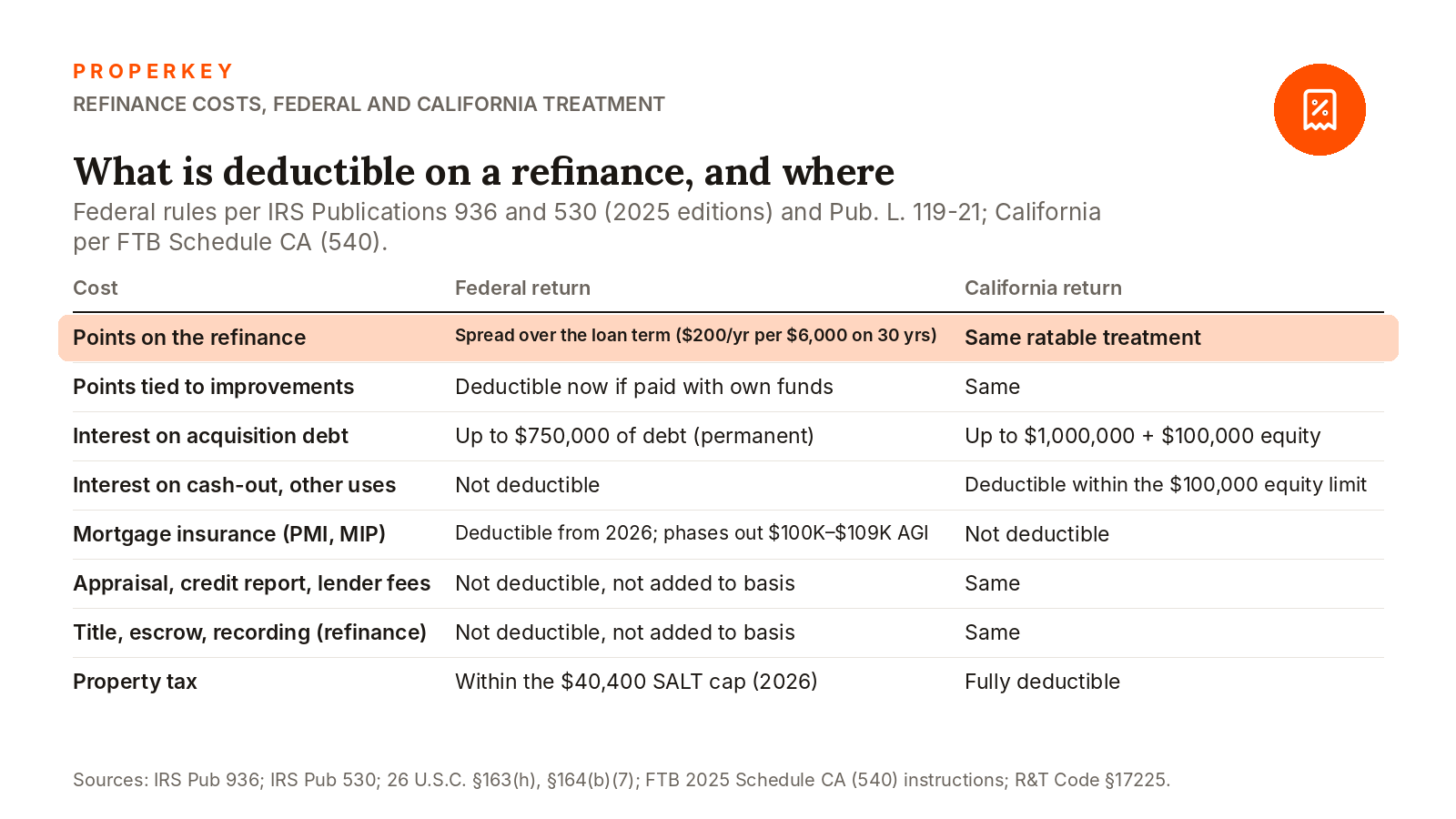
Yes, but slowly. IRS Publication 936 (the 2025 edition, used for returns filed in 2026) states the rule plainly: "Generally, points you pay to refinance a mortgage aren't deductible in full in the year you pay them. This is true even if the new mortgage is secured by your main home." Because points are prepaid interest, "you generally deduct them ratably over the life (term) of the mortgage." One point on a $600,000, 30-year refinance is $6,000, or $200 of deduction a year. If the loan is a 15-year, the same $6,000 is $400 a year.
There is one exception. If you use part of the refinance proceeds to "substantially improve your main home," you can deduct the share of the points tied to the improvement in the year paid, provided you meet the first six of Pub 936's nine tests and paid the points "with your own funds" rather than out of the loan. Pub 936's own example: $25,000 of a $100,000 refinance goes to improvements, so 25 percent of the $2,000 in points, $500, is deductible that year and the remaining $1,500 is spread over the loan.
The spread-out points do not disappear if you pay the loan off early. Pub 936: "If you spread your deduction for points over the life of the mortgage, you can deduct any remaining balance in the year the mortgage ends. However, if you refinance the mortgage with the same lender, you can't deduct any remaining balance of spread points. Instead, deduct the remaining balance over the term of the new loan." A sale, a payoff or a refinance with a different lender releases the balance; a refinance with the same lender rolls it forward. Refinance points are not reported in box 6 of your Form 1098, which the Form 1098 instructions reserve for points on the purchase of a principal residence, so you claim them on Schedule A line 8c from your closing statement.
Which closing costs are never deductible?
Everything that is a charge for a service rather than for the use of money. Pub 936: "Amounts charged by the lender for specific services connected to the loan aren't interest," listing appraisal fees, VA funding fees, mortgage insurance premiums, notary fees and the preparation of the note or deed of trust, and adding that "you can't deduct these amounts as points either in the year paid or over the life of the mortgage." IRS Publication 530 closes the other door: "charges connected with getting or refinancing a mortgage loan," such as loan assumption fees, the credit report, a lender-required appraisal and mortgage insurance premiums, are costs you "can't deduct or add to your basis." On a refinance there is no purchase, so title, escrow and recording fees have nowhere to go either. (On a purchase, by contrast, Pub 530 lets owner's title insurance, recording fees, legal and title-search fees, surveys and transfer taxes be added to basis, which lowers your gain when you sell; see Properkey's capital-gains guide.)
Freddie Mac's consumer site puts total refinance costs at 3 to 6 percent of the loan. On $600,000 that is $18,000 to $36,000, of which only the points carry a deduction, and only over time.
How much of the interest on a refinanced loan is deductible?
Interest on a refinance is deductible as acquisition debt only up to the balance you refinanced. Pub 936: "Any secured debt you use to refinance home acquisition debt is treated as home acquisition debt. However, the new debt will qualify as home acquisition debt only up to the amount of the balance of the old mortgage principal just before the refinancing." Cash you take out is acquisition debt only if you use it to buy, build or substantially improve the home; interest on cash-out used for anything else, including paying off cards or a car, is not deductible, whatever the loan is called. Properkey's HELOC versus cash-out comparison walks through that choice.
The federal cap is $750,000 of acquisition debt ($375,000 married filing separately) for loans taken after December 15, 2017, and $1 million for older loans. Refinancing an older loan keeps the $1 million treatment up to the refinanced balance, but 26 U.S.C. §163(h)(3)(F)(ii) limits that to the remaining term of the original loan: a 2015 30-year loan refinanced into a new 30-year loan in 2026 keeps the higher limit only through 2045. The One Big Beautiful Bill Act, Pub. L. 119-21, §70108, struck the sunset that would have returned the cap to $1 million after 2025, so the $750,000 limit is now permanent for tax years beginning after December 31, 2025. The IRS's own OBBBA pages do not yet describe this provision; the statute does.
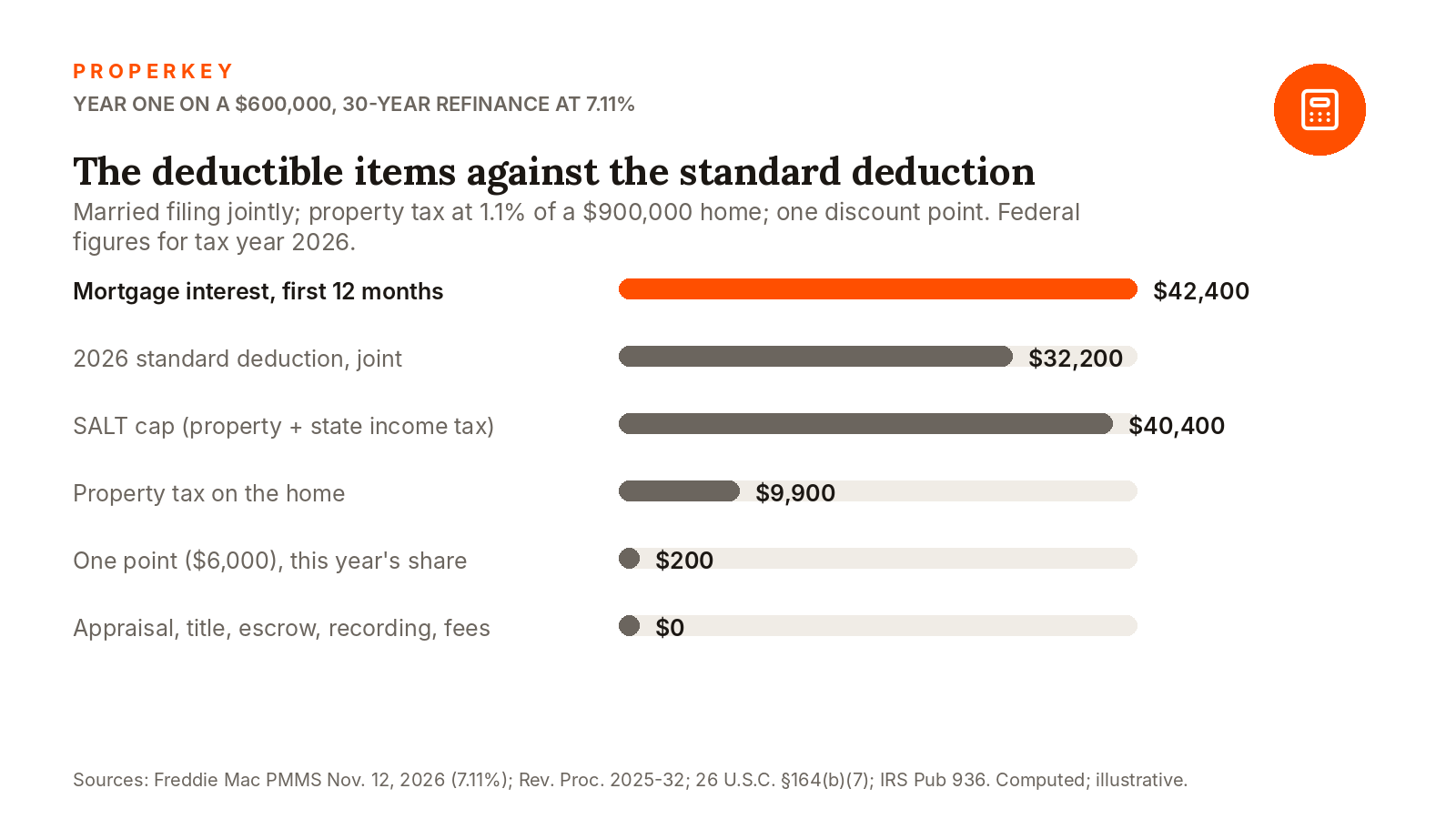
What that is worth in year one at today's rate: a $600,000 30-year loan at Freddie Mac's 7.11 percent (November 12, 2026) pays about $42,400 of interest in its first twelve months, all of it deductible if the loan is acquisition debt. On a $750,000 loan the first-year figure is about $53,000, and on a $900,000 loan only the interest on the first $750,000, roughly five-sixths of it, is deductible federally.
Is mortgage insurance deductible again?
Starting with tax year 2026, yes. Section 70108 of the same act switched the termination clause off, so premiums for "qualified mortgage insurance" paid in tax years beginning after December 31, 2025 are again treated as qualified residence interest under §163(h)(3)(E). Qualified mortgage insurance means private mortgage insurance, FHA mortgage insurance, VA funding fees and USDA Rural Housing Service guarantee fees. The old phase-out was kept and is not indexed: the deduction shrinks by 10 percent for each $1,000 of adjusted gross income over $100,000 ($50,000 married filing separately) and is gone at $109,000. It attaches only to acquisition debt, so MIP on the cash-out portion of a refinance does not qualify, and contracts issued before 2007 are excluded. You will first claim it on the 2026 return you file in 2027; your lender should report the premiums in box 5 of the 2026 Form 1098. Pub 936's 2025 edition still says the deduction "has expired," which is correct for 2025 returns only. Properkey's PMI guide covers what the premiums cost and when they can be cancelled.
Will I itemize at all?
That is the real question, because none of the above matters on a return that takes the standard deduction, which for 2026 is $16,100 single, $24,150 head of household and $32,200 married filing jointly (Rev. Proc. 2025-32), plus $1,650 per spouse aged 65 or over and a separate $6,000 senior deduction through 2028. Only 9.5 percent of returns itemized for tax year 2022, the latest year in the IRS Statistics of Income preliminary data.
California homeowners with a recent loan are the exception. Under 26 U.S.C. §164(b)(7) as rewritten by the act, the state-and-local-tax cap is $40,000 for 2025, $40,400 for 2026, up 1 percent a year through 2029, and back to $10,000 in 2030; it phases down by 30 percent of modified adjusted gross income above $505,000 in 2026 to a floor of $10,000, reaching the floor at about $606,000. A couple paying $42,400 of interest on a $600,000 refinance, $9,900 of property tax on a $900,000 home and $8,000 of California income tax has $60,300 of deductions against a $32,200 standard deduction. The same couple with a 3 percent loan from 2021 paying $18,000 of interest would be close to the line. Whether a refinance makes sense is a payment question first; the deduction is a partial rebate on the interest, worth the interest times your marginal rate, and nothing more. Properkey's refinance math article runs the break-even.
How does California treat all of this?
Differently, and in the homeowner's favor on the big items. The Franchise Tax Board's 2025 Schedule CA (540) instructions, line 8: "Federal law limited the mortgage interest deduction acquisition debt maximum from $1,000,000 ($500,000 for married filing separately) to $750,000 ($375,000 for married filing separately). California law does not conform." The state also did not adopt the federal rule that home-equity interest must be used on the home; California still allows interest on up to $100,000 of home-equity debt regardless of use, and Revenue and Taxation Code §17225 says the federal mortgage-insurance provision "shall not apply," so there is no California deduction for PMI or MIP. California has no SALT cap (line 5e: "California does not conform"), so property tax is fully deductible on the state return, though state income tax never is. The state standard deduction for 2026 is $5,900 single and $11,800 joint (FTB Tax News, October 2026), low enough that most homeowners with a mortgage itemize on the California return even when they take the federal standard deduction. The adjustments go on Schedule CA, column C.
Questions people ask
Can I deduct refinance closing costs on my taxes? Only the points, spread over the life of the loan (or in full for the share tied to home improvements paid with your own funds), and the interest itself. Appraisal, title, escrow, recording, credit-report and lender fees are not deductible and are not added to your basis on a refinance (IRS Pub 936 and Pub 530).
What happens to unamortized points when I refinance again? If the new loan is with a different lender, or you sell or pay off the loan, the remaining points are deductible that year. If you refinance with the same lender, the balance is spread over the new loan's term.
Is mortgage interest still capped at $750,000? Yes, permanently, after the 2025 tax act removed the 2026 sunset. Loans from before December 16, 2017 keep the $1 million cap, including when refinanced, for the remaining term of the original loan. California allows $1 million plus $100,000 of home-equity debt on the state return.
Is PMI tax deductible in 2026? Yes, for the first time since 2021. Premiums paid in 2026 on acquisition debt are deductible as mortgage interest on the 2026 federal return, phasing out between $100,000 and $109,000 of adjusted gross income. California does not allow the deduction.
This article summarizes federal and California tax rules as of November 13, 2026. It is general information, not tax advice; a tax professional can apply the rules to your return.
Sources: IRS Publication 936 (2025); IRS Publication 530 (2025); Instructions for Form 1098 (Rev. 12/2026); Pub. L. 119-21 (One Big Beautiful Bill Act), §§70108, 70120; 26 U.S.C. §163(h); 26 U.S.C. §164(b)(7); Rev. Proc. 2025-32; IRS Statistics of Income, Tax Year 2022 preliminary data; FTB 2025 Schedule CA (540) instructions; R&T Code §17225; FTB Tax News, October 2026; Freddie Mac PMMS, Nov. 12, 2026; Freddie Mac, costs of refinancing.
Written by Keyro, Properkey's AI. Properkey, DRE #01979718.



