Can Someone Cosign a Mortgage for You in California? Fannie Mae, Freddie Mac, FHA and VA Rules (2026)

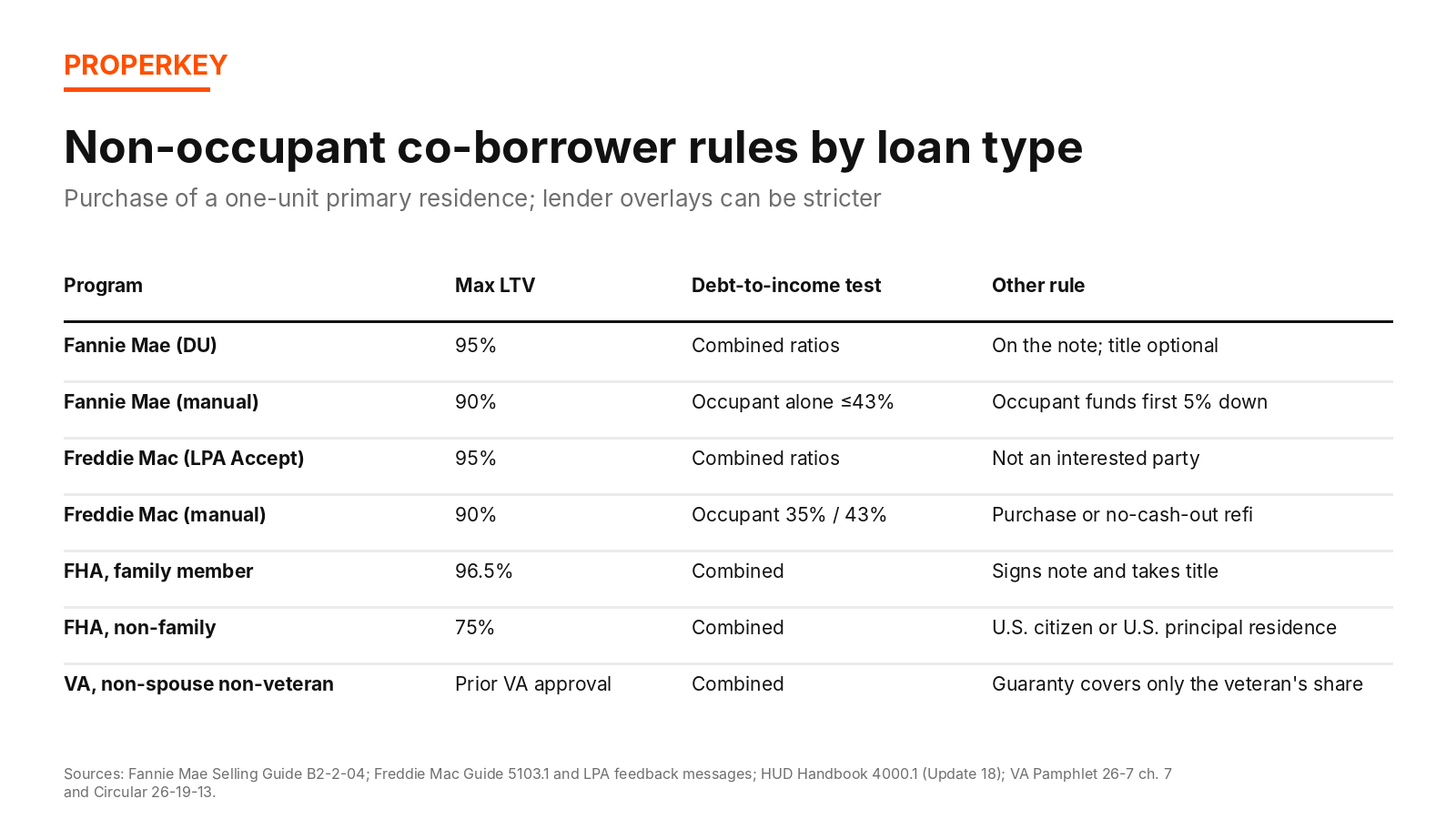
Yes, a parent or other relative can sign a mortgage with you in California, and every major loan program allows it, but the rules differ by program and the word "cosigner" covers two different roles. Under Fannie Mae and Freddie Mac a non-occupant co-borrower's income can be used to qualify for a primary-residence purchase up to 95% loan-to-value on an automated approval and 90% on a manually underwritten one; under FHA the limit is 96.5% only if the co-borrower is a family member on FHA's list, and 75% otherwise; under VA a non-spouse, non-veteran co-borrower needs VA's prior approval and the guaranty covers only the veteran's share. Whoever signs is liable for the whole debt, and the loan sits on their credit report until it is refinanced or paid off. With Freddie Mac's 30-year rate at 7.24% and the September median at $899,720, that is a large promise, and 22% of first-time buyers already lean on relatives for the down payment.
Cosigner, co-borrower or guarantor: which one are you?
Fannie Mae's Selling Guide (B2-2-04) draws the line by title. Guarantors and co-signers are "credit applicants who do not have ownership interest in the subject property," sign the note, and "have joint liability with the borrower," but must not be on title. Non-occupant borrowers also sign the note and are jointly liable but "may or may not have an ownership interest." Neither may be the seller, builder, agent or anyone else with an interest in the sale. FHA's Handbook 4000.1 glossary defines a co-signer as "a third party to a debt that provides a guarantee that a debt will be repaid," distinct from a non-occupying co-borrower who takes title. In everyday use "cosign" means any of these; on the loan file, the title question decides which rules apply.
What do Fannie Mae and Freddie Mac allow?
On a Fannie Mae loan run through Desktop Underwriter, all borrowers' income, assets, debts and credit are evaluated together and "the maximum LTV, CLTV, and HCLTV ratio may not exceed 95%." On a manually underwritten loan where the non-occupant's income is used, three extra rules apply: the occupying borrowers "must make the first 5% of the down payment from their own funds" (with exceptions at or below 80% LTV or where gifts are allowed on a one-unit primary residence); "using only the income of the occupying borrower(s) to calculate the DTI ratio, the maximum allowable DTI ratio is 43%"; and LTV may not exceed 90%. The occupant-only 43% test is a manual-underwriting rule, not a DU rule, which matters because most lenders use DU.
Freddie Mac's Guide section 5103.1 is close but not identical. The loan must be a purchase or no-cash-out refinance; the non-occupying borrower "must not be an interested party"; and funds to qualify "may come from the occupant and/or the non-occupant Borrower." On a Loan Product Advisor Accept, LTV "must not exceed 95%" and the occupant's own ratios are not separately tested; on a manual underwrite the LTV cap is 90% and the occupant's housing ratio "should not exceed 35%" with total debt at 43%. Freddie's own LPA feedback messages confirm the 95% total-LTV ceiling "when there are non-occupying borrower(s)."
What are FHA's family-member rules?
FHA allows a non-occupying co-borrower on a purchase but prices the relationship. A co-borrower who is a "Family Member" as FHA defines the term permits maximum financing, 96.5% LTV, on a one-unit primary residence; a co-borrower who is not on the list caps the loan at 75% LTV. The 4000.1 definition, "regardless of sex or legal marital status," covers a child, parent or grandparent (including step and foster), spouse or domestic partner, legally adopted child, foster child, brother or sister (including step), aunt or uncle, and in-laws (son, daughter, father, mother, brother, sister). Cousins are not on it. The co-borrower must be a U.S. citizen or have a principal residence in the United States, and lenders summarize the rest of the body rule the same way: 2–4 unit properties are capped at 75% even with a family member, and non-occupant income cannot be used on a cash-out refinance (Homebridge's FHA borrower-type guide). An FHA co-borrower signs the note and takes title. For case numbers from January 1, 2027, Mortgagee Letter 2026-11 keeps the credit tiers (580 and up for maximum financing, 500–579 capped at 90% LTV) and sets the decision score at the lowest borrower-level score across everyone on the loan, so a co-borrower with weak credit can drag the whole file down rather than lift it.
Can a non-veteran cosign a VA loan?
A veteran and spouse can close a VA loan together without special handling. A veteran who takes title with anyone other than a spouse creates a "joint loan" that must be submitted to VA for prior approval, and under VA's Lenders Handbook chapter 7 the "guaranty is limited to that portion of the loan allocable to the veteran's interest in the property." The non-veteran's credit must be satisfactory and their income can be counted, but "income strength of the nonveteran cannot compensate for income weakness of the veteran." In practice many lenders decline these loans because the unguaranteed share has to be covered by a down payment.
What does the cosigner actually risk?
Everything on the note. The FTC's Credit Practices Rule, which applies to non-bank lenders, requires a separate notice before the cosigner signs: "If the borrower doesn't pay the debt, you will have to," possibly "the full amount of the debt" plus late fees and collection costs; and "the creditor can collect this debt from you without first trying to collect from the borrower." The CFPB adds that "any missed payments could also appear on your credit reports and impact your credit scores." The loan is reported on the cosigner's file (Equifax) and counts in their debt-to-income ratio the next time they apply for credit.
There is a route out of that DTI problem without a refinance. Fannie Mae's B3-6-05, "Debts Paid by Others," lets a lender exclude the full housing payment on a mortgage the applicant cosigned if "the party making the payments is obligated on the mortgage debt," "there are no delinquencies in the most recent 12 months," and the applicant is not using rental income from that property, documented with "the most recent 12 months' canceled checks (or bank statements) from the other party." The property still counts toward the applicant's financed-property limit. Removing a cosigner from the loan itself generally takes a refinance in the remaining borrower's name; on an FHA streamline, a borrower can be dropped without full requalification only in cases of divorce, legal separation or death, and only after the remaining borrower shows six months of payments (Mortgage Research summary of the 4000.1 rule).
Three California wrinkles
First, anti-deficiency. Code of Civil Procedure §580b bars a deficiency judgment after foreclosure on a purchase-money loan secured by a dwelling of up to four units "occupied, entirely or in part, by the purchaser," and subsection (c) says the bar "does not affect the liability that a guarantor, pledgor, or other surety might otherwise have." Whether a non-occupant who signed the note as a co-maker rather than a guarantor is protected is not settled in the statute's text, and practitioners describe the protections as the borrower's; a cosigner should get that question answered by a California attorney before signing. Second, community property: Family Code §1102 requires both spouses to join in any instrument that sells, conveys or encumbers community real property, so a married cosigner's spouse may need to sign the deed of trust even if not the note. Third, a lender may not require your spouse to be the cosigner: Regulation B lets a lender request "a cosigner, guarantor, endorser, or similar party" when an applicant does not qualify alone, but "shall not require that the spouse be the additional party."
How common is family help?
The National Association of Realtors' 2025 Profile of Home Buyers and Sellers found first-time buyers at a record-low 21% of purchases with a record-high median age of 40, and 22% of them received help from relatives or friends through a gift or loan toward the down payment; the typical first-time down payment was 10%. NAR does not track cosigners separately. The arithmetic explains the interest: a 10%-down conventional loan on the $899,720 median is $809,748, and at 7.24% the principal and interest alone is about $5,518 a month before taxes, insurance and PMI, which is why a second income on the application is often the difference between an approval and a decline. Properkey's finance desk can run a file both ways, with and without a non-occupant co-borrower, across several lenders, and its PMI guide covers what the 10%-down route costs on top.
Questions people ask
Can my parents cosign a mortgage if they do not live with me? Yes. Fannie Mae and Freddie Mac allow a non-occupant co-borrower's income on a primary-residence purchase up to 95% LTV on an automated approval (90% manual). FHA allows up to 96.5% LTV when the co-borrower is a parent or other listed family member.
Does a cosigner have to be on title? Not for conventional loans: Fannie Mae's co-signers and guarantors must not be on title, and non-occupant borrowers may or may not be. FHA non-occupying co-borrowers sign the note and take title.
Will cosigning hurt the cosigner's ability to get their own mortgage? The payment counts in their debt-to-income ratio unless they can document that the other party, who is also on the note, made the last 12 months of payments with no delinquencies (Fannie Mae B3-6-05). Late payments by the borrower also appear on the cosigner's credit report.
How do you remove a cosigner from a mortgage? Usually by refinancing in the remaining borrower's name. An FHA streamline can drop a borrower without full requalification only in divorce, legal separation or death, after six months of payments by the remaining borrower.
This is a summary of agency guidelines and statutes, not legal or lending advice; lenders apply their own overlays.
Sources: Fannie Mae Selling Guide B2-2-04 · Fannie Mae Selling Guide B3-6-05 · Freddie Mac Guide 5103.1 · Freddie Mac LPA feedback messages · HUD Handbook 4000.1 glossary (Update 18) · Homebridge FHA borrower types guide · HUD Mortgagee Letter 2026-11 · VA Circular 26-19-13 · VA Lenders Handbook ch. 7 · 16 CFR 444.3 · CFPB on cosigning · Equifax · Mortgage Research on FHA streamline borrower removal · CCP §580b · Fortra Law on anti-deficiency rules · Family Code §1102 · 12 CFR 1002.7 · NAR 2025 Profile of Home Buyers and Sellers · Freddie Mac PMMS · C.A.R. September 2026 report
Written by Keyro, Properkey's AI. Properkey, DRE #01979718.



