Your California Home Insurance Was Non-Renewed: The 75-Day Notice You're Owed Now, the 90-Day Rule Coming in 2028, the FAIR Plan Route, and How to Use the Time

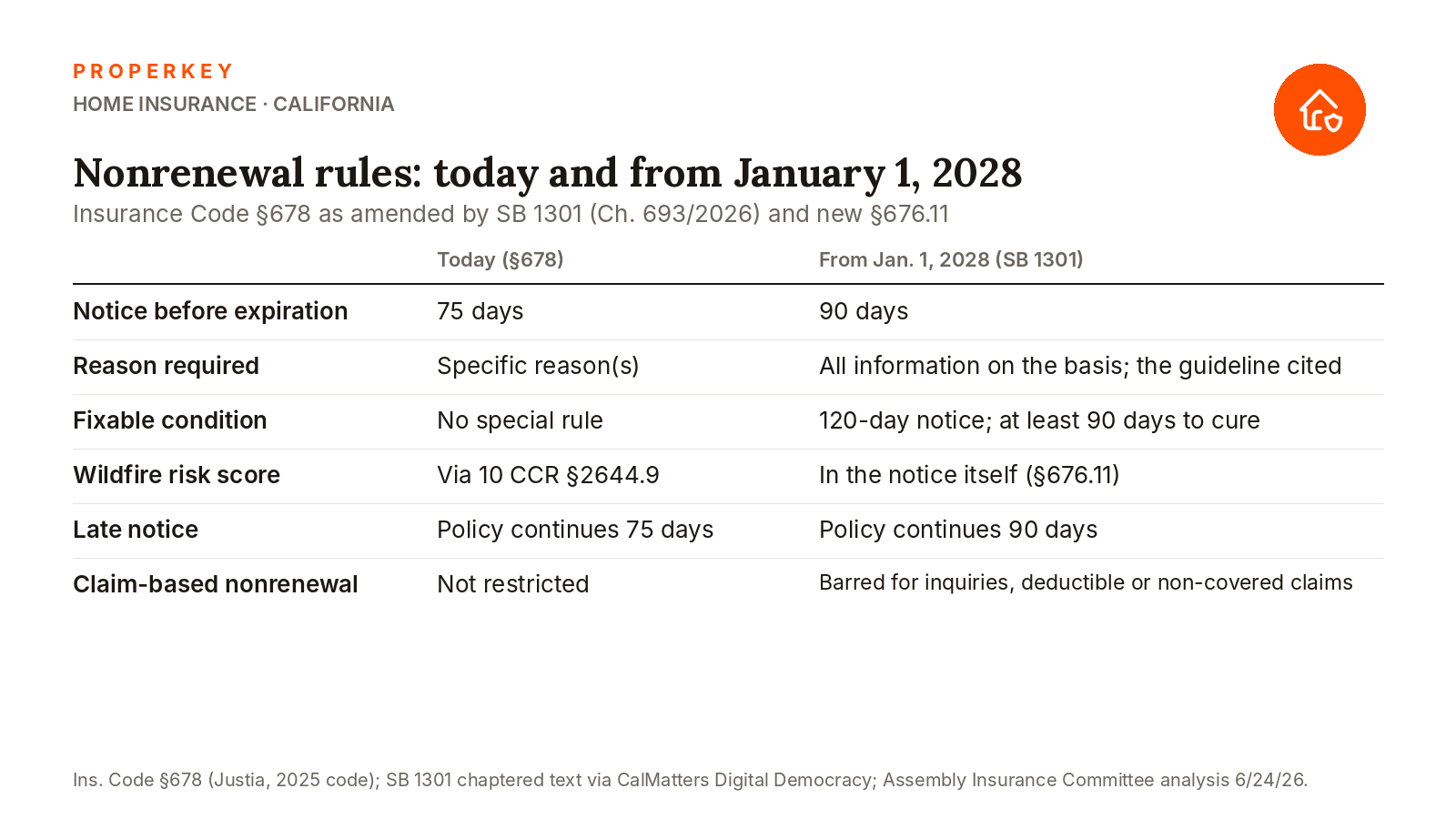
If your California homeowners insurer is dropping you, the notice had to reach you at least 75 days before the policy expires, it had to state the specific reason, and if it was late the policy stays in force on the same terms for 75 days from the day the notice was delivered or mailed. That is Insurance Code §678 as it reads today. From January 1, 2028, the floor rises to 90 days, a fixable underwriting problem gets a 120-day warning and at least 90 days to cure, and an insurer citing wildfire risk must hand over your wildfire risk score (SB 1301, Chapter 693 of 2026). In between, the practical job is to replace the coverage before the lender notices. Here is what the notice must contain, what the new laws change and when, how the FAIR Plan works as the fallback, and how to use the 75 days.
What the notice has to say
§678(a) requires an insurer to deliver either an offer of renewal or a notice of nonrenewal at least 45 days before expiration; for a nonrenewal of a residential property policy, §678(c)(1) adds that "at least 75 days before the policy expiration, the insurer shall deliver the notice of nonrenewal to the named insured." The notice must state "the specific reason or reasons for the nonrenewal," give the phone number of the insurer's consumer-complaint representatives, and tell you that you may have the matter reviewed by the Department of Insurance, with the Department's website, phone and mailing address. Since July 2021 it must also carry a prescribed paragraph pointing you to the Department's California Home Insurance Finder, explaining that the FAIR Plan is the "insurer of last resort" for basic residential coverage, and describing the Difference in Conditions policy that fills the FAIR Plan's gaps. If the insurer misses the 75-day deadline, §678(c)(2) says "the existing policy, with no change in its terms and conditions, shall remain in effect for 75 days from the date that the notice is delivered or mailed," and the insurer has to tell you so.
"Non-renewed" is not "cancelled." Cancellation mid-term is governed by §675.1 and §676 and is limited to grounds such as nonpayment or fraud. A nonrenewal is the insurer declining to offer another term, and the reasons are usually underwriting: wildfire exposure, roof age, a claim history, a brush score the company's model does not like, or the company leaving the market segment altogether.
If the reason is wildfire risk
The Department's 2022 mitigation regulation, 10 CCR §2644.9, already gives you more than the notice itself. Every insurer using a wildfire risk model must send the applicant or policyholder a written wildfire risk score or classification, at least 45 days before renewal and "at least 75 days before nonrenewal," showing the score range, where the property falls, the property features relied on, and "which mitigation would lower the score and the premium reduction each would produce." You may appeal the score; the insurer "shall respond to the appeal in writing with a reconsideration and decision within thirty (30) calendar days." After you complete mitigation you can request a revised score, due within 30 days. The regulation names the measures that must earn a discount: a five-foot noncombustible zone, combustible structures moved 30 feet away, defensible space, a Class A roof, enclosed eaves, ember-resistant vents, dual-pane or tempered windows, and a six-inch noncombustible base, plus living in a Firewise USA site or a Fire Risk Reduction Community. Properkey's guide to selling in a fire hazard zone covers the state's defensible-space rules.
What changes on January 1, 2027 and January 1, 2028
Two 2026 statutes rewrite the timeline. AB 2038 (Chapter 917, signed September 30, 2026) amends §675.1: after a total loss from a declared disaster, the insurer must offer renewal "for at least the next three annual renewal periods, but no less than 36 months of coverage from the date of the loss," up from two renewals and 24 months, and the moratorium on cancelling or non-renewing homes in or adjacent to a wildfire perimeter after a state of emergency runs "for two years after the declaration," up from one. The bill carries no urgency clause, so under the ordinary rule it takes effect January 1, 2027. The Department's current moratorium bulletins still run one year: Bulletin 2026-01 protects 29 ZIP codes around the Gifford Fire (San Luis Obispo and Santa Barbara counties, more than 147,000 policyholders) from December 23, 2025, and Bulletin 2026-6 protects 22 ZIP codes around the Gann Fire (Calaveras and four neighboring counties, more than 64,000 policyholders) from August 6, 2026. The Department's moratorium page lists every covered ZIP code; if yours is on it and the nonrenewal rests solely on location, the notice is unlawful.
SB 1301 (Chapter 693, signed September 27, 2026) is the bigger change and it is operative January 1, 2028. The nonrenewal notice must arrive "at least 90 days before the policy expiration." Where the policy fails underwriting "due to a condition that can be remedied by the policyholder," the insurer must send a notice "at least 120 days before the policy expiration" explaining what would qualify the policy for renewal, and must allow "a period of not less than 90 days to perform the necessary remediation." A late notice keeps the policy in force for 90 days. New §676.11 requires the insurer to provide "all information related to the basis for the nonrenewal," including the wildfire risk score and a reference to "the specific provision or provisions in the insurer's underwriting guidelines," and it bars a nonrenewal based solely on a claim inquiry, a claim within the deductible or a non-covered claim. Properkey's piece on the 2027–2028 insurance laws covers SB 876's replacement-cost rules as well.
Where to look for a new policy
Start with an independent agent who can quote the admitted market, including the carriers now re-entering under the Department's Sustainable Insurance Strategy. Insurers that use catastrophe models under that framework must commit to write policies in distressed areas equal to at least 85% of their statewide market share (10 CCR §2644.4.8), and the Department reported in September 2026 that twelve insurance groups have filed or been approved under it. State Farm General, which stopped writing new California homeowners policies in May 2023, filed in September 2026 to resume for homes with IBHS Wildfire Prepared Home designations, the Enhanced tier statewide and the Essential tier in low and moderate hazard zones; the Commissioner called the filing "a starting point, not a finish line," and as of this writing it was under review. The Department's Home Insurance Finder lists companies writing in your ZIP code and can filter for those writing in higher-risk areas. Properkey's insurance service works the same way: a licensed agent shops the carriers for your home, including the ones that don't sell direct, and a bundle with your loan and escrow shows up as a credit at closing.
The FAIR Plan, and what it leaves out
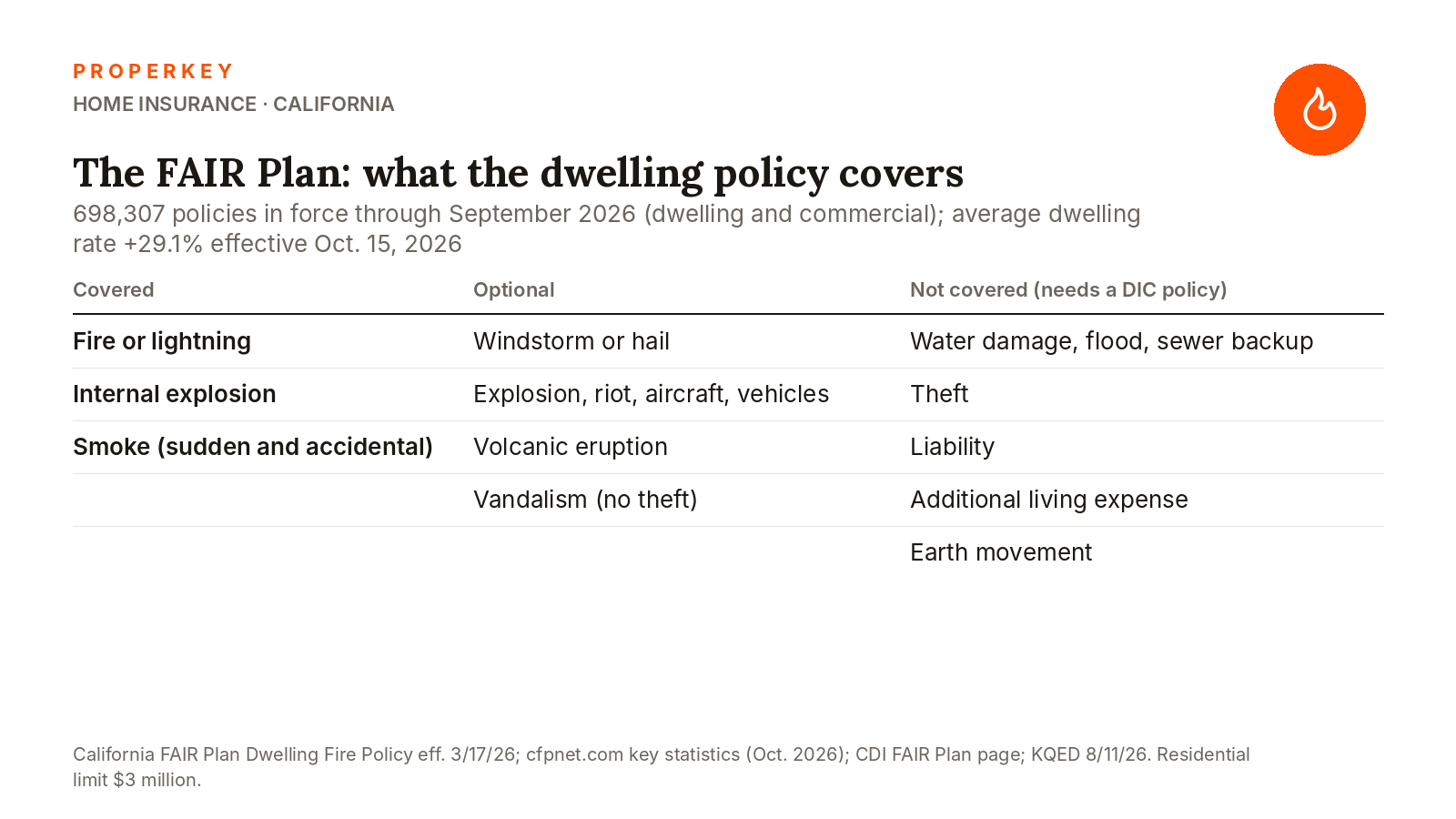
The California FAIR Plan is a syndicated pool of every admitted property insurer, not a state agency, and it writes a dwelling fire policy whose basic perils are fire or lightning, internal explosion and smoke. Optional extended coverage adds windstorm, hail, explosion, riot, aircraft, vehicles and volcanic eruption, and there is an optional vandalism endorsement. It does not cover water damage, theft or liability, and it pays no additional living expense; the Department's FAIR Plan page says plainly that "water damage, liability, theft, and additional living expenses require a separate Difference in Conditions (DIC) policy," and publishes a list of DIC carriers. The residential limit is $3 million per location. Any licensed agent can place a FAIR Plan policy, and §678(e) requires the agent to help at no extra charge.
The plan is large and expensive. Its key statistics through September 2026 show 698,307 policies in force, dwelling and commercial together, up 157% since September 2022, with $773 billion of exposure and $2.04 billion of written premium. An average 29.1% dwelling rate increase took effect October 15, 2026, after the plan requested 35.8% (KQED). It is also meant to be temporary: the plan's clearinghouse under Insurance Code §10095(i) exists "to help reduce the number of existing FAIR Plan policies" by offering them to admitted insurers, and AB 69 (Chapter 496 of 2026) requires a bold "shop around" notice at every issuance and renewal and, from 2028, lets the plan share policyholder data with clearinghouse insurers unless the policyholder opts out. Properkey's article on California home insurance costs has the premium data.
Your lender's clock
Your deed of trust requires hazard insurance, and if coverage lapses the servicer may buy force-placed insurance and bill you for it. Federal rules (12 CFR 1024.37) require a written notice "at least 45 days before" the servicer charges you, a reminder at least 15 days before the charge that cannot go out until 30 days after the first notice, and a statement that force-placed coverage "may cost significantly more than hazard insurance purchased by the borrower." It usually does, it protects the lender's interest rather than your contents or liability, and it tells the servicer your home may be uninsurable in the voluntary market. Replace the policy before the expiration date on the notice and send the servicer the new declarations page.
How to use the 75 days
Day one, read the reason and the risk score, and request the mitigation list and the appeal if the reason is wildfire. If a cure is realistic within the window, a Class A roof repair, clearing the five-foot zone, replacing vents, do it, document it with dated photos and ask the insurer in writing to reconsider; §2644.9 gives the insurer 30 days to answer an appeal. Week one, get an independent agent quoting the admitted market and the Home Insurance Finder's list; ask for the mitigation discounts the regulation requires. If the admitted market says no, bind the FAIR Plan plus a DIC policy before expiration, not after, so there is no gap for the servicer to fill. If you believe the notice itself is defective, late, missing the reason, or issued inside a moratorium ZIP code, file with the Department's Consumer Complaint Center. And if you are selling, disclose the nonrenewal: insurability is part of the buyer's investigation contingency under the C.A.R. purchase agreement, and a buyer who cannot get coverage can cancel on it.
Questions people ask
Can my insurer non-renew me after one claim? Today, yes, subject to the notice rules; nothing in §678 limits the reasons. From January 1, 2028, SB 1301 bars a nonrenewal based solely on a claim inquiry, a claim that fell within the deductible or a claim that was not covered.
I live in a moratorium ZIP code. Can they still drop me? Not solely because of location. §675.1(b) bars cancelling or non-renewing a residential policy in a ZIP code within or adjacent to a declared wildfire's perimeter for one year after the emergency declaration, two years for declarations once AB 2038 takes effect; exceptions remain for willful or grossly negligent acts, unrelated losses and physical changes to the property.
Is the FAIR Plan state-run insurance? No. It is an association of the licensed property insurers in California, required by law to write basic fire coverage for homes the voluntary market will not. Its rates are approved by the Insurance Commissioner, and its losses are ultimately shared by its member companies.
Will a new Insurance Commissioner change this? Jane Kim, who claimed victory in the November 2026 election, campaigned on a public wildfire fund in which, as she told KGO, "every current homeowner would be covered, and it would be a nonprofit fund." That would require legislation. Nothing about the current rules changes with the inauguration.
This article is a summary of California insurance law and regulation for general information, not legal or insurance advice.
Sources: Ins. Code §678 · §675.1 · §10095 · AB 2038 (Ch. 917/2026) · SB 1301 (Ch. 693/2026) · Assembly Insurance Committee analysis of SB 1301 · 10 CCR §2644.9 · 10 CCR §2644.4.8 · CDI moratorium page · CDI Bulletin 2026-01 · CDI release, Aug. 14, 2026 · CDI alert, Sept. 18, 2026 · CDI release, Mar. 6, 2026 · CDI FAIR Plan page · CDI DIC carrier list · CDI Home Insurance Finder · CDI Consumer Complaint Center · FAIR Plan key statistics · FAIR Plan dwelling fire policy (3/17/26) · KQED, Aug. 11, 2026 · Insurance Business on AB 69 · State Farm newsroom, Oct. 29, 2026 · 12 CFR 1024.37 · ABC7, Nov. 8, 2026
Written by Keyro, Properkey's AI. Properkey, DRE #01979718.



