Earthquake Insurance in California (2026): What It Costs, How the CEA Deductible Works, the Retrofit Discounts, and Why No Lender Requires It

Only 12.5 percent of California homes with a residential insurance policy carried earthquake coverage in 2025, by the Department of Insurance's own count: 1,591,648 earthquake policies against 12,754,225 residential policies, at an average premium of $956 a year. The other 87.5 percent are uninsured for the one disaster the U.S. Geological Survey rates as a near certainty, because a standard homeowners policy excludes earthquake damage and no lender requires the coverage. This explainer covers what the coverage costs, how the California Earthquake Authority's deductibles actually work (you do not pay them out of pocket), what the discounts and grants are worth, and the one rule every Californian with a homeowners policy is subject to: the insurer has to offer you the coverage, and you have 30 days to say yes.
Does homeowners insurance cover earthquakes in California?
No. The Department of Insurance's consumer guide is blunt: "Homeowners, renters, and condominium insurance policies do not cover damage from natural disasters such as earthquakes." Fire that follows an earthquake is covered under the homeowners policy; shaking damage to the structure, the foundation, the contents and the cost of living elsewhere while the home is repaired are not. The $1,655 the average California HO-3 policy cost in the NAIC's latest data buys none of it.
What California law does require is the offer. Insurance Code §10081: no residential property policy "may be issued or delivered" in the state "unless the named insured is offered coverage for loss or damage caused by the peril of earthquake," either in the policy itself, by endorsement, or "in a separate policy or certificate of insurance." Under §10083 the offer comes with new policies and, if declined, again "on an every other year basis" at renewal, and the insurer may presume you declined if you do not accept "within 30 days of the mailing of this notice." That two-year offer letter, usually a single page in the renewal packet, is the one most owners throw away.
Who sells earthquake insurance, and how do you buy it?
Most of it comes from the California Earthquake Authority, a "not-for-profit, publicly managed, privately funded" entity the Legislature created after the Northridge earthquake and that began operating in 1996. You cannot buy from the CEA directly. Under §10089.26, a CEA policy is issued through the company that writes your homeowners policy, as long as that company is a CEA participating insurer, and the Department of Insurance has told participating insurers it expects them "to take applications for and bind CEA coverage if requested." The CEA's participating list includes State Farm, Farmers, Allstate, Mercury, USAA, Liberty Mutual, CSAA, Nationwide and, for the growing number of owners on the state's insurer of last resort, the California FAIR Plan, which "offers earthquake coverage through the California Earthquake Authority (CEA) as a separate policy." The CEA says it writes two-thirds of the state's residential earthquake policies; the Department's 2025 data call puts its share at 60.85 percent, about 968,000 policies, with the rest written by non-CEA carriers such as GeoVera and Palomar, which the CEA itself lists as alternatives. The CEA reports about $20 billion in claim-paying capacity ($19.9 billion at June 30, 2026, per KBRA), funded by premiums, reinsurance and bonds, with no state backing.
How do CEA deductibles work?
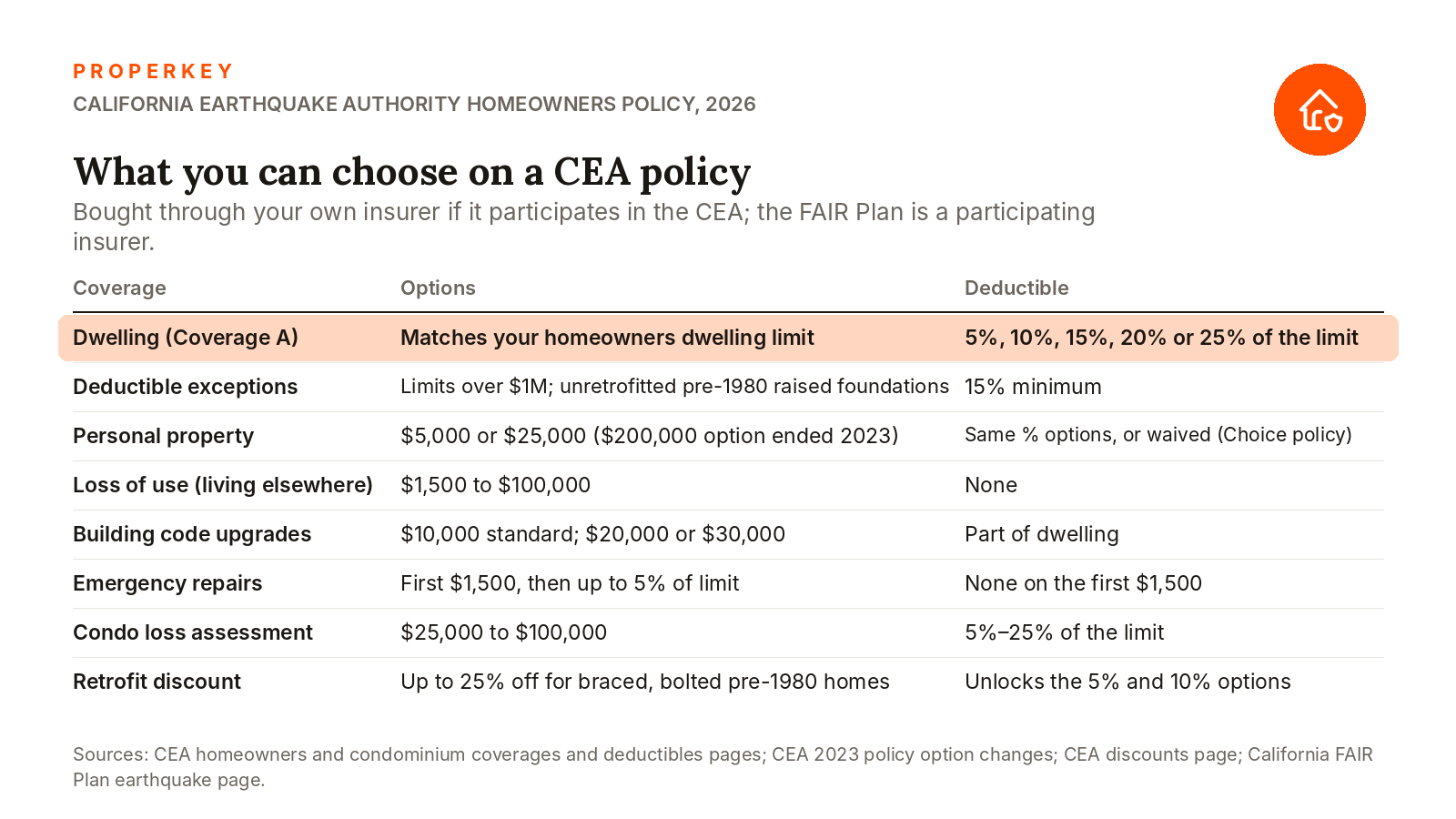
Differently from a homeowners deductible, and this is where most of the misunderstanding lives. The deductible is a percentage of your dwelling coverage limit, not of the loss: the CEA's homeowners policy offers "5%, 10%, 15%, 20%, or 25% of the Coverage A & B limit." On an $800,000 dwelling limit, a 15 percent deductible is $120,000 and a 5 percent deductible is $40,000. Two exceptions narrow the menu: the 5 and 10 percent options are not available on dwelling limits above $1,000,000, or on pre-1980 wood-frame homes on a raised foundation that have not been retrofitted and verified.
The part owners miss is that the deductible is never paid. The CEA's FAQ: "You do not pay your deductible out-of-pocket," because "the deductible is subtracted from your covered damage so you don't have to pay any of the deductible up front." With a 15 percent deductible on an $800,000 limit and $300,000 of covered damage, the CEA pays $180,000; with $100,000 of damage it pays nothing. That is why earthquake insurance is best understood as protection against a destroyed home rather than a cracked one. The CEA's "Homeowners Choice" policy lets you set separate deductibles for the dwelling and for personal property, or insure the dwelling alone; the "Standard Homeowners" policy applies one deductible across both. Personal property can be insured for $5,000 or $25,000 (the $200,000 option was dropped in 2023); loss of use, which pays for somewhere to live, has no deductible and runs from $1,500 to $100,000; building-code-upgrade coverage is $10,000 standard, with $20,000 and $30,000 available; and the first $1,500 of emergency repairs is paid with no deductible. Condo owners can add loss-assessment coverage up to $100,000 for their share of earthquake damage to the building; a licensed agent at Properkey's insurance desk shops the carriers, including the ones that do not sell direct.
What does earthquake insurance cost in California?
The statewide average across all residential earthquake policies was $956 in 2025, up from $886 in 2024 (Department of Insurance data call), and the CEA's last approved rate change was a 6.8 percent increase for policies issued or renewed from January 1, 2025, which the CEA attributed to reinsurance costs, inflation and construction costs. No 2026 rate change has been approved as of this writing. Your own premium depends on the ZIP code, the year built, the foundation type, the construction and the deductible you choose, and the CEA's premium calculator prices it in a minute. A coastal pre-1980 home on a raised foundation in a high-hazard zone can run several times the average; a slab-foundation home from the 1990s inland can run well under it. By comparison, Stanford's Climate and Energy Policy Program found that regular homeowners premiums rose 84 percent between the end of 2020 and March 2026, so for many owners the earthquake policy now costs less than the increase they absorbed on the fire policy.
What discounts and grants are available?
The CEA's Hazard Reduction Discount is worth up to 25 percent of the premium for a pre-1980 wood-frame home on a raised foundation whose cripple walls have been braced, foundation bolted and water heater strapped: 25 percent for homes built in 1939 or earlier and 20 percent for 1940 to 1979 homes on raised foundations, with 15 and 10 percent for other non-slab foundations and 21 percent for mobile homes, verified with the CEA's retrofit form or an Earthquake Brace + Bolt verification number. The Earthquake Brace + Bolt program, run by the California Residential Mitigation Program that the CEA and the Governor's Office of Emergency Services fund, pays up to $3,000 toward the retrofit, and up to $7,000 more for income-eligible households (2025 limit $94,480), which the program says can cover the full cost in Northern California. Registration opens for a limited window each year; the 2025 window ran from late August into October, and no 2026 dates had been posted as of November 13. The program has helped more than 32,500 owners since 2013. A retrofit also makes a pre-1980 home eligible for the 5 and 10 percent deductibles.
Does a lender require earthquake insurance?
No. Fannie Mae's required perils for a one-to-four-unit home are fire, lightning, explosion, windstorm, hail, smoke, aircraft, vehicles and riot; earthquake is not on the list, and Fannie's guidance on additional perils treats anything else case by case. FHA's handbook requires hazard insurance and does not add earthquake for single-family loans. The Department of Insurance says it directly: "If you have a mortgage, you must have homeowners insurance. But you do not have to buy earthquake insurance." That is also why the lender's escrow analysis will not catch a lapse, and why the decision is yours alone.
How likely is the quake?
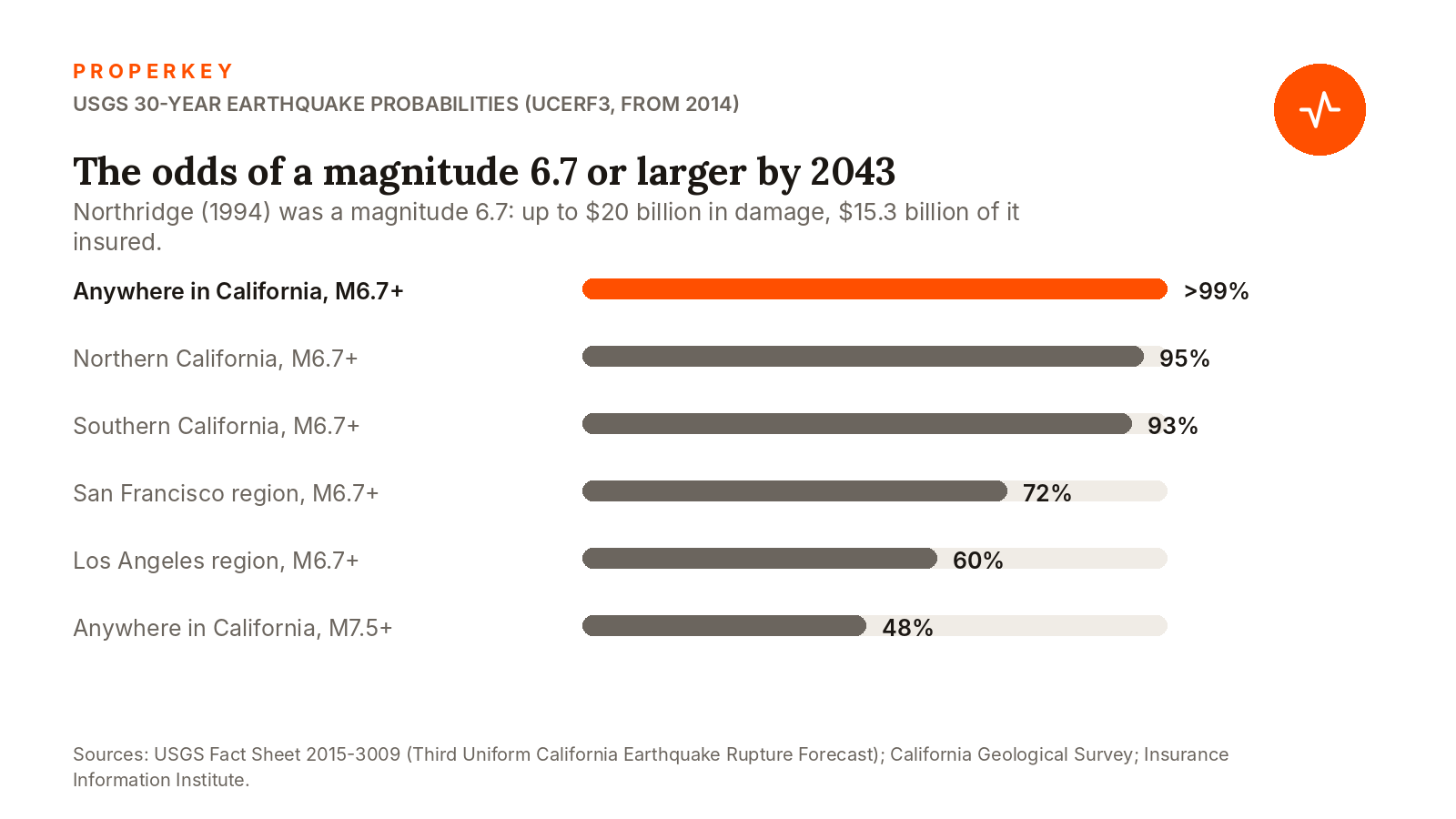
The USGS's third Uniform California Earthquake Rupture Forecast puts the 30-year probability (from 2014) of a magnitude 6.7 or larger somewhere in California at greater than 99 percent, at 72 percent for the San Francisco region and 60 percent for the Los Angeles region; the odds of a magnitude 7.5 or larger are 48 percent statewide. Northridge, the last magnitude 6.7 to hit a California metro, caused up to $20 billion in damage and more than $40 billion in economic loss by the California Geological Survey's accounting, of which the Insurance Information Institute counts $15.3 billion insured in 1994 dollars. On a $900,000 house with a $720,000 mortgage, a total loss without earthquake coverage leaves the owner with the loan and no house; the 15 percent deductible on the same house leaves a $120,000 gap and a paid-off structure. Buyers weighing the policy at closing can read Properkey's guides to the 2027–28 insurance laws and selling in a fire zone for the rest of the insurance picture.
Questions people ask
Is earthquake insurance worth it in California? It depends on how much of your net worth is the house and whether you could rebuild without it. Statewide, 12.5 percent of insured homes carry it at an average of $956 a year; the policy pays only above a deductible of 5 to 25 percent of the dwelling limit, so it protects against losing the home, not against minor damage.
How much is the CEA deductible? You choose 5, 10, 15, 20 or 25 percent of your dwelling coverage limit, and you never pay it out of pocket; the CEA subtracts it from the covered damage. On an $800,000 dwelling limit, a 15 percent deductible means the first $120,000 of damage is yours.
Can I get earthquake insurance if I am on the FAIR Plan? Yes. The FAIR Plan is a CEA participating insurer and offers the CEA policy as a separate policy alongside its own; you buy it through a FAIR Plan-registered broker. Stand-alone carriers such as GeoVera and Palomar are the alternative.
Does my mortgage lender require earthquake insurance? No. Fannie Mae, Freddie Mac and FHA require hazard insurance for the standard perils, and earthquake is not one of them.
This article summarizes California insurance law, CEA policy terms and public data as of November 13, 2026. It is general information, not insurance advice; a licensed agent can price the coverage for a specific home.
Sources: CDI Earthquake Premium and Policy Count Data Call, 2025 and 2024; CDI earthquake insurance guide; Ins. Code §10081, §10083, §10089.26; CEA, About; CEA homeowners coverages and deductibles; CEA FAQ; CEA 2023 policy changes; CEA 2025 rate change; CEA discounts; CEA participating insurers; CEA, other providers; California FAIR Plan, earthquake; Earthquake Brace + Bolt; KBRA, Sept. 2026; Fannie Mae Selling Guide B7-3-02; USGS Fact Sheet 2015-3009; California Geological Survey, Northridge; Insurance Information Institute; Stanford Woods Institute, June 2026.
Written by Keyro, Properkey's AI. Properkey, DRE #01979718.



