Flood Insurance in California (2026): Who Has to Buy It, What the NFIP Costs and Covers, the 30-Day Wait, and Why Your Homeowners Policy Won't Pay

A standard California homeowners policy does not pay for flood damage, the California FAIR Plan does not sell it, and a federally regulated lender must require it on any home in a high-risk flood zone for the life of the loan. Those three facts are the whole subject. The National Flood Insurance Program covers up to $250,000 for the building and $100,000 for contents, a new policy takes effect 30 days after purchase unless it is bought for a loan closing, and almost a third of NFIP claims from 2014 to 2024 came from homes outside the high-risk zones (FEMA, FloodSmart). The Department of Water Resources has estimated that about 2% of California property owners carry flood insurance, and the atmospheric-river season that runs from November to March is when the other 98% find out what their policy excludes.
Why the homeowners policy will not pay
The Department of Insurance says it directly: "Standard homeowners' insurance does not cover flood damage," and homeowners and commercial policies "typically exclude flood, mudslide, debris flow, and other similar disasters" (CDI, Flood Facts). The exclusion in the standard form reaches surface water, overflow of a body of water, storm surge and mudflow, whether driven by wind or not. Water that comes from above, a roof leak or a burst pipe inside the house, is a different peril and is usually covered. The California FAIR Plan is explicit that it does not offer flood coverage and tells its policyholders to "consider purchasing a supplemental policy to cover types of losses we don't, such as flood." A homeowner in a Butte County foothill town on a FAIR Plan policy, or a Sacramento-area owner with a standard policy, has no flood coverage at all unless a separate flood policy was bought.
Who has to buy it
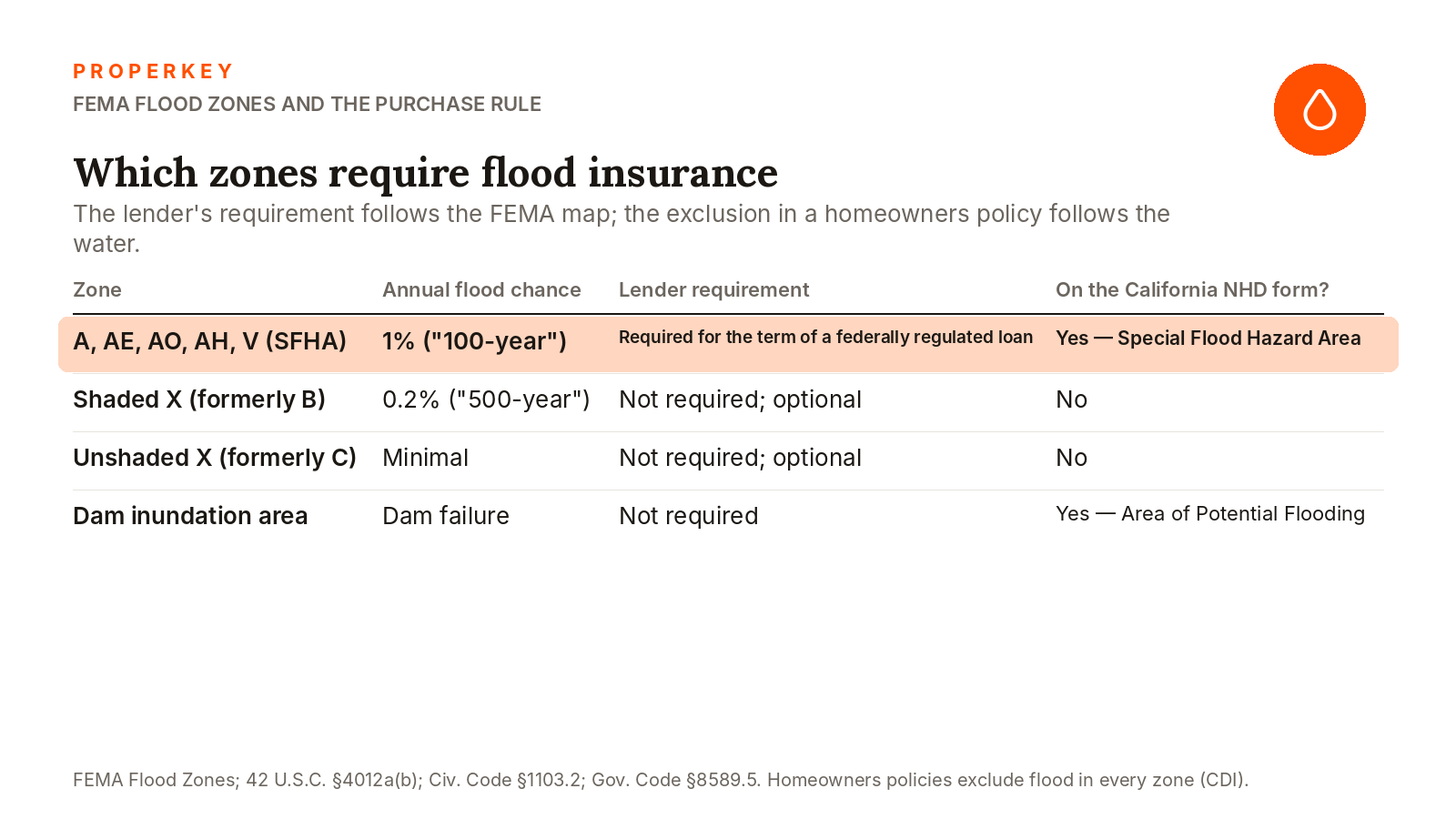
Federal law, 42 U.S.C. §4012a(b), bars a regulated lender from making, increasing, extending or renewing a loan on improved property in an area FEMA has identified as having special flood hazards, where NFIP coverage is available, "unless the building … is covered for the term of the loan by flood insurance in an amount at least equal to the outstanding principal balance of the loan or the maximum limit of coverage made available under the Act with respect to the particular type of property, whichever is less." The high-risk zones are the Special Flood Hazard Areas, the land FEMA maps as having a 1% annual chance of flooding, labeled A, AE, AO, AH and V; shaded Zone X marks the 0.2% (500-year) area and unshaded X minimal risk (FEMA, Flood Zones). The lender orders a flood determination on every loan, and for loans made since January 1, 2016, must escrow the flood premium with taxes and insurance (12 CFR 22.5). Since July 1, 2019, lenders must also accept a qualifying private flood policy in place of an NFIP one (84 FR 4953).
Outside an SFHA, nobody requires it, which is where the 29% statistic belongs. A buyer in Zone X who looks at the parcel's history, the street drainage and the nearest creek is making an insurance decision, not a compliance one.
What the NFIP policy costs and covers
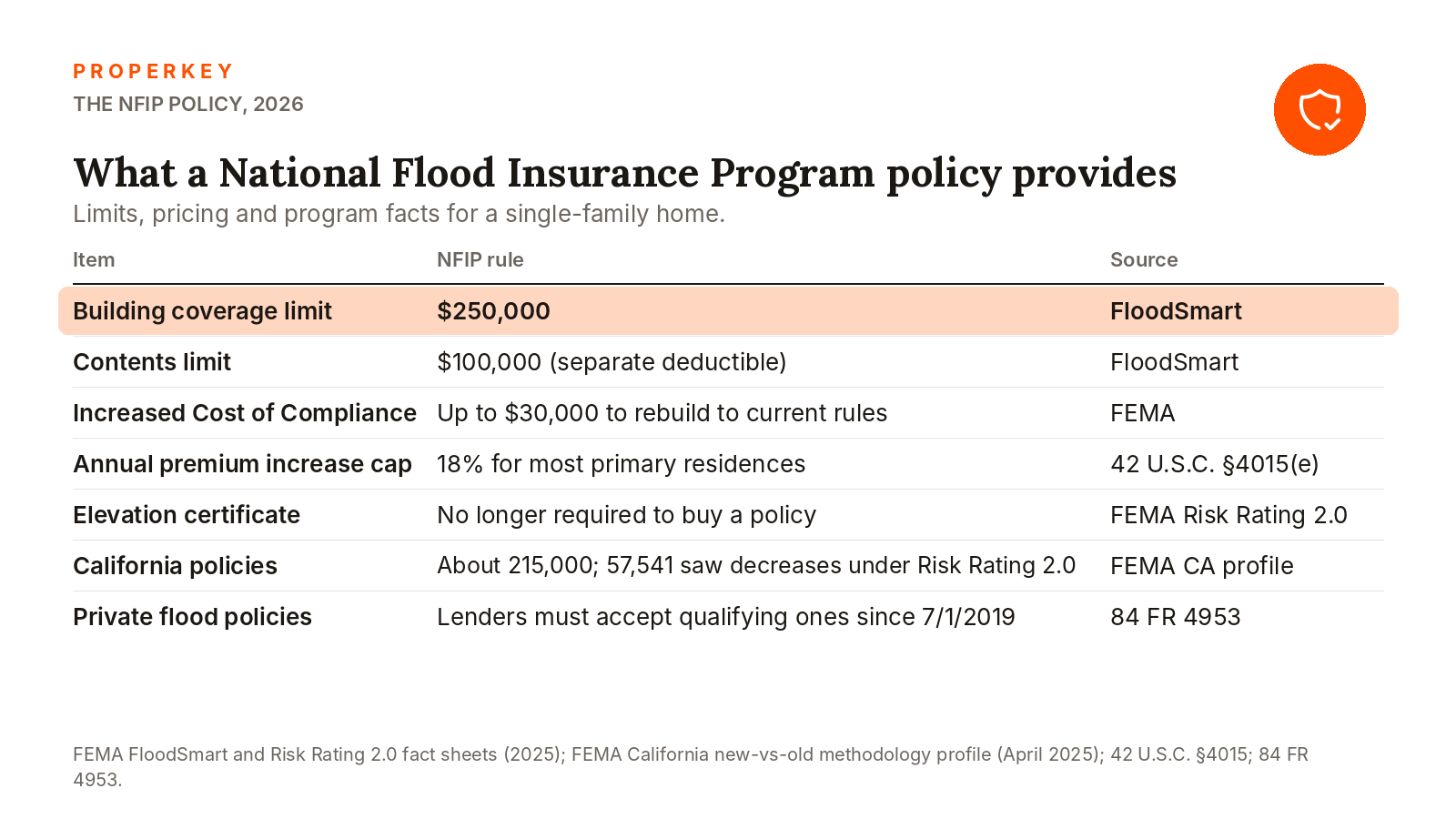
NFIP coverage for a single-family home is capped at $250,000 for the structure and $100,000 for contents, bought separately with separate deductibles (FloodSmart). Since Risk Rating 2.0, FEMA prices each property on its own flood frequency, distance to water, elevation and rebuilding cost; an elevation certificate is no longer required to buy a policy, and "most annual increases [are] capped at 18%" until the policy reaches its full-risk rate (FEMA, Understanding Risk Rating 2.0, July 2025; cap in 42 U.S.C. §4015(e)). FEMA's California profile shows the pricing spread rather than an average: of roughly 215,000 California policies, 57,541 saw decreases under the new method, 135,675 saw increases of $0 to $10 a month, 13,556 saw $10 to $20, and 8,057 saw $20 or more (FEMA, California Risk Rating 2.0 profile, April 2025). Nationally the program held nearly 4.5 million policies and $1.3 trillion of coverage as of August 31, 2026 (CRS R44593).
The policy also carries Increased Cost of Compliance coverage of up to $30,000 to bring a substantially damaged home up to current floodplain rules when rebuilding (FEMA). A home worth more than the NFIP limits, which describes most of coastal California, needs an excess or private flood policy on top; a licensed Properkey agent shops the carriers, including the ones that do not sell direct, and the bundle credit shows up at closing.
The 30-day wait, and the exception for a closing
A new NFIP policy takes effect at 12:01 a.m. on the 30th calendar day after the application date. There are two exceptions that matter to a transaction. When the policy is bought "in connection with the making, increasing, extending, or renewing of a loan," coverage is effective at the loan closing, provided the application and premium are in hand at or before closing. When a new flood map has just moved a property into a high-risk zone, a policy bought within 13 months of the map change takes effect the next day (44 CFR 61.11). A cash buyer, or an owner who decides to add coverage after watching a forecast, waits the full 30 days. An existing NFIP policy can generally be assigned to the buyer at closing, which keeps the seller's rate in place; ask the seller's agent for the declarations page early.
What California requires sellers and landlords to disclose
The Natural Hazard Disclosure Statement every California seller delivers must say whether the home is in "A SPECIAL FLOOD HAZARD AREA (Any type Zone 'A' or 'V') designated by the Federal Emergency Management Agency" and whether it is in "AN AREA OF POTENTIAL FLOODING shown on a dam failure inundation map" (Civil Code §1103.2; Gov. Code §8589.5). A seller or agent who obtains the information from a public agency or a qualified natural-hazard expert with ordinary care is not liable for an error in it that was outside their personal knowledge (§1103.4). Landlords have their own duty: for leases signed on or after July 1, 2018, an owner who knows the property is in a special flood hazard area or dam-inundation area must say so in the lease, point the tenant to the state's MyHazards site, and state that "the owner's insurance does not cover the loss of the tenant's personal possessions" and that "it is recommended that the tenant consider purchasing renter's insurance and flood insurance" (Gov. Code §8589.45). Properkey's guides to selling in a fire hazard zone and earthquake insurance cover the other two hazards on the same form.
The December 11 deadline
The NFIP has no permanent authorization. Congress has extended it in short increments since 2017, and the current extension runs to December 11, 2026 (CRS IN10835). During past lapses FEMA could not issue new policies or increase coverage, which stalled closings in flood zones until the program was renewed; existing policies stayed in force. Buyers in a Zone A or V escrow set to close in mid-December should get the flood policy bound now, under the loan-closing exception, rather than wait.
What a buyer should do
Read the flood zone on the NHD report before the inspection contingency expires. If the home is in an SFHA, ask the listing agent for the seller's current declarations page and quote an assignment, then compare an NFIP quote with a private quote. If the home is in Zone X, pull a quote anyway: the DWR figure of about 2% take-up means most of the homes flooded in California's recent storms were uninsured, and a Zone X premium for a home that has never flooded is the cheapest flood coverage sold. Factor the premium into the payment, since the lender will escrow it, and keep the FEMA zone letter with the closing file.
Questions people ask
Does homeowners insurance cover flooding in California? No. The Department of Insurance states that standard homeowners insurance does not cover flood damage, and the FAIR Plan does not offer it. Flood is a separate policy, from the NFIP or a private insurer.
Is flood insurance required in California? Only by the lender, and only on a home in a FEMA Special Flood Hazard Area (Zone A or V) financed with a federally regulated or federally backed loan. Cash buyers and owners outside those zones choose for themselves.
How much flood coverage can an NFIP policy provide? Up to $250,000 for a single-family building and $100,000 for contents, plus up to $30,000 of Increased Cost of Compliance coverage. Higher limits require an excess or private policy.
How long before a flood policy takes effect? Thirty days from the application date for a standard purchase of coverage. A policy bought for a loan closing is effective at closing, and a policy bought within 13 months of a map change that put the home in a high-risk zone is effective the next day.
This is a summary of insurance and lending rules, not insurance advice. Coverage terms are set by the policy.
Sources: CDI, Flood Facts; California FAIR Plan; 42 U.S.C. §4012a; 42 U.S.C. §4015; 12 CFR 22.5; 84 FR 4953; 44 CFR 61.11; FEMA, Flood Zones; FloodSmart, policy limits; FloodSmart, flood risk; FEMA, Risk Rating 2.0; FEMA, California profile; FEMA, ICC; CRS R44593; CRS IN10835; Civ. Code §1103.2; Gov. Code §8589.5; Gov. Code §8589.45; Delta Stewardship Council (DWR estimate).
Written by Keyro, Properkey's AI. Properkey, DRE #01979718.



