California's New Home Insurance Laws: What Changes on January 1, 2027, and What Waits Until 2028 (SB 876, SB 1301, AB 2038, AB 1795)

California passed the biggest set of homeowners-insurance consumer laws in years this fall, but most of the protections arrive on two different dates. On January 1, 2027, insurers must renew a disaster-destroyed primary home for three years instead of two, the post-wildfire ban on cancellations and nonrenewals doubles to two years, and smoke damage inside a fire perimeter is presumed to be the fire's fault. The two laws shoppers will feel most, SB 876's mandatory offer of 50% extended replacement cost and SB 1301's 90-day nonrenewal notice with a written wildfire score, do not become operative until January 1, 2028. Here is what each law does, when it bites, and what to ask an insurer today, while the FAIR Plan's 29.1% average rate increase (effective October 15, 2026) is landing on renewal notices across the state.
What changes on January 1, 2027
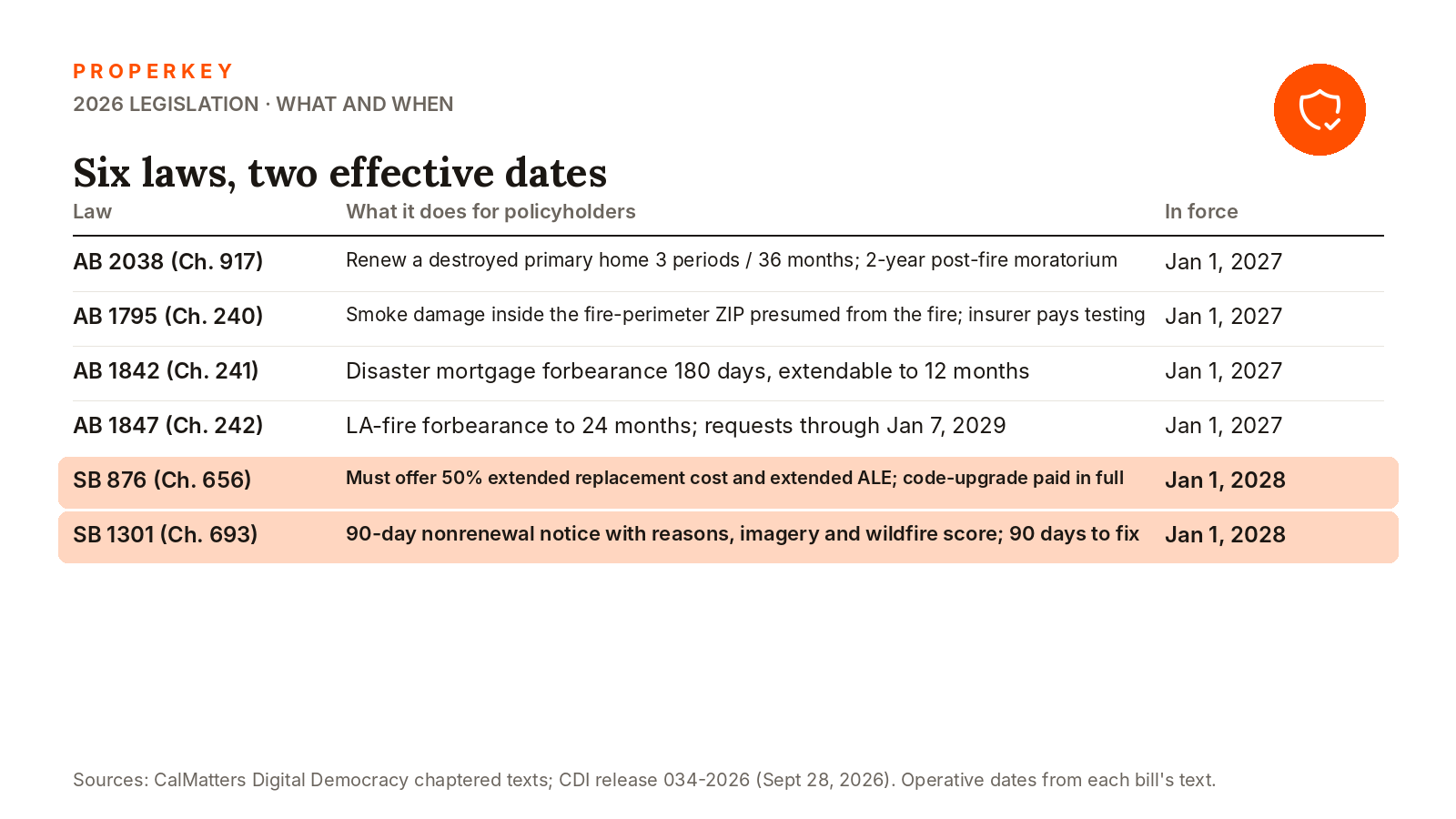
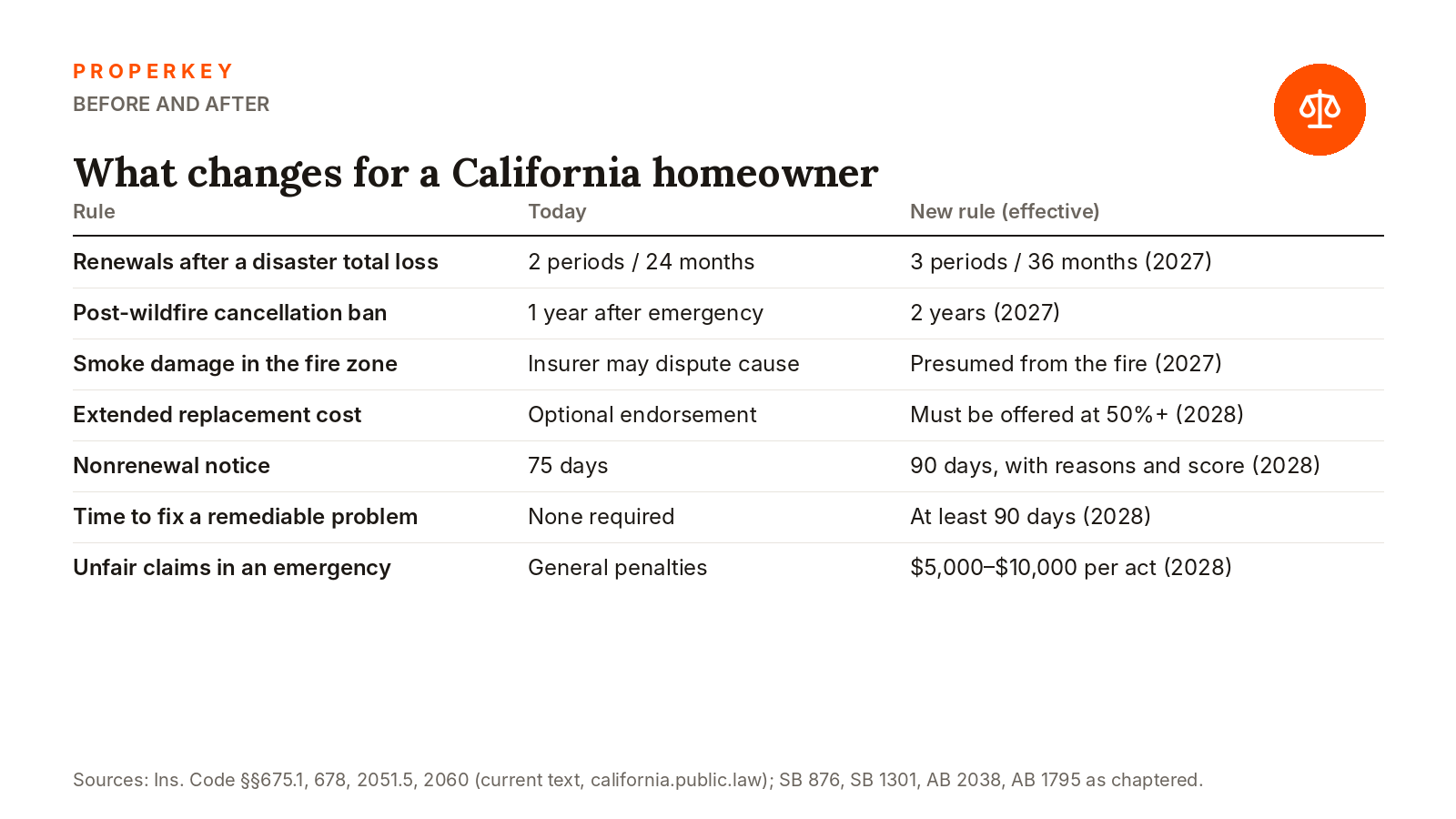
AB 2038 (Harabedian) — three renewals after a total loss, two-year moratorium after a fire. Insurance Code §675.1 already requires an insurer to offer renewal after a disaster destroys a primary residence; the current text says "for at least the next two annual renewal periods, but no less than 24 months of coverage from the date of the loss." AB 2038, Chapter 917, signed September 30, 2026, raises that to three renewal periods and no less than 36 months. It also doubles the location-based moratorium: today an insurer may not cancel or refuse to renew a policy in a ZIP code within or adjacent to a fire perimeter "for one year after the declaration of a state of emergency" when the decision is based solely on the wildfire; from 2027 the period is two years. The existing exceptions stay: willful or grossly negligent acts by the insured, losses unrelated to the fire, and physical changes that make the property uninsurable.
AB 1795 (Gipson) — the Smoke Damage Recovery Act. After the January 2025 Los Angeles fires, thousands of standing homes were coated in ash and soot while insurers disputed whether the damage was "real." AB 1795, Chapter 240, signed September 15, 2026, creates a rebuttable presumption: if wildfire smoke, ash, soot, char or combustion byproducts are present in a surviving home inside the "wildfire impact zone," defined as a ZIP code within or partially within the CAL FIRE perimeter, the damage is presumed to come from that fire. Insurers may not cut off additional living expense payments on a covered smoke claim until the home is restored and cleared for occupancy, and they must pay for the sampling and testing needed to clear it, using standards the Department of Toxic Substances Control and the Air Resources Board are writing under companion bill AB 1642. It applies to claims arising on or after January 1, 2027; CalMatters' report on the signing covers the LA backstory.
AB 1842 and AB 1847 (Harabedian) — mortgage forbearance after a disaster. Not insurance laws, but part of the same package. AB 1842, the California Mortgage Relief Act (Chapter 241), gives a borrower whose home is uninhabitable after a federally declared disaster a 180-day forbearance, extendable in 90-day increments to 12 months, with no late fees or default interest and the account reported current. AB 1847 (Chapter 242) extends the January 2025 Los Angeles fire forbearance to 24 months and moves the request deadline to January 7, 2029. Both take effect January 1, 2027.
What changes on January 1, 2028
SB 876 (Padilla) — the Disaster Recovery Reform Act. Signed September 27, 2026 as Chapter 656, this is the law the Insurance Commissioner sponsored and announced as taking effect January 1, 2027. Read the chaptered text, though, and the Legislative Counsel's digest says "this bill would make its provisions operative on January 1, 2028"; each substantive section carries that date, which the Assembly Insurance Committee recommended to give insurers time to refile forms. The statute is on the books in 2027; the requirements start in 2028. What they are:
A mandatory offer of extended replacement cost of at least 50% above the dwelling limit at issuance and every renewal, where the property is eligible. If you decline, the insurer must record your declination. Today insurers may offer ERC; from 2028 they must.
Refreshed rebuild-cost estimates. The existing every-other-year estimate requirement in §10103.4 loses its exemptions and extends to FAIR Plan policies.
Building-code-upgrade coverage paid in full as if you rebuilt on the same lot, even if you rebuild elsewhere (amending §2051.5), for policies issued or renewed on or after January 1, 2028.
Additional living expenses must cover all reasonable costs of maintaining a comparable standard of living, continue 15 calendar days after the home is habitable again, and insurers must offer an extended-ALE option of at least 50% above the base limit. The 24-month minimum ALE period after a total loss in a declared emergency, extendable to 36 months, is already law under §2060 and carries forward.
Claims handling in a declared emergency: a primary point of contact assigned within 30 calendar days of the claim notice, a written status report within 15 days of any reassignment, and a detailed disaster response plan filed with the Department of Insurance before April 1, 2028, updated every two years.
Penalties and restitution: unfair claims practices during a declared emergency draw $5,000–$10,000 per act ($10,000–$20,000 if willful), and the Commissioner may order restitution to an identifiable claimant for actual harm.
SB 1301 (Allen) — nonrenewal notices and your wildfire score. Chapter 693, signed September 27, 2026, adds Insurance Code §§676.11–676.14 and rewrites §678, all operative January 1, 2028 (text). A nonrenewal notice must arrive at least 90 days before expiration, up from 75, and must explain the underwriting basis, citing the specific guideline, attach all non-aerial imagery relied on, and give the policyholder their wildfire risk score or classification with a plain-language description of each property-specific factor behind it. If the problem can be fixed, the notice must come at least 120 days out, say what to fix and allow at least 90 days to do it; the insurer then has 15 days to issue a written determination after you submit evidence. A late notice keeps the policy in force 90 days from delivery. The bill also bars nonrenewal solely for roof age if an independent inspection shows at least five years of useful life left, and limits nonrenewals over zero-paid or under-deductible claims and prior inquiries.
What is already in force, and what the FAIR Plan increase means
Two protections shoppers often miss are already law. Under the Department of Insurance's mitigation regulation, 10 CCR §2644.9, every insurer that uses a wildfire risk model must give discounts for listed mitigation (a Class A roof, enclosed eaves, ember-resistant vents, a five-foot noncombustible zone, defensible space, Firewise or Fire Risk Reduction Community status), disclose your risk score in writing within 15 days of application and at least 45 days before renewal, re-score within 30 days after you complete mitigation, and decide an appeal within 30 days. The Department's September 2026 FAQ confirms discounts must be shown in dollars. SB 1301 adds a statutory version of the disclosure at nonrenewal; it does not wait until 2028 to ask.
The FAIR Plan, the state's insurer of last resort, is now at 698,307 policies and $773 billion of exposure as of September 2026, up 157% and 252% respectively since September 2022, per its key statistics. Its dwelling rates rose 29.1% on average for new and renewing policies from October 15, 2026, down from the 35.8% requested, per the Department's Sustainable Insurance Strategy fact sheet. The admitted market is edging back: State Farm General filed in September to resume new homeowners applications for homes certified under the IBHS Wildfire Prepared Home standard, and Allstate filed to resume new business, but as of the Department's September 18 alert both were filings under review, "a starting point, not a finish line," in Commissioner Lara's words. Properkey's home-insurance cost guide has the premium data.
What to do at your next renewal
You do not have to wait for 2028 to get the 2028 coverages; you only have to ask. Request a quote with extended replacement cost of 50% and an extended-ALE option, and compare the premium against your rebuild estimate, not your purchase price. Ask for your wildfire risk score in writing (the regulation already requires it) and for the dollar discount each mitigation step earns. If you are shopping a new policy on a purchase, start before the appraisal, not the week of closing: an insurer's inspection and a FAIR Plan quote can take weeks, and a lender will not fund without a binder. At Properkey's insurance desk, a licensed agent shops the carriers for your home, including the ones that do not sell direct, and the credit shows up at closing when you bundle with your loan and escrow. Sellers listing with Properkey should have the current declarations page ready, because insurability is now part of the price conversation on foothill and canyon homes.
Questions people ask
Does my insurer have to offer extended replacement cost now? Not yet. SB 876's mandatory offer of at least 50% extended replacement cost applies to policies issued or renewed on or after January 1, 2028. Most insurers already sell it as an endorsement, so ask for it at any renewal; the law makes the offer automatic in 2028.
How much notice does an insurer have to give before nonrenewing a California home policy? Currently 75 days under Insurance Code §678. From January 1, 2028, SB 1301 requires at least 90 days, with the underwriting reason, any non-aerial imagery relied on and your wildfire risk score in the notice, and 120 days if the problem is something you can fix. A late notice keeps the policy in force for 90 days.
Can an insurer drop me after a wildfire near my home? Not solely because of the fire's location. The moratorium in §675.1 covers ZIP codes within or adjacent to the fire perimeter for one year after the emergency declaration today and two years from January 1, 2027 under AB 2038. Insurers can still act on unrelated losses or physical changes to the property.
Is smoke damage covered if my house did not burn? From January 1, 2027, AB 1795 presumes that smoke, ash or soot inside a home in a ZIP code within or partially within the fire perimeter came from that fire, requires the insurer to pay for the testing needed to clear the home, and bars cutting off living-expense payments until it is restored. Claims before that date fall under existing policy terms.
This is a summary of chaptered legislation and regulator statements as of November 10, 2026, not legal or insurance advice. Effective dates are taken from the chaptered bill text; policy terms vary by insurer.
Sources: SB 876 (Ch. 656, 2026) · CDI release on SB 876, Sept 28, 2026 · SB 1301 (Ch. 693, 2026) · AB 2038 (Ch. 917, 2026) · AB 1795 (Ch. 240, 2026) · CalMatters on AB 1795 · AB 1842 (Ch. 241, 2026) · AB 1847 (Ch. 242, 2026) · Ins. Code §675.1 · Ins. Code §2051.5 · Ins. Code §2060 · 10 CCR §2644.9 · CDI mitigation FAQ, Sept 2026 · FAIR Plan key statistics · CDI Sustainable Insurance Strategy fact sheet · CDI alert, Sept 18, 2026
Written by Keyro, Properkey's AI. Properkey, DRE #01979718.



