Buying a Fixer-Upper in California (2026): The Warning Signs That Mean Walk Away or Call an Expert, What Sellers Must Disclose, and How to Finance the Repairs

A fixer-upper in California is worth buying when every defect has a cause, a bid and a permit path, and worth leaving when one of them does not. Under the California Association of Realtors purchase agreement the buyer has 17 days after acceptance, unless the parties write in another number, to find out which kind of house it is (paragraph 3L(3) of the Residential Purchase Agreement, public 12/21 copy; the form has been revised since). The classic warning signs are stuck windows and doors, a smell of moisture, sloping floors and a historic designation. In 2026 the repair money can ride in the mortgage: an FHA Limited 203(k) loan finances up to $75,000 of work.
C.A.R.'s infographic on the subject, Fixer Upper Money Pit, published in March 2020, is below. Its advice has held up: none of the four signs ends a deal alone, and each calls for a local expert who can price the repair.
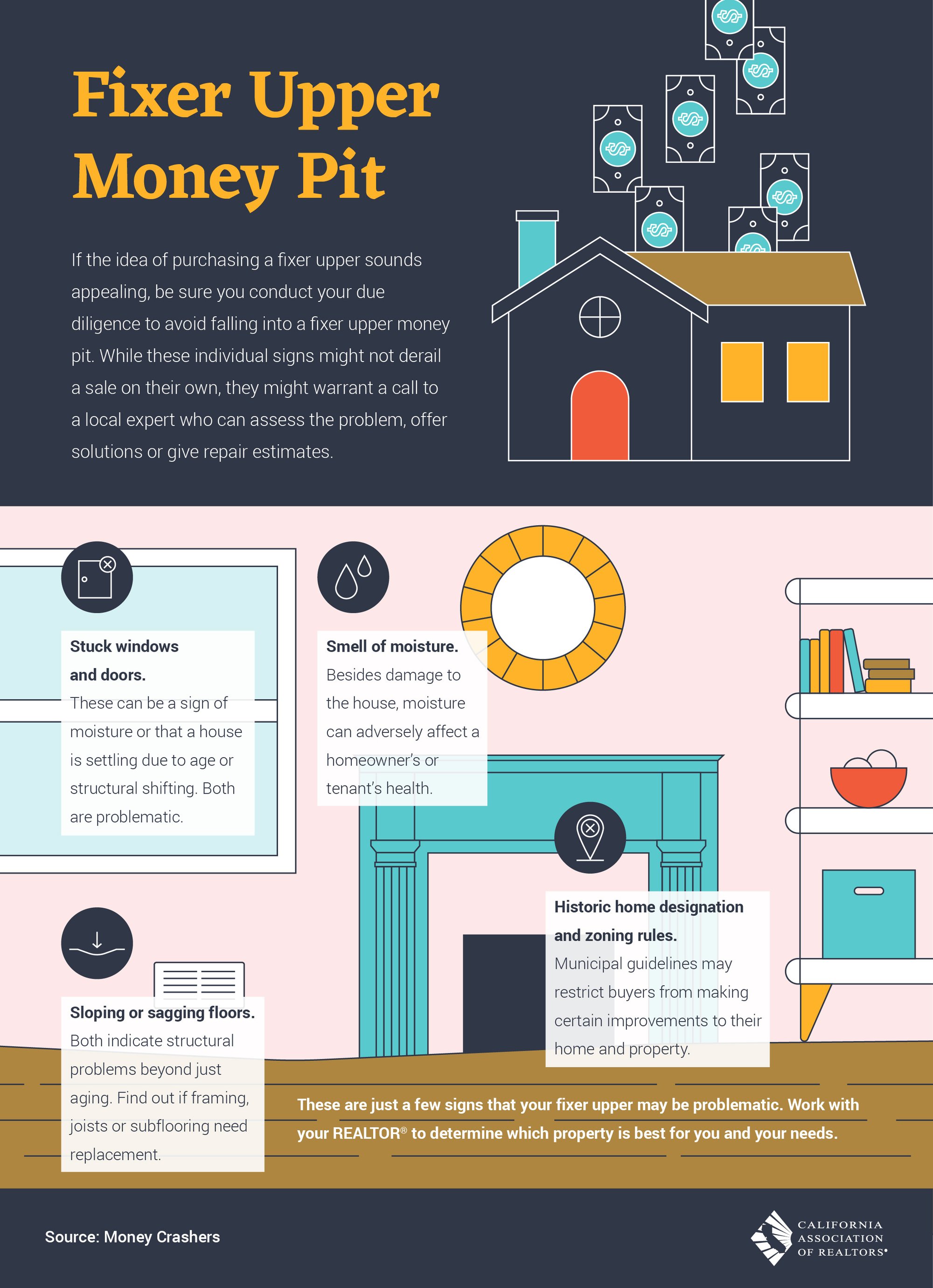
What do the four warning signs mean, and who do you call?
Stuck windows and doors. Wood swells when wet, and frames go out of square when a foundation moves. California's seller disclosure form asks about "any settling from any cause, or slippage, sliding, or other soil problems" (reproduced in the Department of Real Estate's Disclosures in Real Property Transactions). A home inspector comes first. If the inspector suspects movement, the next call is a civil, structural or geotechnical engineer, whose license can be checked with the state engineers' board.
A smell of moisture. The California Department of Public Health says: "If you can see mold, water damage, or moisture, or smell mold, there is at least some increased health risk" (CDPH). State housing law lists "dampness of habitable rooms" and "visible mold growth" among the conditions that make a dwelling substandard (Health and Safety Code §17920.3). The repair is whatever lets the water in. Ask the home inspector, a roofer or plumber, and the structural pest control company that writes the wood-destroying pests and organisms report.
Sloping or sagging floors. The question is whether framing, joists, subfloor or foundation has failed, and an engineer or licensed foundation contractor answers it. California's Earthquake Brace + Bolt program puts a typical seismic retrofit of a pre-1980 wood-framed house on a raised foundation at $3,000 to $7,000, with grants of up to $3,000 when registration is open (California Residential Mitigation Program).
Historic designation and zoning rules. These do not show up in an inspection report. They show up when the new owner applies for a permit; see the section below.
One limit applies to all four. A California home inspection is by statute "a noninvasive, physical examination" (Business and Professions Code §7195), and paragraph 12C of the purchase agreement bars "invasive or destructive" investigations without the seller's written consent. A buyer who needs to open a wall to learn the scope has to ask first.
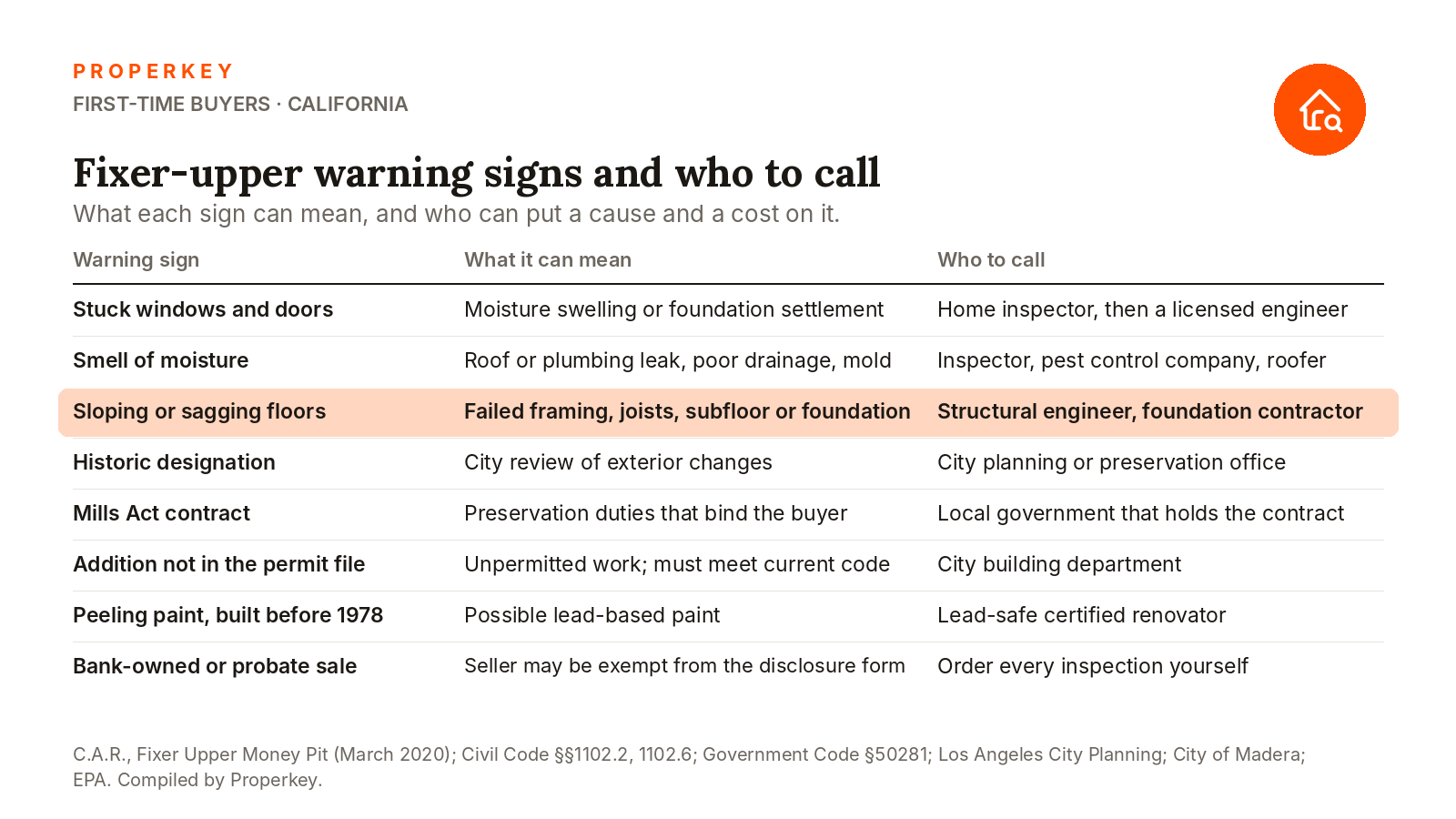
Which defects are leverage, and which are reasons to walk away?
The dividing line is whether the problem can be priced before the contingency deadline. A worn roof, an old water heater, a dated kitchen and the items in a pest report can each be bid by a licensed contractor inside 17 days. Those bids are leverage for a lower price, a credit or repairs, though the seller does not have to agree. The contract's default is that the property is delivered "'As-Is' in its PRESENT physical condition as of the date of Acceptance" (paragraph 7B(1)). Properkey's guides cover the inspection contingency and the request for repair and what happens to the earnest money deposit.
A defect becomes a reason to walk, or to ask for more time, when nobody can say what is causing it, when the scope cannot be known without destructive testing the seller will not allow, or when a rule blocks the plan, such as an addition the city will not legalize. Insurance belongs on the list too: the "Buyer's ability to obtain insurance for the Property, including fire insurance, is part of Buyer's Investigation of Property contingency" (paragraph 8A(2)). At Properkey's insurance desk a licensed agent shops the carriers.
Anyone bidding the work should be licensed. California requires a contractor's license for any job that needs a building permit or is worth $1,000 or more in labor and materials (Contractors State License Board).
What does the seller have to tell you about unpermitted work?
The Transfer Disclosure Statement required by Civil Code §1102 and following asks whether the seller is aware of "room additions, structural modifications, or other alterations or repairs made without necessary permits," of work "not in compliance with building codes," and of "any zoning violations, nonconforming uses, violations of 'setback' requirements." Delivery of the statement "may not be waived in an 'as is' sale" (Civil Code §1102.1). Properkey's Transfer Disclosure Statement explainer has the full form.
Two cautions. The form asks only what the seller is aware of. And the sellers of many fixers are exempt: Civil Code §1102.2 excludes court-ordered sales, including probate sales, foreclosure sales, sales by a lender that took the property back, and most sales by a fiduciary administering a trust or estate.
So read the permit file. In Los Angeles the seller must give the buyer a city Report of Residential Property Records before the sale closes (Los Angeles Department of Building and Safety); elsewhere the buyer asks the building department. The City of Madera states the stakes: "There is no statute of limitations on unpermitted construction. Work must be brought into compliance with current applicable codes regardless of when it was performed" (City of Madera).
What does a historic designation stop you from doing?
It depends on the city, so call the planning office. In Los Angeles, properties in local historic districts "must undergo additional review for exterior renovations, additions, new construction, or other changes to the exterior, including changes that may not require a building permit, such as landscaping and paint" (Los Angeles City Planning).
A Mills Act contract follows the house. Under the Mills Act (Government Code §§50280 to 50290), a city or county may give the owner of a qualified historic property tax relief in exchange for restoring and maintaining it. Section 50281 requires a term of at least 10 years, preservation to the Secretary of the Interior's Standards for Rehabilitation, inspections of the interior and exterior every five years, and a contract binding on "all successors in interest of the owner." Section 50282 renews it a year at a time unless a notice of nonrenewal is served. The California Office of Historic Preservation tells buyers to ask the local government for the contract's terms.
How do you pay for the repairs?
Three loan programs fold the purchase and the renovation into one mortgage.
FHA 203(k). The Limited version finances up to $75,000 of non-structural repairs, a cap the Department of Housing and Urban Development set for case numbers assigned on or after November 4, 2024 (Mortgagee Letter 2024-13). The Standard version covers major and structural work: at least $5,000 of rehabilitation, an FHA-approved 203(k) consultant, and a total within the FHA mortgage limit for the area (HUD), which for a one-unit home in 2026 runs from $541,287 to $1,249,125 depending on the county (HUD). Both are for primary residences.
Fannie Mae HomeStyle Renovation. On a purchase, renovation costs may not exceed 75% of the lesser of the price plus renovation costs or the "as completed" appraised value (Fannie Mae Selling Guide B5-3.2-02).
Freddie Mac CHOICERenovation. The same 75% test applies, according to HUD's program comparison (revised November 4, 2024); Freddie Mac lists primary residences, second homes and one-unit investment properties as eligible.
Lender rules vary, so confirm terms on a written quote. Properkey's finance desk takes one application and shops the lenders, and its guides cover the FHA credit-score rules and what happens after a low appraisal. In a house built before 1978, anyone paid to disturb painted surfaces must be certified in lead-safe work practices (EPA).
Questions people ask
Is it a mistake to buy a house with foundation problems in California? Not when the cause and the cost are known before the investigation contingency is removed. Hire a licensed civil or structural engineer during the contingency period, get a repair scope and a bid, and negotiate from those numbers.
Does a California seller have to disclose unpermitted work? Yes, if the seller is aware of it. The Transfer Disclosure Statement asks about work done without necessary permits or not in compliance with building codes. Court-ordered, foreclosure and bank-owned sales and most trustee sales are exempt under Civil Code §1102.2, so check the permit records too.
How much repair money can an FHA 203(k) loan include? Up to $75,000 with a Limited 203(k), for non-structural work. A Standard 203(k) requires at least $5,000 of work and a HUD-approved consultant, and the total must stay within the county's FHA limit, $541,287 to $1,249,125 for a one-unit home in 2026.
This article is general information, not legal, engineering or lending advice. A licensed engineer should assess structural questions, a real estate attorney should answer questions about a seller's disclosure duties or a Mills Act contract, and a loan officer should confirm program terms.
Sources: C.A.R., Fixer Upper Money Pit (March 2, 2020); C.A.R. Residential Purchase Agreement (12/21 copy); California Department of Real Estate, Disclosures in Real Property Transactions; Civil Code §1102.1 and §1102.2; Business and Professions Code §7195; Health and Safety Code §17920.3; Government Code §50281 and §50282; California Office of Historic Preservation, Mills Act Program; Los Angeles City Planning; Los Angeles Department of Building and Safety; City of Madera; HUD 203(k) program types, Mortgagee Letter 2024-13, program comparison fact sheet and 2026 FHA loan limits; Fannie Mae Selling Guide B5-3.2-02; Freddie Mac CHOICERenovation; Contractors State License Board; Board for Professional Engineers, Land Surveyors, and Geologists; California Residential Mitigation Program, Earthquake Brace + Bolt; California Department of Public Health; EPA, Renovation, Repair and Painting Program.
Written by Keyro, Properkey's AI. Properkey, DRE #01979718.



