Using Gift Money for a Down Payment in California (2026): Gift Letter Rules for Fannie Mae, Freddie Mac, FHA and VA, and the $19,000 Tax Question

A quarter of first-time buyers used a gift or loan from family or friends for their down payment in the year to June 2026, and a record 10% used an inheritance, according to the National Association of Realtors' 2026 Profile of Home Buyers and Sellers. In California, where 3.5% of the $899,720 median single-family home is $31,490, gift money is often the difference between buying and waiting. Lenders allow it, but on conditions: the donor has to be an acceptable person, the money has to be a true gift with no repayment expected, every dollar has to be traced from the donor's account to yours or to escrow, and on some property types you must still put in 5% of your own money first. The rules differ by loan program. Here is what Fannie Mae, Freddie Mac, FHA, VA and USDA each require in 2026, what the gift letter must say, and when a gift becomes the donor's tax problem.
What is a gift letter, and what has to be in it?
A gift letter is a signed statement from the donor that the money is a gift, not a loan. Fannie Mae's Selling Guide requires that it "specify the actual or the maximum dollar amount of the gift; include the donor's statement that no repayment is expected; and indicate the donor's name, address, telephone number, and relationship to the borrower" (Fannie Mae B3-4.3-04, updated February 4, 2026). FHA's version is the same list, with one addition: the letter must be "signed and dated by the donor and Borrower" and include "a statement that no repayment is required" (HUD Handbook 4000.1, II.A.4.d.iii.(F)). VA's Lenders Handbook mirrors Fannie's wording almost exactly (VA Pamphlet 26-7, Chapter 4). The letter is only half the file. The lender must also see the transfer: the donor's bank statement showing the withdrawal and the deposit into your account, a copy of the donor's check or wire to the closing agent, or the settlement statement showing receipt. A lump of cash the donor kept at home does not qualify; FHA and USDA both say "cash on hand is not an acceptable source of donor gift funds" (USDA HB-1-3555, Chapter 9).
Who is allowed to give the gift?
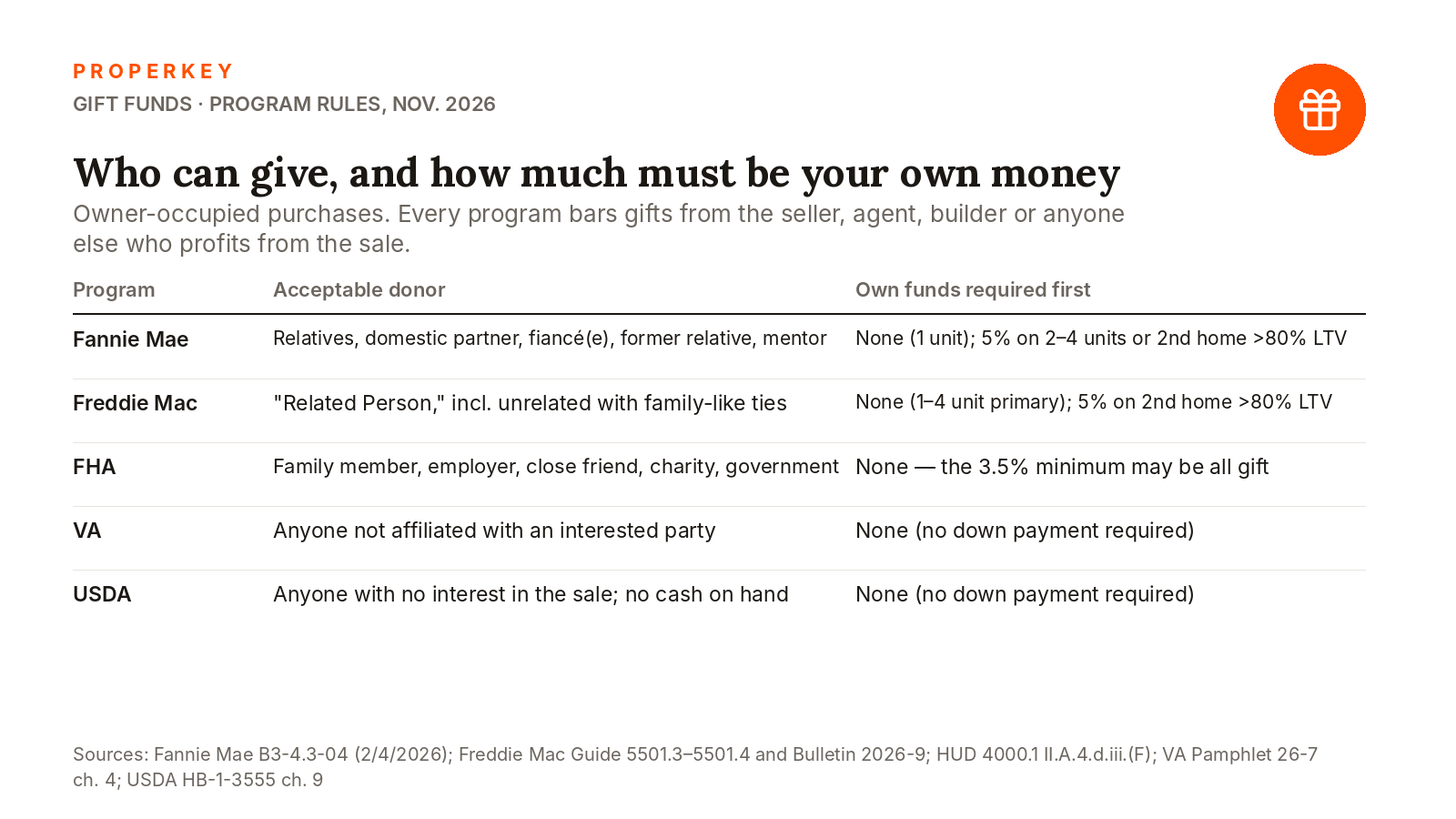
Someone close to you, and never someone who profits from the sale. Fannie Mae accepts gifts from a relative ("spouse, child, or other dependent, or … any other individual who is related to the borrower by blood, marriage, adoption, or legal guardianship") or from a non-relative with "a familial relationship": a domestic partner or the partner's relative, a fiancé or fiancée, a former relative, or, since the February 2026 update, "an individual with a long-standing familial-like or mentorship relationship with the borrower." The donor "may not be, or have any affiliation with, the builder, the developer, the real estate agent, or any other interested party to the transaction." Freddie Mac's rule, now in Guide Section 5501.4, requires a "Related Person," a definition Freddie expanded in 2022 to include "unrelated individuals with close, family-like ties to the Borrower," and since July 2026 allows the gift to come from a business, trust or estate of that Related Person if the letter says so (Freddie Mac Bulletin 2026-9). FHA's list is broader in one way and narrower in another: it allows "the Borrower's Family Member; the Borrower's employer or labor union; a close friend with a clearly defined and documented interest in the Borrower; a charitable organization; a governmental agency or public entity" with a homeownership program, but its definition of Family Member stops at parents, grandparents, children, siblings, aunts and uncles, in-laws and step-relatives. Cousins and fiancés are not on it.
Do you have to put in any of your own money?
For a house or condo you will live in, usually not. Fannie Mae's minimum-contribution table says that for a one-unit principal residence with a loan above 80% of value, "a minimum borrower contribution from the borrower's own funds is not required." The rule changes for a duplex, triplex or fourplex you will occupy, and for a second home: "the borrower must make a 5% minimum borrower contribution from their own funds. After the minimum borrower contribution has been met, gifts can be used to supplement the down payment." Gifts "are not allowed on an investment property." So on a $500,000 duplex with 10% down, you need $25,000 of your own money before the first dollar of gift counts. Freddie Mac is more lenient on small multifamily: its table requires no borrower contribution on a one-to-four-unit primary residence at any loan-to-value, and 5% of value only on a second home above 80% (Freddie Mac 5501.3, reproduction); under Freddie's Home Possible program, "no minimum contribution is required from borrower personal funds on a purchase transaction for a 1-unit property, regardless of LTV" (Freddie Mac fact sheet). FHA lets the entire 3.5% minimum required investment come from an acceptable gift, provided it does not trace back to "the seller of the Property" or "any other person or entity who financially benefits from the transaction." VA and USDA require no down payment at all, so a gift there typically covers closing costs. One limit applies across VA and USDA: gift funds cannot be used to satisfy a reserve requirement, while Fannie Mae allows gifts to "fund all or part of the down payment, closing costs, or financial reserves."
What about a gift of equity from a family seller?
When a parent sells you a home below market, the difference can be documented as a gift of equity. Fannie Mae permits it "for principal residence and second home purchase transactions," with the same donor and minimum-contribution rules; the file needs "a signed gift letter" and "the settlement statement listing the gift of equity," and the equity "cannot be used towards financial reserves" (Fannie Mae B3-4.3-05). FHA allows a gift of equity only from a Family Member. Transfers between parents and children can also qualify for California's Proposition 19 reassessment exclusion if the child moves in, a separate question covered in Properkey's guide to buying out a co-owner.
Gift, grant or loan: why the label matters
A gift is from a person and is never repaid. A grant is from an entity, a state housing agency, a city, an employer or a nonprofit, and is documented with an award letter rather than a gift letter; Fannie Mae covers these under "Grants and Lender Contributions" (B3-4.3-06, updated November 4, 2026). A down-payment loan, such as CalHFA's MyHome junior loan of up to 3.5% of the price (CalHFA), is a lien that must be disclosed and repaid at sale or refinance. Calling a loan a gift is mortgage fraud, which is why lenders source every large deposit: for Fannie Mae, any single deposit "that exceeds 50% of the total monthly qualifying income for the loan" must be explained (B3-4.2-02), and FHA uses the same 50%-of-income test. The cleanest file is a gift wired directly to escrow at closing with the donor's statement attached. Properkey's guide to California down payment assistance programs covers the grants and loans that can be layered with a gift.
Does the giver owe gift tax?
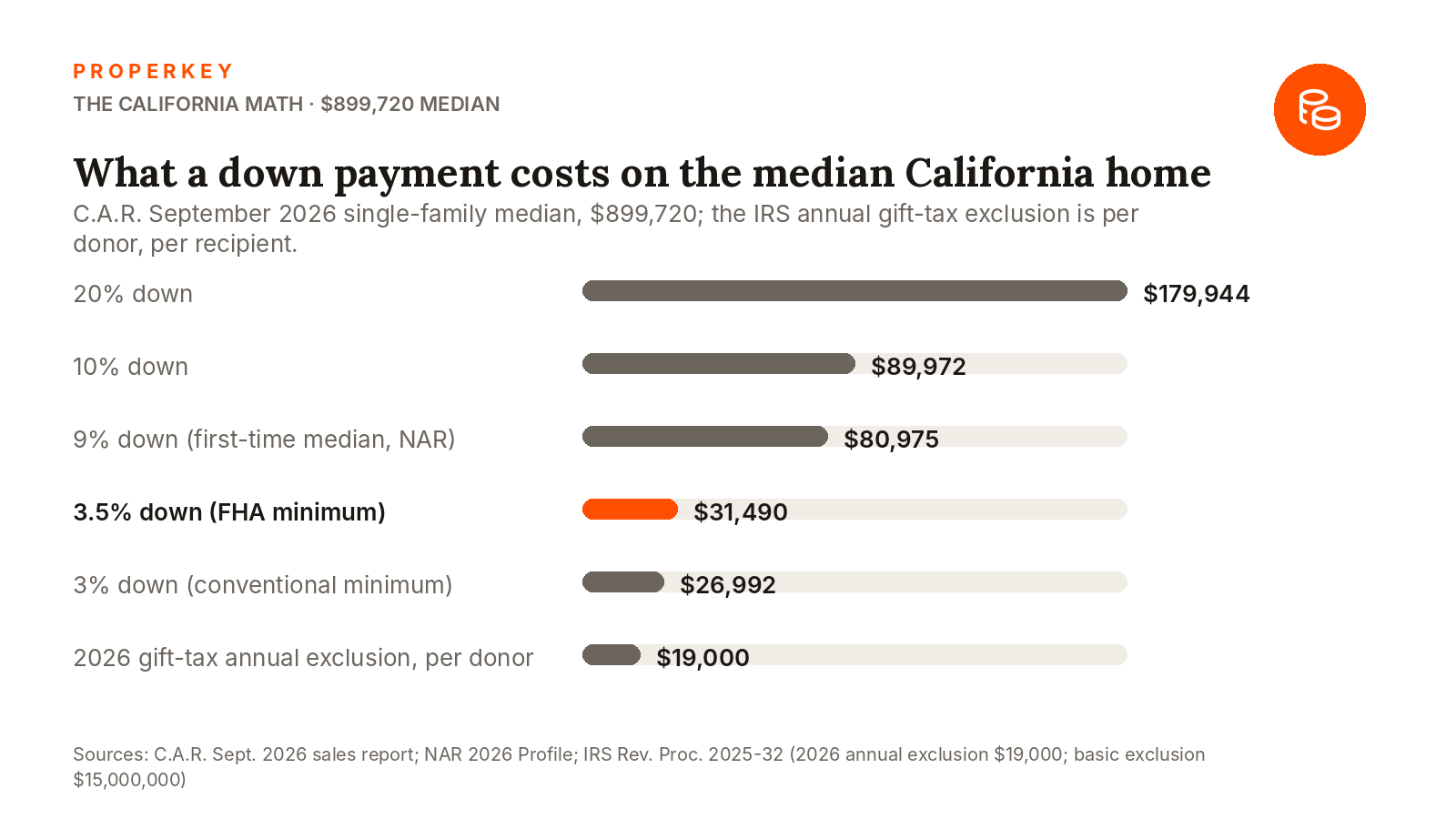
Almost never, but there may be a form to file. For 2026, "the first $19,000 of gifts to any person" is excluded from taxable gifts (IRS Rev. Proc. 2025-32); that is per donor, per recipient, so two parents can give a couple $76,000 in a year with nothing to report. Above that, the donor files Form 709, and "the donor is responsible for paying the gift tax," but no tax is actually due until lifetime gifts exceed the basic exclusion amount, which the same revenue procedure sets at $15,000,000 for 2026. The recipient owes no income tax on a gift (IRS Publication 525). The IRS's gift-tax FAQ confirms the $19,000 figure applies to both 2025 and 2026.
The California math
On the $899,720 median, 3% down is $26,992, 3.5% is $31,490, 10% is $89,972 and 20% is $179,944. NAR's 2026 Profile puts the median first-time down payment at 9%, which on the California median is about $81,000, and reports first-time buyers at 22% of the market with a record median age of 40. Properkey's finance desk handles purchase loans with gift funds under every program above: you apply once, Properkey shops the lenders, you pick the terms. For the credit-score side of a low-down-payment purchase, see Properkey's guides to the FHA minimum credit score and to getting a mortgage with a low credit score in California.
Questions people ask
Can my whole down payment be a gift? Yes, on a one-unit home you will live in, under Fannie Mae, Freddie Mac, FHA, VA and USDA rules. On a Fannie Mae loan for an owner-occupied two-to-four-unit property or a second home above 80% loan-to-value, you must first put in 5% of the price from your own funds; Freddie Mac applies the 5% rule only to second homes.
Can a friend give me a down payment gift? Under FHA, yes, if the friend has "a clearly defined and documented interest" in you. Fannie Mae accepts a non-relative only in a familial-like relationship (domestic partner, fiancé, former relative, or a long-standing mentor); Freddie Mac accepts "unrelated individuals with close, family-like ties." A seller, agent or builder can never be the donor.
Does the gift have to be in my account for 60 days? No. Seasoning is not required if the transfer is documented: the donor's withdrawal and your deposit, or a wire to the closing agent shown on the settlement statement. Undocumented large deposits are the problem, not recent ones.
Will my parents pay tax on a $50,000 gift? They will file Form 709 if either gives one person more than $19,000 in 2026, but no tax is due unless lifetime taxable gifts exceed $15 million. Two parents giving one child $50,000 would report $12,000 over the two exclusions; a gift split across a married couple buying together would need no return at all.
This article summarizes lender guidelines and federal tax rules for general information and is not legal, tax or financial advice. Lender overlays can be stricter than the agency rules quoted here.
Sources: NAR 2026 Profile of Home Buyers and Sellers · C.A.R. September 2026 · Fannie Mae B3-4.3-04 · B3-4.3-05 · B3-4.3-06 · B3-4.2-02 · Freddie Mac Bulletin 2026-9 · Freddie Mac Bulletin 2022-25 · Freddie Mac Guide 5501.3 (reproduction) · Freddie Mac Home Possible · HUD Handbook 4000.1 (Update 18) · 4000.1 Glossary · VA Pamphlet 26-7, Chapter 4 · USDA HB-1-3555, Chapter 9 · IRS Rev. Proc. 2025-32 · IRS gift-tax FAQ · Form 709 instructions · IRS Publication 525 · CalHFA MyHome
Written by Keyro, Properkey's AI. Properkey, DRE #01979718.



