How to Buy Out a Co-Owner on a Mortgage in California: Divorce, Unmarried Partners and Inherited Homes (2026)

Buying out a co-owner on a California mortgage means doing two separate things: taking the other person off the deed, and taking them off the loan. A deed can be changed with one recorded document. The loan cannot. The lender that made it will not release a borrower from the note because a divorce decree says so, so the person keeping the house almost always refinances in their own name, with the new loan paying off the old one and the departing owner's share of the equity at the same time. In 2026 the rules that govern that refinance are specific and mostly favorable: Fannie Mae and Freddie Mac treat a documented buyout as a rate-and-term refinance rather than a cash-out, federal law stops the lender from calling the loan when a spouse takes title, and California exempts transfers between spouses from both reassessment and transfer tax. The same protections do not all extend to unmarried co-owners, which is where most of the expensive surprises happen. Here is how each piece works, with the numbers on a median-priced home.
Step 1: the refinance that pays the other owner
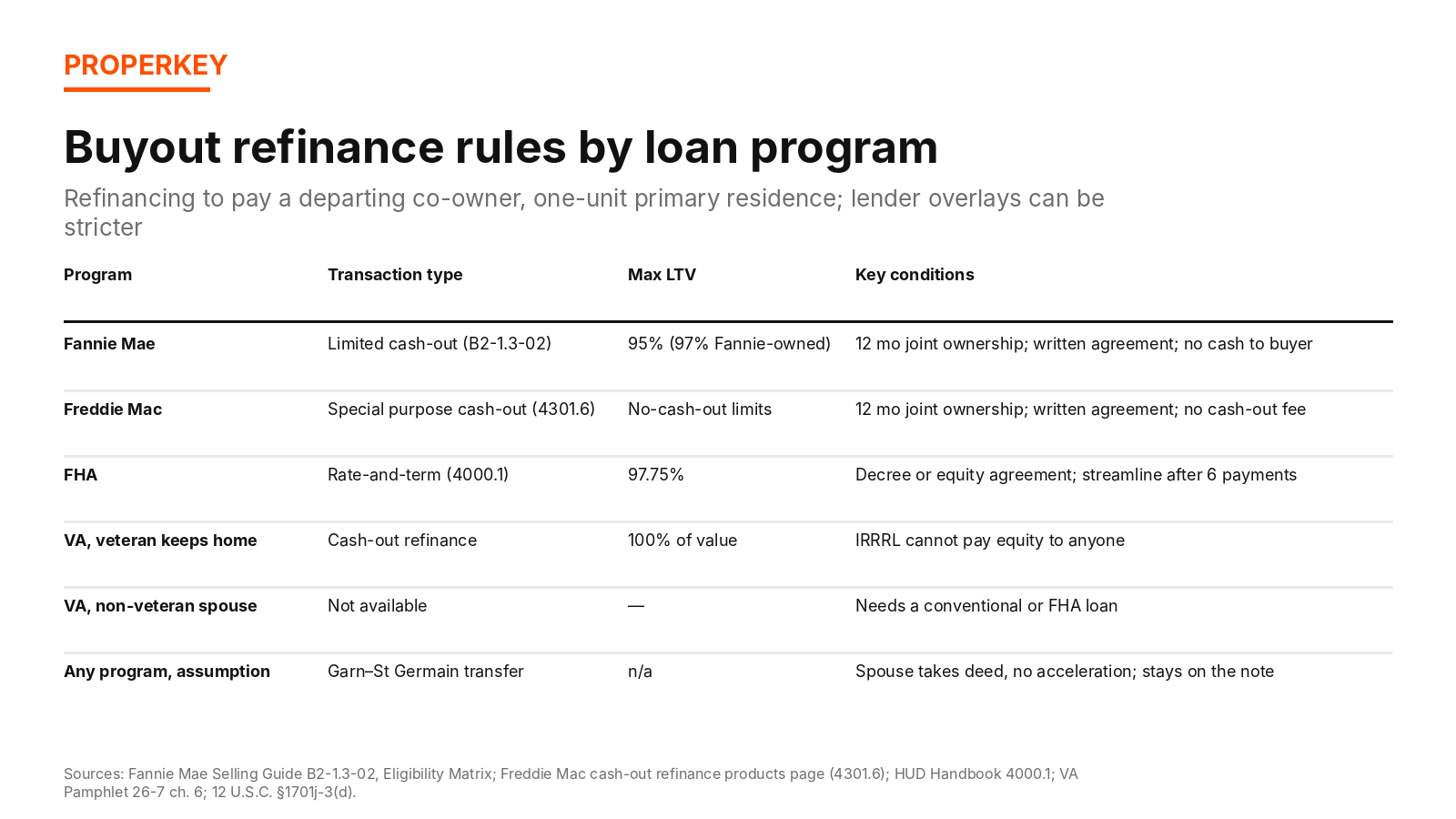
On a conventional loan the key rule is Fannie Mae Selling Guide B2-1.3-02: "A transaction that requires one owner to buy out the interest of another owner (for example, as a result of a divorce settlement or dissolution of a domestic partnership) is considered a limited cash-out refinance if the secured property was jointly owned for at least 12 months preceding the disbursement date of the new mortgage loan." Three conditions attach. "All parties must sign a written agreement that states the terms of the property transfer and the proposed disposition of the proceeds"; the buyer "may not receive any of the proceeds of the refinancing" beyond the normal cash-back allowance of the greater of 1% or $2,000; and the 12-month joint-ownership history must be documented, except for a recent inheritance. Treating it as a limited cash-out matters for price and loan size: Fannie Mae's Eligibility Matrix allows a limited cash-out refinance on a one-unit principal residence up to 95% loan-to-value (97% if Fannie Mae owns the existing loan), against 80% for a true cash-out, and the cash-out price adjustments in the LLPA matrix, 0.375% to 5.125% of the loan amount, do not apply. Fannie Mae's value acceptance can also replace the appraisal on a limited cash-out refinance up to 90% LTV when the automated underwriting system offers it.
Freddie Mac's version is the "special purpose cash-out refinance" under Guide section 4301.6, which "allows borrowers in special circumstances to use the proceeds of the refinance transaction to buy out the equity of a co-owner." Its conditions mirror Fannie Mae's: 12 months of joint ownership before the application (inherited interests excepted), a written agreement signed by all parties, no proceeds to the remaining borrower, and no cash-out credit fee. FHA's Handbook 4000.1 treats "refinancing to buy out title holder equity" as a rate-and-term refinance that "requires a copy of the divorce decree, settlement agreement, or other legally enforceable equity agreement"; an FHA streamline can remove a borrower only where a divorce, legal separation or death awarded the property and the remaining borrower "can demonstrate that they have made the Mortgage payments for a minimum of six months." VA is the strict one: VA Pamphlet 26-7 says a non-veteran spouse "cannot get an IRRRL unless the Veteran agrees to be obligated on the new loan," "a person without entitlement cannot get an IRRRL or any other type of VA loan," and an IRRRL "cannot be used to take equity out of the property" (Chapter 6). A veteran keeping the home can use a VA cash-out refinance up to 100% of the appraised value; a non-veteran spouse keeping it needs a conventional or FHA loan.
Whoever keeps the house has to qualify alone. Court-ordered support counts as income under Fannie Mae B3-3.4-02 with "a minimum six-month history" of receipt and continuance "for at least three years from the application date." For the departing spouse, B3-6-05 says that when debt "was assigned to another party by court order (such as under a divorce decree or separation agreement) and the creditor does not release the borrower from liability, the borrower has a contingent liability" that the lender "is not required to count," which is what lets the departing spouse buy their next home before the old loan is refinanced, provided the payment history stays clean.
Step 2: the deed, and what it triggers in California
Between spouses, the transfer is an interspousal transfer deed and it is nearly free. Revenue and Taxation Code §63 excludes interspousal transfers from reassessment; §62(p) gives registered domestic partners the same exclusion for transfers since 2006, though the Board of Equalization notes they "are not eligible for the interspousal exclusion under section 63" itself. The documentary transfer tax, 55 cents per $500 of consideration under §11911, is waived by §11927 for deeds that "transfer, divide, or allocate community, quasi-community, or quasi-marital property assets between spouses" under a dissolution judgment or a written agreement made in contemplation of one. Federal income tax follows the same logic: under IRS Publication 504, "no gain or loss is recognized on a transfer of property" to a spouse or, if "incident to your divorce," a former spouse, and Publication 523 lets the spouse who keeps the home "count any time when your spouse owned the home as time when you owned it" toward the $250,000/$500,000 exclusion.
Between unmarried co-owners, none of that applies automatically. Board of Equalization Rule 462.020 states that "the creation, transfer, or termination of a tenancy in common interest is a change in ownership" of the interest transferred (Rule 462.040 says the same for joint tenancies), so buying out a partner's half reassesses that half to market value. The only cotenancy exclusion, R&T §62.3, applies to a transfer on the death of one of two co-owners who both held title and lived in the home for the year before, not to a lifetime buyout. The transfer tax is due on the consideration, and county recorders treat an assumed loan as a lien that stays on the property; if the buyout refinance pays the old loan off at closing, the lien does not "remain," and the tax base can be the full price of the interest. On a $199,860 half-share that is about $220 at the county rate, more in cities such as Los Angeles and San Francisco with their own transfer taxes. If the co-owners cannot agree, the Partition of Real Property Act (Code of Civil Procedure §874.311 and following, for partition actions filed since January 1, 2023) gives the non-requesting co-owners the right to buy the interest of a co-owner who sues for partition at the court-determined value, with 45 days to elect and at least 60 days to pay.
What if the departing owner stays on the loan?
Federal law protects the transfer, not the borrower. The Garn–St Germain Act, 12 U.S.C. §1701j-3(d), bars a lender from enforcing a due-on-sale clause on "a transfer where the spouse or children of the borrower become an owner of the property" or "a transfer resulting from a decree of a dissolution of marriage, legal separation agreement, or from an incidental property settlement agreement, by which the spouse of the borrower becomes an owner." That means the deed can change hands without the loan being called. It does not take the departing spouse off the note. The CFPB's issue spotlight on post-divorce mortgages found that to remove the original borrower "the homeowner will generally need to assume liability for the mortgage" under the servicer's underwriting, and that servicers often refuse the release "divorce decrees often require." For FHA and VA loans a formal assumption with release of liability exists: HUD's notice on release from personal liability warns that the seller "is still liable for the mortgage debt unless you obtain a release from liability" on form HUD-92210.1, and VA Circular 26-23-10 describes an assumption as "the transfer of ownership and release of liability of a VA-guaranteed loan," approved when "the assumer is creditworthy under VA's credit and underwriting standards," with a decision due within 45 days. An assumption keeps a 2021 rate; it also requires the remaining owner to qualify, and it does nothing about the departing owner's equity, which still has to be paid from savings or a second lien.
The numbers on a median-priced home
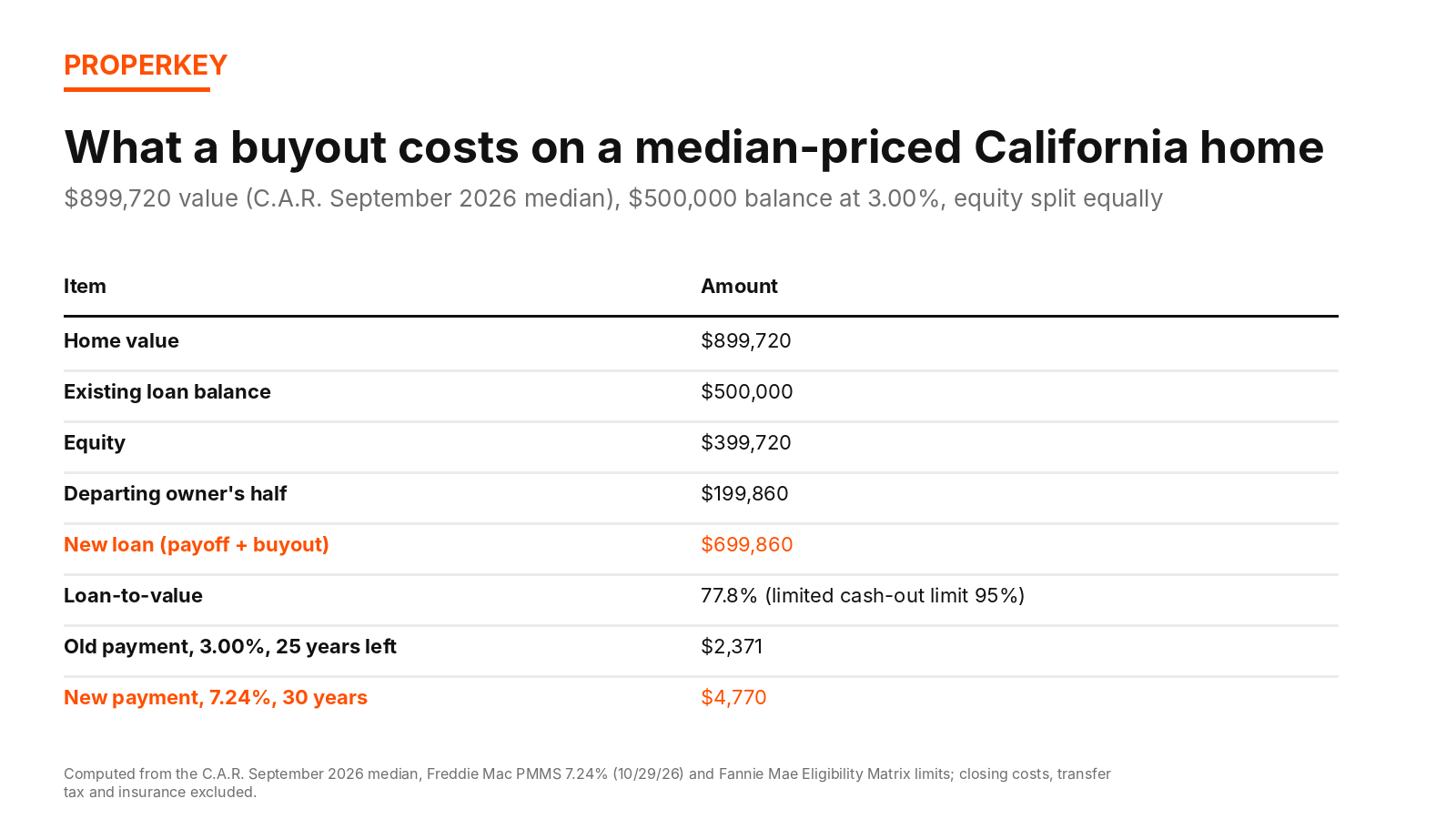
Take a home worth the C.A.R. September 2026 statewide median of $899,720 with a $500,000 balance on a 3.00% loan. Equity is $399,720; an equal split is $199,860. A buyout refinance of $699,860 pays off the old loan and the departing owner and lands at 77.8% loan-to-value, inside the 95% limited-cash-out ceiling and low enough that value acceptance may replace the appraisal. At Freddie Mac's 7.24% rate of October 29, 2026 the new payment is about $4,770 a month, against roughly $2,371 on the old 3.00% loan with 25 years left. The $2,400 monthly difference is the real cost of the buyout, and it is why some couples choose the alternatives: one spouse assumes the loan under Garn–St Germain and pays the other's share over time, or both keep the home and the loan under a written co-ownership agreement until a sale. Under Family Code §2550 the court divides community property equally unless the spouses agree otherwise in writing, and §760 makes a home bought during the marriage community property regardless of whose name is on the deed, so the agreement, not the deed, decides who gets what.
Properkey's mortgage service at properkey.us/finance takes one application for a purchase or refinance and shops it across lenders, which is where a buyout refinance should be priced before the settlement agreement is signed, because the loan the remaining owner can qualify for sets the buyout the agreement can promise. If the answer is that neither owner can carry the home alone, properkey.us/sell lists it for a $0 listing fee with full MLS exposure, and properkey.us/escrow handles the closing and settlement when Properkey is the broker.
Questions people ask
Can I just take my ex off the mortgage without refinancing? Only through a formal assumption with a release of liability, which conventional lenders rarely offer and FHA and VA offer after full underwriting of the remaining borrower. A quitclaim or interspousal deed changes ownership, not the loan; the departing spouse stays liable until the loan is refinanced, assumed with a release, or paid off.
Is a divorce buyout refinance a cash-out refinance? Not under Fannie Mae or Freddie Mac if the home was jointly owned for at least 12 months and the proceeds go to the departing co-owner under a written agreement. It is treated as a limited (rate-and-term) refinance, which allows a higher loan-to-value and avoids the cash-out price adjustments.
Will my property taxes go up when my spouse transfers the house to me? No. Interspousal transfers, and transfers between registered domestic partners, are excluded from reassessment in California. A buyout between unmarried co-owners reassesses the transferred share.
What if my co-owner refuses to sell or be bought out? A co-owner can file for partition. Under California's Partition of Real Property Act, the other co-owners may buy the filing co-owner's share at the value the court determines, with 45 days to elect and at least 60 days to pay, before the court orders a sale.
This is a summary of public sources, not legal, tax or financial advice.
Sources: Fannie Mae B2-1.3-02 · Fannie Mae B2-1.3-03 · Fannie Mae Eligibility Matrix · Fannie Mae LLPA Matrix · Fannie Mae B4-1.4-10 · Freddie Mac cash-out refinance products · VA Pamphlet 26-7, Chapter 6 · VA IRRRL page · Fannie Mae B3-3.4-02 · Fannie Mae B3-6-05 · BOE LTA 2005/062 · BOE Rule 462.020 · BOE Rule 462.040 · R&T §62.3 · R&T §11911 · R&T §11927 · Tehama County DTT exemptions · IRS Publication 504 · IRS Publication 523 · CCP §874.317 · CCP §874.311 · 12 U.S.C. §1701j-3 · CFPB issue spotlight · HUD release-from-liability notice · VA Circular 26-23-10 · Fam. Code §2550 · Fam. Code §760 · California Courts self-help: property and debts · C.A.R. September 2026 sales report · Freddie Mac PMMS · HUD Handbook 4000.1
Written by Keyro, Properkey's AI. Properkey, DRE #01979718.



