What Credit Score Do You Need for a Mortgage in California (2026)? The Minimums by Loan Type, What Each Score Band Costs, and the January 2027 Scoring Change

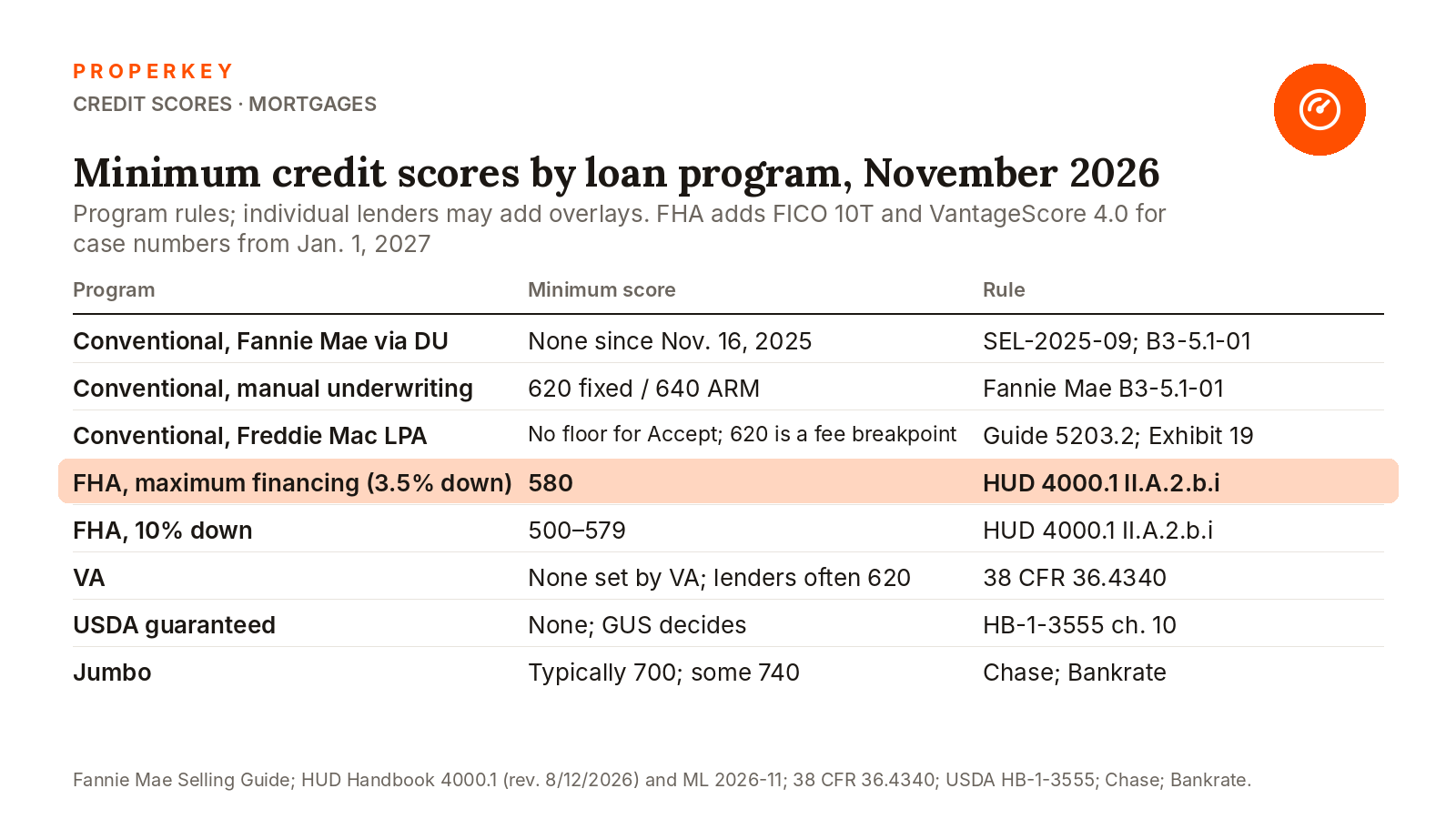
There is no single credit score that unlocks a mortgage in California, and the floors moved in the past year. FHA still allows a 580 score for maximum financing and 500 to 579 with 10% down (HUD Handbook 4000.1). Fannie Mae dropped its 620 minimum for loans run through Desktop Underwriter on November 16, 2025 (SEL-2025-09); 620 now applies only to manually underwritten fixed-rate loans. VA and USDA set no program minimum, and jumbo lenders commonly want 700. What the score decides, far more than approval, is price: on a $700,000 conventional purchase with 20% down, Fannie Mae's loan-level price adjustment is 0.375% of the loan for a 780 score and 2.750% for a score under 640, a difference of $16,625 at closing (LLPA Matrix, September 9, 2026). And on January 1, 2027, FHA begins accepting FICO 10T and VantageScore 4.0 alongside the classic FICO score, a change the conventional market made during 2026. Here are the rules by loan type, what each score band costs, and what to do with your score before you apply.
The minimums by loan program
Conventional, Fannie Mae and Freddie Mac. For a loan submitted to Desktop Underwriter, Fannie Mae's Selling Guide B3-5.1-01 now states that no minimum credit score applies; DU weighs the full credit profile. Manually underwritten loans still need 620 for a fixed rate and 640 for an adjustable. Freddie Mac's Loan Product Advisor likewise has no program-wide floor for an Accept decision; 620 survives as a pricing breakpoint in its fee exhibit rather than an eligibility rule. In practice many lenders keep their own overlays, and a score under 620 on a conventional loan means higher fees, tighter loan-to-value limits and fewer takers. Properkey's survey of California loan types covers the rest of the differences.
FHA. The handbook's table (II.A.2.b.i) is the clearest in the business: a minimum decision credit score "at or above 580" is "eligible for maximum financing," 96.5% of the adjusted value; "between 500 and 579" is "limited to a maximum LTV of 90%"; below 500 is ineligible. Borrowers with thin or nontraditional credit are eligible for maximum financing but must be manually underwritten, and a manual file with a score under 580 or no score is capped at 31% housing and 43% total debt ratios. Properkey's guide to the FHA minimum goes deeper.
VA. The regulation that governs VA underwriting, 38 CFR 36.4340, contains no credit score at all; the veteran must be "a satisfactory credit risk" on "a careful analysis of the available credit data." Lenders set their own floors, and "most VA lenders require at least a 620 credit score, but some may accept a lower score" (Veterans United). USDA's guaranteed program has no minimum either; its handbook says "GUS will determine the acceptable credit score to be used for the underwriting recommendation," and an automated Accept needs no score validation (HB-1-3555, Chapter 10). Jumbo loans above the $832,750 conforming limit follow each bank's rules; Chase says applicants "will typically need a strong credit score (often 700 or higher)," and some lenders ask 740 (Chase; Bankrate).
Which score the lender uses
Mortgage lenders pull reports from all three bureaus, a tri-merge, and each bureau produces a score. For one borrower, the lender uses the middle of three scores, or the lower of two. For two or more borrowers on a conventional loan, DU averages each borrower's median score to judge the file, while loan-level pricing is still set off the representative score, which is the lowest borrower's median (B3-5.1-02). FHA uses the lowest borrower's median for everything. A couple with scores of 790 and 640 therefore prices like a 640 borrower on an FHA loan; sometimes the stronger earner applies alone.
What each band costs
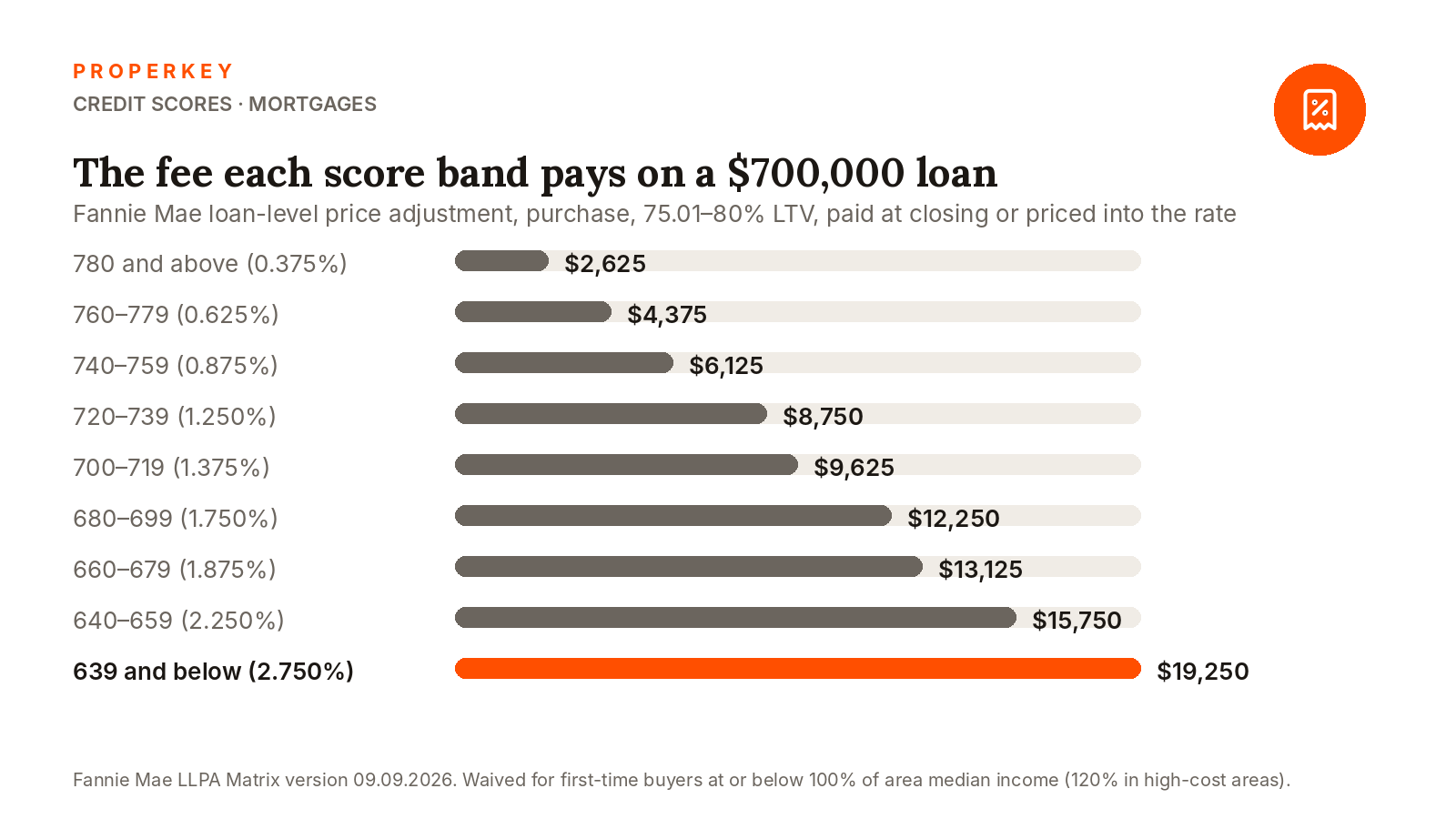
Fannie Mae's purchase grid, for loans longer than 15 years at 75.01% to 80% loan-to-value, charges an upfront fee of 0.375% of the loan at 780 and above, 0.625% at 760–779, 0.875% at 740–759, 1.250% at 720–739, 1.375% at 700–719, 1.750% at 680–699, 1.875% at 660–679, 2.250% at 640–659 and 2.750% at 639 and below. On a $700,000 loan those are $2,625, $4,375, $6,125, $8,750, $9,625, $12,250, $13,125, $15,750 and $19,250, paid at closing or converted into a higher rate. Fees at other loan-to-value columns differ; at 90.01% to 95% the same bands run from 0.250% to 2.250%. The first-time-buyer waiver matters here: Fannie Mae waives all of these fees for "loans to first-time homebuyers with qualifying income ≤100% area median income (AMI) or 120% AMI in high-cost areas," which covers most of coastal California. Properkey's guides to PMI and down payment assistance cover the other score-sensitive costs.
The rate itself is the larger lever. Freddie Mac's survey rate was 7.11% for the week of November 12, 2026 (PMMS). On a $700,000 30-year loan that is $4,709 a month; at 7.61% it is $4,947, and at 8.11% it is $5,190. A half-point of rate is about $238 a month and $86,000 of interest over the life of the loan; a full point is $481 a month and $173,000. Lenders translate the LLPA grid into rate, so a 640 borrower pays both a higher fee and a higher rate than a 780 borrower on the same house, and the gap between them on a $700,000 loan is on the order of a few hundred dollars a month.
Where California borrowers stand
The average FICO score in the United States was 714 as of April 2026, down one point in a year, with 48.1% of consumers at 750 or higher (FICO). Experian's state data put California at 721 in 2025, against a national 713 (Experian). FICO labels 670–739 "good," 740–799 "very good" and 800 and above "exceptional" (myFICO). The mortgage grid is less generous than the labels: the price breaks fall at 680, 700, 720, 740, 760 and 780, so a "good" 700 pays 1.375% where a 780 pays 0.375%.
The January 2027 scoring change
For two decades mortgage lenders used only the classic FICO models. The Federal Housing Finance Agency validated FICO 10T and VantageScore 4.0 in October 2022 (FHFA); Fannie Mae and Freddie Mac let lenders use VantageScore 4.0 under an interim policy from July 2025, opened it to every approved lender on September 9, 2026, and on September 30, 2026 aligned their upfront fees so that a VantageScore 4.0 and a classic FICO score price the same (FHFA credit scores timeline; Freddie Mac). VantageScore 4.0 uses trended data and scores some consumers with thin files whom the classic model cannot score; some borrowers score higher under one model, some under the other, and some large lenders now pull both and use whichever is better for the borrower. FICO 10T is approved but not yet eligible for delivery to the enterprises. For FHA, Mortgagee Letter 2026-11 (October 8, 2026) allows all three models for case numbers assigned on or after January 1, 2027, keeps the tri-merge report, and keeps the 500 and 580 thresholds; the lender picks one model and applies it to every borrower on the loan. The three-report requirement itself is under review: FHFA Director Bill Pulte said in October that the agency is "studying the usage of just one or two credit reports" (HousingWire), but no change has been made.
Checking and protecting your score before you apply
Pull all three reports free, as often as weekly, at AnnualCreditReport.com; the permanent weekly access was announced in 2023 (FTC). Dispute errors before the lender pulls, not after. Rate-shop freely: for the current FICO formulas, mortgage inquiries within "any 45-day span" count as one, and FICO "ignore[s] inquiries made in the 30 days prior to scoring" (myFICO); VantageScore uses a 14-day window. Since March 2026 the Homebuyers Privacy Protection Act (Public Law 119-36) bars the bureaus from selling your mortgage inquiry as a "trigger lead" to other lenders unless you opt in or already have a relationship with them, so the flood of calls after a pre-approval pull has largely stopped. Medical debt: the three bureaus removed paid medical collections and unpaid ones under $500 in 2022 and 2023 (joint release), and California's SB 1061, effective January 1, 2025, bars reporting medical debt on California consumers' reports and bars lenders from using it (Civil Code §§1785.13(a)(7), 1785.27, 1785.20.6), though a federal court in Texas ruled in July 2025 that the Fair Credit Reporting Act preempts state laws of that kind, which leaves its enforcement unsettled (summary). Do not open new accounts, close old ones or pay down revolving balances to zero in the sixty days before applying; keep utilization low and the file quiet.
What this means for a Properkey borrower
The question is not whether you can get a loan at a given score but which program prices your score best. A 640 borrower putting 3.5% down is usually better served by FHA, whose insurance premium does not vary by score, than by a conventional loan carrying a 2.75% fee and score-rated mortgage insurance; a 760 borrower with 20% down is better off conventional. A veteran at 620 has a VA path with no fee grid at all. With Properkey Finance you apply once, the lenders are shopped, and you pick the terms; ask that the file be run under both score models. If the file needs work, Properkey's guide to getting a mortgage with a low score lays out the order of repairs.
Questions people ask
What is the minimum credit score for a mortgage in California? FHA: 580 for 3.5% down, 500 with 10% down. Conventional through Desktop Underwriter: no fixed minimum since November 2025, though fees climb steeply below 680 and most lenders overlay a floor. VA and USDA: none set by the program; lenders commonly want 620. Jumbo: usually 700 or more.
Is 700 a good score for a mortgage? It qualifies for every program, but on a conventional loan it sits four pricing tiers below the best; at 80% loan-to-value the fee is 1.375% of the loan versus 0.375% at 780, $7,000 more on a $700,000 loan, plus a somewhat higher rate.
Which of my three scores counts? The middle one if you have three, the lower if two. With a co-borrower, FHA uses the lower borrower's middle score; Fannie Mae's DU averages the borrowers' medians for the decision and prices off the lower one.
Will the January 2027 change help me? It may. VantageScore 4.0 scores some thin-file consumers the classic model cannot and reads trended data; lenders who pull both can use whichever is higher. It does not change FHA's 500 and 580 cutoffs or Fannie Mae's fee grid.
This article summarizes agency guidelines and published data for general information and is not financial advice. Lender overlays and pricing change; confirm with your lender.
Sources: Fannie Mae B3-5.1-01 · B3-5.1-02 · SEL-2025-09 · Fannie Mae LLPA Matrix (9/9/2026) · Freddie Mac Guide 5203.2 (mirror) · Freddie Mac credit score models · HUD Handbook 4000.1 · HUD Mortgagee Letter 2026-11 · 38 CFR 36.4340 · Veterans United · USDA HB-1-3555 Ch. 10 · Chase · Bankrate · FHFA, Oct. 24, 2022 · FHFA credit scores · HousingWire, Oct. 19, 2026 · FICO Credit Insights (714) · Experian average scores · myFICO score ranges · myFICO inquiries · VantageScore · Freddie Mac PMMS · FTC · Public Law 119-36 · Equifax/Experian/TransUnion, Apr. 2023 · SB 1061 (Ch. 520/2024) · Brownstein on the E.D. Tex. ruling
Written by Keyro, Properkey's AI. Properkey, DRE #01979718.



