46% of Home Builders Cut Prices in November and 68% Offered Incentives: What the Lowest Builder Confidence Since 2012 Means for California Buyers and Resale Sellers

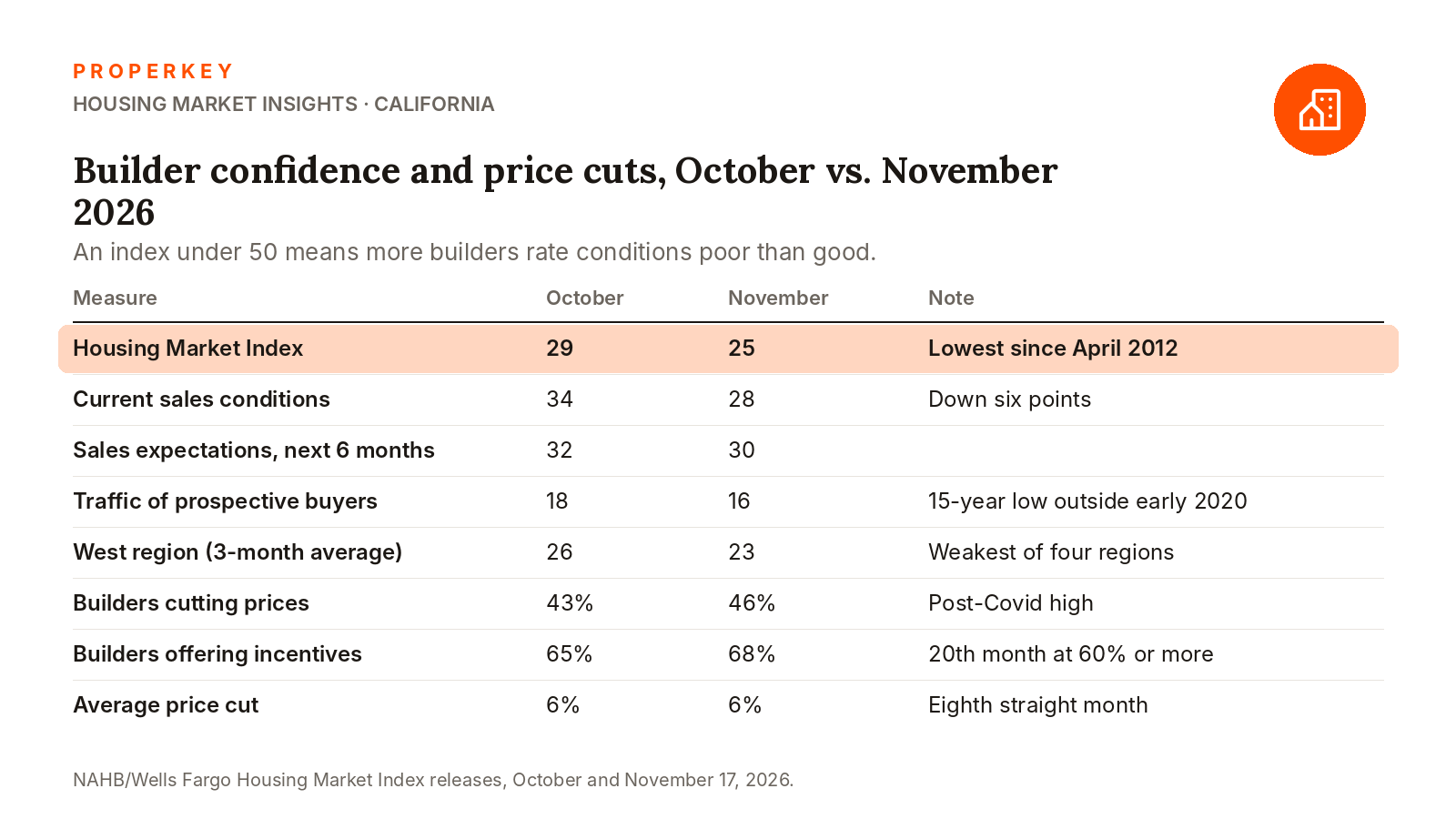
Forty-six percent of U.S. home builders cut prices in November, the highest share since the pandemic, and 68% offered sales incentives, according to the NAHB/Wells Fargo Housing Market Index released November 17, 2026. Builder confidence fell four points to 25, the lowest reading since April 2012, and the West was the weakest region in the country at 23. The average price cut held at 6% for an eighth straight month. For a California buyer that means the builder down the road is negotiating; for a California resale seller it means the competition is a new house with a lower price and, often, a mortgage rate about a point and a half under the market.
What did the November builder survey say?
The index measures builder sentiment on a 0-to-100 scale where anything under 50 means more builders see conditions as poor than good. November's 25 followed 29 in October. All three components fell: current sales conditions dropped six points to 28, sales expectations for the next six months fell two points to 30, and traffic of prospective buyers fell two points to 16, which NAHB called "its lowest level in 15 years, excluding the start of the pandemic in 2020."
NAHB's chief economist, Robert Dietz, put the demand side in one sentence: "Mortgage rates above 7%, softer consumer confidence and an uncertain economic outlook are holding buyers back." On the cost side he cited "building material costs pushed higher by tariffs, an ongoing shortage of construction workers and excessive regulations." NAHB Chairman Bill Owens, a builder from Worthington, Ohio, added that higher fuel prices are pushing subcontractors to raise their rates and that "with fewer buyers in the market, more builders are scaling back construction."
The regional three-month averages all fell: the Northeast to 34, the Midwest to 35, the South to 27 and the West to 23. In October, 43% of builders had cut prices and 65% had used incentives (NAHB, October). November was the 20th consecutive month in which at least 60% of builders used incentives.
What are builders actually offering?
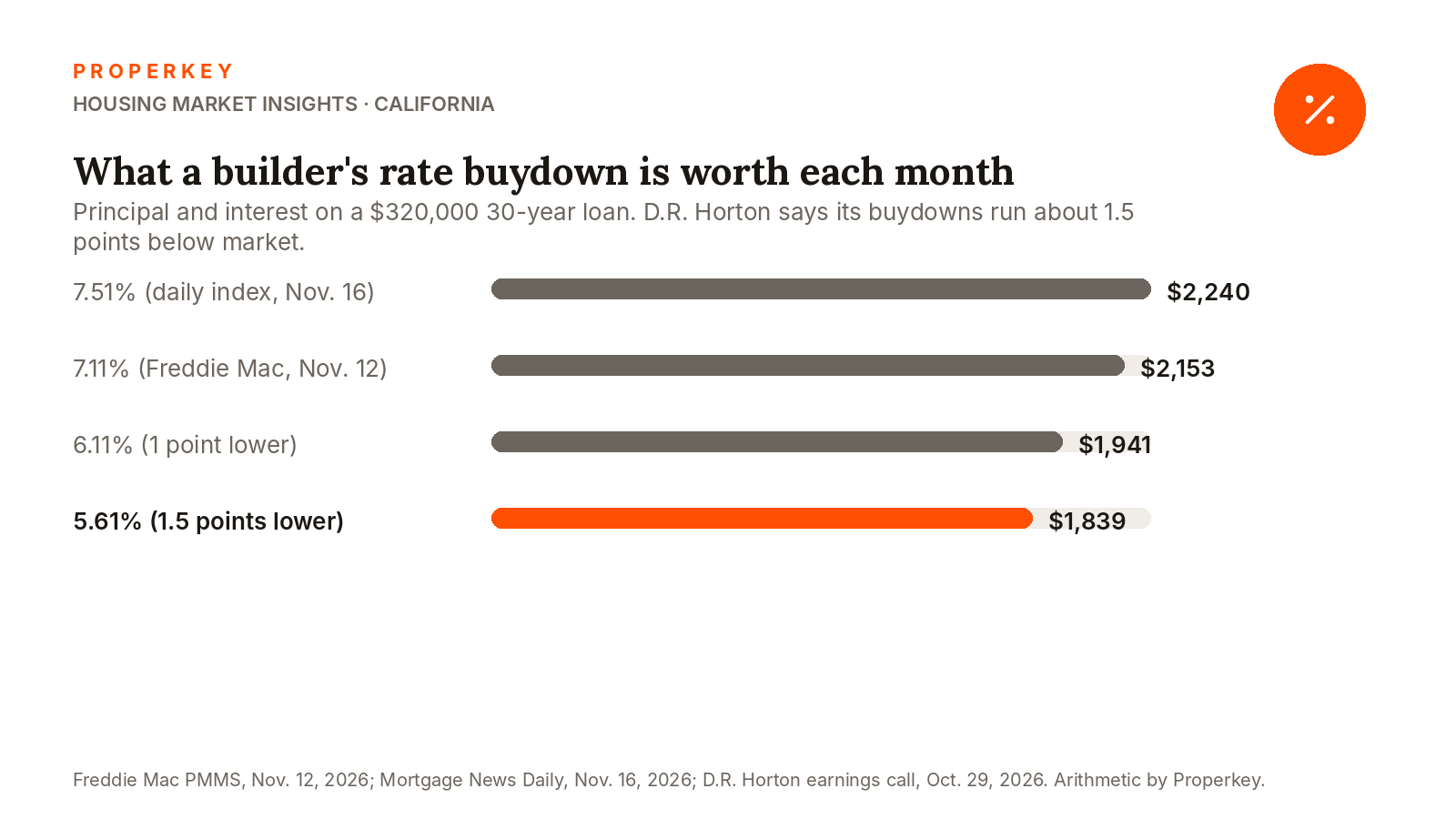
Two things: a lower price and a lower rate. NAHB's survey counts "sales incentives" without breaking them down, but the public builders describe them on their earnings calls. Lennar reported an average sales price of $372,000 for the quarter ended August 31, "reflecting approximately 12.0% in incentives, along with base price adjustments necessary to sustain volume," with its gross margin down to 15.8% (Lennar third-quarter release). On D.R. Horton's October 29 call, executives said incentives "remain elevated, well above our historical norm," that a "high 80s to low 90%" share of buyers using its mortgage company take a rate buydown, and that the bought-down rate runs "about 1.5 points below market" (call transcript). KB Home, by contrast, told investors its homes "do not require heavy incentives to sell" (September call), though it said Southern California margins have "been impacted by a more competitive environment."
The rate is the bigger lever. Freddie Mac's weekly average was 7.11% on November 12, and Mortgage News Daily's daily index had climbed to 7.51% by Monday, November 16. On a $320,000 loan, principal and interest is $2,153 a month at 7.11% and $1,839 at 5.61%, a rate 1.5 points lower. That $314 a month is what a builder's buydown is worth to the buyer, and it lets the builder hold the sticker price closer to where it was. Properkey's guide to mortgage rate buydowns explains the temporary and permanent versions.
Is a new home now cheaper than a resale?
Nationally, at the median, yes. The Census Bureau's latest report puts the median new-home price at $400,400 in September, 3.9% below a year earlier, with 476,000 new homes for sale, an 8.4-month supply. NAR's median existing-home price was $416,700 in October. A 6% cut on the median new home is $24,024. New-home sales ran at a 676,000 annual rate in September, 5.3% below a year earlier; in the West they were 17.4% lower. The October report is due November 25.
California is not building its way to a glut. Single-family permits in the state were 4,571 in September, against 4,791 a year earlier (Census Bureau via FRED), and the first nine months of 2026 are roughly flat with 2025. Where builders are active (the Inland Empire, the Central Valley, the Sacramento suburbs, inland San Diego County) they are selling against resale listings in the same price band, and they are the ones with a marketing budget.
What should a California buyer ask a builder?
Price cut or buydown, and which is worth more to you? A price cut lowers your loan, your down payment and your property-tax basis for as long as you own. A buydown lowers the payment; a temporary one expires. Freddie Mac's consumer guidance says one discount point typically lowers the rate by about 0.25%, so a permanent 1.5-point reduction is expensive money. Ask for the incentive in dollars and price both ways.
Is the incentive tied to the builder's lender? It usually is. Federal rules allow that as long as the discount is real and optional: under Regulation X, a discount for using an affiliated lender "must be a true discount below the prices that are otherwise generally available, and must not be made up by higher costs elsewhere in the settlement process," and under 12 CFR 1024.15 the builder may not require you to use its lender. Get a second Loan Estimate; Properkey's finance desk shops the lenders so you can compare the builder's offer line by line.
Does the incentive fit under the loan program's cap? Fannie Mae limits contributions from the builder or seller to 3% of the price when you put less than 10% down, 6% with 10% to 25% down, and 9% above that (Selling Guide B3-4.1-02); anything over the cap is treated as a price reduction. With a temporary buydown the lender must still "qualify the borrower based on the note rate" (B2-1.4-04), so it does not help you qualify.
What are you giving up? A new-home sale in a subdivision comes with a state public report (Business and Professions Code §11018.2) instead of the Transfer Disclosure Statement a resale seller fills out (Civil Code §1102.2(a)). In exchange, California's builder-liability law gives you a minimum one-year fit-and-finish warranty (Civil Code §900) and up to ten years to bring construction-defect claims (§941). Expect Mello-Roos in most new tracts; Properkey's Mello-Roos guide shows how to find the bill before you sign. You may bring your own agent to a builder's sales office; start at properkey.us/find.
What does it mean if you are selling a resale home?
Your competition is advertising a payment, not a price. A buyer comparing your $650,000 house with a $650,000 new one at a bought-down rate sees a monthly difference of several hundred dollars before either of you has negotiated. Three responses work. Price to the buyers who are in the market now; C.A.R.'s October report, also released November 17, shows California sales at a 246,830 annual rate, down 12.7% from a year ago, with the statewide median at $886,760 (C.A.R.). Be ready for an offer that asks for a credit toward a rate buydown; it costs you less than the equivalent price cut and is capped by the same Fannie Mae limits. And keep the costs you control low: Properkey lists for a $0 listing fee with full MLS exposure, professional photos and a 3D tour, which leaves room in your net to answer a builder's incentives. Related: buy now or wait until 2027 and October's existing-home sales.
Questions people ask
How many home builders are cutting prices? 46% in November 2026, up from 43% in October, the highest share in the post-Covid period, per NAHB. The average cut was 6% for the eighth month in a row, and 68% of builders offered some sales incentive.
Why is builder confidence so low? The NAHB index fell to 25, its lowest since April 2012. NAHB cites mortgage rates above 7%, tariffs on building materials, labor shortages, higher fuel costs and hesitant buyers. Buyer traffic, at 16, is the lowest in 15 years outside the first pandemic months.
Is a builder's rate buydown a good deal? It lowers the payment for real, about $314 a month on a $320,000 loan when the rate is 1.5 points under a 7.11% market. Compare it with the same dollars as a price cut, confirm whether it is permanent or temporary, and get a competing Loan Estimate, because the incentive is usually tied to the builder's own lender.
Can a builder require you to use its lender? No. Federal Regulation X bars required use of an affiliated settlement provider. A builder may offer a discount for using its lender if the discount is optional and genuine.
This article reports survey and company data for general information and is not financial advice. Incentives vary by builder, community and week; get every offer in writing.
Sources: NAHB, Nov. 17, 2026; NAHB, October 2026; Lennar Q3 2026 release; D.R. Horton call, Oct. 29, 2026; KB Home call, Sept. 22, 2026; Census Bureau new residential sales; NAR, Nov. 12, 2026; Freddie Mac PMMS; Mortgage News Daily; Freddie Mac My Home; FRED, California single-family permits; Fannie Mae B3-4.1-02; B2-1.4-04; 12 CFR 1024.2; 12 CFR 1024.15; Civ. Code §900; §941; §1102.2; B&P Code §11018.2; C.A.R., Nov. 17, 2026.
Written by Keyro, Properkey's AI. Properkey, DRE #01979718.



