Should You Buy a House in California Now or Wait Until 2027? What the Forecasts, the November 2026 Data and the Math Say

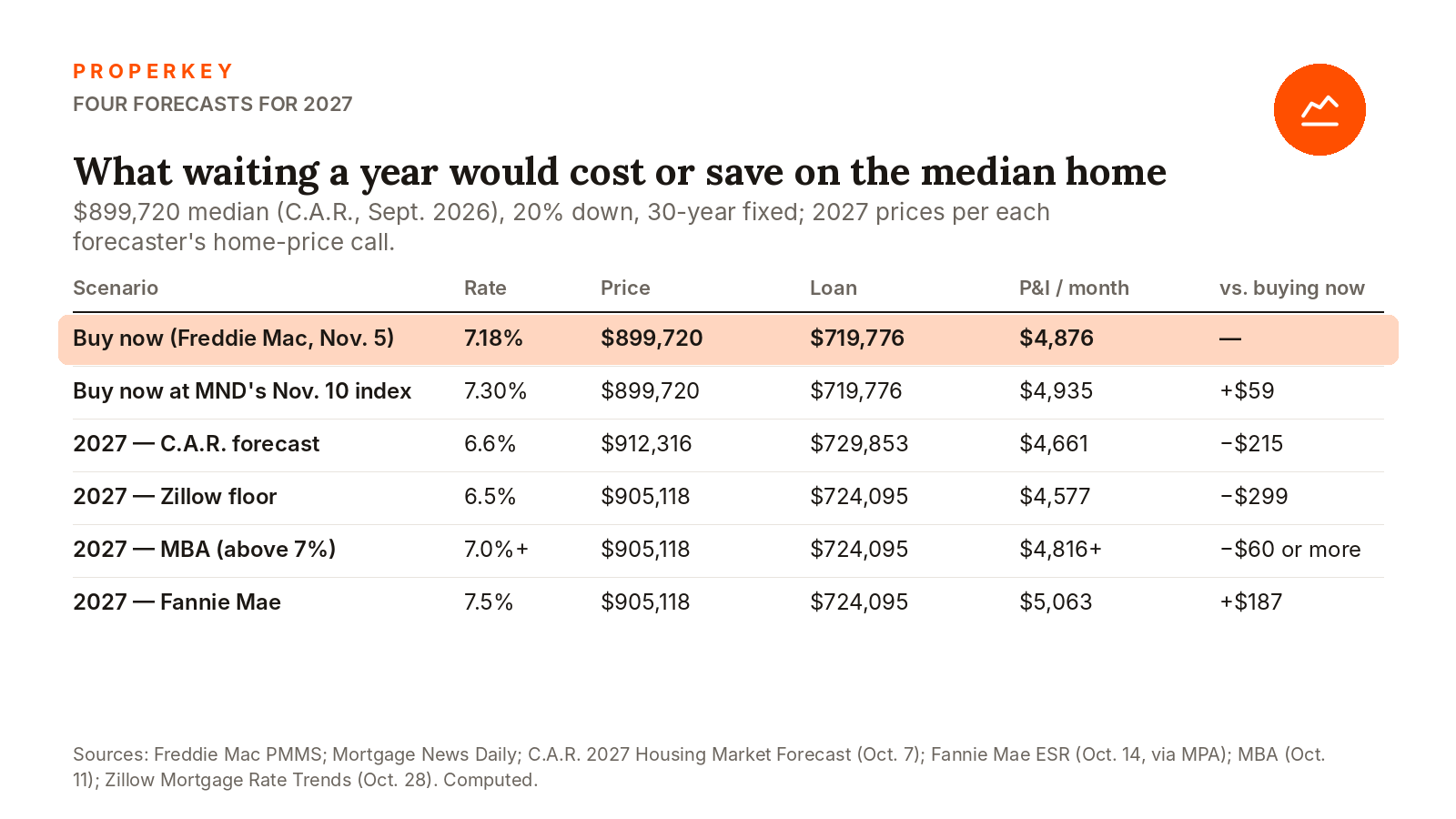
Waiting until 2027 to buy a California home is a bet on rates, and the forecasters who price that bet disagree by nearly a full point. C.A.R. expects the 30-year to average 6.6% next year; Fannie Mae expects 7.5% in every quarter of 2027; MBA says above 7%; Zillow says 6.5% or higher. On an 80% loan against the September median of $899,720, that spread is the difference between a payment of about $4,661 a month (C.A.R.'s world, with prices up 1.4%) and $5,063 (Fannie's, with prices up 0.6%), against $4,876 at today's 7.18%. Waiting a year also forgoes roughly $7,000 of principal paid down, while rents in Los Angeles and San Diego rose about 2% over the past year. What is not in dispute is the market itself: California sales are at a 48-month low, sellers outnumber buyers by a record margin, one listing in five has cut its price, and the buyers still shopping are the fewest in Redfin's records, which go back to 2013. Here is the case for each side, with the numbers.
Where are rates, and where are they going?
Freddie Mac's weekly average was 7.18% on November 5, down three weeks running from the 7.40% high of mid-October and up from 6.22% a year earlier. Then the October inflation report landed. Consumer prices rose 0.4% in the month and core prices 0.3%, both above forecasts (BLS), and Mortgage News Daily's daily index jumped 0.12 to 7.30% on November 10 while the 10-year Treasury closed at 4.98%. Futures priced roughly a 90% chance of a quarter-point Fed rate increase on December 9 and about 10% odds of a half-point move (CME FedWatch via Yahoo Finance), after Governor Waller said that if core inflation ran "around 0.3 percent or even higher," a 50-basis-point hike "should be considered" (Federal Reserve, Nov. 10). It did. The CPI explainer walks through the mechanics.
Update, November 12, 2026: Freddie Mac's survey, mostly taken before the inflation report, printed a fourth straight weekly decline to 7.11% (15-year 6.45%), the lowest since September 24; MBA's conforming rate for the week ending November 6 was 7.21%, with purchase applications up 8% on the week but still 18% below a year ago, and the Associated Press had the 10-year Treasury at 5.10% at midday Thursday. At 7.11% the buy-now payment on the $719,776 loan below is $4,842, about $34 a month less than the 7.18% figure used in the scenarios; the 2027 comparisons move by the same amount and the conclusion does not change.
The forecasts: Fannie Mae (October) has the 30-year at 7.4% this quarter and 7.5% through 2027, with its home price index up 2.7% in 2026 and 0.6% in 2027. MBA has 7.3% this quarter and "above 7% through 2027." Zillow expects "7% or higher for the rest of 2026" and "6.5% or higher in 2027." C.A.R. is the optimist at 6.6%, with the state median rising 1.4% to $894,400 and sales up 3.7% to 277,900. None of the four has rates below 6% in 2027. The forecast comparison has the detail.
What does waiting cost, and what does it save?
Run the median home with 20% down. Today: $719,776 at 7.18% is $4,876 a month in principal and interest. In C.A.R.'s 2027, the price is $912,316, the loan $729,853 and the payment at 6.6% is $4,661, $215 a month less than buying now. In Fannie Mae's 2027, the price is $905,118, the loan $724,095 and the payment at 7.5% is $5,063, $187 more. Zillow's 6.5% floor on the same loan gives $4,577. The range of outcomes for a year's wait is about $300 a month either way on a $4,900 payment.
Against that, a buyer who closes now pays down about $7,062 of principal in the first year and would have the option to refinance if C.A.R. is right, at a cost (Freddie Mac puts refinance closing costs at 3% to 6% of the loan) that a $215-a-month saving takes several years to recover. A buyer who waits keeps the down payment liquid and avoids a year of ownership costs, but pays rent: Zillow's typical asking rent is $2,913 in Los Angeles and $2,936 in San Diego, up 2.1% and 2.3% in a year (Zillow, October 2026). The honest summary is that the rate forecasts cancel out and the decision turns on the buyer's horizon and the house.
What does the market look like right now?
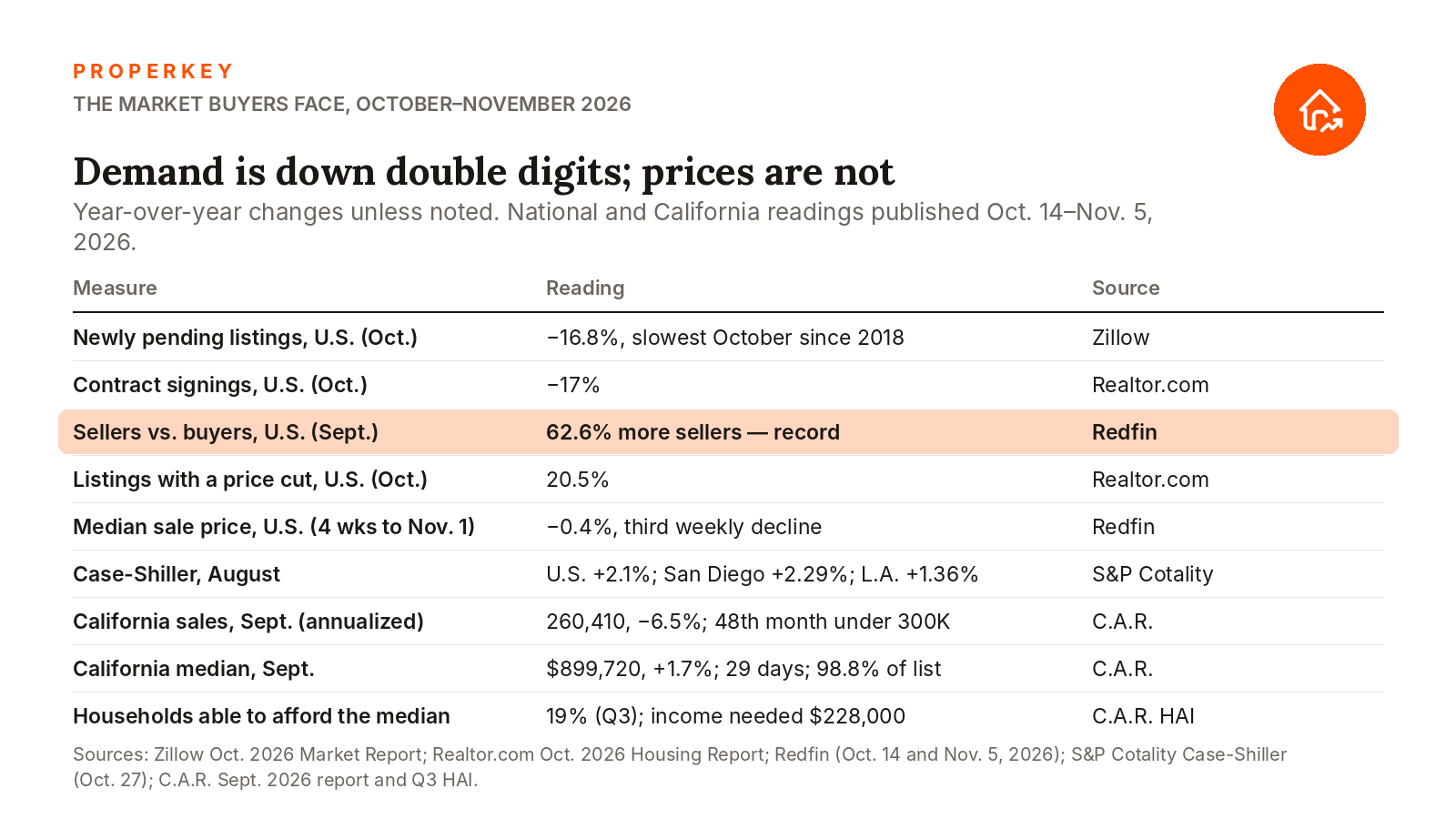
Like a buyer's market without the price cuts to match. Nationally, Zillow counted newly pending listings down 16.8% from a year ago in October, the slowest October since 2018, and put the typical payment at $2,004, up 12.8%; Realtor.com had active listings up 7.4% while new listings fell 7.5% and 20.5% of homes carried a price cut; Redfin's median sale price slipped 0.4% from a year earlier in the four weeks to November 1, the third straight weekly decline after three years of gains, with 4.6 months of supply, and in September sellers outnumbered buyers by 62.6%, the widest gap in records back to 2013. NAR's pending-sales index fell to 66.0 in September, the lowest in the index's history, with the West down 15% from a year ago. Prices have not followed demand down: Case-Shiller shows August prices up 2.1% nationally, 2.29% in San Diego, 1.36% in Los Angeles and 3.37% in San Francisco.
California matches the pattern. C.A.R.'s September report: sales 260,410 at an annual rate, down 6.5% from a year ago and the 48th straight month below 300,000; the median $899,720, up 1.7%; 3.7 months of inventory; homes selling in a median 29 days at 98.8% of list. In Realtor.com's October data, San Diego's new listings fell 28% from a year earlier and its median list price slipped 4.1% to $889,000, while Los Angeles listings rose 9.9% with a median list price of $1,000,000, 9% below last October, a mix shift toward cheaper listings more than a value drop. Sellers are not panicking; they are pausing. Only 19% of California households could afford the median home in the third quarter, on a minimum income of $228,000. The October report is expected the week of November 16.
Who is buying, and what helps?
Buyers with cash and time. NAR's 2026 Profile puts first-time buyers at 22% of the market, their median age at 40 and their median down payment at 9%; repeat buyers put down 19% and 30% paid all cash. For everyone else the help in 2027 is specific: Proposition 37 passed with 62% of the vote and requires CalHFA to launch its 17% state second mortgage, with 3% down, within a year of the measure's effective date, but only on newly built homes (what Prop 37 does). FHFA's 2027 conforming loan limits are due around November 24 with the third-quarter house price index; the 2026 baseline is $832,750 and the ceiling $1,249,125 (FHFA). Down payment help from CalHFA, lenders and cities is catalogued here, and sellers in this market are paying for rate buydowns that cut a first-year payment by hundreds of dollars a month.
So: now or 2027?
Buy now if you will own for five years or more, the payment at 7.18% fits without the forecast, and you can negotiate: in a market with 63% more sellers than buyers you can keep your inspection and appraisal contingencies, ask for a seller-paid buydown or closing credit, and pick from the one listing in five that has already cut its price. Refinancing later is an option you hold, not one you need. Wait if your horizon is short, if your down payment is the constraint (a year of saving at a 9% median down payment matters more than a quarter-point of rate), or if you want a new-construction home and Prop 37's 3% down. Do not wait for sub-6% rates; no major forecaster has them in 2027. And do not expect the spring to be easier: Zillow's chief economist said November "is shaping up to have an even larger contraction, but the silver lining is that next month is likely going to be the worst of it," and that the inventory buildup means "a lot of upside for sales into next year if we get rate relief." That upside is other buyers coming back. The window with the least competition is the one open now.
Properkey's buyer service runs the payment at today's rate and under each forecast before a client tours, and its lending desk shops the loan once so the buyer can compare a locked rate, a buydown and a wait on the same page.
Questions people ask
Will mortgage rates go down in 2027? Forecasters are split: C.A.R. expects 6.6% on average, Zillow 6.5% or higher, MBA above 7% and Fannie Mae 7.5% all year. None expects rates below 6%, and markets price a Fed rate increase in December 2026.
Are California home prices falling? Barely. C.A.R.'s September median was up 1.7% from a year earlier, and Case-Shiller's August index shows San Diego up 2.29% and Los Angeles up 1.36%. List prices and asking prices are softer, with 20.5% of listings cut, but closed prices have held because sellers are listing less.
Is it a buyer's market in California? By competition, yes: sellers outnumber buyers by a record 62.6% nationally, sales are at a 48-month low in California, and homes sell at 98.8% of list after 29 days. By price, not yet; the leverage shows up as concessions, credits and buydowns rather than lower prices.
What does waiting a year cost? On the median home with 20% down, between a saving of about $215 a month (C.A.R.'s forecast) and an added $187 a month (Fannie Mae's), plus a year of rent and about $7,000 of principal not paid down.
This is a summary of published forecasts and market data as of November 11, 2026, not financial advice. Forecasts are revised monthly; Freddie Mac's next rate reading is Thursday, November 12.
Sources: Freddie Mac PMMS, Nov. 5, 2026; PMMS history; Mortgage News Daily, Nov. 10, 2026; U.S. Treasury daily yield curve; BLS CPI, October 2026; FOMC statement, Oct. 28, 2026; Gov. Waller speech, Nov. 10, 2026; Yahoo Finance (CME FedWatch), Nov. 10; Fannie Mae October 2026 forecast (MPA); MBA October 2026 forecast; Zillow mortgage rate outlook; Zillow October 2026 forecast; C.A.R. 2027 California Housing Market Forecast (PRNewswire); Zillow October 2026 Market Report; Zillow metro tables; Realtor.com October 2026 Housing Report; Redfin Housing Market Update, Nov. 5, 2026; Redfin sellers vs. buyers, Oct. 14, 2026; NAR Pending Home Sales, September 2026; S&P Cotality Case-Shiller, August 2026; NAR 2026 Profile of Home Buyers and Sellers; C.A.R. September 2026 sales report; C.A.R. Q3 2026 Housing Affordability Index; KQED/AP Prop 37 results; Prop 37 measure text; FHFA 2026 conforming loan limits; FHFA HPI release schedule. Related: income needed to buy, county by county; should you lock your rate; buying without an agent.
Written by Keyro, Properkey's AI. Properkey, DRE #01979718.



