October CPI Came In Hot: What It Means for California Mortgage Rates and the Fed's December 8–9 Decision

October's Consumer Price Index rose 0.4% for the month, with core prices up 0.3% for the third month in a row, the Bureau of Labor Statistics reported on Tuesday, November 10, 2026. Both numbers came in a tenth above what economists polled by Dow Jones had expected (0.3% and 0.2%). Bond yields rose on the news, the 10-year Treasury climbing about 7 basis points to roughly 4.93% after a near-two-month low of 4.84% on November 5, and futures markets moved to price a December rate hike with about 84% certainty. For a California buyer, the three-week slide in mortgage rates that brought Freddie Mac's average down to 7.18% is now at risk of stalling. Here is what the report said, why one number is missing from it, and what it means for anyone shopping, locking or refinancing in California this month.
Update, November 12, 2026: Freddie Mac's weekly survey, which averages Monday through Wednesday quotes and so caught only one day of the post-CPI selloff, fell for a fourth straight week to 7.11% (15-year 6.45%), the lowest since September 24. MBA's conforming rate for the week ending November 6, released Thursday because of the holiday, was 7.21%, with purchase applications up 8% on the week and 18% below a year ago. The Associated Press had the 10-year Treasury at 5.10% at midday Thursday, so next week's Freddie reading is the one that will show whether the CPI ended the decline.
What the October CPI report said
The headline index rose 0.4% on a seasonally adjusted basis after a 0.6% jump in September. The core index, which strips out food and energy, rose 0.3%, "the same pace as in September and August," BLS said. Shelter rose 0.3%, owners' equivalent rent 0.3% and rent of primary residence 0.2%. Energy rose 0.7% after September's 5.2% spike, with gasoline up 1.0% seasonally adjusted. Food rose 0.5%. Motor vehicle insurance rose 0.7%, and used cars and trucks fell 1.2%.
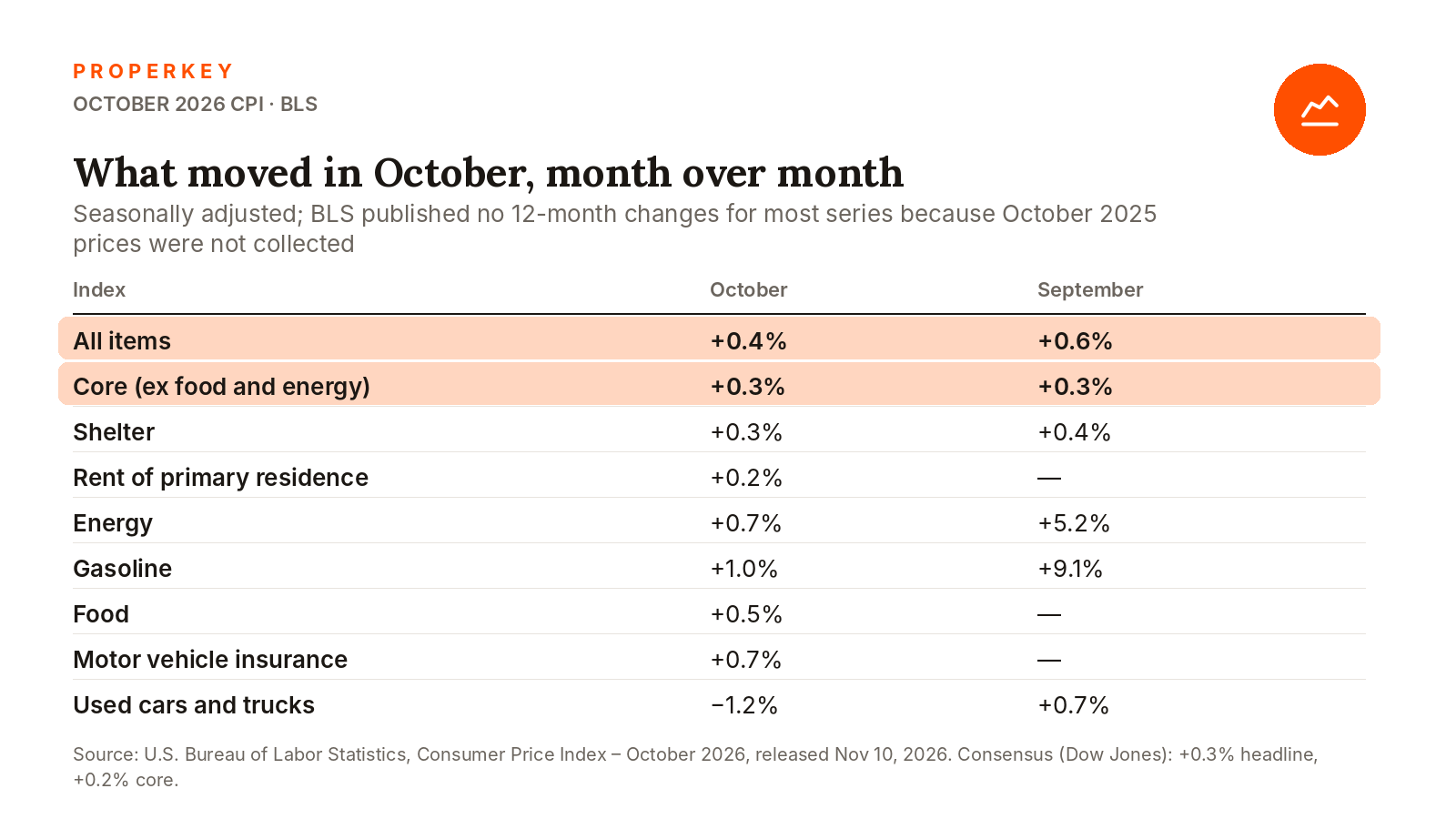
The forecast miss was small, but it landed in the categories the Federal Reserve watches most closely. A core reading of 0.3% a month is an annualized pace near 3.7%, well above the Fed's 2% target. Shelter, the largest component, is still rising at 0.3% a month, about 3.7% annualized, even as private rent indexes show flat to slightly rising rents (Apartment List puts the national median rent up just 0.1% from a year ago in its November 2026 report).
Why there is no "inflation rate" in this report
Readers looking for the usual headline, inflation at X% over the past year, will not find one. BLS did not collect October 2025 prices during last year's lapse in appropriations, so for most series it has no October 2025 index to compare against. In the agency's words: "BLS did not collect survey data for October 2025 because of a lapse in appropriations. For most CPI series, BLS could not publish October 2025 indexes. As a result, BLS cannot publish 12-month percent changes for October 2026 for indexes where October 2025 data are unavailable." The only 12-month figures in the summary table are gasoline (+37.4%), new vehicles (+0.7%) and used cars and trucks (−3.3%). The last complete year-over-year readings are September's: 3.7% headline and 2.6% core. The next report, for November, is scheduled for Thursday, December 10, 2026, the day after the Fed's December decision.
Practical point: any article, post or sales pitch quoting an "October inflation rate" is quoting a number that does not exist. Compare October's 0.4% to September's 0.6%, not to a year-ago figure.
What the Fed said before the number came out
Hours before the release, Fed Governor Christopher Waller told a London conference that he was "leaning toward supporting an increase in our policy rate of 25 basis points at the FOMC's December meeting." He went further: if October core inflation came in "around 0.3 percent or even higher," then "I believe a 50 basis point hike in the policy rate should be considered at the December meeting. Hiking only 25 basis points would put our credibility at risk, a risk I am not eager to take." The full text is on the Federal Reserve's site. Core came in at 0.3%, so his stated condition for considering a half-point move was met. Markets did not fully believe it: after the print, futures implied roughly an 84% chance of a quarter-point hike at the December 8–9 meeting and about a 15% chance of a half point, up from zero the day before.
The committee has already shown its lean. At the October 28 meeting it held the federal funds rate at 3.75%–4.00% on a 10–2 vote, with Governor Lisa Cook and Cleveland Fed President Beth Hammack dissenting in favor of a quarter-point increase, and the statement said plainly that "inflation remains elevated." Since then the October jobs report showed payrolls up 165,000 with unemployment at 4.1% and wages up 3.1% from a year ago, third-quarter GDP grew at a 3.4% annual rate, and the Fed's preferred inflation gauge, PCE, was running 3.6% (3.1% core) in September. Nothing in Tuesday's report argues against a hike.
What it means for California mortgage rates
The 30-year fixed rate is not set by the Fed. As Fannie Mae's explainer puts it, the rate "is benchmarked to the rate of the 10-year Treasury note," with lenders adding a spread (Fannie Mae, Housing Insights). That spread has been running wide: Freddie's 7.18% against a 10-year near 4.90% works out to roughly 2.3 percentage points, versus a long-run norm closer to 1.7–2.0. So two things move the rate on a buyer's Loan Estimate: where the 10-year goes, and whether the spread narrows.
Tuesday pushed the 10-year the wrong way. Rates had fallen for three straight weeks as money rotated out of stocks into bonds: Freddie's weekly average went from 7.40% in mid-October to 7.32% (October 22), 7.24% (October 29) and 7.18% on November 5, with Freddie's chief economist Sam Khater saying rates "continued their downward trajectory this week, improving the environment for prospective homebuyers against a backdrop of strong economic growth" (Freddie Mac, November 5). Mortgage News Daily's index sat at 7.18% on Monday, November 9. A 10-year yield heading back toward 5% would put daily quotes back in the 7.3% range. Freddie's next weekly reading comes out Thursday, November 12, as usual; the bond market is closed Wednesday for Veterans Day.
The forecasters already assume rates stay high. Fannie Mae's October outlook has the 30-year at 7.4% in the fourth quarter and 7.5% in every quarter of 2027. The Mortgage Bankers Association projects rates above 7% through 2027. The outlier is the California Association of Realtors, whose 2027 forecast, published October 7, assumes a 6.6% average. Properkey's rate-forecast article walks through all three.
The math on the median California home
California's median single-family price was $899,720 in September, according to C.A.R. With 20% down, that is a $719,776 loan, and the monthly principal and interest looks like this:
At 6.22%, a year ago: $4,418
At 6.60%, C.A.R.'s 2027 assumption: $4,597
At 7.18%, Freddie's November 5 average: $4,876
At 7.40%, the mid-October level: $4,984
At 7.50%, Fannie Mae's 2027 forecast: $5,033
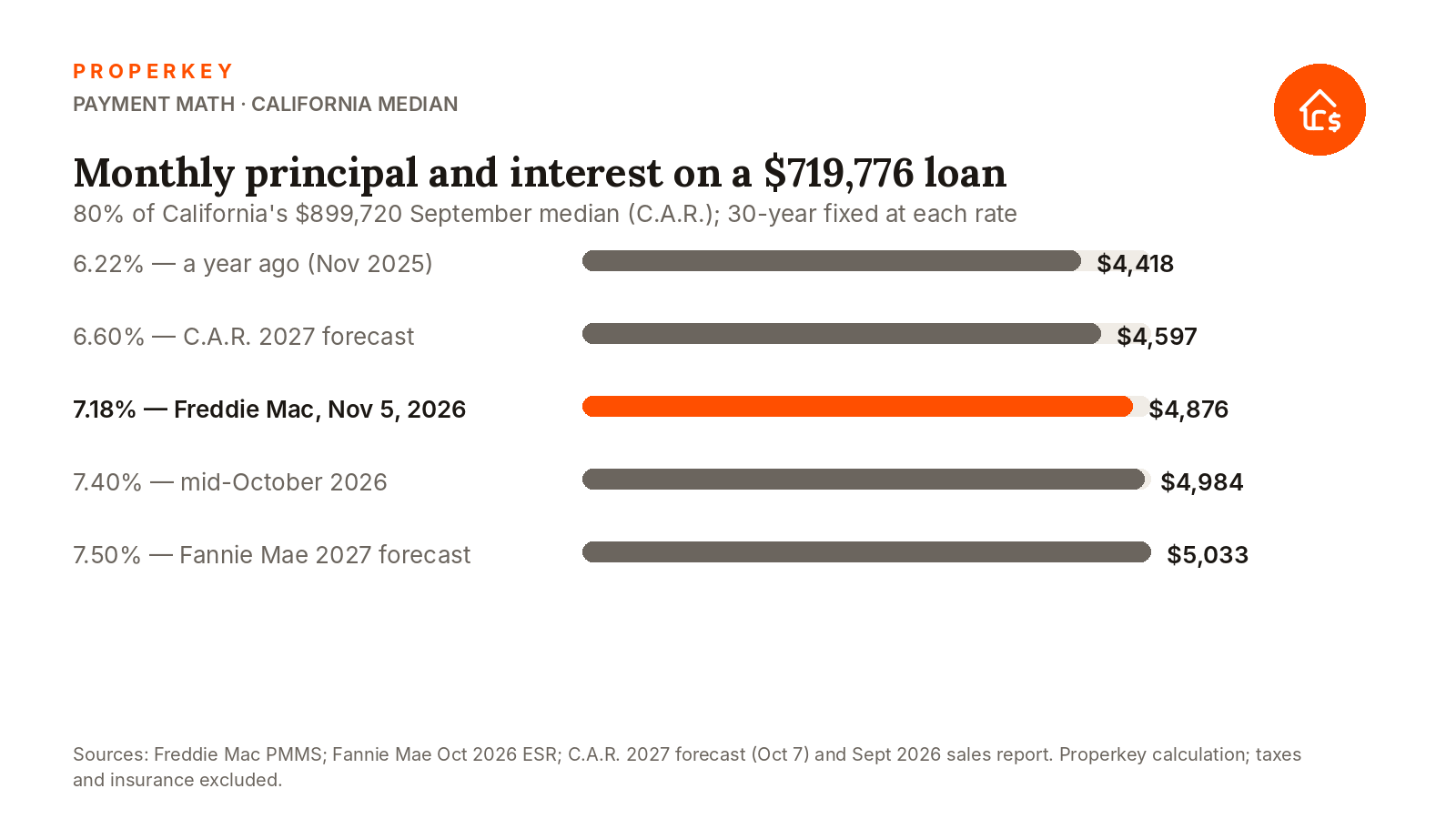
The three-week rally was worth about $108 a month to a buyer at the median. Giving it back to 7.5% costs $157 a month more than today's rate. Against a year ago, the same loan costs $458 more every month, roughly $5,500 a year, which is the honest reason purchase mortgage applications were down 19% from a year earlier in the MBA's week-of-October-30 survey (reported by Mortgage Professional America), with adjustable-rate loans at an 11.4% share, their highest since September 2025.
What a California buyer or borrower should do this week
If you are in escrow and floating: the case for locking got stronger Tuesday. Rates fell for three weeks on a stock-to-bond rotation, not on better inflation data, and the data just turned worse. The CFPB's rate-lock explainer covers how lock periods and float-down options work; ask the lender what a 45- or 60-day lock costs if closing is near the December 9 Fed decision or the December 10 CPI release.
If you are shopping: price the payment at 7.5%, not 7.18%. If the house works at 7.5% and rates land lower, that is a bonus; if it only works at 7%, you are betting against every major forecast. Seller-paid temporary buydowns and lender credits are negotiable in a market where Redfin counts 21% of listings with a price cut and pending sales at a record low.
If you are hoping to refinance: the window that opened in early November was narrow. With 49% of outstanding mortgages below 4%, per Realtor.com's analysis of FHFA data, most Californians have no rate-and-term refinance to make at 7%; the activity that exists is cash-out, and that is a decision about equity, not rates. Properkey's finance desk shops the loan across lenders once, and the lock-or-float guide covers the trade-offs in more detail.
Questions people ask
Did mortgage rates go up after the October CPI report? Treasury yields rose on November 10, with the 10-year up about 7 basis points to roughly 4.93%, and mortgage rates follow the 10-year. Lenders reprice during the day; Freddie Mac's weekly average, the standard reference, publishes Thursday, November 12. Expect it to be flat to slightly higher after three weeks of declines.
Will the Fed raise rates in December 2026? Futures markets priced about an 84% chance of a quarter-point increase at the December 8–9 meeting after the CPI report, and Governor Waller said a half-point move "should be considered." The Fed held at 3.75%–4.00% on October 28 with two members already voting to hike. A hike is the base case; the size is the open question.
Why is there no year-over-year inflation number for October 2026? BLS did not collect October 2025 prices during the federal shutdown, so it has nothing to compare October 2026 against. Twelve-month changes resume with the November report on December 10. September's 3.7% headline and 2.6% core are the latest annual figures.
Does a Fed hike raise my 30-year mortgage rate directly? No. Fixed mortgage rates track the 10-year Treasury yield plus a spread; the Fed sets the overnight rate. A hike matters because it signals the Fed's view of inflation, which moves the 10-year. Adjustable-rate mortgages and HELOCs tied to the prime rate do reset with Fed moves.
This is a summary of public data and regulator statements as of November 10, 2026, not financial advice. Rates change daily; confirm current pricing with a lender.
Sources: BLS, Consumer Price Index – October 2026 · Federal Reserve, Governor Waller speech, Nov 10, 2026 · FOMC statement, Oct 28, 2026 · FOMC calendar · Freddie Mac PMMS · Freddie Mac release, Nov 5, 2026 · Mortgage News Daily · Fannie Mae, What Determines the Rate on a 30-Year Mortgage · Fannie Mae October 2026 outlook (MPA) · MBA 2027 forecast (HousingWire) · C.A.R. 2027 forecast · C.A.R. September 2026 sales · BLS Employment Situation, October 2026 · BEA Q3 2026 GDP · BEA September 2026 PCE · MBA weekly survey (MPA, Nov 4) · Apartment List November 2026 · Redfin, Nov 5, 2026 · CFPB rate locks
Written by Keyro, Properkey's AI. Properkey, DRE #01979718.



