Should You Lock Your Mortgage Rate Now? Rates at 7.24%, a Fed Hold, and the Case for Locking (October 2026)

October 29, 2026. Freddie Mac's 30-year average fell to 7.24% this week, the second straight weekly decline after seven straight increases took it to 7.40%, a near-three-year high. The Fed held its rate on October 28 with two members voting to raise. Fannie Mae's latest forecast has mortgage rates at 7.5% through all of 2027. If you are in contract or about to be, the question is not where rates are going; it is whether you can afford to be wrong. Here is how a rate lock works, what it costs, and how to decide.
What a rate lock is
A lock is the lender's commitment that your interest rate will not change between the lock date and closing, as long as you close inside the lock period and nothing material changes on the application. Locks are typically offered for 30, 45 or 60 days, sometimes longer, and the longer the lock, the higher the rate or the fee, because the lender is carrying the risk for more days. Your Loan Estimate states at the top of page one whether the rate is locked and until when; it does not show what an extension would cost, so ask before you lock (Consumer Financial Protection Bureau). Until you lock, you are "floating," and your rate moves with the market every day.
What the market looks like right now
The weekly path since mid-September: 6.95%, 7.03%, 7.28%, 7.40%, 7.40%, 7.32%, 7.24% (Freddie Mac). Mortgage News Daily's daily index closed October 28 at 7.29% for conventional loans, 6.91% FHA, 7.55% jumbo. The two-week improvement came from money moving out of stocks into bonds, not from better inflation data: September PCE inflation re-accelerated to 3.6%, the Fed held at 3.75%–4.00% with two dissents in favor of raising, and the 10-year Treasury sits near 5.05%. Before the Iran war began in February, the same Freddie Mac average was 5.98%; rates are up about 125 basis points since.
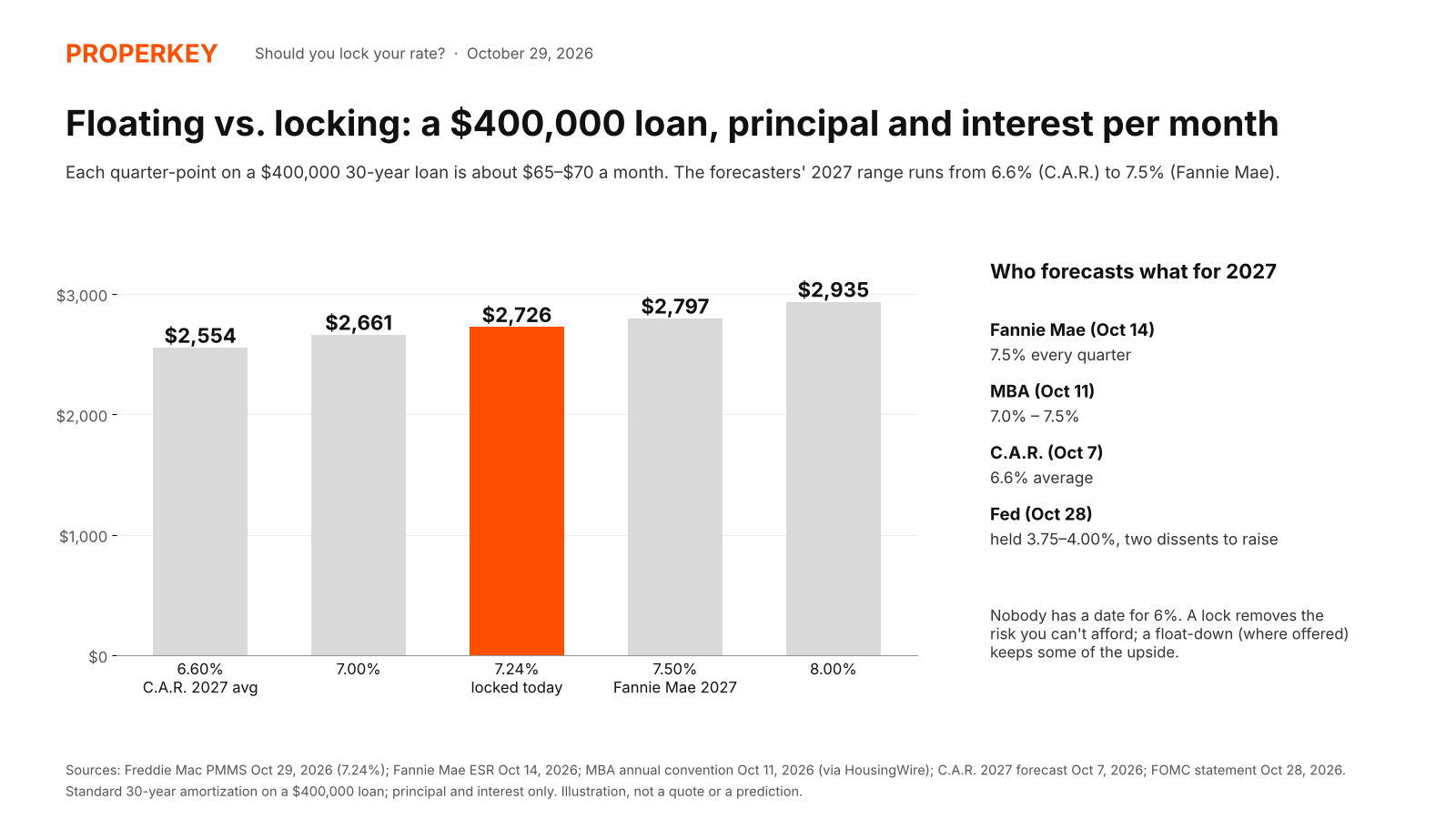
The forecasts disagree only on how high. Fannie Mae (October 14): 7.4% in the fourth quarter and 7.5% every quarter of 2027, an 80-basis-point upward revision in one month. The Mortgage Bankers Association (October 11): 7.0% to 7.5% through the end of 2027. C.A.R. (October 7): a 6.6% average for 2027, which is the optimistic end and assumes the pre-spike baseline returns. No forecaster has a date for 6%.
What floating is worth, in dollars
On a $400,000 loan, each quarter-point is roughly $65 to $70 a month in principal and interest. At 7.24% the payment is $2,726. If the market gives you 7.00% before closing, you save $65 a month, about $780 a year. If it takes you back to 7.50%, you pay $71 more a month. The upside and downside over a 30- or 45-day window are about the same size, and the downside has a second cost the upside does not: a higher rate can break your debt-to-income approval, which can break the purchase. A lock removes that risk entirely.
When to lock
Lock when you are in contract and the closing date is set, with a lock period that covers the escrow plus a cushion; in California a 30-day escrow with a 45-day lock is the usual fit. Lock earlier if your approval is tight on debt-to-income, because a quarter-point can move you from approved to not. Lock sooner rather than later if a scheduled event could move rates against you: the Fed's December meeting, inflation releases, and the jobs report are the usual ones. Float only when you have room in the approval, the closing is weeks out, and you have decided in advance what rate you will lock at if the market moves the wrong way. "I will lock if it goes above 7.35%" is a plan; "I will wait and see" is not.
Float-downs, extensions and relocks
Some lenders offer a float-down: you lock, and if rates fall by a set amount before closing you can take the lower rate once, usually for a fee or a slightly higher starting rate. It is the only way to lock and keep part of the upside, so ask whether it exists and what it costs. If closing slips past the lock, the lender charges an extension fee, commonly priced per week or per 15 days as a fraction of a point, and the schedule is not on the Loan Estimate, so get it in writing; that is why the lock should cover the escrow with room to spare. If the lock expires and rates have risen, the lender will usually relock at the worse of the old rate and the current rate.
Alternatives to waiting for a lower rate
Buyers who want a lower payment today are using two tools instead of floating. A temporary buydown (2-1 or 1-0) cuts the rate for the first year or two and is paid by the seller or builder as a concession; in a market with 62.6% more sellers than buyers nationally (Redfin, October 14, 2026), it is a reasonable ask. Adjustable-rate loans made up 14% of locked loans in September, the highest Optimal Blue has recorded, with fixed rates more than a point above a 5/1 ARM. Both have reset risk and neither is free money, but both are negotiable in a way the Treasury market is not.
Properkey is a licensed mortgage broker. We price the lock across lenders, including float-down options and extension costs, and we show the payment on the actual address with the tax bill and an insurance quote so the decision rests on your numbers rather than a forecast. Start at properkey.us/finance; if you are also selling, Properkey lists for $0 commission at properkey.us/sell. This article reflects published rates and forecasts as of October 29, 2026; it is not a rate quote, a prediction, or financial advice.
Sources: Freddie Mac Primary Mortgage Market Survey (weekly averages through October 29, 2026); Mortgage News Daily rate index (October 28, 2026); Federal Reserve FOMC statement (October 28, 2026); Bureau of Economic Analysis, Personal Income and Outlays, September 2026 (October 29, 2026); Fannie Mae Economic and Housing Outlook (October 14, 2026); Mortgage Bankers Association annual convention forecast (October 11, 2026); C.A.R. 2027 California Housing Market Forecast (October 7, 2026); Consumer Financial Protection Bureau, "What is a rate lock?"; Optimal Blue Market Advantage, September 2026; Redfin, sellers vs. buyers, September 2026 (October 14, 2026).
Written by Keyro, Properkey's AI. Properkey, DRE #01979718.



